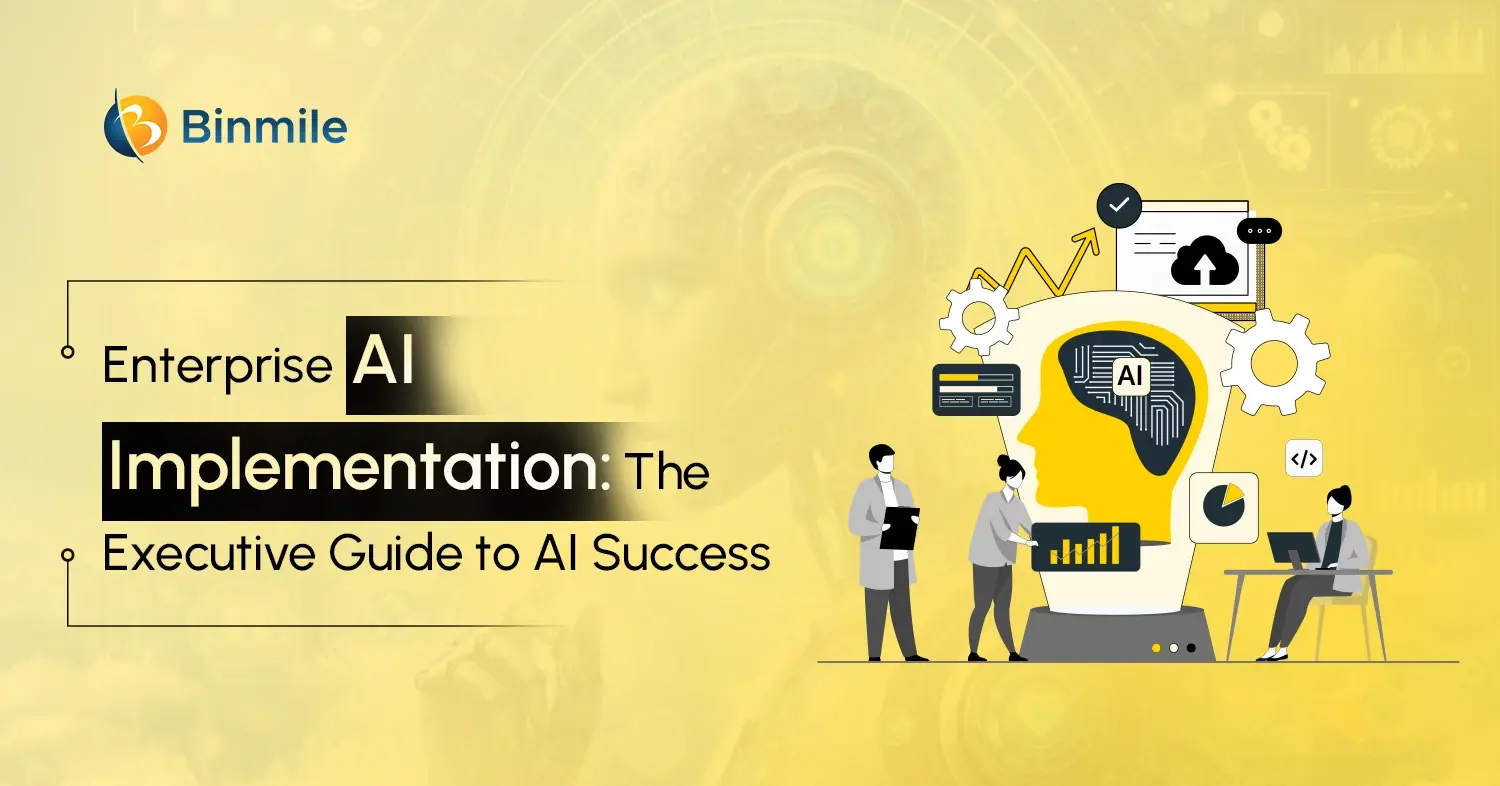
Access to artificial intelligence is no longer the biggest challenge for enterprises. Turning it into measurable business value is. According to the McKinsey State of AI 2025 survey, 88% of respondents said their organizations regularly use AI in at least one business function, yet only around one-third had started scaling AI across the enterprise. This difference highlights a critical reality: adopting AI tools is relatively easy, but embedding them into data, workflows, applications, decisions, and everyday operations requires a structured AI implementation approach.
This AI Implementation Guide explains what enterprise AI implementation involves, why it matters, which business functions can benefit, and how executives can create a practical AI implementation strategy. It also covers the AI implementation process, essential components, cost factors, common challenges, implementation tools, performance metrics, and the criteria organizations should use when selecting an implementation partner.
What Is Enterprise AI Implementation?
Enterprise AI implementation is the process of integrating artificial intelligence into an organization’s workflows, applications, products, and business decisions. It may involve machine learning, generative AI, predictive analytics, intelligent automation, computer vision, or AI agents.
Unlike a limited proof of concept, enterprise implementation focuses on whether an AI solution can operate securely and consistently with real business data, existing systems, compliance requirements, and large user volumes. It requires reliable data, suitable infrastructure, system integration, governance, employee adoption, and continuous monitoring. This structured approach also supports long-term AI Transformation by connecting technology investments with measurable business outcomes.
The goal is not simply to introduce new AI tools. It is to build a scalable capability that improves business performance without creating unnecessary operational or security risks. These AI implementation components must work together to support successful AI implementation in organizations.
Why Enterprise AI Implementation Matters to Business Leaders
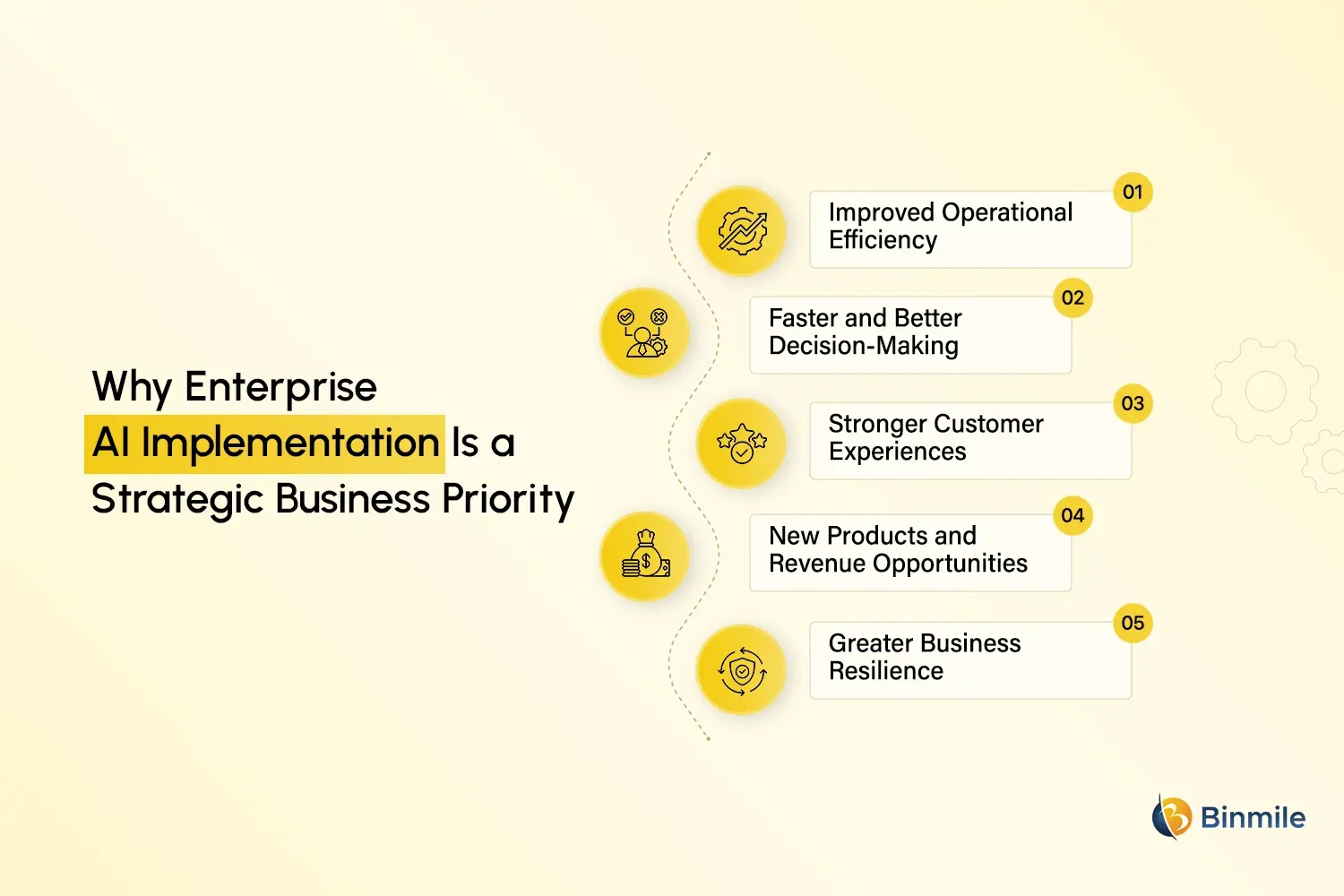
The benefits of AI implementation depend on the problems being solved. Here are the reasons why enterprise AI implementation matters to business leaders.
-
Improved Operational Efficiency
AI can automate repetitive activities such as data entry, document review, ticket classification, reporting, quality checks, and scheduling. This reduces processing time and allows employees to focus on exceptions, decisions, and higher-value work.
-
Faster and Better Decision-Making
AI analyzes large volumes of operational, financial, customer, and market data quickly. It can help leaders forecast demand, detect anomalies, identify risks, and make better-informed decisions.
-
Stronger Customer Experiences
AI assistants, personalization engines, and predictive support tools help enterprises provide faster and more relevant customer interactions based on preferences, behavior, and previous conversations.
-
New Products and Revenue Opportunities
AI implementation in business can support intelligent products, automated advisory services, personalized digital experiences, and new data-driven revenue models. Generative AI in digital product development can also add intelligent capabilities to existing or newly developed products.
-
Greater Business Resilience
AI can identify cybersecurity threats, equipment failures, supply chain disruptions, and unusual financial activity earlier. Combined with a Digital Immune System, it can help enterprises respond faster and reduce operational disruption.
Which Business Functions Benefit Most from AI Implementation?
AI should be applied where it can improve a clear business metric. The following functions often provide practical starting points.
| Business function | Common AI opportunities | Possible success metrics |
|---|---|---|
| Customer Service | Virtual assistants, ticket routing, response recommendations, sentiment analysis | Resolution time, service cost, customer satisfaction |
| Sales and Marketing | Lead scoring, personalization, campaign optimization, and content assistance | Conversion rate, acquisition cost, revenue per lead |
| Finance | Forecasting, fraud detection, invoice processing, and financial analysis | Forecast accuracy, processing time, and detected anomalies |
| Supply Chain | Demand planning, inventory optimization, supplier risk analysis | Inventory cost, stock availability, and forecast accuracy |
| Manufacturing | Predictive maintenance, quality inspection, production optimization | Downtime, defect rate, maintenance cost |
| Human Resources | Candidate matching, workforce planning, employee support | Hiring time, query resolution, and workforce retention |
| IT and Engineering | Code assistance, incident analysis, testing, and infrastructure monitoring | Release speed, ticket volume, and system reliability |
| Project Management | Resource planning, risk prediction, status reporting, and schedule optimization | Delivery time, budget variance, project risk |
| Product Development | Customer research, prototyping, and intelligent product features | Time to market, adoption, feature performance |
Similarly, AI-Powered Project Management can help teams forecast delivery risks, optimize resource allocation, automate reporting, and identify budget or schedule deviations.
What Is the Enterprise AI Implementation Roadmap
A structured AI implementation roadmap helps organizations move from opportunity discovery to production deployment without losing sight of business outcomes.
Phase 1: Define Business Objectives
Identify the specific performance issue AI should improve, such as reducing service costs, increasing forecast accuracy, accelerating software delivery, or improving product quality.
Assign an executive sponsor, a business owner, and a measurable baseline.
Phase 2: Assess AI Readiness
Evaluate the organization’s data, infrastructure, applications, workforce capabilities, security controls, and governance maturity. While AI Integration for Startups may prioritize rapid validation and flexible architecture, enterprise implementation.
This assessment should expose data gaps, integration limitations, skill shortages, and regulatory requirements before development begins.
Phase 3: Identify and Prioritize Use Cases
Evaluate possible use cases using four factors: Business value, Technical feasibility, Implementation risk, and Adoption potential.
Priority should be given to use cases that are valuable, achievable, measurable, and supported by reliable data.
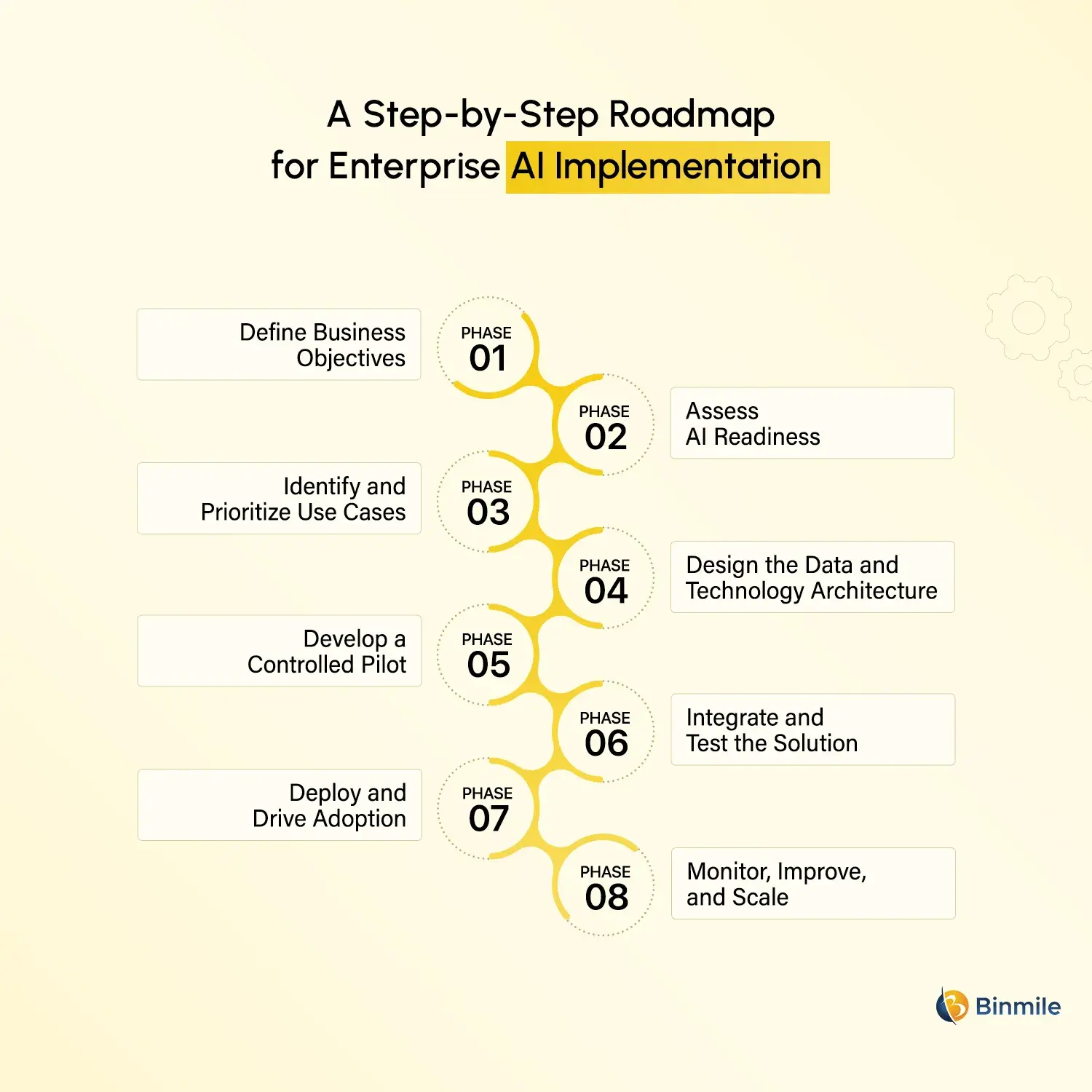
Phase 4: Design the Data and Technology Architecture
Define how data will be collected, cleaned, stored, accessed, and protected. Select the required models, cloud services, APIs, integrations, monitoring tools, and security controls.
The organization should also decide whether Artificial Intelligence as a Service, a custom model, an open-source model, or a hybrid architecture is most suitable.
Phase 5: Develop a Controlled Pilot
Build a limited version of the solution using real business data and a defined user group. Test its accuracy, usability, business value, integration requirements, security, and operating cost.
Establish clear success and failure criteria before starting the pilot. This prevents technically impressive but commercially weak projects from receiving further investment.
Phase 6: Integrate and Test the Solution
Connect the AI solution with relevant platforms such as CRM, ERP, HR systems, data warehouses, customer portals, or manufacturing applications.
Testing should cover model performance, access controls, system reliability, unusual inputs, failure scenarios, user experience, and human escalation procedures.
Phase 7: Deploy and Drive Adoption
Support production deployment with role-based training, updated processes, user guidance, and clear ownership.
Employees should understand how AI supports their work, when human judgment is required, and how incorrect or risky outputs should be reported.
Phase 8: Monitor, Improve, and Scale
Track business outcomes, model quality, adoption, security events, operating costs, and changes in data patterns after deployment.
Successful use cases can then be expanded across additional teams, locations, products, or customer segments. Continuous monitoring turns a single AI implementation project into a sustainable enterprise capability.
Ready to move your AI initiatives beyond isolated experiments and into scalable business operations?

What Determines AI Implementation Cost?
AI implementation cost varies according to the complexity of the business problem, data, integrations, model selection, security requirements, user volumes, and deployment environment.
Important cost categories include:
| Cost Area | What Executives Should Evaluate |
|---|---|
| Strategy and Discovery | Readiness assessment, use case analysis, roadmap, and business case |
| Data Preparation | Data cleaning, labeling, migration, pipelines, storage, and governance |
| Model Development | Model access, customization, training, evaluation, and prompt engineering |
| Application Development | User interfaces, workflows, APIs, dashboards, and business logic |
| Enterprise Integration | Connections with CRM, ERP, databases, identity systems, and third-party tools |
| Infrastructure | Cloud services, computing capacity, storage, networking, and environments |
| Security and Compliance | Access controls, encryption, testing, audit logs, and documentation |
| Change Management | Training, communication, process redesign, and user support |
| Ongoing Operations | Monitoring, model updates, support, usage charges, and optimization |
Executives should evaluate the total cost of ownership rather than the initial development quote. Model usage, cloud consumption, data growth, monitoring, support, and future integrations can materially affect long-term spending.
What Are the Common AI Implementation Challenges and How to Address Them
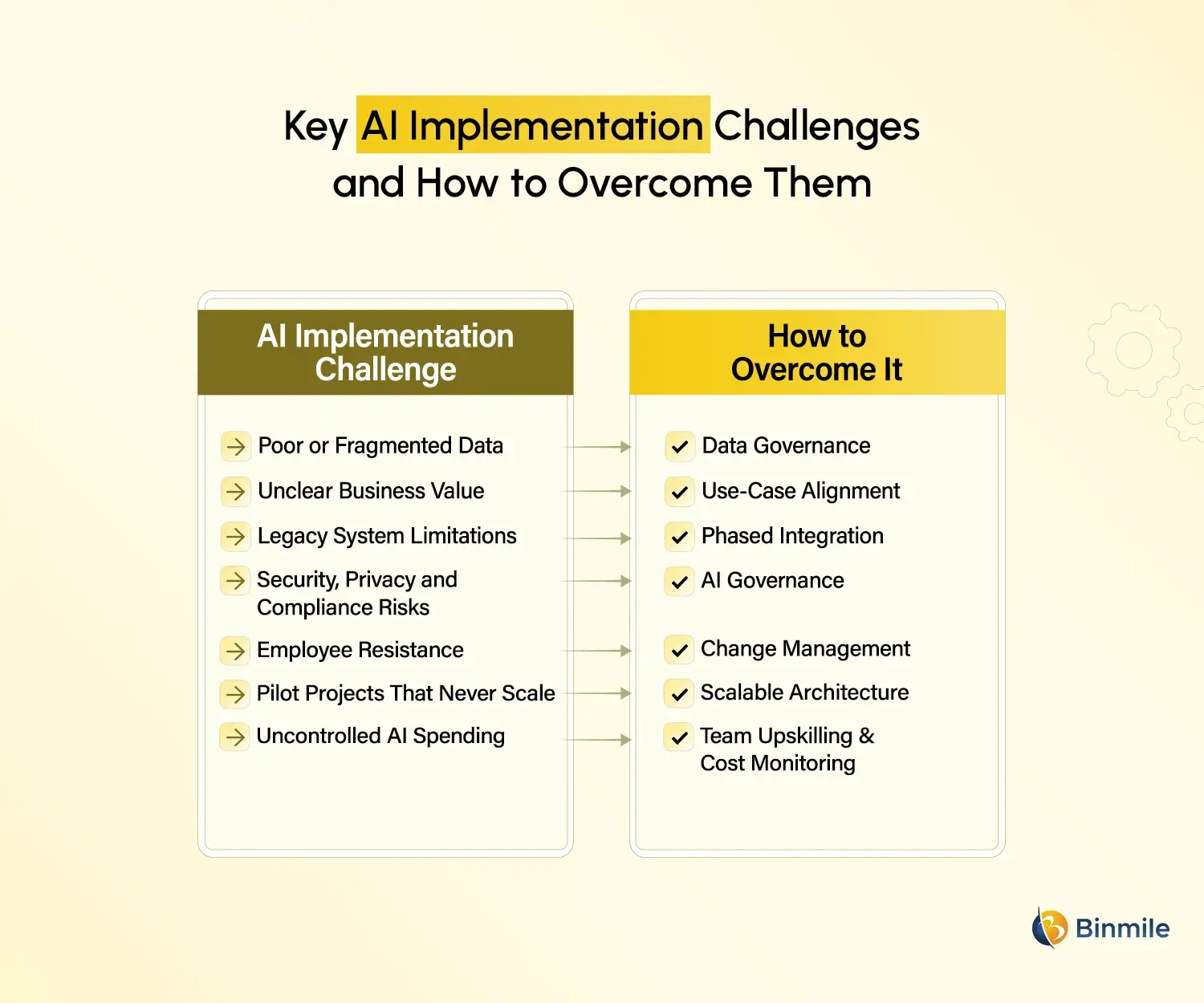
Here are the common AI implementation challenges and the ways to address and overcome them
-
Poor or Fragmented Data
Missing, outdated, or inconsistent data reduces AI accuracy. Enterprises should improve data quality, establish ownership, create secure pipelines, and define clear data access policies.
-
Unclear Business Value
AI projects can lose direction when they are not linked to a measurable problem. Every initiative should have a defined objective, baseline, expected outcome, and accountable business owner.
-
Legacy System Integration
Older systems may lack suitable APIs or real-time access. APIs, middleware, data platforms, and phased modernization can help connect AI without replacing the entire technology environment.
-
Security, Privacy, and Compliance Risks
AI may process customer data, employee records, intellectual property, or regulated information. Role-based access, encryption, audit logs, model policies, and human review are essential.
-
Employee Resistance
Employees may avoid AI when its purpose is unclear. Leaders should explain how it supports their work, involve users in workflow design, and provide practical training.
-
Pilot Projects That Never Scale
A pilot may succeed in a controlled environment but fail in production. Scalability, integration, governance, support, ownership, and operating costs should be considered from the beginning.
-
Uncontrolled AI Spending
Usage-based models, duplicate tools, and unused licenses can increase costs. Enterprises should track consumption, set spending limits, optimize model selection, and review costs regularly.
How to Select AI Implementation Tools
The right AI implementation tools depend on the selected use case and existing technology ecosystem. Enterprises may require tools across several layers:
Data tools collect, prepare, catalog, govern, and deliver information to AI systems. Model development tools support training, customization, prompt management, evaluation, and experimentation. Generative AI app development provides access to language, image, speech, code, and multimodal models. Agent orchestration tools coordinate models, business rules, APIs, memory, tools, and multi-step actions.
Integration tools connect AI applications with enterprise platforms, databases, services, and external systems. MLOps and LLMOps tools support deployment, versioning, monitoring, testing, and model lifecycle management. Security and governance tools enforce policies, permissions, auditability, risk controls, and responsible AI standards.
How to Measure Enterprise AI Implementation Success
AI success should be measured through a combination of business, technical, financial, adoption, and risk indicators. Tracking only model accuracy does not show whether the solution is creating meaningful enterprise value.
| Measurement Area | Metrics to Track |
|---|---|
| Business Value | Revenue growth, cost reduction, productivity, customer retention, error reduction, and cycle time |
| Operational Performance | Response time, automation rate, processing volume, system availability, and escalation frequency |
| Model Performance | Accuracy, precision, relevance, hallucination rate, bias, consistency, and model drift |
| User Adoption | Active users, usage frequency, task completion, employee satisfaction, and workflow adoption |
| Risk and Governance | Policy violations, incorrect decisions, security incidents, data exposure, and human overrides |
| Financial Performance | Development cost, infrastructure cost, model usage, support, integration, and change management expenses |
A basic calculation for measuring financial performance is:
AI ROI = (Financial benefit generated by AI − Total AI cost) ÷ Total AI cost × 100
Enterprises should establish baseline performance before implementation. For example, if AI is introduced to reduce customer service resolution time, the organization must record the existing resolution time before deployment.
Leaders should also review whether improvements remain consistent over time. A solution that performs well during launch may lose accuracy, become expensive, or experience lower adoption as business data and user behavior change.
Need an enterprise AI solution that works securely with your existing applications, data, and business processes?
How Binmile Can Support Your Enterprise AI Implementation
Moving from an AI idea to a production-ready capability requires business strategy, data engineering, software development, integration, cloud infrastructure, security, and continuous improvement to work together.
As an experienced AI development company, Binmile supports this journey through AI readiness assessments, use case prioritization, implementation roadmaps, custom application development, generative AI solutions, AI agents, predictive systems, and intelligent workflow automation. The approach focuses on connecting AI with existing enterprise applications and processes so that solutions can operate within the organization’s actual technology environment.
The engagement can also cover data architecture, API and system integration, model evaluation, cloud deployment, governance controls, monitoring, and post-launch optimization. This helps businesses move from disconnected pilots to secure and scalable AI systems aligned with measurable operational, customer, and financial outcomes.
Frequently Asked Questions
Enterprise AI implementation is the structured process of selecting use cases, preparing data, integrating models, redesigning workflows, establishing governance, and measuring results. It matters because isolated AI experiments rarely produce the operational, financial, or customer impact executives expect.
The key steps include defining business objectives, assessing readiness, prioritizing use cases, preparing data, selecting architecture, developing a pilot, integrating systems, testing risks, training users, deploying the solution, monitoring performance, and scaling successful applications.
Customer service, sales, marketing, finance, supply chain, manufacturing, human resources, IT, engineering, project management, and product development can benefit. The strongest opportunities usually involve high-volume processes, repetitive decisions, extensive data, measurable delays, or frequent operational errors.
Businesses should track financial outcomes, productivity, cycle time, customer satisfaction, model accuracy, employee adoption, operating costs, and risk indicators. Metrics should be linked to a pre-implementation baseline so leaders can distinguish measurable improvement from general AI usage.
An experienced implementation partner brings strategy, data, development, integration, security, governance, and deployment expertise together. This can reduce technical risk, accelerate production readiness, improve cost visibility, and help internal teams avoid creating isolated solutions that cannot scale.