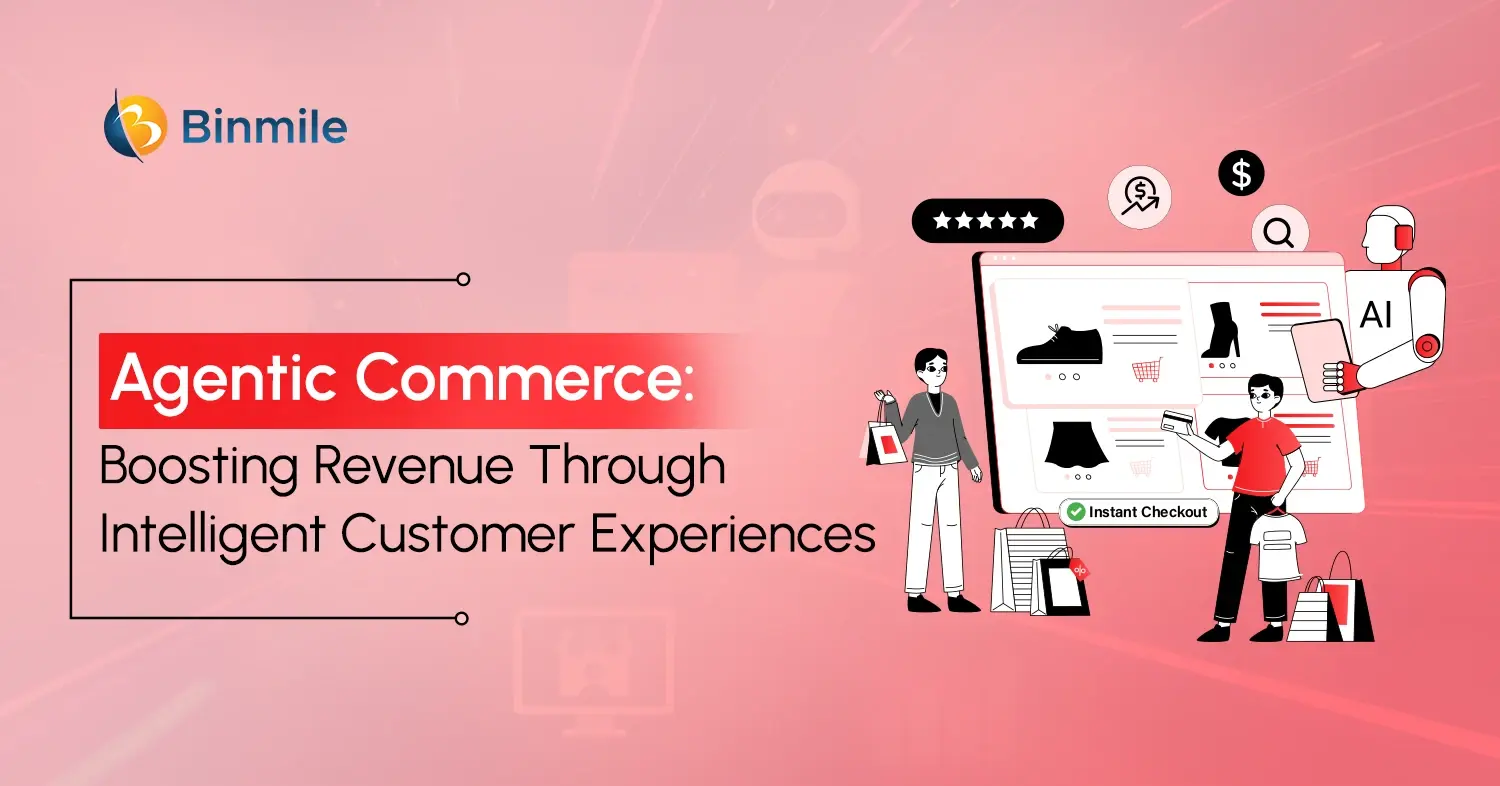
Online shopping has changed dramatically over the past decade, but customer expectations are evolving even faster. Shoppers no longer want to browse hundreds of products, compare countless reviews, or repeat the same searches across multiple websites. They expect businesses to understand their needs, provide personalized recommendations, and make purchasing effortless.
This shift is paving the way for Agentic Commerce, where AI agents go beyond recommending products to actively assisting customers throughout their buying journey. From understanding intent and comparing products to completing purchases and offering post-sale support, these intelligent agents are transforming how businesses engage with customers. In this blog, we will explore what Agentic Commerce is, how it works, the technologies behind it, how it increases sales and customer retention, and why businesses should start preparing for this next phase of digital commerce.
What Is Agentic Commerce?
Agentic Commerce is an AI-powered approach to digital commerce where autonomous AI agents can understand customer intent, make decisions, perform tasks, and complete transactions with minimal human intervention. Unlike traditional eCommerce platforms that rely on customers to search, filter, compare, and purchase products manually, Agentic Commerce enables AI agents to handle much of the buying journey on behalf of the customer.
Imagine telling an AI assistant:
“Find me a lightweight laptop under ₹80,000 with at least 16GB RAM and the best battery life.”
Instead of showing hundreds of search results, the AI agent understands your requirements, compares products across multiple commerce platforms, evaluates customer reviews, identifies the best available offers, recommends the most suitable option, and can even complete the purchase after receiving your approval. Rather than making customers navigate every step themselves, the AI works as an intelligent shopping assistant focused on delivering the best possible outcome. The focus shifts from searching to achieving outcomes, making shopping faster, more personalized, and more convenient.
How Agentic Commerce Improves Customer Retention
Acquiring a new customer is often more expensive than retaining an existing one. While discounts and loyalty programs still play a role, long-term retention now depends on delivering personalized, convenient, and consistent experiences. This is where agentic commerce solutions create lasting value.
-
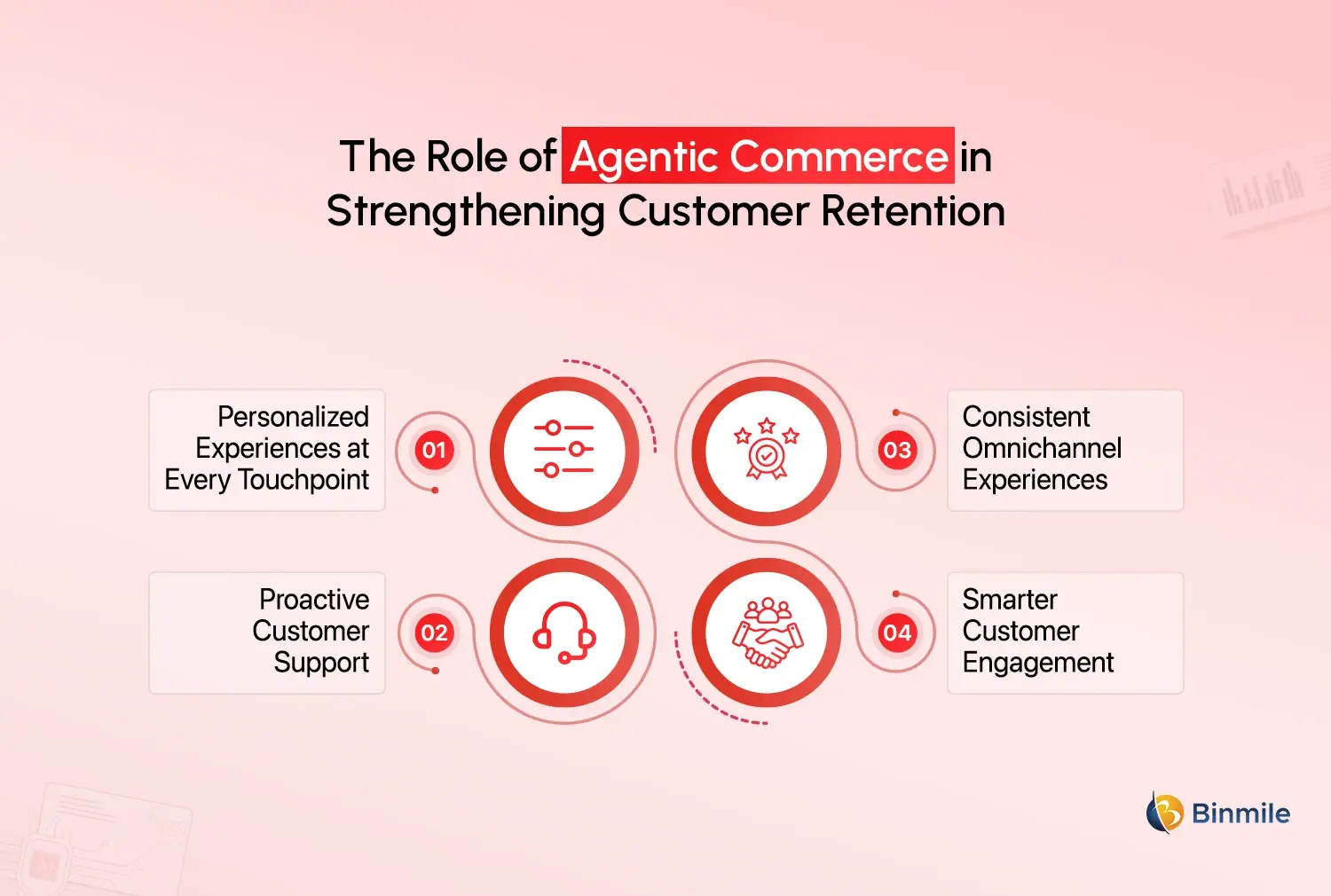
Personalized Experiences at Every Touchpoint
AI agents continuously learn from customer interactions, preferences, and purchase history to make every shopping experience more relevant.
For example, if a customer regularly buys fitness products, the AI agent can proactively recommend new arrivals, remind them when consumable products are running low, or suggest accessories that match their interests. This level of personalization encourages repeat purchases without feeling intrusive.
-
Proactive Customer Support
Customers no longer want to wait hours for support responses. Intelligent AI agents can answer queries, resolve common issues, initiate returns, track orders, and even escalate complex cases when needed.
Quick issue resolution builds trust and reduces the chances of customers switching to competitors.
-
Consistent Omnichannel Experiences
Customers often move between websites, mobile apps, social media, and physical stores before making a purchase. Agentic Commerce maintains context across these channels, allowing conversations and recommendations to continue seamlessly regardless of where customers engage.
-
Smarter Customer Engagement
Instead of sending generic promotional emails, AI agents deliver personalized messages based on customer intent and behavior.
Examples include recommending products that complement recent purchases, sending replenishment reminders, sharing relevant offers based on browsing behavior, and notifying customers when wishlist items are back in stock.
This makes communication more useful and improves long-term customer relationships.
How Agentic Commerce Increases Sales
One of the biggest advantages of Agentic Commerce is its ability to remove friction from the buying process. Instead of expecting customers to complete every step themselves, AI agents actively guide purchasing decisions.
-
Better Product Discovery
Many customers leave eCommerce websites simply because they cannot find the right product.
AI agents understand customer intent rather than relying solely on keywords, helping buyers discover relevant products faster.
-
Highly Personalized Recommendations
Traditional recommendation engines usually depend on previous purchases. Agentic Commerce considers current intent, budget, shopping history, seasonal preferences, and product availability, and real-time trends
This creates recommendations that feel far more relevant and timely.
-
Faster Buying Decisions
Customers spend less time researching because AI agents perform much of the comparison process automatically.
Shorter buying journeys often translate into higher conversion rates.
-
Intelligent Cross-Selling and Upselling
Rather than displaying generic “Customers also bought” suggestions, AI agents recommend complementary products based on actual customer goals.
For example, someone purchasing a gaming laptop may automatically receive recommendations for compatible accessories, warranty plans, and productivity software that genuinely enhance the purchase rather than indiscriminately increase cart value.
How Agentic Commerce Works
At its core, Agentic Commerce combines autonomous AI in business strategy with enterprise systems to make intelligent purchasing decisions.
A typical buying journey looks like this:
| Step | What Happens |
|---|---|
| Customer Shares Intent | The AI understands the customer’s goal instead of just keywords. |
| AI gathers Information | It checks products, prices, inventory, reviews, and preferences. |
| Intelligent Analysis | The AI compares multiple options based on customer priorities. |
| Personalized Recommendation | The best product or service is suggested. |
| Purchase Execution | The AI assists or completes the transaction after approval. |
| Post-Purchase Engagement | The AI tracks orders, handles support, and recommends future purchases. |
Instead of simply reacting to user clicks, AI agents proactively guide customers toward the most relevant decisions.
Understanding Agentic Commerce Architecture
An effective Agentic Commerce Architecture connects multiple business systems so AI agents can make informed decisions. Rather than operating independently, AI agents continuously exchange information across the entire commerce ecosystem.
A typical Agentic Commerce Architecture brings together customer interaction channels, an AI decision engine, product catalogs, inventory management systems, CRM platforms, payment gateways, order management solutions, analytics platforms, and customer support applications into a unified ecosystem. By connecting these systems, AI agents can access real-time business information, make informed decisions, and deliver highly personalized shopping experiences across every customer touchpoint.
This integrated agentic AI architecture enables AI agents to respond instantly using real-time business information instead of static rules. For example, if a product is unavailable, the AI can automatically recommend alternatives based on customer preferences, price range, and delivery timelines without requiring manual intervention.
What Is the Agentic Commerce Protocol?
The Agentic Commerce Protocol is a communication framework that enables AI agents, business applications, and enterprise systems to exchange information securely and efficiently.
Instead of operating in isolated systems, the Agentic Commerce Protocol enables AI agents to securely access inventory information, retrieve real-time pricing, verify customer preferences, check product and delivery availability, initiate secure payment processes, and coordinate actions across multiple enterprise applications. This seamless exchange of information allows businesses to deliver faster, more accurate, and highly personalized customer experiences.
This standardized communication is becoming increasingly important as organizations integrate AI into complex commerce environments. The protocol also lays the foundation for Agentic AI in Payments, enabling AI agents to securely verify payment methods.
What Are the Technologies Powering AI-Driven Commerce
Several advanced technologies work together to enable AI-driven commerce.
-
Artificial Intelligence and Machine Learning
Machine learning helps AI agents understand customer behavior, predict buying patterns, and continuously improve recommendations.
-
Large Language Models
These models enable conversational interactions, allowing customers to communicate naturally instead of relying on predefined search terms. When combined with Agentic RAG, AI agents can retrieve real-time product information.
-
Real-Time Analytics
AI analyzes customer activity, browsing history, purchasing behavior, and inventory changes to deliver relevant recommendations instantly.
-
Intelligent Commerce Infrastructure
Modern commerce infrastructure connects customer-facing applications with backend enterprise systems, enabling AI agents to make accurate decisions using real-time business data.
-
Conversational Interfaces
Conversational commerce allows customers to interact through chatbots, voice assistants, messaging platforms, and virtual shopping assistants while maintaining a natural shopping experience.
Let's build a scalable, future-ready commerce ecosystem that delivers smarter customer experiences and measurable business growth.
What Are Industries Benefiting from Agentic Commerce
Agentic Commerce is not limited to online retail. Any industry that involves customer interactions, product recommendations, or purchasing decisions can benefit from AI-powered automation.
| Industry | Example Use Case |
|---|---|
| Retail | Personalized shopping assistants and automated recommendations |
| Healthcare | AI-guided medical product selection and appointment bookings |
| Banking & Financial Services | Personalized financial product recommendations |
| Manufacturing | Intelligent procurement and supplier management |
| Travel & Hospitality | Automated itinerary planning and personalized travel packages |
| Automotive | Vehicle configuration, financing options, and after-sales recommendations |
| B2B Commerce | Automated product discovery, quote generation, and repeat ordering |
What Are the Emerging Agentic Commerce Trends
As businesses continue investing in enterprise AI, several Agentic Commerce trends are shaping the future of digital commerce.
-
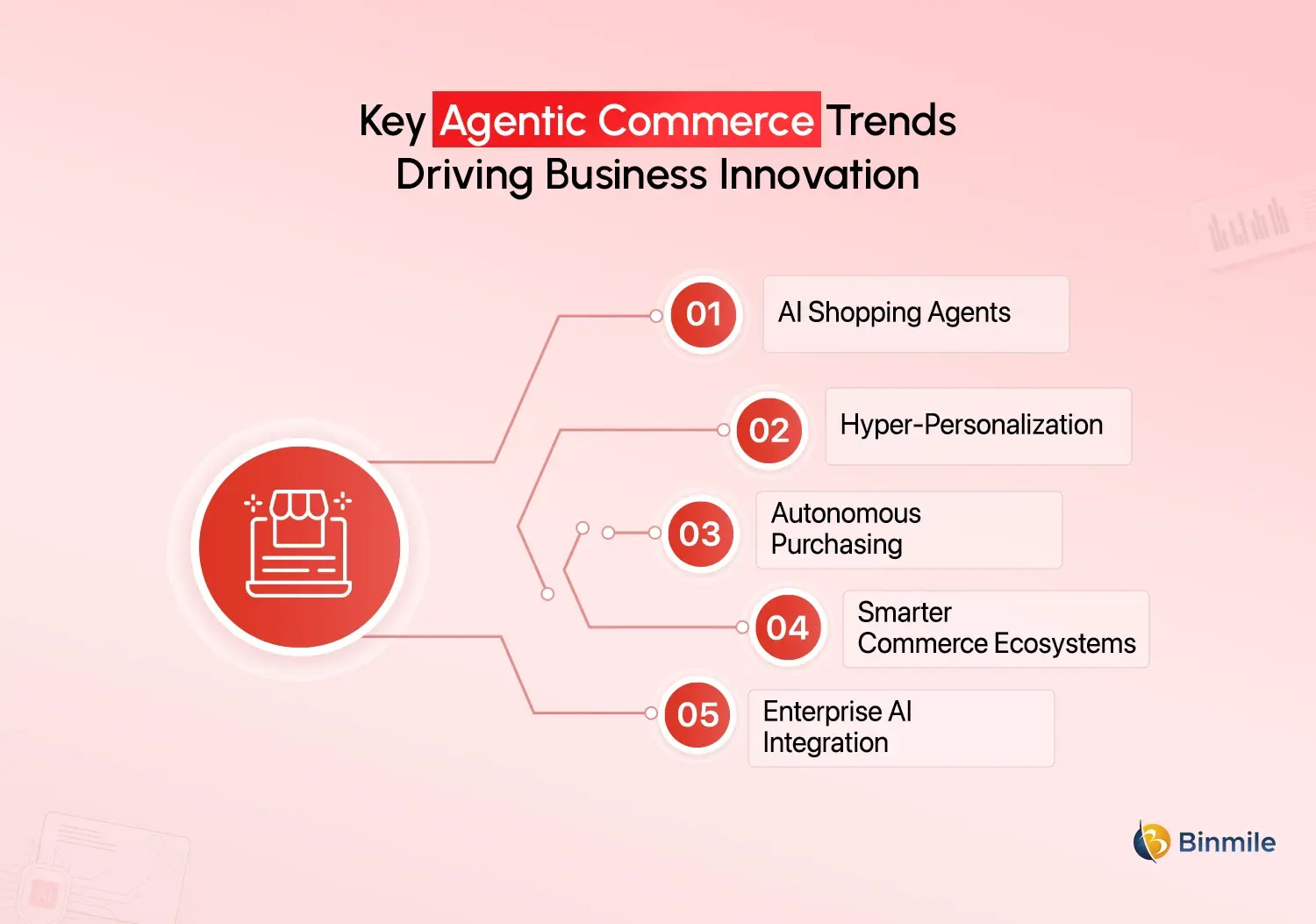
AI Shopping Agents
Customers will increasingly rely on AI assistants to research products, compare prices, and negotiate offers. The discussion around Q-Commerce vs. E-Commerce has primarily focused on delivery speed. However, Agentic Commerce introduces an entirely new dimension.
-
Hyper-Personalization
Future AI systems will analyze customer intent in real time, creating shopping experiences tailored to individual preferences rather than broad customer segments.
-
Autonomous Purchasing
Routine purchases such as office supplies, groceries, or subscription renewals can be automatically managed by AI agents based on predefined preferences and spending limits.
-
Smarter Commerce Ecosystems
Businesses are moving away from isolated applications toward connected commerce ecosystems, where CRM platforms, inventory systems, payment gateways, logistics, and analytics work together to deliver seamless customer experiences.
-
Enterprise AI Integration
Organizations are increasingly integrating Agentic Commerce with broader Enterprise AI Solutions to improve customer service, supply chain operations, pricing strategies, and business intelligence.
What Are the Challenges Businesses Should Prepare For
While Agentic Commerce offers significant advantages, successful implementation requires careful planning. Some common challenges include:
-
Integrating AI with Legacy Systems
Many organizations still rely on legacy commerce platforms that were not designed to support autonomous AI agents. Modernizing these systems or integrating them with newer AI technologies requires careful planning to avoid operational disruptions.
-
Ensuring High-Quality and Secure Data
AI systems are only as effective as the data they receive. Businesses need accurate, well-governed, and secure customer and operational data to deliver reliable recommendations while protecting sensitive information.
-
Maintaining Transparent AI Decisions
Customers and businesses should understand how AI reaches its recommendations and purchasing decisions. Transparency helps build trust while supporting compliance with evolving AI governance standards.
-
Meeting Privacy and Regulatory Requirements
As AI processes increasing volumes of customer information, organizations must ensure compliance with data privacy regulations and establish responsible data management practices.
-
Building Customer Trust
Customers are more likely to adopt AI-assisted shopping when they feel confident that recommendations are accurate, unbiased, and aligned with their interests. Clear communication and human oversight remain important.
-
Modernizing Commerce Infrastructure
Supporting Agentic Commerce often requires businesses to upgrade existing commerce infrastructure, so AI agents can access real-time inventory, pricing, customer, and order information without affecting business continuity.
Businesses that address these challenges early will be better positioned to scale AI initiatives and deliver consistent customer experiences.
How To Prepare Your Business for Agentic Commerce
Adopting Agentic Commerce does not necessarily require replacing your existing eCommerce platform. Partnering with an experienced eCommerce developer can further simplify this modernization process.
A practical approach includes:
-
Evaluate Your Current Digital Commerce Capabilities
Start by assessing how well your existing digital commerce platform supports automation, AI integration, and personalized customer experiences. This helps identify capability gaps before implementation begins.
-
Modernize Your Commerce Infrastructure
Upgrading legacy systems and adopting scalable cloud-based technologies creates the foundation needed for AI agents to access real-time business information efficiently.
-
Integrate AI Across Enterprise Systems
Connect AI with CRM, ERP, inventory management, payment gateways, and customer support platforms to ensure seamless information sharing across the commerce ecosystem.
-
Build AI on High-Quality Data
Reliable AI depends on clean, consistent, and well-governed data. Establishing strong data management practices improves recommendation accuracy and business outcomes.
-
Start with High-Impact Use Cases
Rather than transforming every process at once, begin with use cases such as personalized recommendations, AI-powered customer support, or intelligent product discovery before expanding to more advanced capabilities.
-
Continuously Monitor and Optimize
Track AI performance using customer feedback, business metrics, and operational insights. Continuous optimization ensures AI systems remain aligned with changing customer expectations and business objectives.
This phased approach reduces implementation risks while delivering measurable business value.
Discover how intelligent Agentic Commerce solutions can help you increase conversions, improve customer retention, and create personalized shopping journeys.
Building an AI-Ready Commerce Strategy with Binmile
Businesses looking to embrace Agentic Commerce need more than just AI capabilities. They need a technology partner that understands how intelligent systems, enterprise applications, and digital commerce platforms work together to create meaningful business outcomes.
Binmile helps organizations modernize their commerce platforms by combining expertise in Agentic AI, Enterprise AI Solutions, digital transformation, and eCommerce engineering. Whether the goal is enhancing customer experiences, integrating AI into existing commerce infrastructure, or building intelligent shopping assistants, the focus remains on creating scalable, secure, and business-driven solutions.
As customer expectations continue to evolve, organizations that invest in intelligent, AI-powered commerce today will be better positioned to increase conversions, strengthen customer loyalty, and stay ahead in an increasingly competitive market.
Frequently Asked Questions
Agentic Commerce is an AI-powered commerce model where intelligent agents understand customer intent, recommend products, automate purchasing tasks, and provide ongoing support, creating faster, more personalized, and seamless shopping experiences across digital channels.
Agentic Commerce increases sales by improving product discovery, delivering personalized recommendations, reducing buying friction, enabling intelligent cross-selling, and shortening purchase journeys, which collectively improve conversion rates and average order values.
Yes. By offering personalized experiences, proactive customer support, relevant recommendations, and consistent interactions across multiple channels, Agentic Commerce helps businesses strengthen customer relationships and encourage repeat purchases.
No. Businesses of all sizes can adopt Agentic Commerce. Many organizations begin with AI-powered customer support or personalized recommendations before gradually expanding to more advanced autonomous commerce capabilities.
Traditional eCommerce depends on customers manually searching and completing purchases. Agentic Commerce uses AI agents that understand intent, recommend products, automate decisions, and assist customers throughout the entire buying journey.
Agentic Commerce combines artificial intelligence, machine learning, large language models, real-time analytics, conversational interfaces, modern commerce infrastructure, and integrated enterprise systems to deliver intelligent and personalized shopping experiences.
Retail, healthcare, banking, manufacturing, travel, automotive, telecommunications, and B2B commerce can all benefit by improving customer experiences, streamlining purchasing processes, increasing operational efficiency, and strengthening long-term customer relationships.