Building great software is no longer just about writing clean code. Businesses today need to deliver applications quickly, maintain high quality, adapt to changing customer expectations, and keep development costs under control. However, many software projects still experience delays, communication gaps, and quality issues due to poorly defined development processes. According to the report, only about 31% of software projects are completed successfully, making a structured software development workflow essential for delivering projects on time and within budget.
Whether you are developing a new application, modernizing legacy systems, or managing large-scale enterprise software, having a well-defined workflow helps improve collaboration, accelerate delivery, and reduce project risks. In this guide, we will explore what a software development workflow is, why it matters, the key stages involved, best practices to follow, the tools that support efficient development, and practical steps to build a workflow that scales with your business.
What Is a Software Development Workflow?
A software development workflow is a structured process that defines how software moves from planning and development to deployment and ongoing maintenance. It outlines the sequence of tasks, responsibilities, and approvals needed to keep projects organized and teams aligned.
A typical workflow includes requirement gathering, planning, design, development, testing, deployment, and continuous monitoring. By following a standardized workflow, businesses can improve collaboration, maintain software quality, reduce delays, and deliver projects more efficiently.
Why Businesses Need a Well-Defined Software Development Workflow
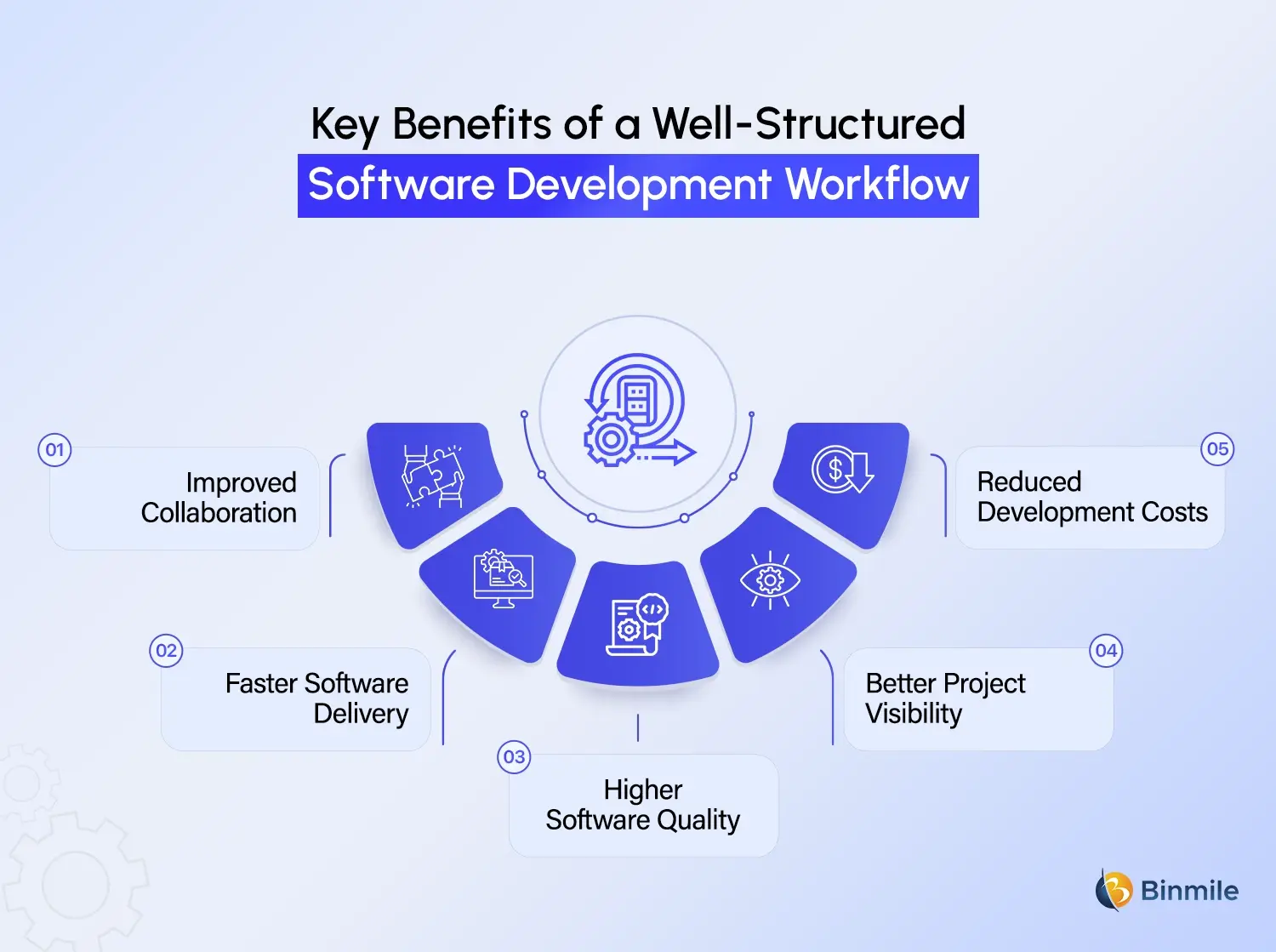
A structured workflow provides far more than operational efficiency. It enables organizations to build better software while reducing unnecessary costs and delays. Some of the biggest business benefits include:
-
Improved Collaboration
Software development involves multiple teams with different responsibilities. A standardized workflow creates clear ownership, improves communication, and ensures everyone works toward shared business objectives.
-
Faster Software Delivery
Clearly defined processes eliminate unnecessary delays caused by approval bottlenecks, duplicated work, or poor coordination. Teams can focus on delivering features instead of resolving process issues.
-
Higher Software Quality
Quality becomes part of the workflow rather than an activity performed only before release. Regular code reviews, automated testing, and continuous validation reduce production defects.
-
Better Project Visibility
Leaders gain better insight into project progress, resource utilization, risks, and delivery timelines, enabling informed business decisions.
-
Reduced Development Costs
Identifying issues early is significantly less expensive than fixing them after deployment. An efficient workflow minimizes rework, improves productivity, and lowers long-term maintenance costs.
Software Development Workflow vs Software Development Lifecycle
Although they are closely related, a software development workflow and the Software Development Lifecycle (SDLC) are not the same.
| Software Development Workflow | Software Development Lifecycle |
|---|---|
| Defines how work moves between teams | Defines the complete lifecycle of software development |
| Focuses on collaboration and execution | Focuses on project phases and delivery methodology |
| Covers day-to-day engineering activities | Covers planning through maintenance |
| Can evolve throughout a project | Usually follows an established SDLC model |
Think of the Software Development Lifecycle as the overall framework and the workflow as the operational process that keeps every phase running efficiently.
Effective software development lifecycle management ensures that every phase, from planning and development to deployment, maintenance, and future enhancements, follows consistent governance. This not only improves project visibility but also reduces technical debt, simplifies change management, and helps organizations deliver software more predictably.
What Are the Core Stages of the Software Development Process
Every successful software development process follows a series of interconnected stages that ensure software meets business and user expectations.
1. Requirement Gathering
The first step is understanding the project’s objectives, business requirements, user needs, and technical constraints. Clear requirements help reduce misunderstandings, prevent scope changes, and establish a solid foundation for development.
2. Planning and Design
After gathering requirements, teams define the project’s technical roadmap by selecting the technology stack, designing the architecture, planning infrastructure, and addressing security considerations. Effective planning ensures the software is scalable and easy to maintain.
3. Development
During this stage, developers build the application by writing code, implementing features, conducting code reviews, and managing versions. Many teams combine Agile and DevOps practices to improve collaboration and accelerate delivery.
4. Testing in Software Development
Testing in Software Development should be integrated throughout the development lifecycle to identify issues early and improve software quality. A robust testing strategy includes unit, integration, functional, performance, security, regression, and user acceptance testing. Combining automated testing with continuous integration and continuous delivery helps organizations release reliable software faster.
5. Deployment
Once testing is complete, the software is deployed to production. Modern deployment practices such as Continuous Integration, continuous delivery with automated testing, Blue-Green deployments, Canary releases, and rollback mechanisms help reduce risks and ensure smooth releases.
6. Monitoring and Continuous Improvement
After deployment, teams continuously monitor application performance, security, and user feedback to identify improvement opportunities. These insights help optimize future releases and keep the software reliable, secure, and aligned with evolving business needs.
Software Development Workflow Best Practices Every Business Should Follow
An effective workflow is built through continuous improvement rather than one-time process changes. The following best practices help organizations improve collaboration, accelerate delivery, and maintain consistent quality.
-
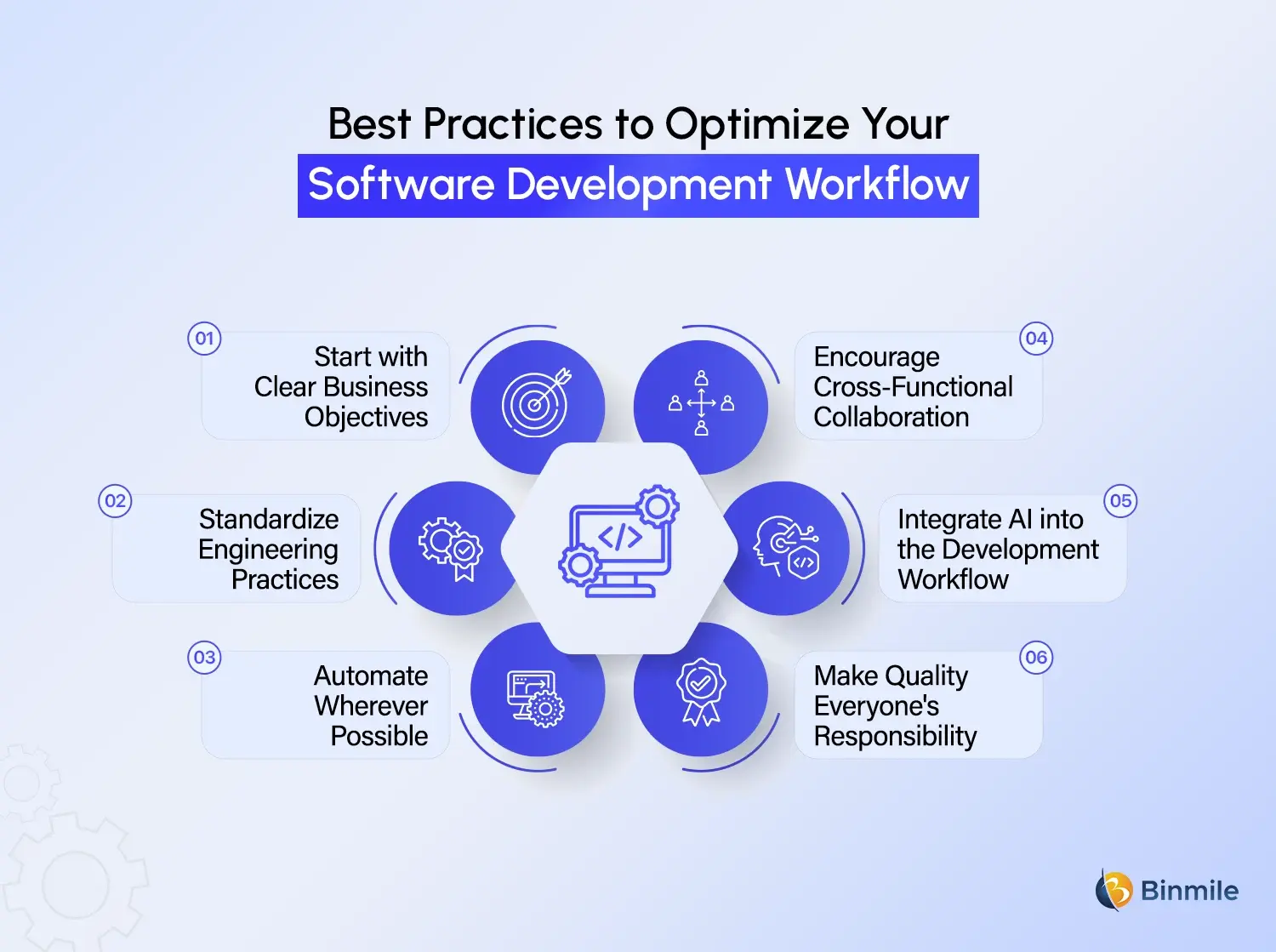
Start With Clear Business Objectives
Technology initiatives should solve business problems, not simply deliver features. Every project should begin with measurable goals, defined success metrics, and stakeholder alignment to ensure development efforts create tangible business value.
-
Standardize Engineering Practices
Establishing software development standards across teams creates consistency throughout the development lifecycle. Standard coding guidelines, documentation practices, review processes, and release approvals improve maintainability while reducing technical debt.
-
Automate Wherever Possible
Automation significantly improves engineering productivity by eliminating repetitive manual tasks. Automation should include code builds, testing, security scanning, deployment, infrastructure provisioning, and monitoring. Besides improving efficiency, automation reduces human error and enables faster software releases.
-
Encourage Cross-Functional Collaboration
Successful workflows depend on effective communication between business leaders, developers, testers, designers, and operations teams. Regular sprint reviews, planning sessions, and shared documentation improve transparency and reduce misunderstandings.
-
Integrate AI into the Development Workflow
Modern engineering teams increasingly use AI-Assisted Software Development to improve productivity. AI-powered tools help generate code suggestions, automate documentation, support code reviews, recommend test cases, and identify defects earlier in the development cycle. Rather than replacing developers, AI enables teams to focus more on solving complex business problems while reducing repetitive work.
-
Make Quality Everyone’s Responsibility
Quality should not be limited to the QA team. Developers, testers, product owners, and operations teams should collaborate throughout the workflow to identify issues early and continuously improve software reliability.
Ready to modernize your software development process with the right engineering strategy?

What Are the Common Challenges That Affect Software Development Workflows
Even mature engineering organizations encounter workflow challenges that slow delivery and affect software quality. Recognizing these issues early helps businesses build more resilient and efficient development processes.
-
Unclear Requirements
Poorly defined requirements often result in changing project scopes, repeated revisions, and unnecessary rework. Investing time in requirement gathering, stakeholder workshops, and detailed documentation helps teams establish a clear project direction from the beginning.
-
Poor Communication Between Teams
When development, testing, operations, and business teams work in isolation, misunderstandings become inevitable. Encouraging regular sprint reviews, collaborative planning sessions, and transparent communication helps keep everyone aligned throughout the project.
-
Manual Testing Processes
Relying heavily on manual testing increases release timelines and raises the risk of human error. Integrating automated testing into the development workflow enables faster feedback, improves software quality, and supports continuous delivery.
-
Limited Project Visibility
Without centralized reporting and project tracking, leaders struggle to monitor project progress, identify risks, and allocate resources effectively. Modern project management and reporting tools provide better visibility across the entire development lifecycle.
-
Inconsistent Coding Practices
Different coding styles and review processes often lead to technical debt and maintenance challenges. Standardizing engineering practices through coding guidelines, peer reviews, and documentation creates consistency across software development projects.
-
Limited Automation
Manual builds, deployments, and infrastructure management slow down software delivery and increase operational costs. Automating these activities helps engineering teams improve efficiency while reducing deployment risks.
Software Development Tools That Streamline Modern Workflows
The right software development tools help teams collaborate efficiently, automate repetitive tasks, and improve visibility throughout the development process. When integrated effectively, they create a connected workflow that accelerates software delivery and enhances productivity.
Project management tools help plan and track tasks, while version control systems enable seamless code collaboration. CI/CD platforms automate code integration, testing, and deployments, allowing faster and more reliable releases. Test automation tools ensure consistent software quality, documentation platforms centralize project knowledge, and monitoring tools track application performance and identify issues early. Communication platforms further improve collaboration by keeping teams connected throughout the development lifecycle.
Choosing integrated tools instead of standalone solutions helps eliminate information silos, streamline workflows, and improve overall engineering efficiency.
How to Build an Effective Software Development Workflow
Creating a successful workflow is not about following a rigid process. It is about establishing a repeatable framework that enables teams to deliver high-quality software efficiently while adapting to changing business needs.
-
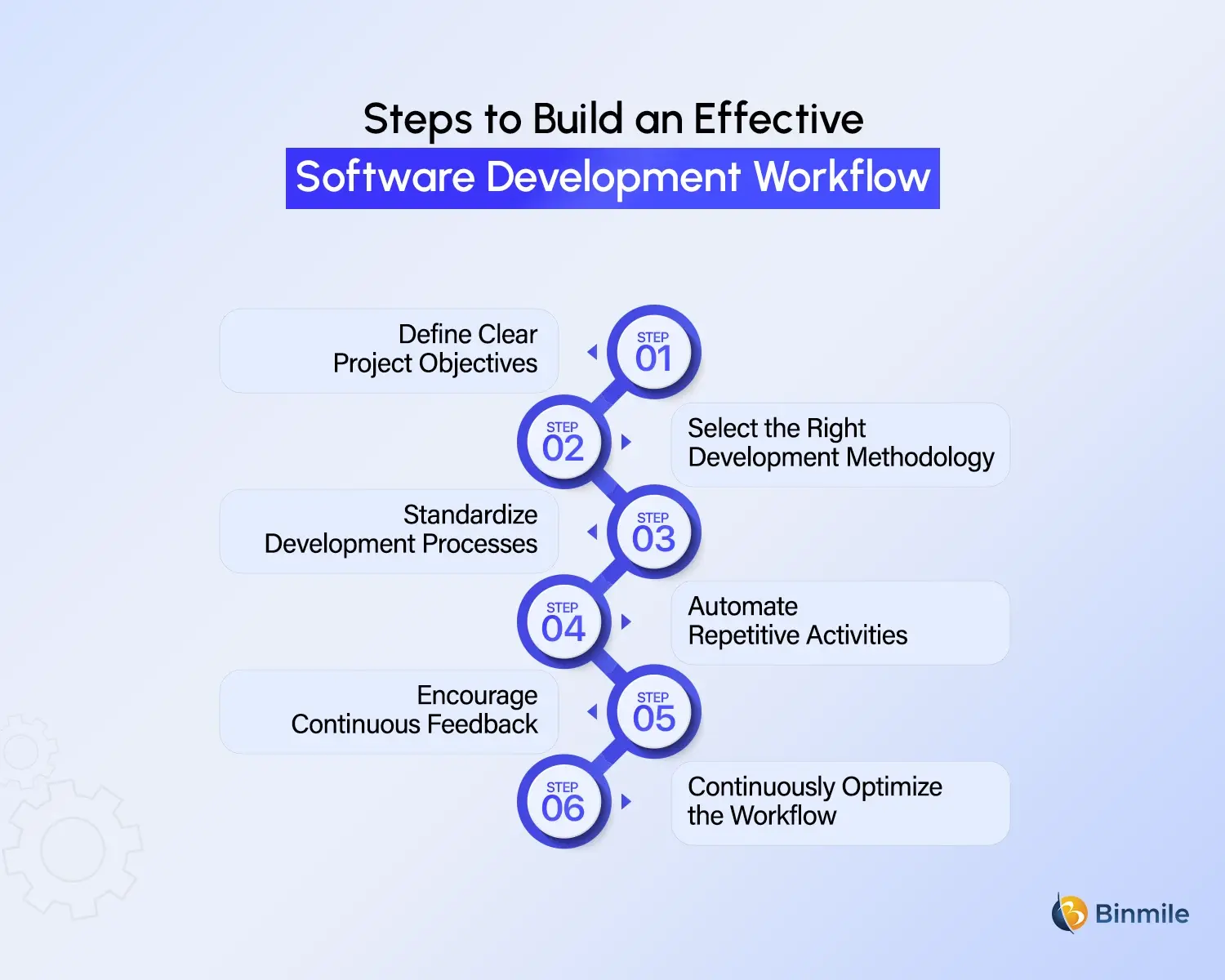
Define Clear Project Objectives
Every project should begin with well-defined business goals, user requirements, and measurable success criteria. Clear objectives help teams prioritize work and reduce unnecessary changes during development.
-
Select the Right Development Methodology
There is no single approach that works for every organization. Businesses should evaluate different software development models based on project complexity, regulatory requirements, team size, and delivery expectations before selecting the most suitable framework.
-
Standardize Development Processes
Consistent coding practices, documentation, software development guide, review procedures, and testing strategies help improve collaboration while reducing maintenance challenges across multiple software development projects.
-
Automate Repetitive Activities
Automation improves consistency and allows engineering teams to focus on solving business problems rather than managing repetitive operational tasks. Integrating automated builds, testing, deployments, and monitoring significantly accelerates software delivery.
-
Encourage Continuous Feedback
Regular stakeholder reviews, sprint retrospectives, customer feedback, and production monitoring provide valuable insights that help teams improve future releases and respond quickly to changing business priorities.
-
Continuously Optimize the Workflow
A software development workflow should evolve alongside business objectives and technology advancements. Periodic workflow assessments help identify inefficiencies, improve collaboration, and ensure development practices remain aligned with organizational goals.
Looking to optimize your software development workflow without compromising quality or speed?

Building Better Software Development Workflows with the Right Technology Partner
An effective software development workflow is built on more than processes and tools. It requires engineering expertise, the right delivery framework, and a deep understanding of business priorities. Organizations that invest in structured workflows are better equipped to deliver reliable software faster, improve collaboration across teams, and reduce operational risks while supporting long-term growth.
Businesses looking to modernize their custom software development services often benefit from partnering with experienced engineering teams that can design scalable workflows tailored to their unique requirements. Binmile combines modern software engineering practices, quality engineering, cloud technologies, automation, and AI-driven development approaches to help organizations streamline their software development process and accelerate digital transformation. Whether developing new enterprise applications or optimizing existing systems, the focus remains on delivering secure, scalable, and high-quality software that creates measurable business value.
Frequently Asked Questions
A software development workflow defines how software moves through planning, development, testing, deployment, and maintenance. It improves collaboration, increases development efficiency, reduces errors, and helps organizations deliver high-quality software faster while maintaining better visibility across projects.
An effective workflow includes requirement gathering, planning, design, development, testing, deployment, monitoring, documentation, collaboration, automation, and continuous improvement. Together, these components create a structured process that supports efficient software delivery and consistent quality.
Businesses can improve workflows by standardizing development practices, automating testing and deployments, adopting suitable SDLC models, encouraging collaboration, integrating continuous feedback, and regularly reviewing workflows to identify and eliminate process bottlenecks.
Project management platforms, version control systems, CI/CD solutions, automated testing frameworks, documentation tools, monitoring platforms, and collaboration software help streamline software development workflows by improving communication, automation, and project visibility.
Common challenges include unclear requirements, manual testing, inconsistent coding standards, poor communication, limited workflow visibility, lack of automation, and changing business priorities. Addressing these issues improves software quality, delivery speed, and project predictability.
Experienced software development partners provide engineering expertise, scalable delivery frameworks, automation capabilities, quality assurance, and proven development methodologies that reduce project risks, improve operational efficiency, and accelerate successful software delivery.