With increased data and complex processes within a business, organizations are beginning to use AI to help improve and streamline processes. Customer Service, Demand Forecasting, and many other areas of business benefit from the use of AI. According to the McKinsey State of AI 2026 report, 88% of organizations regularly use AI across at least one area of their business
Many of these use cases stem from using Narrow AI. Narrow AI is the use of AI to complete specific tasks like analyzing customer behavior, fraud detection, predicting equipment faults, and automating processes. Also known as artificial narrow intelligence, this approach is becoming increasingly relevant for organizations exploring narrow artificial intelligence for businesses and practical narrow AI initiatives.
Whilst not a universal solution to all problems, organizations can use Narrow AI to enhance areas of their business. So how does it work, what makes it different, and how to use it to drive growth? Let’s look into it below
What Is Narrow AI and How Does It Work?
Narrow AI (also known as ANI – Artificial Narrow Intelligence or Weak AI) is the use of AI to complete a specific task. These systems use machine learning, natural language processing, and computer vision to analyze data, spot patterns, make predictions, and automate. These are some of the core narrow AI technologies used to develop narrow artificial intelligence systems for specific business requirements.
Unlike AGI (Artificial General Intelligence), which would be able to think like humans, Narrow AI can only complete specific tasks. For example, an AI recommendation system can analyze and make suggestions about what products customers like, but it cannot manage inventory or make business decisions on its own.
How Does It Work
Narrow AI uses specific algorithms and trained models to analyze data. It gathers and prepares the relevant data it needs to use machine learning or deep learning to analyse the data. Additionally, the models are then implemented into business applications and their performance is tracked. Depending on the requirements, a narrow AI model may use different narrow AI modules and narrow AI components to process information and generate outputs.
A retail business could use Narrow AI to analyze past sales data, seasonal trends, and inventory data to make predictions about demand. Such narrow AI capabilities can also be developed through machine learning development and AI consulting services to address specific operational requirements.
By completing specific tasks, businesses can streamline processes, become more efficient, and make data-driven decisions. These narrow AI systems can also be integrated with existing enterprise applications through artificial intelligence development services.
What Are the Different Types of Narrow AI?
Narrow AI does not have one universally accepted classification of types or forms. Some of the most common narrow AI categories include different narrow AI types and narrow AI forms based on their capabilities and applications.
1. Predictive AI
Predictive AI uses historical and real-time data to see patterns and make predictions. Businesses can use this for demand forecasting, inventory planning, predictive maintenance, customer churn, and financial risk.
2. Classification and Recognition AI
These systems can identify and classify information using specific patterns or learned traits. Common uses include fraud detection, email spam detection, document classification, manufacturing defect detection, and customer sentiment.
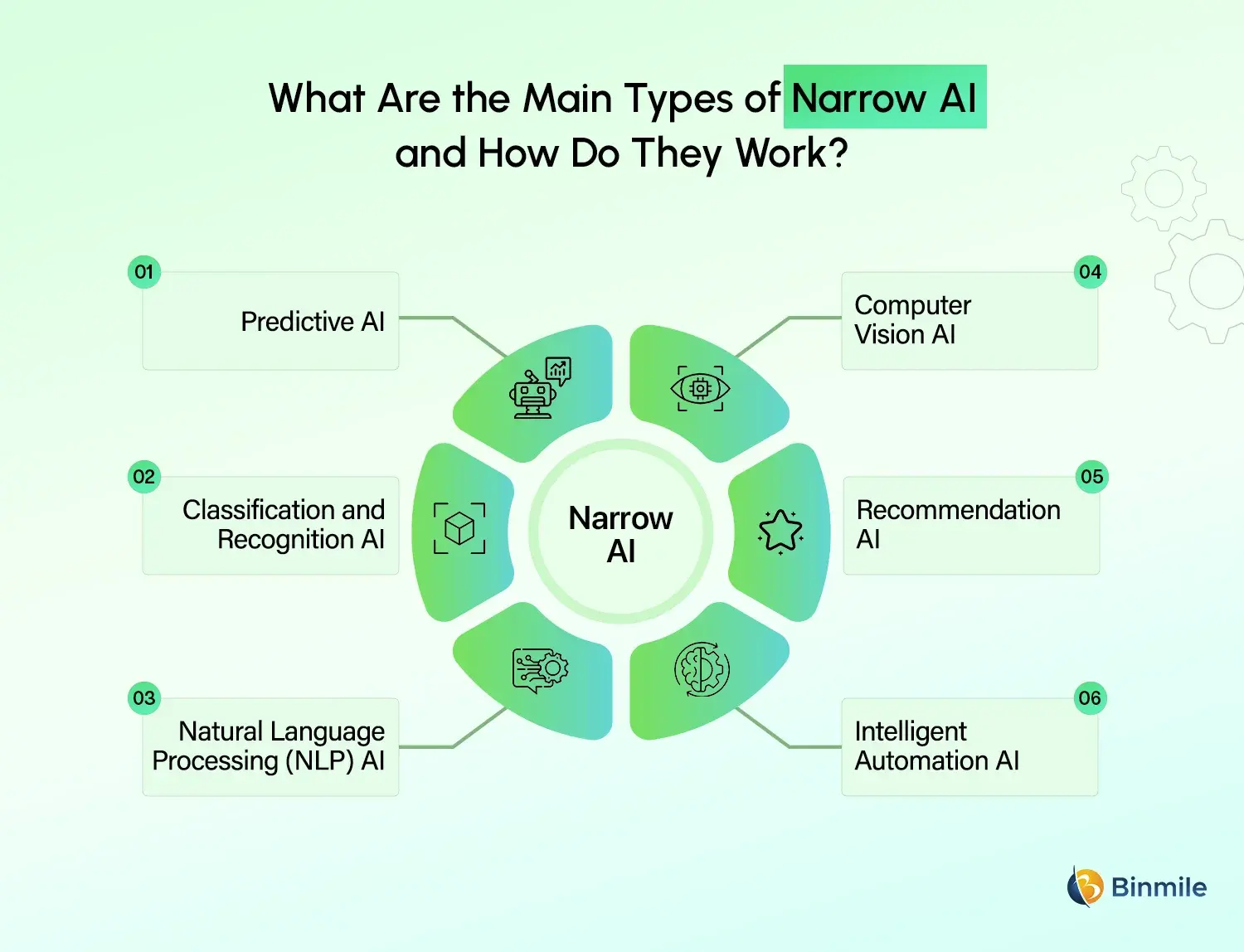
3. Natural Language Processing (NLP) AI
These systems understand human language using text or speech. They can be used for customer service chatbots, document analysis, sentiment analysis, translating languages, and speech recognition. Natural language processing services can help businesses develop these capabilities for customer-facing and internal applications.
4. Computer Vision AI
Computer vision allows AI systems to understand and analyze images and videos. Use it for quality assurance, object detection, medical imaging, and warehouse monitoring.
5. Recommendation AI
Recommendation systems use customer preferences, browsing behavior, and historical data to make recommendations. Additionally, use it to personalize shopping, targeted marketing, cross-selling, and customer engagement.
6. Intelligent Automation AI
These systems use AI models along with automation to complete specific tasks with minimal manual input. Common uses include invoice processing, data entry, document verification, customer query routing, and business automation. Business process automation can further connect these capabilities with existing enterprise workflows.
What Are Some Real-World Narrow AI Examples?
Narrow AI is already integrated into many of the digital products and business systems organizations use every day. These narrow AI applications demonstrate how specialized intelligence can support different industries and business functions.
Here are some common narrow AI examples:
| Narrow AI Example | How It Works | Business Application |
|---|---|---|
| Virtual Assistants | Understand spoken commands and respond to specific requests. | Employee assistance and customer interaction |
| Recommendation Engines | Analyze user behavior and preferences. | Product discovery and personalized shopping |
| Fraud Detection Systems | Identify irregular transactions. | Financial security and risk management |
| Predictive Maintenance | Analyzes equipment data to identify potential failures. | Manufacturing and asset management |
| Email Filtering | Categorizes emails using learned patterns. | Communication management and cybersecurity |
| AI Chatbots | Understands natural language questions and makes relevant responses. | Customer support and service automation |
| Image Recognition | Identifies objects, defects, or patterns. | Quality control and healthcare imaging |
| Demand Forecasting | Analyzes historical and current data to make predictions about demand. | Supply chain and inventory management |
Examples of narrow AI include Apple’s Siri, Amazon’s Alexa, Google Translate, and recommendation engines. These are practical examples of narrow AI being applied to specific tasks.
Even advanced large language models fall under the narrow AI category. Just because they can do multiple tasks does not mean they can think like humans. They can be very advanced but will only be able to do what they have been created to do. Large language models are also used in generative AI development services to build specialized solutions, including a narrow AI chatbot for defined customer support requirements.
How Can Businesses Use Narrow AI to Improve Operational Efficiency?
For organizations, the value of narrow AI lies in how effectively it addresses specific business challenges. Here are some of the most valuable narrow AI use cases across business functions. These narrow AI use cases also demonstrate how narrow AI in business can support operational improvements across departments.
1. Automating Repetitive Business Processes
Narrow AI can be used to automate invoicing, data entry, and document verification. For example, AI systems can extract invoice details, verify data, and highlight any discrepancies.
2. Improving Customer Experience and Personalization
Narrow AI can be used to analyze customer preferences. Recommendation engines can make recommendations, and chatbots can answer common queries. Additionally, these narrow AI applications can also work alongside generative AI development services to support more advanced customer interactions.
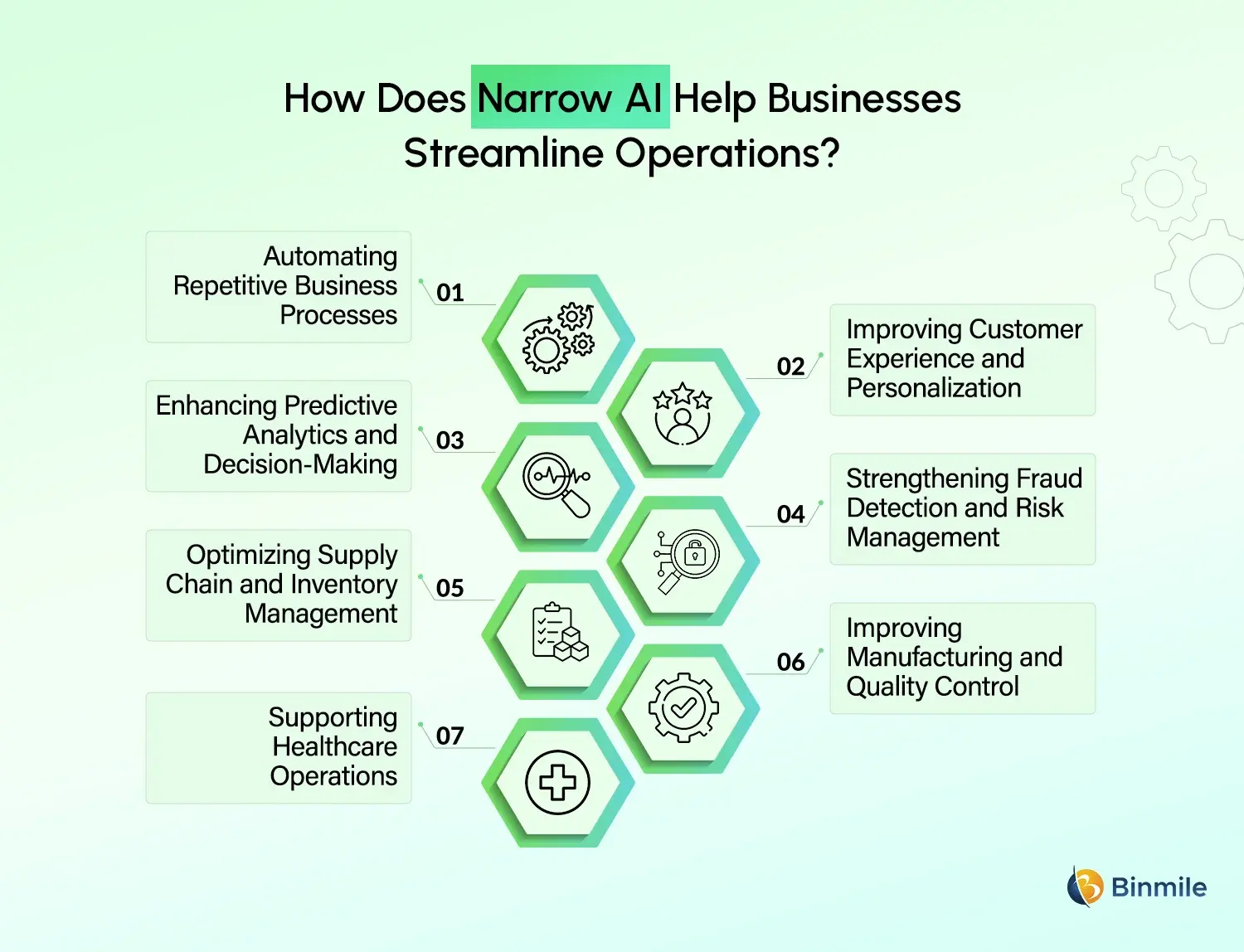
3. Enhancing Predictive Analytics and Decision-Making
Narrow AI can be used to analyze historical data and market trends. This can help make predictions about demand, customer churn, and high-potential sales leads. This can help make informed decisions.
4. Strengthening Fraud Detection and Risk Management
AI models can analyze transaction patterns and customer behavior to identify any suspicious activity. For example, banks can use narrow AI to highlight unusual transactions.
5. Optimizing Supply Chain and Inventory Management
Use Narrow AI to make predictions about demand, track inventory, and optimize deliveries. This can help reduce stock issues and delays.
6. Improving Manufacturing and Quality Control
Manufacturers can use computer vision to identify product defects and predictive models to identify potential equipment failure. This can help improve quality, reduce downtime, and streamline processes.
7. Supporting Healthcare Operations
Narrow AI can be used for medical imaging, documentation, and risk assessment. This can help with clinical processes and reduce admin.
What Are the Key Benefits of Narrow AI for Businesses?
Narrow AI offers several advantages for organizations looking to improve their operations and make better use of business data. These narrow AI benefits can vary depending on the business objective, implementation approach, and capabilities of the selected narrow AI solution.
Some of its most significant benefits include:
1. Higher Operational Efficiency
Tasks can be automated, which means employees can focus on tasks that require human judgement, creativity, and strategic thinking.
2. Faster and More Consistent Processing
AI models can process large amounts of structured and unstructured data quickly. This can help reduce delays.
3. Improved Decision-Making
Pattern recognition and predictive analytics can help organizations identify trends, assess risks, and gain insights.
4. Better Customer Engagement
Personalized recommendations, intelligent chatbots, and sentiment analysis can help businesses understand customer preferences.
5. Reduced Operational Costs
Suitable processes can be automated to reduce manual input, reduce the need for rework, and improve resource usage. This will depend on how much it costs to implement, how much can be automated, and what is required during operation.
6. Scalability Across Business Functions
Once you have validated your narrow AI solution for a specific use case, you can use similar capabilities for other teams, locations, and processes.
7. Better Use of Business Data
Narrow AI can help organizations gain meaningful insights from data that may not be fully utilized across your databases, documents, applications, and processes.
Transform everyday business processes with tailored narrow AI solutions that improve efficiency, simplify decisions, and create opportunities for sustainable growth.

What Are the Limitations and Challenges of Narrow AI?
Despite its practical applications, narrow AI has limitations that businesses need to consider before implementing it. Additionally, understanding these challenges is important when evaluating narrow AI limitations and planning enterprise adoption. These narrow AI challenges can influence model selection, integration requirements, and long-term narrow AI performance.
1. Limited Scope and Generalization
Narrow AI can only complete specific tasks. It won’t automatically be able to use its capabilities in unrelated areas. You may need specific models for different requirements.
2. Dependence on Data Quality
If your data is incomplete, out of date, or biased, it may affect the accuracy of your model. You need to ensure your data is prepared correctly.
3. Bias and Unreliable Predictions
Your models may have bias or inaccurate predictions. It is important to have human oversight and regularly assess your models, especially if they are being used in sensitive areas of the business.
4. Integration Complexity
Integrating narrow AI into legacy systems and siloed systems may require additional APIs, middleware, and changes to processes.
5. Maintenance and Model Drift
As the business and data change over time, your model accuracy may decrease. You will need to constantly monitor, test, and train your models.
6. Security, Privacy, and Compliance Risks
Use Narrow AI to process sensitive business and customer data. If you do not have good security measures in place, you may be at risk of data privacy issues.
7. Implementation and Infrastructure Costs
There are costs involved with narrow AI. You will need to consider the total cost of ownership.
Narrow AI vs. Generative AI vs. General AI: What’s the Difference?
Narrow AI and General AI are primarily distinguished by their breadth of intelligence, whereas Generative AI describes systems designed to create new content based on learned patterns.
Understanding these distinctions is important when evaluating different AI technologies and deciding where advanced narrow AI capabilities fit within an enterprise AI strategy.
| Comparison Factor | Narrow AI | Generative AI | General AI |
|---|---|---|---|
| Primary Purpose | Perform specific tasks | Generate new content and outputs | Perform a broad range of intellectual tasks |
| Scope | Defined or specialized | Varies by model and application | Broad, human-like intelligence |
| Core Capabilities | Classification, prediction, recognition, automation | Text, image, audio, video, and code generation | General reasoning, learning, and adaptation |
| Learning | Trained or configured for specific tasks | Learns patterns from training data and may be adapted for specific tasks | Would learn and transfer knowledge across different domains |
| Business Applications | Fraud detection, forecasting, recommendation engines | Content generation, code assistance, document generation | Not currently available as a realized technology |
| Current Status | Widely implemented | Widely implemented | Theoretical |
Is Generative AI a Form of Narrow AI?
Yes! Generative AI is generally seen as a type of narrow AI. Whilst it can complete many tasks like content creation, document summaries, and coding, it does not have human-like intelligence.
Use Generative AI alongside machine learning models and automation to help solve complex processes without needing AGI. Additionally, this combination is also relevant to AI orchestration, where different AI models and services work together to support enterprise workflows.
What Does the Future of Narrow AI Look Like?
The future of narrow AI shows improvements in machine learning, deep learning, specialized models, automation, and enterprise AI integration. Additionally, the narrow AI future will also depend on how businesses approach narrow AI development, model deployment, and the adoption of advanced AI capabilities.
Here are some developments likely to influence the future of narrow AI.
1. More Specialized and Efficient AI Models
Businesses are now using smaller specialized models. This means they are more efficient, less resource-heavy, and more flexible.
2. Greater Integration with Enterprise Applications
Narrow AI is becoming more integrated with CRM, ERP, HRMS, and supply chain platforms, allowing businesses to embed intelligent capabilities into existing workflows.
3. Combining Multiple AI Models Through Orchestration
AI orchestration allows businesses to orchestrate multiple specialized models, APIs, and processes. For example, businesses can use NLP to extract information from documents, classification models to categorize requests, and predictive models to prioritize.
4. Greater Adoption of Edge AI
Edge AI allows processing information closer to the source, such as in industrial equipment and IoT devices. Additionally, this helps reduce lag and reliance on a constant cloud connection.
5. More Emphasis on Responsible and Governed AI
As AI becomes more popular, businesses will want to ensure they are protecting data, being transparent with models, secure, explainable, and constantly monitoring performance.
What Are the Best Practices for Implementing Narrow AI in Business?
Successful narrow AI implementation requires more than choosing an algorithm or developing a machine learning model. Additionally, following narrow AI best practices can help organizations improve narrow AI deployment, manage risks, and get more value from their AI investments.
Here are some best practices organizations should follow.
1. Identify a Clearly Defined Business Problem
Identify specific issues you want to improve with AI. Additionally, this could be repetitive tasks, high volume of support, or inaccurate demand forecasts.
2. Assess Data Availability and Quality
Evaluate data accuracy, completeness, accessibility, and potential bias to ensure the AI model has reliable information for training and processing.
3. Select the Right AI Technologies and Models
Identify the right models for your business. This could be classification models for fraud detection, NLP for document processing, or predictive models for demand forecasting. Additionally, the selection of narrow AI tools should also account for scalability, compatibility, and business requirements.
4. Integrate AI with Existing Business Workflows
Ensure you integrate AI solutions into your enterprise applications like CRM and ERP systems.
5. Establish AI Governance and Human Oversight
Ensure you know who is responsible, have access controls, and have data protection policies. Ensure you have human oversight for decisions that could have a big impact on the business or customers.
6. Begin with a Pilot Project
Test your AI solution to understand how it will perform, what kind of integration it needs, and what impact it will have.
7. Continuously Monitor and Optimize Performance
Monitor how accurate, quick, error-prone, and costly your AI is. This will help you to identify issues and when you need to optimize your models.
How Can Businesses Measure the ROI of Narrow AI?
Measuring the return on investment (ROI) of narrow AI requires evaluating both the financial impact and operational improvements generated by the solution. This also helps businesses assess the effectiveness of their narrow AI initiatives and identify opportunities for further optimization.
Some important KPIs include:
| Business Objective | Key Performance Indicators |
|---|---|
| Reduce Manual Effort | Hours saved, manual tasks automated, automation rate |
| Improve Operational Efficiency | Processing time, turnaround time, throughput |
| Reduce Costs | Cost per transaction, operating expenses, rework costs |
| Improve Accuracy | Error rate, prediction accuracy, false-positive rate |
| Improve Customer Experience | Customer satisfaction, first-response time, resolution time |
| Increase Revenue | Conversion rate, average order value, customer retention |
| Improve Resource Utilization | Equipment utilization, downtime, inventory turnover |
A basic ROI calculation goes as:
ROI (%) = [(Total Benefits − Total Costs) / Total Costs] × 100
For example, if a company is using AI to process documents, they can calculate their ROI by comparing how much they are saving by reducing manual input, processing quicker, and fewer errors compared to the cost of developing, integrating, and maintaining.
However, you won’t necessarily save money by reducing processing time. You should consider how effectively you are making use of your saved resources.
Discover how specialized AI solutions can help your business automate complex workflows, make informed decisions, and improve operational efficiency.

How Businesses Can Start with Narrow AI?
To get started with narrow AI, identify processes to solve with specialized intelligence. Additionally, businesses evaluating narrow AI development should also consider whether they need custom models, existing AI platforms, or a combination of both.
You will need to understand your business requirements, data availability, technical feasibility, choose the right models, and integrate them into your enterprise systems. Additionally, once live, you should constantly monitor performance, track relevant KPIs, and optimize your models as your requirements change.
Working with an experienced AI development partner can make this easier. At Binmile, we can help you develop and integrate AI solutions like machine learning, natural language processing, and business automation to meet your operational requirements. Our artificial intelligence development services and AI consulting services can help businesses assess their requirements and explore suitable narrow AI solutions.
Frequently Asked Questions
Narrow AI, also known as Artificial Narrow Intelligence (ANI), refers to AI systems designed to perform specific tasks. Examples include recommendation engines, fraud detection systems, virtual assistants, and AI-powered chatbots.
Businesses can use Narrow AI to automate repetitive tasks, forecast demand, detect fraud, analyze customer behavior, and optimize inventory. These applications reduce manual effort and improve decision-making.
The cost depends on model complexity, data availability, infrastructure, integration requirements, and maintenance. Businesses should consider the total cost of development, deployment, and ongoing optimization.
A basic proof of concept may take a few weeks, while complex enterprise solutions can take several months, depending on data readiness, model development, testing, and integration requirements.
Narrow AI suits processes involving repetitive tasks, large datasets, and pattern recognition. Common examples include invoice processing, fraud detection, demand forecasting, customer support, and predictive maintenance.
Yes. Narrow AI can integrate with CRM, ERP, HRMS, and other enterprise applications through APIs and middleware, depending on the existing technology infrastructure.
Businesses can measure ROI through indicators such as processing time, cost savings, error reduction, automation rates, customer satisfaction, and revenue improvements, compared against implementation and maintenance costs.