AI agents are being used in business workflows to make decisions and perform functions. Compared to traditional AI, autonomous AI agents can interact with applications, gather information, make decisions, and perform tasks with minimal human interaction.
According to the 2026 AI Agents survey conducted by Zapier, 88% of enterprises either currently use or are trialing AI agents (compared to 72% in 2025). Only 30% of organizations using AI agents state that they perform the majority of tasks without much human input. As such, appropriate governance is important with the increasing use of autonomous AI agents.
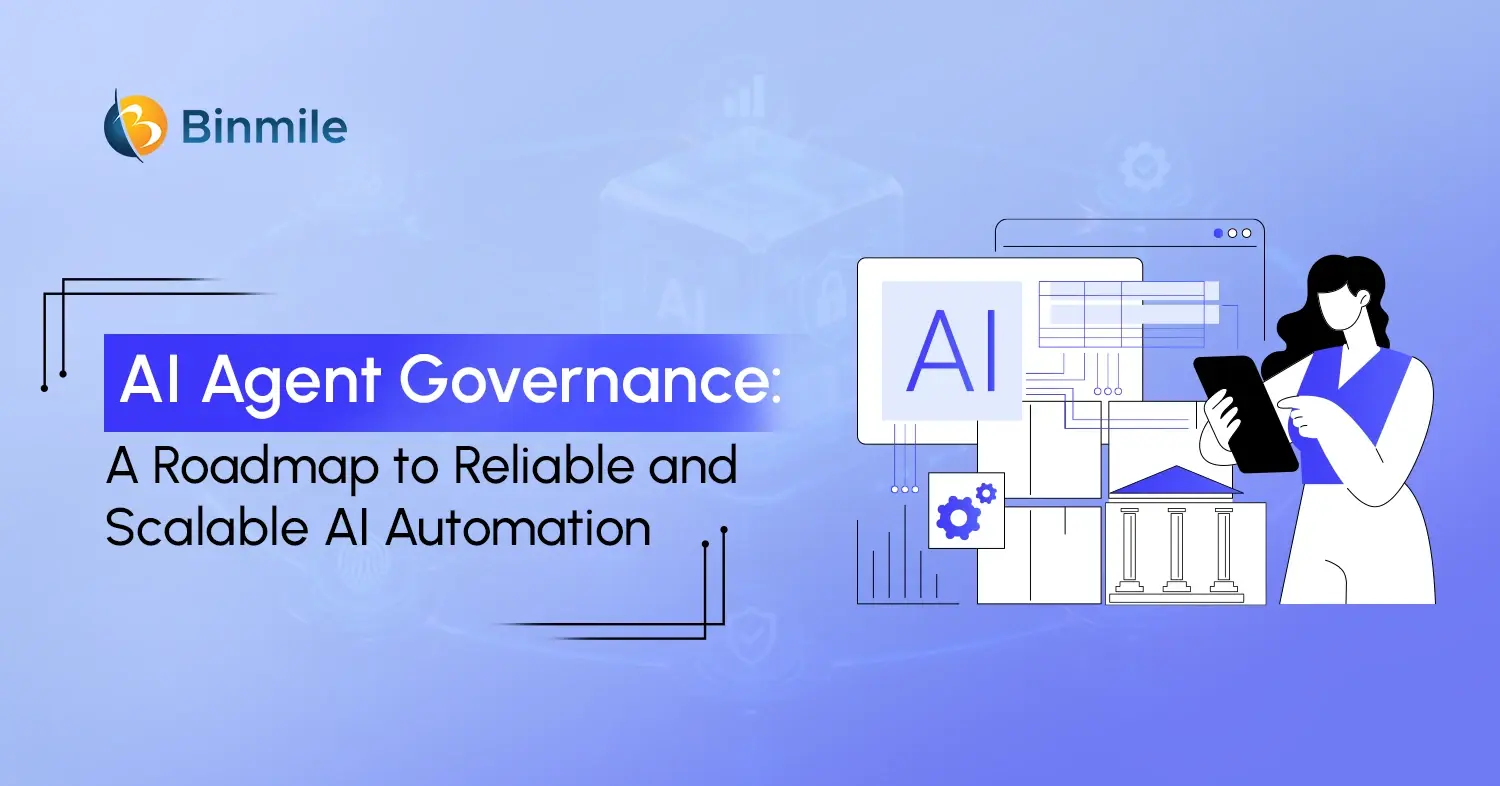
AI agent governance defines policies, security controls, and responsibilities to ensure that AI agents behave appropriately within business constraints and regulations. Within this article, we will look at the key considerations of AI agent governance, benefits, challenges, and how it can be implemented. This AI agent governance guide also covers important governance frameworks and processes for enterprises.
What Is AI Agent Governance and Why Is It Important for Enterprises?
AI agent governance refers to the policies, processes, and technical safeguards that control how AI agents are developed, deployed, accessed, monitored, and managed throughout their lifecycle. It defines what an agent can do, which systems it can access, what information it can process, and when human approval is necessary. Additionally, these practices form the foundation of enterprise AI agent governance.
For example, in customer service, AI agents may only need to be able to search for customer information and suggest solutions. However, issuing refunds or changing a customer’s information may require human approval. Additionally, defining rules for what actions AI agents can perform ensures appropriate control within businesses, while minimizing the risk of unexpected actions.
With increased use of autonomous AI agents within businesses, AI agent governance ensures appropriate security, responsibility, and reliability. Restricting access to information means sensitive data remains protected. Additionally, assigning ownership and ensuring auditable logs means that if an AI agent makes an incorrect decision, it can be easily investigated. Having documented policies and monitoring AI agent activity ensures regulatory requirements are met, and unexpected behavior can be picked up.
Within businesses, AI agent governance allows appropriate management of AI sprawl. It provides a single source of truth for which AI agents have been implemented, prevents duplication, and ensures uniform security policies between departments. Additionally, this is particularly relevant when addressing AI sprawl in enterprises. In addition to the considerations of traditional AI governance, agentic AI governance also incorporates governance of the autonomous actions taken by AI agents, tools used, interactions between AI agents, and permissions. This means it is a valuable consideration for scalable, responsible AI automation within business.
What Are the Key Components of an AI Agent Governance Framework?
An effective AI agent governance framework combines organizational policies with technical safeguards and continuous monitoring. An AI governance framework can also help organizations establish consistent policies for managing autonomous systems.
1. Agent Identity and Access Management
All AI agents should have a unique identity, with defined permissions. Authentication, role-based permissions, and least privilege should be put in place.
For example, an AI agent generating financial reports may only need read access to specific data.
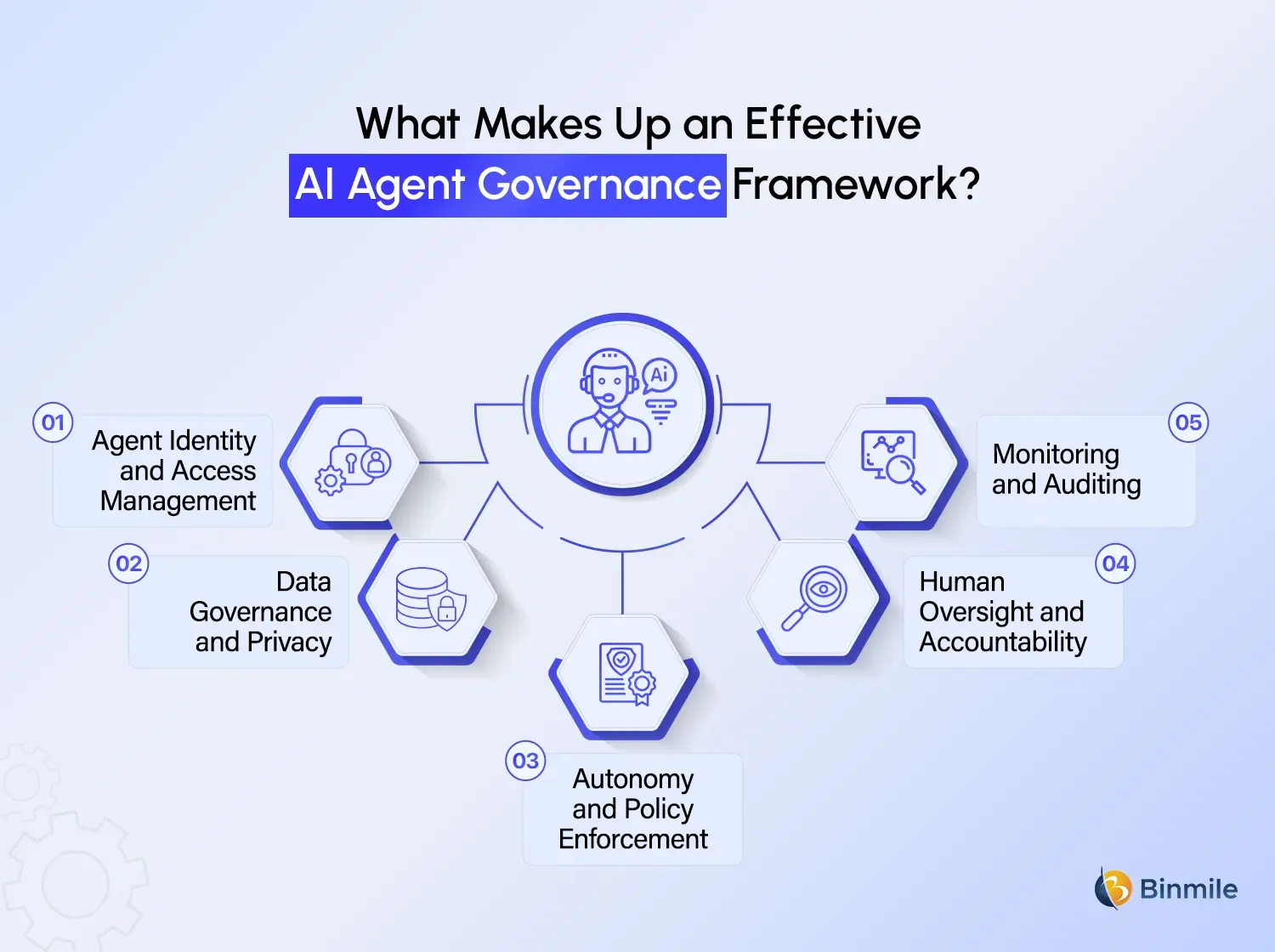
2. Data Governance and Privacy
As AI agents often interact with various systems, applications, and documents, it is important to define how data is searched, processed, stored, and shared within AI agents.
Additionally, incorporating an AI agent within data governance can help ensure high data quality, detect any anomalies, and enforce policies. However, it is important to restrict access to this AI agent.
3. Autonomy and Policy Enforcement
Depending on the AI agent in question, different levels of autonomy can be allowed. Within the AI agent governance framework, different levels of autonomy should be defined depending on the nature of the AI agent and potential risks. Additionally, this is an important part of the AI agent governance model and AI agent policy governance.
Some AI agents may simply be able to search for information. Depending on the AI agent, it can autonomously perform pre-defined tasks or suggest actions to be performed by humans. If high-impact tasks are being performed, they should have stricter permissions and monitoring.
4. Human Oversight and Accountability
Decide on which decisions should be made by humans, and set appropriate approval processes.
Within production AI agents, assign business and technical owners. Addtionally, these teams should have the ability to pause AI agents, remove permissions, and investigate issues.
5. Monitoring and Auditing
Ensure that logs are kept detailing the actions performed by AI agents, tools used, systems accessed, and actions completed.
By implementing an AI agent governance dashboard, visibility can be given into agent activities, permissions, performance, and policy breaches. Additionally, this is particularly important if multiple AI agents are in use across different departments.
What Are the Main AI Agent Governance Challenges?
Although governance provides a structured approach to managing autonomous systems, enterprises may encounter several AI agent governance challenges.
-
Limited Visibility
Organizations may struggle to identify all agents operating across departments.
-
Complex Interactions
Multiple agents may exchange information and delegate tasks, making accountability difficult.
-
Excessive Permissions
Agents with unnecessary access can create security vulnerabilities.
-
Changing Behavior
Updates to models, prompts, and integrations can affect agent performance.
-
Balancing Autonomy
Excessive restrictions can reduce efficiency, while insufficient oversight increases risks.
-
Fragmented Policies
Different departments may follow inconsistent security and development practices.
Addressing these challenges requires an integrated approach connecting AI development, enterprise security, and IT operations. These considerations are also relevant to AI in government, where governance, accountability, and compliance are important.
How Can Businesses Implement AI Agent Governance at Scale?
A structured AI agent governance implementation strategy should cover the entire agent lifecycle.
1. Identify and Classify AI Agents
Create a central list of AI agents (both existing and planned). Define the purpose of AI agents, who owns them, what applications they interact with, what data they require access to, and what autonomy they have.
Categorize AI agents depending on the impact they could have within the business. Additionally, if it is an internal knowledge assistant, very basic governance may be needed. If it deals with financial data, stricter authorization will be required.
2. Establish a Governance Strategy
Define policies for appropriate use of AI within the business. This should include appropriate access, data handling, approval processes, and incident management.
Forming a multidisciplinary team, with members from IT, Security, Compliance, and Business, can help deliver consistent governance.
AI consulting services can support assessment and planning of AI agent governance. Additionally, refer to frameworks such as the NIST AI Risk Management Framework and the Model AI Governance Framework for Agentic AI in Singapore.
3. Design a Secure Governance Architecture
Within AI agent governance, a secure architecture should be designed. Additionally, this should include identity management, authentication, authorization, data access control, monitoring, and auditing.
Artificial Intelligence development services can support the development of secure AI solutions that align with these governance requirements.
Within interactions between AI agents, if one AI agent passes a task to another, the second AI agent should only have permissions under its own rules, and not inherit the permissions of the first AI agent.
4. Introduce Lifecycle Governance
Applying governance throughout the AI agent lifecycle ensures good controls are maintained.
Before deployment of AI agents, functionality and security checks should be performed. Additionally, once deployed, activity should be monitored and permissions reviewed. Policy adherence should also be checked.
AI agent development services can help businesses build agents with defined responsibilities and permissions as part of the development process.
Changes to models, integrations, or duties of AI agents should result in appropriate testing. Additionally, if AI agents are no longer needed, credentials should be removed and access to systems removed.
5. Implement Monitoring and Incident Management
Set up central monitoring to highlight any unexpected activity, unauthorized access, and policy breaches.
Define processes to pause AI agents, remove AI agent credentials, and investigate security issues.
6. Review Governance Policies
Regularly review AI agent governance policies to identify any outdated permissions, new risks, and compliance issues. Additionally, as AI agents become more capable and take on new tasks, governance controls should be updated.
Looking to establish a secure and scalable AI agent governance strategy?

What Are the Best Practices for AI Agent Governance?
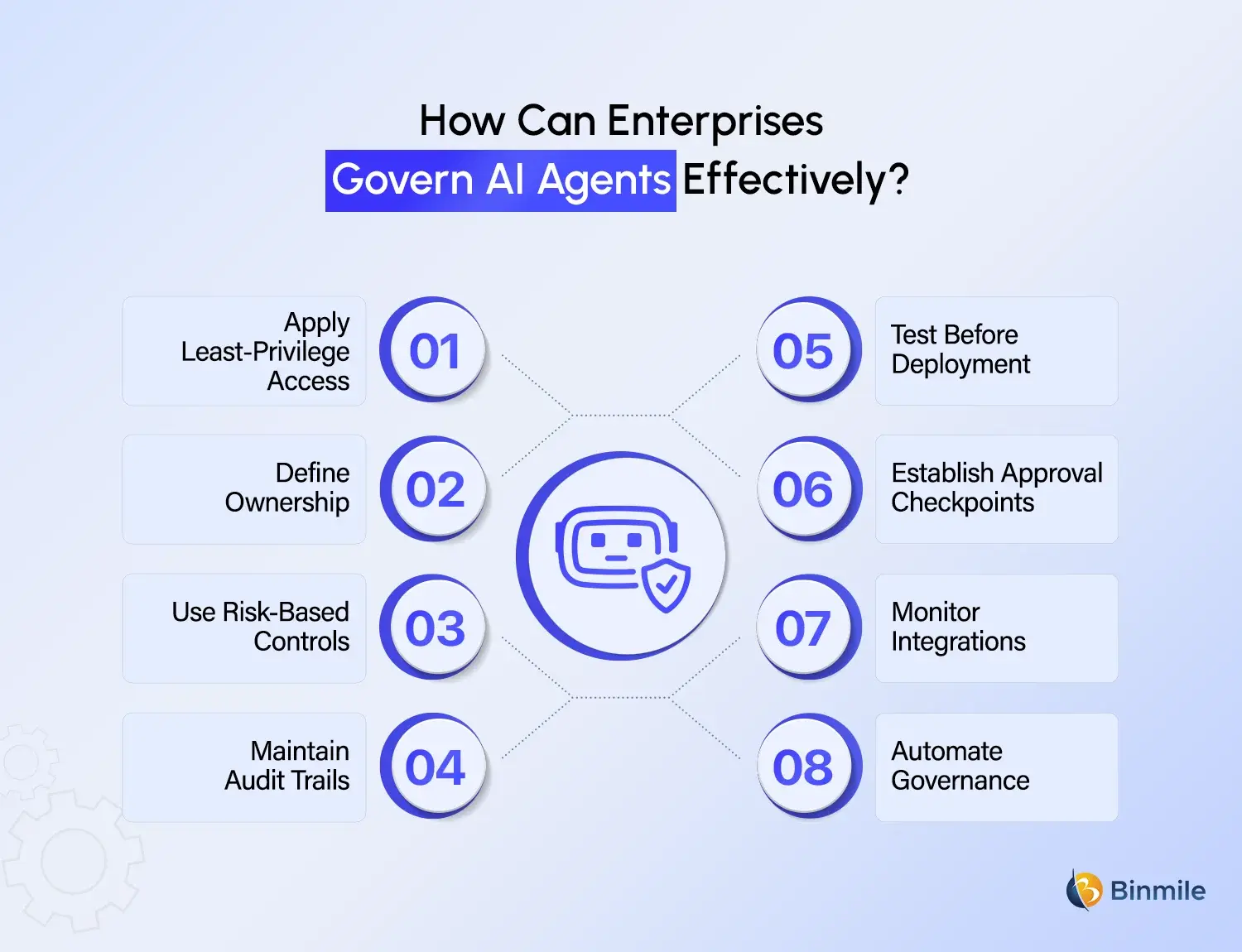
Organizations should follow these AI agent governance best practices to maintain consistency, security, and accountability across enterprise AI deployments.
-
Apply Least-Privilege Access
Ensure AI agents only have the permissions necessary to carry out the tasks they are assigned. Additionally, this reduces the risk of unauthorized access to data.
-
Define Ownership
Assign business and technical owners to production AI agents. Additionally, this creates clear responsibility and accountability.
-
Use Risk-Based Controls
AI agents handling sensitive information, financial data, or other high-impact business processes should have stricter security controls.
-
Maintain Audit Trails
Create logs of decisions made by AI agents, tools used, systems interacted with, and any changes in permissions. Additionally, this can help with transparency and investigation of issues.
-
Test Before Deployment
Evaluate agents against realistic workflows, unexpected inputs, and potential security threats before introducing them into production environments. Testing as a Service can support continuous verification of agent behavior and security.
-
Establish Approval Checkpoints
If an AI agent will make high-impact decisions or irreversible changes, requiring human approval will minimize any unintended consequences.
-
Monitor Integrations
Periodically check external models, tools, and APIs to identify any vulnerabilities. Additionally, this means unauthorized access to systems cannot occur through integrations.
-
Automate Governance
Implement centralized policies and monitoring, along with reporting, to reduce manual oversight. Additionally, ensure it is embedded in day-to-day operations. Additionally, following an AI agent governance checklist can also help organizations maintain consistent practices and avoid common AI agent governance mistakes.
Which AI Agent Governance Tools Can Enterprises Use?
The tools help organizations maintain visibility, enforce policies, and monitor agent activities across enterprise environments.
Businesses can consider the following categories:
-
Agent Management Platforms
Provide central visibility on AI agents. Include information on ownership and lifecycle. Additionally, this can allow visibility into AI agents deployed within the business and what they are doing.
-
Identity and Access Management Tools
Control authentication, user credentials, and access permissions. This means AI agents can only interact with approved systems.
-
AI Security Platforms
Identify unexpected activity, unauthorized tool usage, and potential security risks. Additionally, this reduces risk within AI agent operations.
-
Data Governance Tools
Monitor data quality, access, and usage to ensure agents handle enterprise information according to established policies.
-
Workflow Orchestration Platforms
Allow approval processes to be performed, coordinate AI agent activity, and ensure governance is applied across workflows.
ServiceNow AI Control Tower provides discovery, management, and governance for AI agents.
The choice of AI agent governance tools to implement within your business should be dependent on your current infrastructure, security requirements, regulatory requirements, and scale of deployment. Additionally, AI agent governance software can also support centralized monitoring and policy enforcement across enterprise environments.
The technology should support governance strategies, and not replace them.
How Can Businesses Build a Scalable AI Agent Governance Program?
To allow scalable governance within businesses, it is important to consider technical, security, and business requirements.
Firstly, understand what AI infrastructure is currently in place. Identify any governance gaps and decide on appropriate levels of autonomy. Additionally, create policies to govern identity, data security, testing, monitoring, and responsibility. Partnering with experienced technologists can help overcome any technical complexities.
Existing IT processes can also help. Having a strong DevOps Strategy means security checks and approval processes can be included in development. Additionally, Testing as a Service can mean continuous verification of correct behavior and security. Additionally, for businesses continuing to scale their AI ecosystems, it is important to implement appropriate governance to allow useful automation without limiting it.
Ready to build AI agents with the right controls in place?

Conclusion
AI agents are becoming an important part of enterprise automation, but their growing autonomy introduces risks that traditional AI governance may not fully address.
An effective AI agent governance strategy combines clear policies, secure architecture, access controls, human oversight, and lifecycle management. By introducing these practices early, organizations can improve accountability, manage emerging risks, and build reliable AI ecosystems.
At Binmile, we help businesses build and scale AI solutions with a focus on security, reliability, and responsible implementation. Additionally, through our AI consulting services and AI agent development services, we help enterprises develop governance-aligned AI solutions that support their business objectives while maintaining control over autonomous operations.
Frequently Asked Questions
AI agent governance is the combination of policies, security controls, and accountability processes used to manage AI agents throughout their lifecycle. It defines what agents can access, which actions they can perform, and when human intervention is required.
It helps enterprises protect sensitive information, manage autonomous activities, improve accountability, support compliance, and maintain visibility across AI deployments.
Traditional AI governance focuses on models, outputs, data quality, fairness, and compliance. AI agent governance additionally addresses autonomous actions, tool usage, system permissions, and agent-to-agent interactions.
Key components include identity and access management, data governance, autonomy controls, policy enforcement, human oversight, monitoring, audit logging, and lifecycle management.
Businesses can define permission levels, restrict access to sensitive systems, establish approval checkpoints, and monitor agent activities. High-impact actions should require appropriate human authorization.
Organizations should introduce governance during development and experimentation, before deploying agents into production. This ensures that security, accountability, and monitoring requirements are established from the beginning.