
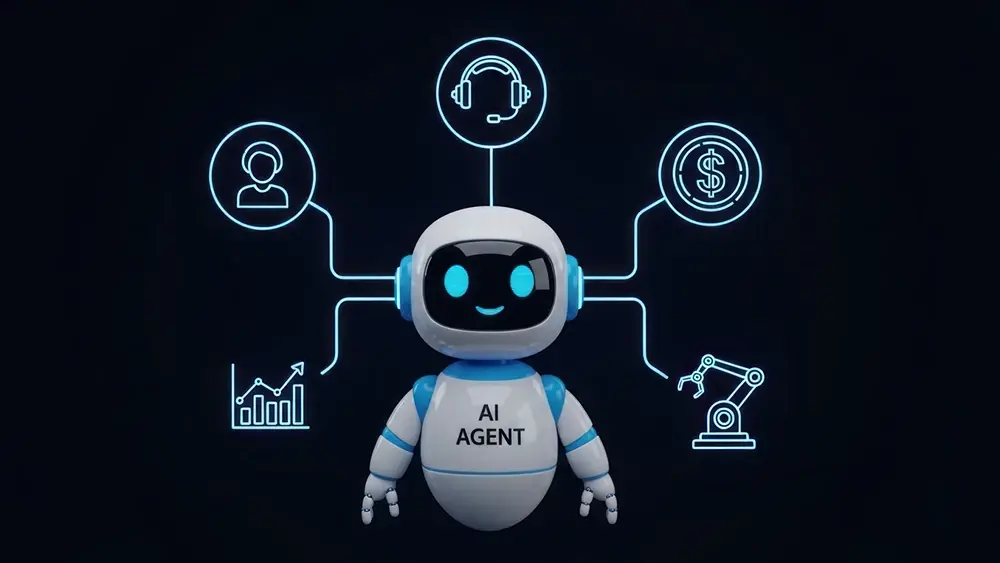
Build AI Agents Around Real Business Work
We look at the objective, available data, systems involved, decision points, human approvals, and expected outcome before defining how the agent should work.
Trusted by Global Enterprises


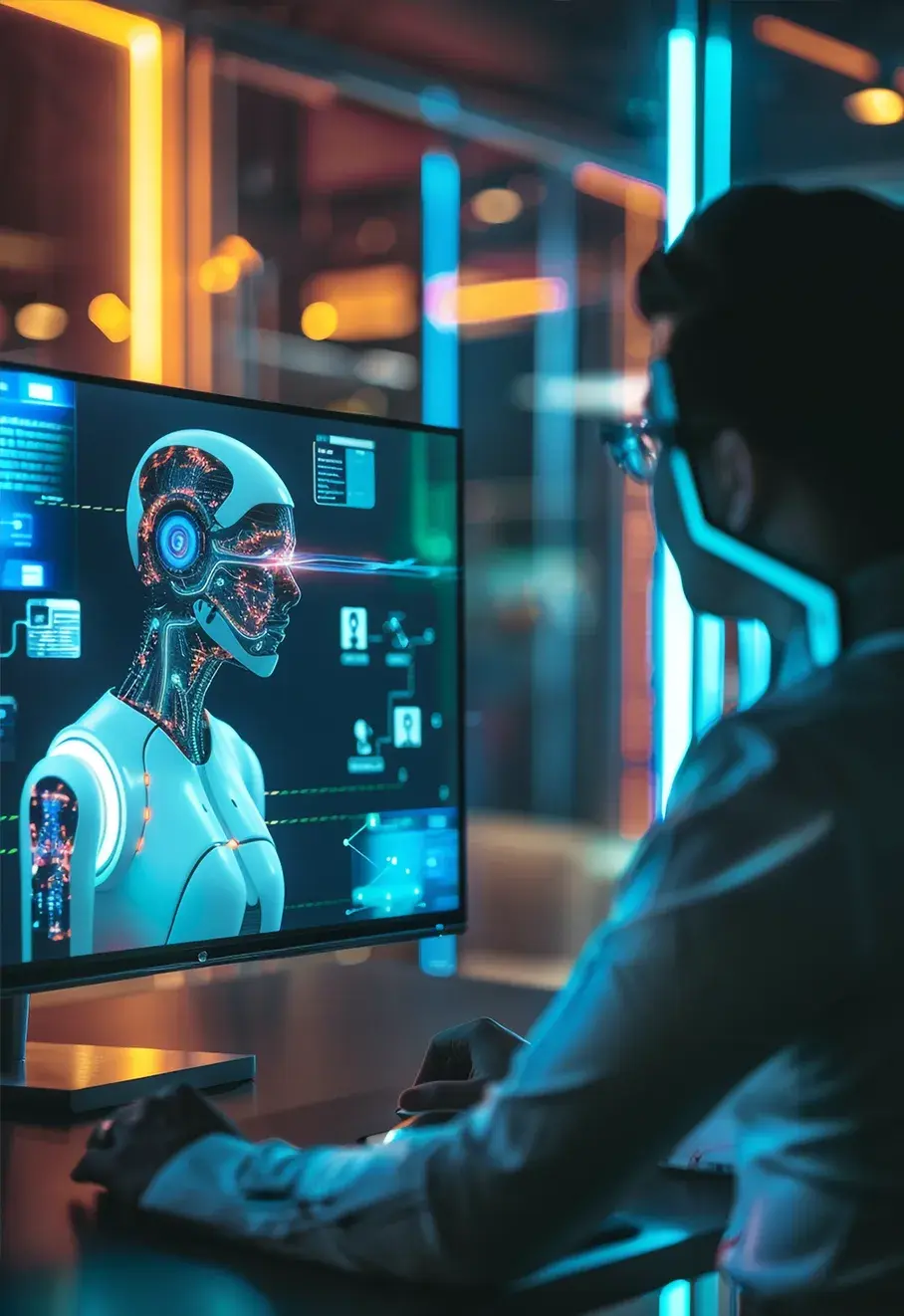
AI Agent Development for Businesses That Want More Than Automation
Business processes, however, often involve requests that need to be interpreted before the next action can be taken.
A support team may need to understand a customer request before routing it. A sales representative may need information from several systems before following up with an account. An operations team may need to investigate an exception rather than follow a fixed sequence.
This is how AI agents make a difference.
Our enterprise AI agent development approach combines AI models with business rules, enterprise data, APIs, and workflows. Depending on the use case, that may mean a conversational AI agent, an autonomous agent, or several specialized agents working together.
The architecture also needs to account for permissions, security, governance, and human involvement, particularly when agents can access sensitive data or take actions in business systems.
Our AI Agent Development Services For Enterprises

AI Agent Strategy & Consulting
Our AI Agent Strategy & AI Consulting services help businesses assess use cases, define the agent's responsibilities, evaluate feasibility, and decide how much autonomy makes sense.
We consider business priorities, existing workflows, data, technology dependencies, and expected outcomes before creating a practical roadmap. This AI Agent Strategy Consulting approach helps teams move from experimentation to a defined implementation plan.

Custom AI Agent Development
General-purpose AI assistants are useful, but business workflows often have specific requirements.
We build our custom AI agent development services around those requirements. Agents can work with APIs, retrieve information, use approved tools, follow business rules, maintain context, and hand tasks to people when needed.
These custom AI agents can support internal applications, along with customer-facing experiences, or existing business workflows.

Conversational AI Agent Development
Some agents need to communicate with users while completing the task itself.
Our conversational AI agents can understand intent, maintain context, retrieve relevant information, and connect a conversation with an action. NLP Integration, knowledge retrieval, workflow actions, and human escalation can all be part of the solution.
This approach can also support use cases involving Zendesk AI agents, ticket handling, customer information, and service workflows.

Autonomous AI Agent Development
Some processes can be handled by an agent without constant human direction.
Our autonomous AI agents can work through defined tasks, use approved tools, and make decisions within established rules. When something falls beyond their scope, the agent can escalate it for human review.
Low-risk internal tasks may allow more freedom than workflows involving financial records or customer transactions.

AI Agent Integration
Our AI agent integration services work with agents with CRMs, ERPs, ITSM platforms, databases, APIs, and other knowledge bases. For businesses already working with ServiceNow, relevant ServiceNow Agentic AI capabilities can support selected enterprise workflows.
Enterprise AI Agent Integration also involves authentication, permissions, system dependencies, and the actions an agent is allowed to perform. This allows AI agent integration with enterprise systems without forcing employees to move between multiple applications.

AI Agent Orchestration
Our AI agent orchestration approach defines how different agents communicate, divide tasks, and hand work from one stage to another. Where responsibilities are clearly separated, Multi-Agent System Development can bring together specialized agents for research, validation, decision support, or execution.
This is particularly useful for multi-agent AI development involving several systems or business functions.

AI Agent Testing & Evaluation
AI agents can fail in ways that are not immediately obvious. An agent may retrieve the wrong information, use a tool incorrectly, or continue with a task when it should have asked for clarification.
Therefore, AI agent testing and evaluation cover task completion, retrieval, tool usage, permissions, consistency, and failure handling.
We also test for AI Agent hallucinations and other behavior that could affect the reliability of the application before it reaches production.

AI Agent Deployment
Moving an agent into production brings its own requirements around infrastructure, access, integrations, monitoring, and operational controls.
Our AI Agent Deployment services cover the work required to move an agent from development into a controlled production environment, with the approach shaped by the data and systems the agent needs to access.

AI Agent Monitoring & Optimization
An agent performs well during testing and behaves differently once real users start interacting with it.
AI Agent Monitoring & Optimization helps track response quality, task completion, usage, failures, latency, and other measures of AI agent performance.
We also support AI agent lifecycle management, including updates to models, knowledge sources, integrations, workflows, and evaluation criteria as business requirements change.

Machine Learning Model Training & Behavioral Modeling
Not every agent needs a custom model. Existing foundation models can handle many use cases effectively.
For specialized requirements, our capabilities include Machine Learning Model Training, model evaluation, fine-tuning, and Behavioral Modeling. The approach depends on the domain, available data, expected performance, and level of customization required.

AI Agent Security & Governance
Our AI agent security and governance services help businesses establish the controls needed for safe and responsible agent deployment. We address access permissions, data protection, audit trails, and human oversight to manage agent actions, reduce operational risks, and maintain accountability across enterprise workflows.

AI Agent Performance Optimization
Our AI agent performance optimization services help improve response quality, task accuracy, latency, and resource usage. Through prompt refinement, model selection, workflow adjustments, and continuous evaluation, we help businesses make agents more reliable and efficient while keeping operational costs under control.
AI Agent Development Solutions Built Around Your Priorities

AI Agents for Customer Service
AI agents for customer service can handle recurring questions, information requests, ticket updates, and routine service actions.
They can retrieve relevant information, update records, guide customers through processes, and transfer complex cases to human representatives with the necessary context.

AI Agents for Workflow Automation
Some business processes are repetitive without being completely predictable. Employees may need to understand a request, collect information, choose the right workflow, and then update another system.
AI agents for workflow automation can handle the interpretation and decision-making involved, while Robotic Process Automation can continue to manage deterministic steps.
This combination is useful for AI Agent Automation where a workflow includes both structured and variable tasks.

AI Agents With Enterprise Data
Businesses already have valuable information across documents, databases, applications, and knowledge platforms.
We build AI agents with enterprise data that can retrieve information from approved sources and use it as part of a task. AI agents with RAG can help ground responses in relevant business information rather than relying only on a model's general knowledge.
Permissions and data access remain part of the architecture so agents only work with information they are authorized to use.

AI Agents for Sales
Sales teams spend considerable time on research, account preparation, lead qualification, follow-ups, and CRM updates.
AI agents for sales can support these activities by gathering account information, preparing summaries, assisting with follow-ups, identifying potential leads, and updating routine CRM information.
The salesperson remains responsible for the relationship. The agent takes care of more of the work around it.

Multi-Agent Business Operations
Some processes involve several distinct responsibilities that are better separated across multiple agents.
One agent can gather information, another can validate it, and another can prepare the next action. Our multi-agent AI development approach supports these workflows with defined responsibilities and communication between agents.
This can be particularly useful for AI agents for enterprise automation where several applications or business functions are involved.

Industry-Specific AI Agent Solutions
Industry workflows come with their own terminology, data structures, regulations, and operational requirements.
Our Agentic AI Solutions can be designed around these differences for finance, healthcare, ecommerce, manufacturing, real estate, education, and supply chain use cases.

Need Help Deciding Where an AI Agent Fits?
Have a process in mind but not sure whether it needs an agent, traditional automation, or both?
The Technology Behind Our AI Agent Development
-

-

-

- Scikit-Learn
-























Industry-Focused AI Agent Solutions
An AI agent used in financial services may need strict controls around transactions and sensitive information. Healthcare applications bring their own requirements around patient information, while manufacturing and supply chain agents may need to work across operational systems.
We consider these differences when defining AI agent business applications, including the data, integrations, workflows, and governance required for each industry.


AI Agent Strategy to Solutions That Work
An AI agent strategy is useful when it helps a business decide what should happen next.
At Binmile, our work can span strategy, architecture, development, integration, testing, deployment, and monitoring. This gives teams a practical path from identifying an opportunity to putting an agent into production.
For broader agentic AI initiatives, our work can include Agentic AI Architecture, where multiple agents, tools, and workflows need to operate together. We also support related initiatives through Generative AI Development, machine learning development, and AI consulting services.
As an AI Development Company, Binmile can take selected initiatives from planning through development, integration, testing, and production deployment. For organizations already working with ServiceNow, this can also extend to relevant ServiceNow Agentic AI use cases.

Why Businesses Choose Binmile for AI Agent Development
Our engineers bring together application development, data engineering, and machine learning development to build agents that fit existing technology environments








Business-Led Agent Strategy
We start with the business process and expected outcome before deciding what the technology should look like.
AI & Machine Learning Expertise
Our teams work across generative AI development, machine learning development, retrieval, model evaluation, and agent-based applications.
Enterprise Architecture
Agents often need to work with existing applications, APIs, data sources, and identity systems. We consider these dependencies as part of the architecture.
AI Agent Governance & Security
Access controls, data handling, human approvals, auditability, and escalation paths are considered when agents operate within enterprise environments.
Testing Before Production
We evaluate agents across expected workflows, edge cases, retrieval, tool usage, failure scenarios, and other conditions before deployment.
From Strategy to Implementation
Our teams can take the initiative from discovery and strategy through AI agent software development, integration, deployment, and optimization.
How We Approach AI Agent Development
Discovery & AI Agent Requirements
We understand the business process, users, systems, data, and expected outcome before defining the AI Agent requirements.
Use Case & Agent Strategy
We identify the right use case, determine the required level of autonomy, and decide whether a single agent, multi-agent setup, or another approach fits best.
Architecture & Solution Design
The agentic AI architecture brings together models, tools, retrieval, data sources, integrations, permissions, and workflow logic.
Development & Integration
Development covers the agent, its tools and knowledge sources, business logic, and AI agent integration with the required systems.
Testing, Deployment & Validation
We test the agent across expected and unexpected scenarios before AI Agent Deployment and production validation.
Monitoring & Continuous Improvement
Usage, failures, feedback, and AI agent performance help identify where models, workflows, knowledge, or integrations need to be improved.
AI Agent Projects Across Business Functions

AI Agents in Finance

AI Agents in Healthcare

AI Agents for eCommerce

AI Agents for Sales

AI Agents for Real Estate

AI Agents for Manufacturing

AI Agent for Education

AI Agents in Supply Chain
AI Agent Development Engagement Models
Different organizations need different levels of involvement. Some already have an AI team and need additional engineering capacity, while others need support across the full development cycle.

1. Dedicated AI Agent Development Team
- A dedicated team can work across architecture, development, integration, testing, and ongoing improvements. This model works well for organizations building multiple agents.

2. Project-Based Development
- For a defined use case, we can take the project through discovery, design, development, testing, and deployment around agreed milestones.

3. Team Augmentation
- Organizations can add AI Agent Developers with experience in agent frameworks, machine learning, integration, testing, or cloud engineering. These AI agent development engagement models also work for businesses looking to hire an AI Agent Developer for a specific initiative.
What Determines AI Agent Development Cost?
AI Agent Development Cost depends on the complexity of the use case and the systems surrounding the agent.
Key factors include:
- Agent complexity and decision-making
- Number of workflows and functions
- Model selection and usage
- RAG and enterprise knowledge requirements
- Data preparation and quality
- APIs and integrations
- Single-agent or multi-agent architecture
- Level of autonomy and human involvement
- Security and governance
- Testing and evaluation
- Deployment infrastructure
- Monitoring and maintenance
The AI agent technology stack also affects the overall investment, including models, frameworks, databases, cloud infrastructure, integrations, and monitoring requirements.
Frequently Asked Questions
AI agent development involves building software that can understand a task, use available information and tools, make decisions within defined boundaries, and take actions as part of a workflow.
To build an AI Agent, start with the business problem and define what the agent needs to accomplish. Then determine the required data, model, tools, integrations, permissions, and level of autonomy before moving into development and testing.
A chatbot mainly focuses on conversation. An AI agent can also retrieve information, use tools, make decisions, and take actions to complete a task.
Enterprise AI agents are designed to work with business data, applications, workflows, and rules. They typically require stronger controls around security, permissions, governance, monitoring, and human oversight.
Yes. AI agents can work with documents, databases, knowledge bases, CRM systems, ERP platforms, and other enterprise sources. AI agents with RAG can retrieve relevant information before responding or taking action.
AI agent frameworks provide components for building applications involving models, tools, retrieval, memory, workflows, and agent interactions. Common options include LangChain, LangGraph, LlamaIndex, AutoGen, and Semantic Kernel.
Yes. AI agents can automate processes that involve interpretation, decision-making, and actions. AI agents for business process automation can also work alongside traditional automation and Robotic Process Automation.
AI agent testing and evaluation covers task completion, retrieval quality, tool usage, permissions, consistency, failure handling, unexpected inputs, and escalation behavior.
The timeline depends on the use case, integrations, data requirements, model approach, and testing needs. A focused internal agent will generally require less work than a multi-agent system connected to several enterprise applications.
Yes. Our AI Agent Consulting Services can cover use-case discovery, strategy, architecture, development, integration, testing, deployment, and ongoing optimization.
Bring your Ideas to Reality with our Digital Transformation Services
Impact Generating Enterprise Software Development Company
Projects Delivered
Industries
Clients
Repeat Customer Rate


