A government office can have all the data it needs and still struggle to act on it quickly. That gap is one reason AI in Government is moving from small experiments to practical applications across public services and internal operations. The OECD’s 2026 Digital Government Outlook reports that 35 of 36 OECD countries, or 97%, now use AI in at least one area of government, while 75% use it in public service delivery. The numbers show that government AI is no longer limited to pilot projects. It is becoming part of how agencies process information, manage workflows, support employees, and interact with citizens.
But adopting AI is not simply about adding a chatbot to a government website or automating a few administrative tasks. Effective AI in public administration requires reliable data, secure infrastructure, clear accountability, trained employees, and systems that can work with existing government technology. This guide explores where AI is being used, the benefits it can bring, practical AI use cases in government, the challenges agencies need to address, the role of Generative AI, and what a responsible implementation approach looks like. AI for public sector organizations can include everything from AI in government systems to Government AI solutions designed around specific operational needs.
Why AI Is Becoming Important for Government
Government organizations encounter unique sets of issues. They conceptualize vast amounts of data, work with different people, obey rigid restrictions, and rely on technological instruments that were invented long ago.
Nonetheless, people have begun to expect government organizations to provide highly responsive service just like they are accustomed to having in the digital world. Wasted time, resubmission of information, and complex navigation on sites only add to citizens ‘ burdens and increase the job burden on public servants.
This is where the implementation of AI has a high practical value. AI for Government is increasingly being considered across public administration, from internal operations to citizen-facing services.
AI is knowledgeable about many ways of data processing, especially about recognizing patterns, executing repetitive functions, assisting in data collection, and answering frequent questions. Moreover, AI can assist in predictions and decision-making processes if there is enough quality data available. These capabilities can also support AI in business strategy when government organizations evaluate where AI can create practical value.
However, it is important not to substitute people with technology. Giving AI the responsibility to accomplish routine, repetitive, and data-heavy tasks would be a much smarter choice, while humans would take care of everything that involves context, judgment, responsibility, and communication.
What Are the Benefits of AI in Government?
The benefits of AI in government extend beyond cost reduction. When implemented around genuine operational problems, AI can improve how public agencies deliver services and manage resources. This includes the growing use of AI applications in government solutions for administrative and public-facing processes.
-
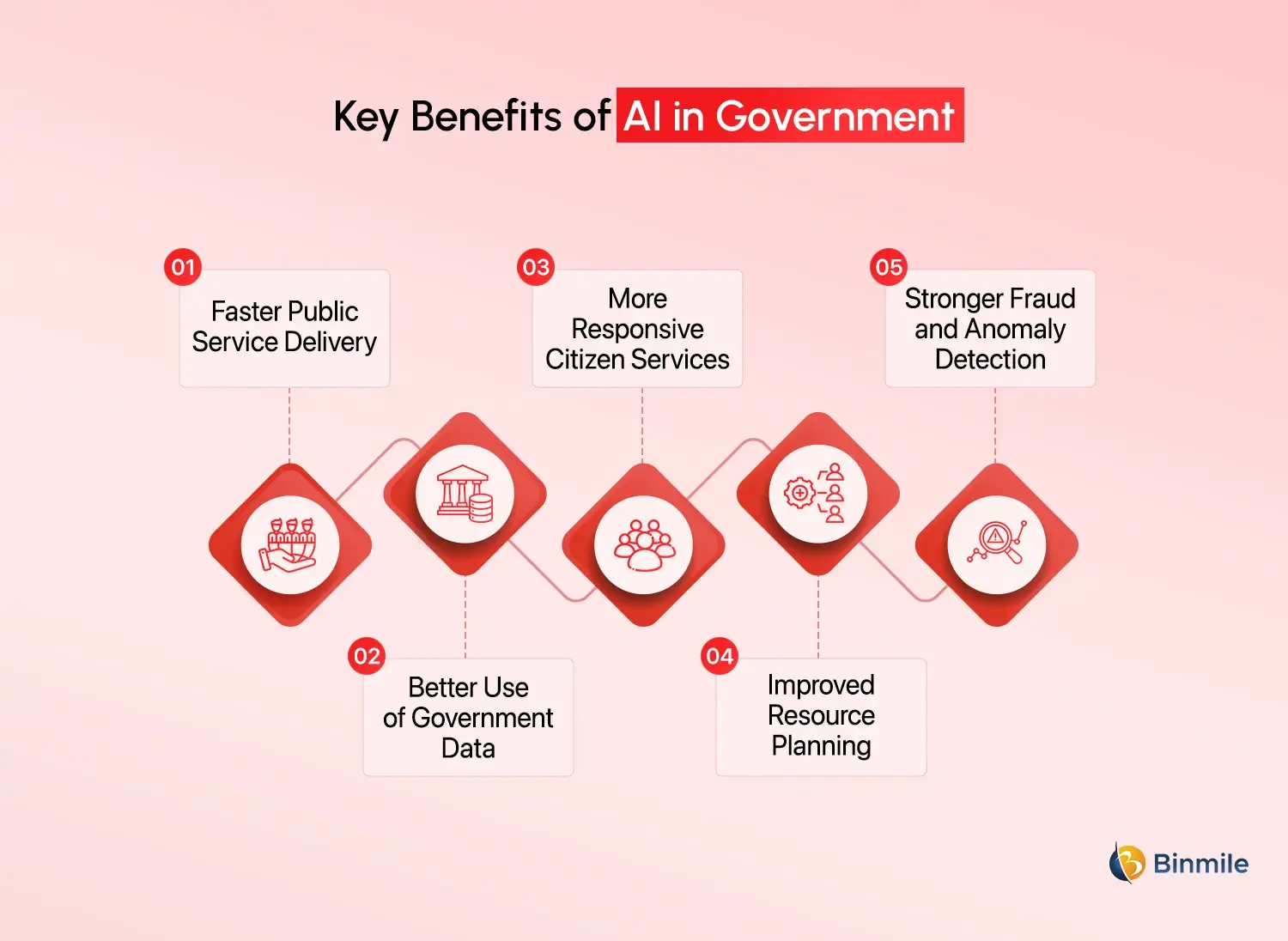
Faster Public Service Delivery
AI automation for government can handle repetitive processes like document examination, application routing, and common inquiries, thus allowing employees to be free to engage in cases where human functions are required.
The AI customer service agents and AI-Powered Chatbots can also support routine citizen interactions and provide information without requiring employees to handle every request manually.
-
Better Use of Government Data
AI can retrieve necessary information from documents, summarize different reports, and discover common trends in governmental databases, thus simplifying the work of employees in terms of utilization of data for planning and decision-making.
Artificial Intelligence Development Services can support these types of applications, while Artificial Intelligence as a Service can provide access to AI capabilities without requiring agencies to develop every component internally.
-
More Responsive Citizen Services
AI-powered citizen services can provide access to the necessary information, as well as allow people to know about their application status and requirements for obtaining desired services outside working hours. The use of multilingual platforms also increases the number of customers.
AI in government services can therefore make routine interactions more accessible, while Government AI solutions can connect these capabilities with existing public-service systems.
-
Improved Resource Planning
AI can analyze the historical and real-time data collected by governments for more efficient demand planning in healthcare, transport, emergencies, infrastructure, and social services.
Applications such as AI Investment and AI in wealth management can also demonstrate how AI is already being used in financial and investment-related environments, although government use cases require their own governance and oversight requirements.
-
Stronger Fraud and Anomaly Detection
Machine learning can flag unusual transactions, duplicate claims, and suspicious patterns for further investigation. This is especially relevant to AI governance in financial services, where automation must be balanced with privacy, compliance, and accountability.
Looking to turn AI opportunities into secure, practical solutions for your government operations?

What Are the Key AI Use Cases in Government
The AI in government services landscape covers everything from citizen-facing applications to internal administrative systems. Some use cases are already relatively mature, while others require stronger governance and human oversight. These applications form part of the wider Government AI Applications being explored across public-sector organizations.
| Government Area | How AI can be used | Potential Outcome |
|---|---|---|
| Citizen Services | Virtual assistants, intelligent search, query classification | Faster access to information |
| Document Processing | Extraction, classification, summarization | Reduced manual processing |
| Healthcare | Demand forecasting, image analysis, administrative automation | Better planning and operational efficiency |
| Public Safety | Pattern analysis, emergency response support | Faster identification of risks |
| Tax and Finance | Anomaly detection, fraud analysis, forecasting | Improved compliance and financial oversight |
| Infrastructure | Predictive maintenance, traffic analysis, geospatial intelligence | Better asset management |
| Human Resources | Employee assistants, document processing, workforce analytics | Lower administrative workload |
| Policy Research | Data analysis, scenario modelling, document summarization | Faster research and analysis |
| Local Services | Complaint routing, permit processing, service information | More responsive local administration |
AI in Local Government
The development of AI applications in local governments is particularly noteworthy because local authorities engage with their citizens on a daily basis.
AI-powered chatbots can also handle routine questions from residents, provide service-related information, and direct more complex requests to the appropriate department.
For instance, a citizen calling to report a broken road should not need to think about which department is in charge of this matter. The AI-based system should analyze the inquiry, classify it, point out its location, and refer it to the right department.
This means that AI does not make the final decision, but it eliminates the unnecessary intermediate steps between the request made by the citizen and the responsible civil servant.
The same works for Artificial Intelligence as a Service applications in local jurisdictions in public works, utility services, transportation, housing, etc. Such use cases can form part of wider Government AI Initiatives aimed at improving local services.
Generative AI Is Changing Government Workflows
Traditional AI is useful for prediction, classification, and pattern recognition. Generative AI adds another layer because it can work with natural language and create new content based on the information provided to it.
This makes Generative AI for the public sector particularly relevant to knowledge-heavy administrative work. Generative AI development services and generative AI consulting can help organizations assess and develop these types of applications.
Government employees can use Gen AI to:
- Summarize lengthy policy documents and reports
- Draft routine communications
- Search internal knowledge bases using natural language
- Generate first drafts of forms, reports, and responses
- Compare information across large document collections
- Convert complex regulations into easier-to-understand explanations
- Assist employees in finding relevant procedures and guidelines
For government agencies evaluating where generative AI can deliver practical value, generative AI consulting can help identify suitable use cases, assess data and infrastructure readiness, and define an implementation approach.
For example, an employee handling a citizen request could ask an internal AI assistant to identify the relevant policy, summarize the applicable requirements, and draft a response. The employee can then review the information before anything is sent.
This human review is important because generative AI can produce inaccurate or incomplete information. Government environments also involve sensitive information, making security, access controls, data handling, and auditability essential.
How AI Supports Government Digital Transformation
Buying an AI tool does not automatically create government digital transformation. In many agencies, the harder task is connecting AI with existing processes and technology.
A practical transformation usually involves several layers.
1. Identify the Process Worth Improving
Choose real operational issues to solve instead of concentrating on technology. High-volume, repetitive, and boring processes are a much better choice than complex and complicated processes subject to decision-making based on limited information.
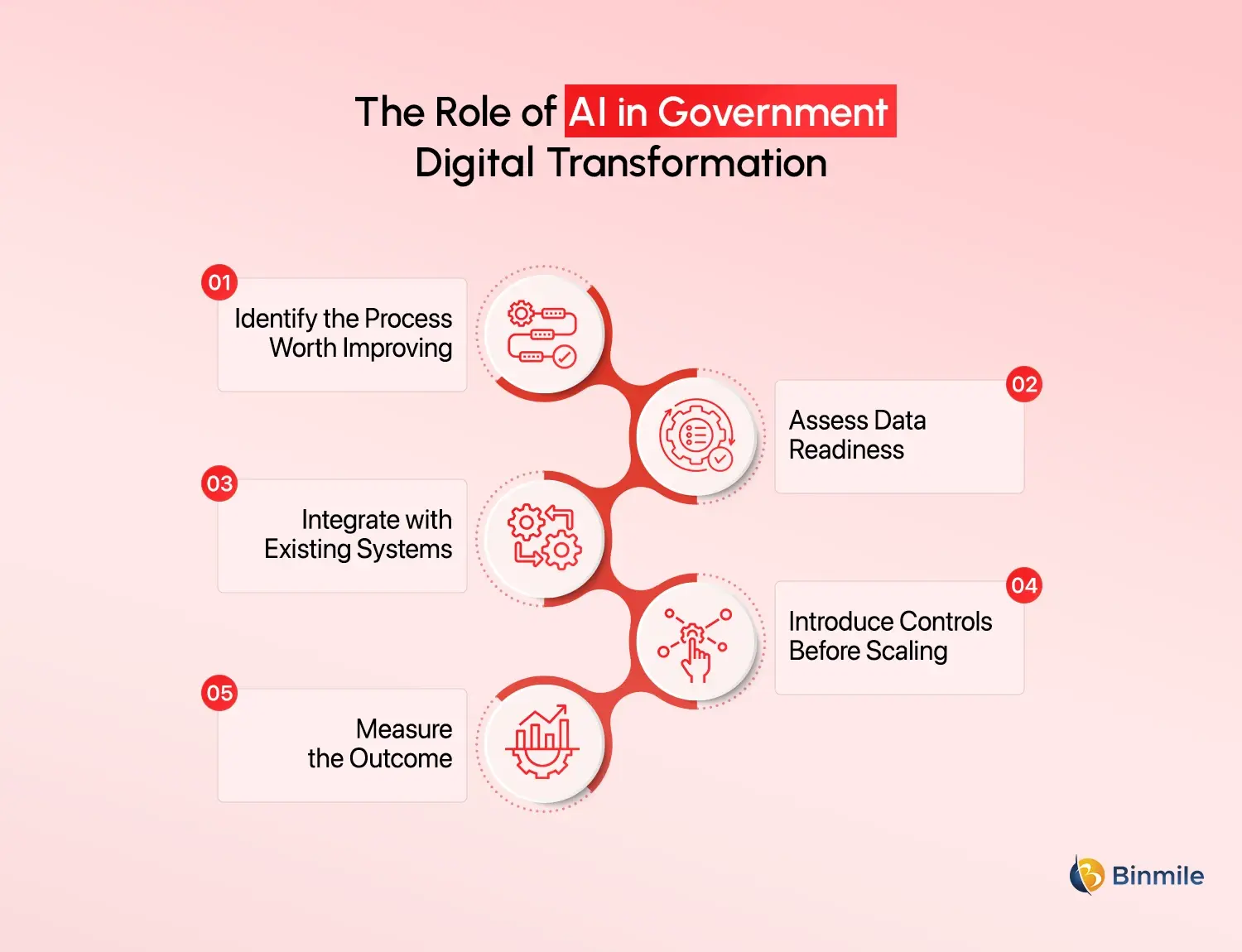
2. Assess Data Readiness
An effectively working AI system relies on good and easy-to-access data that allows government agencies to understand what data exists, where it is stored, who can use it, how often it is updated, and whether there is a possibility of data inconsistencies.
3. Integrate with Existing Systems
Government agencies are forced to work with current legacy systems and cannot afford the luxury of switching to new systems all at once; hence, AI solutions for public institutions must function within current databases, portals, and workflow systems.
This is where AI in government systems and AI in Government workflows become particularly important, as AI capabilities need to operate within existing technology environments.
4. Introduce Controls Before Scaling
The aspects of security and privacy policies, access rights, human control, logging, and performance tracking must be incorporated into the process of implementing any AI project in the public sector.
This is central to Responsible AI in government and AI implementation in government, particularly when agencies move from individual pilots to larger deployments.
5. Measure the Outcome
Any successful AI project must have measurable aims, which could include such things as time necessary to perform the task, time of response to the requests of the public, employee workload, etc. Measuring these outcomes also helps agencies assess whether their AI investment is delivering meaningful operational value before expanding the implementation.
This approach helps separate genuine AI innovation in the public sector from technology experiments that look impressive but do not solve a meaningful problem.
What Are the Challenges of AI in Government
The challenges of AI in government are not limited to technical complexity. Public-sector AI operates in an environment where mistakes can affect large populations, public funds, access to services, and individual rights.
-
Data Quality and Fragmentation
AI will not solve problems with poor data. When records are incorrect, even missing, there are duplicates or disconnected databases, the final output of the AI system may be affected.
-
Legacy Technology
In many governmental systems, AI is dealing with legacy systems that were never designed to cope with modern AI loads. Therefore, integration becomes more complicated than the AI model itself.
-
Privacy and Security
Government systems are usually charged with sensitive personal, financial, health, and identity information. There should be specific regulations concerning data flows, who may gain access to which data, how long it will be kept, and what the AI systems are going to do with it.
-
Skills and Workforce Readiness
Technology is not enough. There should be necessary training sessions on AI tools, data competence, safety, responsible behavior, and human control.
Employees should also understand where AI may be helpful and where human intervention is a must.
-
Bias and Explainability
AI systems may recreate issues that are already present in the training data. If AI influences access to services or important decisions, there should be means to check it for discrimination.
-
Measuring Actual Impact
A pilot can demonstrate that an AI system works technically without proving that it improves public services. Agencies should define measurable outcomes before scaling an implementation.
What Is the Future of AI in Government
The governmental future with AI should see the integration of systems rather than simply isolated AI instruments. Civil servants may encounter AI assistants more frequently, whose algorithms can search permitted knowledge sources, prepare documentation, sum up cases, or launch the already preset workflow. In addition, the citizens’ portals may become more interactive, allowing individuals to say what is needed rather than roam around complex service directories.
The Power of AI in Government will increasingly depend on how effectively these capabilities are integrated into existing services, systems, and workflows.
However, the government should be more careful with governance. As the government brings more and more AI applications to public decisions. The requirements concerning security, transparency, accountability, and human control will also rise.
AI in government policies will therefore become increasingly relevant as agencies establish frameworks for responsible adoption. However, AI adoption in government will depend on how effectively these frameworks support practical use.
At the end of the day, the ability of AI to perform efficiently in government isn’t about how sophisticated the model is but whether it fits the organization using it. Good data quality, smart workflow, competent staff, and stringent governance will either bring success to AI or let it fail.
Ready to improve public services with AI that works within your existing systems and processes?
How Binmile Can Help Government Organizations Move From AI Ideas to Working Systems
Government organizations do not necessarily need more AI experiments. They need technology that fits their existing processes, systems, security requirements, and service objectives.
That is where a structured implementation approach can make a difference. Binmile can support organizations in evaluating suitable AI applications, designing secure AI-enabled workflows, and integrating intelligent capabilities with existing systems. Additionally, developing solutions around specific operational requirements. The focus remains on making AI useful within the organization rather than treating it as a standalone technology layer.
From intelligent citizen interfaces and internal knowledge assistants to workflow automation and data-driven applications, the right solution depends on the problem being addressed, the available data, and the level of oversight required. A phased approach can help government teams validate value, address implementation risks, and build a stronger foundation for broader AI adoption.
Frequently Asked Questions
AI can automate repetitive administrative tasks, answer routine citizen queries, classify documents, support employees, and analyze large datasets. This can reduce processing delays while allowing government staff to focus on complex cases requiring human judgement.
Common applications include citizen-service chatbots, document processing, fraud detection, predictive maintenance, resource forecasting, employee assistants, data analysis, workflow automation, and intelligent search across government information and knowledge repositories.
Agencies should assess data sensitivity, apply strong access controls, encrypt information, establish human oversight, monitor AI outputs, maintain audit logs, and define clear governance policies before moving AI applications into production environments.
Yes. AI can be integrated with existing databases, portals, APIs, workflow platforms, enterprise applications, and legacy systems. The integration approach depends on the architecture, data formats, security requirements, and capabilities of existing government technology.
AI can provide faster responses to routine questions, guide citizens through government processes, classify service requests, provide application updates, and route issues to appropriate departments. This can make services more accessible and reduce administrative workload.
Government agencies can use Generative AI for document summarization, drafting, knowledge retrieval, report preparation, employee assistance, citizen communication, and policy research. Sensitive or high-impact outputs should remain subject to appropriate human review.
Binmile can help organizations identify suitable AI use cases, design intelligent workflows, integrate AI with existing technology, and develop secure solutions aligned with operational requirements. Its approach focuses on practical implementation, scalability, governance, and measurable outcomes.