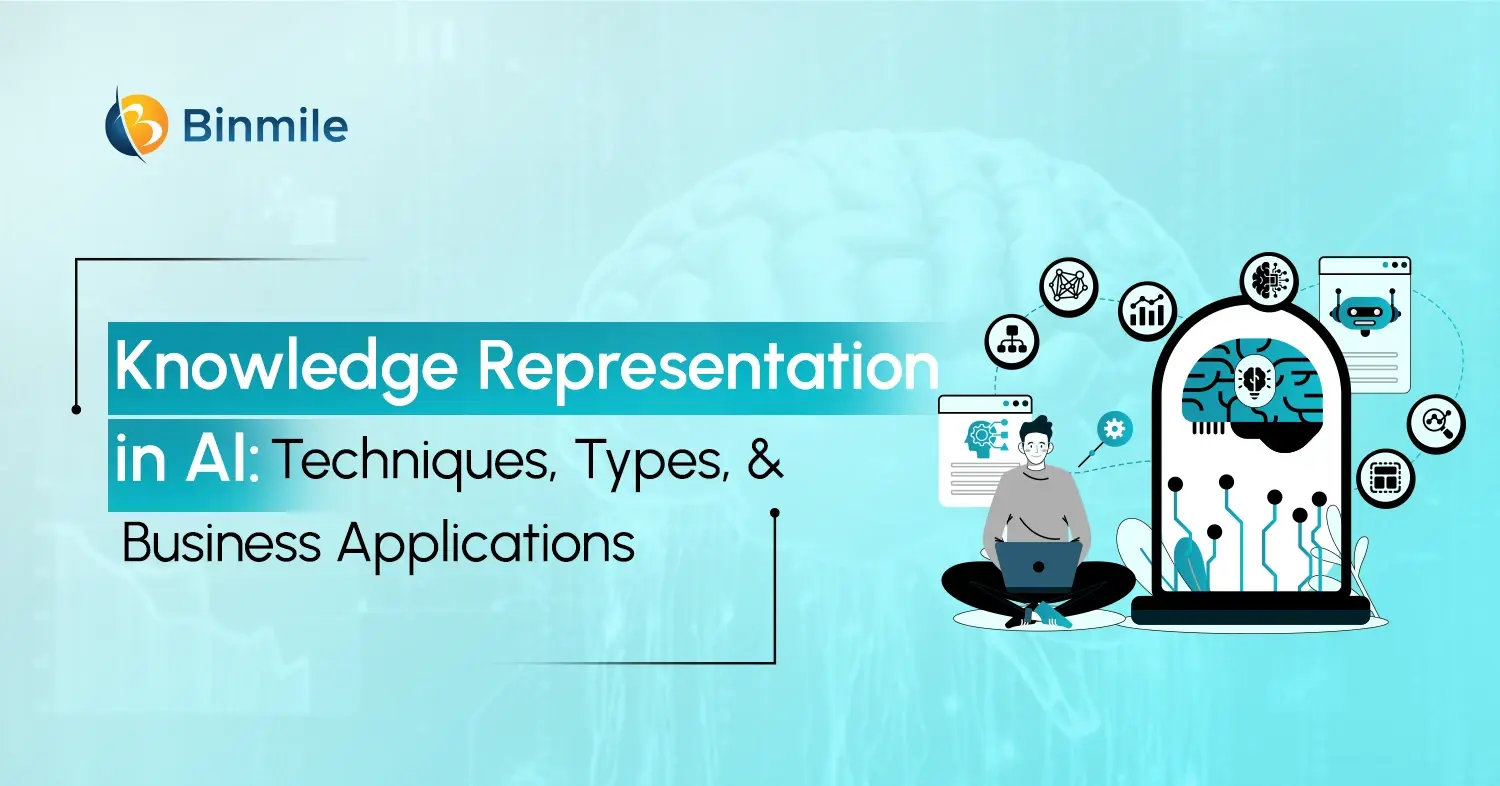
Artificial intelligence can analyze large quantities of data and produce responses quickly. But how does artificial intelligence understand how different pieces of information link together and make informed decisions? This is where Knowledge representation in AI comes in. Additionally, it plays an important role in Knowledge representation in AI systems by helping machines interpret connected information rather than isolated data points.
Knowledge Representation provides a method for AI systems to organize information, understand how different concepts connect, and make logical decisions. In other words, Knowledge Representation in Artificial Intelligence gives machines a structured way to work with facts and relationships.
This is valuable in a business setting, as information can be held across multiple platforms such as CRM systems, ERP systems, databases, and documents. Additionally, using knowledge representation to connect this information together can allow intelligent applications to be created to support better decision-making. This also makes it a relevant consideration in AI in business strategy, where connected data can support more informed operational choices.
In this guide, we will cover the different types, techniques & business applications of knowledge representation in AI.
What Is Knowledge Representation in AI & How Does It Work?
Knowledge representation in AI is the process of organizing real-world information into structured formats that AI systems can interpret and apply. Additionally, this allows information to be stored, understood, and reasoned about by AI systems. Information such as factual information, concepts, relationships & rules can be organized into formats that a machine can understand. This makes it easier for AI systems to understand context & make informed decisions. Additionally, this is a practical knowledge representation example of how structured information can help an AI application interpret business relationships.
For example, in an e-commerce business, there may be many separate records for customers, products, orders, payments & deliveries. By using knowledge representation, we can connect information together. Additionally, this allows an AI system to understand that a customer has made an order containing products that have been paid for. This allows the AI system to understand and find relevant information.
How Does AI Represent and Process Knowledge?
To begin with, information is collected. Once information has been gathered, relevant entities & their properties will be identified. Relationships are defined, and information is structured.
An example would be in a healthcare organization. An AI system can support clinical decision-making by analyzing patient information and identifying relevant medical insights. Additionally, this can connect information together relating to patients, symptoms, medical conditions, medications & diagnostic processes. This enables the AI system to access and use relevant medical information when supporting clinical decisions.
What Are the Different Types of Knowledge Representation in AI?
Understanding the different types of knowledge representation will help businesses understand how their AI applications should deal with facts, processes, relationships & decisions. Additionally, these categories provide a foundation for selecting suitable Knowledge Representation in AI Methods.
1. Declarative Knowledge
Declarative knowledge is used to store factual information. This can include concepts & properties. For example, whether a customer has subscribed, what category a product falls into & what department an employee is in.
This allows information to be retrieved in AI systems. For example, enterprise knowledge management platforms can use this to organize company policies, product information & organizational records.
2. Procedural Knowledge
Procedural knowledge is used to show how something should be done. For example, verifying a payment, checking stock availability & processing an order.
Procedural knowledge can be used in AI agents & automation systems to complete specific processes.
3. Heuristic Knowledge
Heuristic knowledge is knowledge gained from experience. This can help AI systems deal with complex situations. For example, in a fraud detection system, transactions can be flagged if they look suspicious.
Financial organizations can use heuristic knowledge to flag suspicious transactions to investigate for fraud.
4. Meta-Knowledge
Meta-knowledge is knowledge about knowledge. This helps AI systems to understand the source, trustworthiness & relevance of information.
For example, an enterprise AI assistant can identify whether a policy is approved or an old document. Organizations can use meta-knowledge to improve their information governance.
5. Structural Knowledge
Structural knowledge helps to show relationships between concepts, objects & entities. For example, how a department may relate to a business unit & region.
This can help in creating knowledge graphs, organizational intelligence, supply chain & data integration, including a knowledge graph for enterprise information that spans multiple departments.
What Knowledge Representation Techniques Do AI Systems Use?
Knowledge representation techniques help to structure information and allow an intelligent system to understand & reason about the information. There are various techniques that can be used depending on the desired outcome. Choosing between Knowledge Representation in AI techniques depends on the information being modeled and the reasoning an application needs to perform.
Here are six commonly used AI knowledge representation methods. These Knowledge Representation in AI Methods offer different ways to encode facts, rules, concepts, and relationships.
1. Logical Representation
Logical representation uses logic to store information. It is commonly used with propositional logic (True/False) and first-order predicate logic (objects, properties & relationships). Additionally, this allows AI systems to reason about information and make conclusions.
For example, if all employees with approved access can enter a restricted system & employee A has approved access, the AI system can conclude that they are eligible.
Business Relevance: Helps with compliance management, eligibility, access control & rule-based decision making.
2. Semantic Networks
Semantic networks connect concepts and entities through nodes and the relationships between them, creating a structured representation of knowledge. Additionally, each node represents an entity/concept, and relationships define how they connect. For example, customers place orders, orders contain products & products fall under a category.
Business Relevance: Can be used within companies to connect customer information, product catalog & enterprise knowledge.
3. Frame-Based Representation
Frame-based representation stores information in frames. Frames contain information about an entity using slots & values.
For example, a frame can store customer details such as their ID, subscription type, account status, and renewal date. Additionally, this can include information such as customer ID, subscription type, account status & renewal date. This can help AI systems to represent objects.
Business Relevance: Can be used to create customer profiles, product configuration, employee information & domain-specific AI.
4. Production Rule Representation
Production rules use IF-THEN statements to decide how an AI system should respond. For example, if a customer has an outstanding payment, the account can be flagged.
Business Relevance: Can be used within organizations to automate processes, enforce policies & decision-making.
5. Ontology-Based Representation
Ontology-based representation defines concepts within a domain. Additionally, this includes properties, relationships & rules. For example, in a manufacturing business, equipment, components, suppliers & maintenance can be linked.
The Web Ontology Language (OWL) is a W3C standard that allows complex relationships to be represented; validation can be carried out & implicit knowledge discovered.
Business Relevance: Can be used to connect enterprise data, healthcare information, compliance & domain-specific AI.
6. Knowledge Graph Representation
Knowledge graphs help information be represented in a network. This is commonly done using triples.
For example, Customer A bought Product X, which falls under Category Y & is managed by Department Z. Additionally, this can help AI systems understand relationships & find information.
Business Relevance: Can be used for enterprise search, recommendation engines, fraud detection & AI-driven customer experiences.
What Is the Cycle of Knowledge Representation in AI?
The knowledge representation cycle outlines how information can be captured, organized, represented, processed & updated for an intelligent system to use.
Although the exact workflow depends on the application, most implementations involve six stages.
1. Knowledge Acquisition
Information that is relevant to the AI system can be captured. Additionally, this can include information from enterprise databases, documents, APIs, industry reports & domain experts.
2. Knowledge Modeling
Once information has been captured, it can be organized. Entities, attributes, relationships & business rules can be identified. For example, in an insurance company, relationships between policyholders, policies, claims & limits can be mapped.
3. Knowledge Encoding
The knowledge model can then be represented in a machine-readable format. Additionally, this can be done using logical representation, production rules, semantic networks, ontologies, knowledge graphs, etc. This will depend on the complexity of the application.
4. Knowledge Storage and Integration
The information can then be stored in a suitable database. This could include relational databases, graph databases, or knowledge bases. Additionally, the information can then be integrated with relevant systems.
5. Knowledge Inference and Reasoning
The information can then be used by the AI system to make conclusions. For example, in a supply chain system, it can identify how late delivery may impact production.
6. Knowledge Validation and Updating
Knowledge must be regularly validated. Additionally, outdated information should be updated, inconsistencies resolved & duplicate records removed.
What Are the Benefits and Applications of Knowledge Representation in AI?
Knowledge representation can help businesses move away from working with standalone data. Additionally, this can help create AI systems that understand the business context. Knowledge representation can be used across many industries. Its applications also extend to AI in government, where connected regulations, public records, and service information can support public administration.
1. Healthcare and Clinical Decision Support
Knowledge representation can be used to connect patient information, medical history, symptoms, medications & guidelines. Additionally, this can help clinical decision support systems help healthcare professionals find information, assess treatments & identify potential drug interactions.
2. Financial Services and Fraud Detection
Financial organizations can connect customer information, accounts, transactions & merchants. Additionally, knowledge graphs can help identify suspicious relationships between accounts.
3. Retail, E-commerce, and Customer Experience
Retailers can connect product catalogs, customer preferences, transaction history & stock information. Additionally, this can help AI applications provide personalized recommendations and support AI in customer experience through more relevant, context-aware interactions.
Customer experience platforms can also connect CRM information, support tickets & previous interactions. This can help AI agents understand customer journeys & find relevant information, improving how AI in customer experience systems respond across service channels.
4. Manufacturing and Supply Chain Management
Knowledge representation can connect equipment, components, suppliers, stock & production schedules. This can help AI systems identify potential issues in the supply chain.
5. Enterprise Knowledge Management
Knowledge representation can be used to connect enterprise documents, company policies, technical manuals & applications. Additionally, this can help AI assistants find contextual information. Businesses exploring Artificial Intelligence as a Service (AIaaS) can also use connected knowledge sources to make AI capabilities more useful across existing applications.
It also helps bridge information silos, making enterprise data more accessible and consistent across departments.
6. Government and Public Administration
Government departments can connect public information, service requirements, regulations, & administration information. This can be used for policy analysis, regulatory knowledge management, public service information & inter-departmental data, supporting AI in government initiatives that depend on consistent, accessible knowledge.
Ready to make your enterprise data work smarter with AI aligned with your business goals?
What Is the Role of Knowledge Representation in Generative AI?
Generative AI models such as large language models (LLMs) can help to generate responses based on patterns they have learned. However, they may not always have access to the most up-to-date information, company policies & domain specific information. Knowledge representation can help to provide the AI systems with structured information to help them generate contextual responses. This is particularly useful when organizations combine generative models with enterprise data and Generative AI development services.
1. Improving Retrieval-Augmented Generation (RAG)
Retrieval-Augmented Generation (RAG) can be used with LLMs to find relevant information from external knowledge. Knowledge graphs can help improve this process by connecting related entities. This can help identify relationships that may not have been identified using traditional vector based methods, making knowledge graphs useful for a knowledge graph for enterprise retrieval workflows.
For example, an enterprise system can use a knowledge graph to find out how a late delivery from a supplier may affect components, orders & customers that rely on them. This can help an LLM produce a more relevant response. This is commonly known as GraphRAG.
2. Supporting More Context-Aware AI Agents
AI agents need to have access to relevant information, business rules & constraints. Knowledge representation can help connect this information together so that AI agents can understand the dependencies in processes.
For example, an AI procurement agent can find approved supplier information, check procurement policies & start approval processes.
3. Improving Domain-Specific Generative AI Applications
Knowledge representation can help businesses integrate domain-specific information into generative AI applications. Machine Learning development services can also help build and adapt models that use this structured information for domain-specific tasks.
>
For example, a financial services organization can connect internal compliance policies, financial regulations & business documentation to help an AI assistant give more relevant responses using approved information.
What Are the Challenges and Best Practices for Implementing Knowledge Representation in AI?
There are several challenges when implementing knowledge representation. Additionally, these are commonly described as the challenges of knowledge representation in AI. Below are some best practices to overcome these challenges, including key Knowledge Representation in AI Best Practices.
1. Data Quality and Knowledge Acquisition
Enterprise data can often contain duplicate, incomplete & out of date information. This can cause inaccurate outputs from AI.
Best Practice: Create validation processes, identify the source of truth, determine who owns the data & perform regular quality checks.
2. Integration, Scalability, and Performance
Connecting legacy systems, cloud & databases can be challenging due to differences in how data is stored & identified. Additionally, as knowledge bases grow, relationships can become complex & increase processing requirements.
Best Practice: Create common data models, perform entity resolution, choose the right storage solution & optimize graphs & indexes.
3. Knowledge Maintenance and Governance
As business processes, regulations, products & customer information change, knowledge can become out of date.
Best Practice: Implement data synchronization, version control, regular validation & identify who owns domain-specific information.
4. Uncertainty, Accuracy, and Validation
Information within a business can contain assumptions, predictions & incomplete facts. AI systems will need to know what is accurate.
Best Practice: Include confidence scores, sources, and appropriate handling of uncertainty. Regularly check how accurate knowledge is being retrieved, reasoning & relevant responses.
5. Security, Compliance, and Access Control
Enterprise knowledge bases may contain sensitive customer, employee & financial information. Additionally, this can be a concern for unauthorized access.
Best Practice: Implement role-based access, encryption, audit trails & information governance. Ensure authorization is enforced when retrieving information.
How Can Businesses Use Knowledge Graph Development to Build Enterprise AI Solutions?
Knowledge graph development can help businesses connect information across the business. Additionally, this can help create a common knowledge base for enterprise AI applications.
A typical knowledge graph development process involves four stages.
1. Identify Business Requirements and Data Sources
Identify what entities need to be connected. This can include customers, suppliers, employees, products & transactions. Additionally, developers will also identify what data sources are relevant. This can include CRM platforms, ERP systems, databases & documents.
2. Define the Knowledge Graph Schema
Define how to organize the information. This can include defining what entities, attributes, relationships & business rules will be used. Additionally, having a consistent knowledge graph solution will help keep information accurate.
3. Extract, Transform, and Integrate Knowledge
Data will need to be cleaned, entities extracted, relationships extracted & normalized. NLP & LLM techniques can help to identify relationships in unstructured documents. Additionally, this should be validated.
4. Enable Retrieval, Reasoning, and Continuous Monitoring
The graph can be used to retrieve connected information. For example, an enterprise AI assistant can identify what products a supplier has & what business units rely on them. Additionally, data quality should be validated, relationships updated, inconsistencies resolved & query performance monitored.
The aim of knowledge graph development for businesses is to create a common knowledge base that can be used across multiple AI applications.
For businesses, the objective of knowledge graph development is to create a reusable knowledge foundation that supports multiple AI applications and delivers measurable operational value.
Build smarter AI solutions that connect enterprise knowledge, streamline operations, and support better business decisions.
How Can Binmile Help Businesses Build AI-Powered Knowledge Solutions?
Building AI applications that understand enterprise information requires expertise in data engineering, AI development, and system integration. Additionally, businesses may draw on Artificial Intelligence development services to bring these capabilities together. Organizations need the right approach to structure, connect, and use business knowledge effectively.
Binmile helps businesses explore AI solutions aligned with their operational requirements through its AI Consulting Services. Additionally, its capabilities across Artificial Intelligence development services, Generative AI development services, and AI agent development support organizations in building intelligent applications that use enterprise information, automate workflows, and deliver context-aware outputs.
Whether businesses want to develop a knowledge graph for AI, build an enterprise AI assistant, or integrate generative AI into existing systems, Binmile can help align technology choices with their business goals.
Frequently Asked Questions
Knowledge representation in AI organizes information into machine-readable formats, helping AI systems understand relationships, interpret facts, and draw conclusions.
The five main types are declarative, procedural, heuristic, meta-knowledge, and structural knowledge. Each helps AI systems represent different kinds of information and relationships.
Common techniques include logical representation, semantic networks, frames, production rules, ontologies, and knowledge graphs. The choice depends on the application’s requirements and complexity.
It involves collecting, structuring, and encoding information into machine-readable formats. AI systems use this knowledge to identify relationships, apply rules, and support decision-making.
Knowledge representation provides LLMs with structured, domain-specific information, helping improve contextual understanding and response relevance. It also supports RAG, knowledge graphs, and enterprise AI assistants.
Binmile offers AI consulting, generative AI, machine learning, and AI agent development capabilities to help businesses identify suitable use cases and build AI-powered applications aligned with their requirements.