While businesses use diverse data sources, including applications, databases, and both internal and external channels, access to data does not always result in improved business outcomes. Fragmentation can prevent organizations from effectively managing data and analyzing it to inform decision-making.
As AI, alongside machine learning and generative AI, is adopted more widely, there is an increasing need for clean and well-organized data to ensure good quality AI outputs. Conventional integration often involves labor-intensive data mapping, conversion, and management and can therefore struggle to meet these new demands.
AI data integration is a useful approach that utilizes artificial intelligence and data engineering to further automate data management and to construct flexible data integration to underpin an organization’s analytics and AI initiatives. This approach is increasingly central to AI-powered data integration and the broader AI data integration strategy.
What Is AI Data Integration?
AI data integration is the application of artificial intelligence and machine learning to integrate, analyze, convert, and manage data. Also known as AI for data integration, this approach helps organizations build AI-ready data integration environments.
Compared with conventional approaches, which predominantly involve hard-coded and user-defined integration methodologies, AI can recognize trends and advise on conversions. It can also recognize and resolve data incompatibilities and respond to evolving data.
For example, while an enterprise may hold customer data in a range of applications such as CRM, ERP, marketing, and customer service, the data fields in these applications may differ. Consequently, it can prove challenging to compile consistent customer data.
Using an AI data integration system, data can be analyzed and relevant data fields recognized. The system can further advise on data conversions and then facilitate the compilation of data in a harmonized way. These capabilities are often delivered through artificial intelligence integration services and modern AI data integration solutions.
How Does AI Data Integration Work?
Combining intelligent automation with data engineering, it undertakes data discovery – recognizing available data, exploring the associated metadata, and categorizing data. Intelligent data mapping follows, with AI identifying linkages between data fields in differing applications. During data conversion, AI assists in normalizing and cleansing data and converting it appropriately.
Furthermore, AI improves data management by recognizing any gaps and inconsistencies. AI additionally facilitates data pipeline orchestration, advising on and managing how data is transmitted between systems. Real-time monitoring can highlight irregularities and even malfunctions in data pipelines. This reduces manual effort and supports more efficient AI data integration workflows.
What Are the Key Benefits of AI Data Integration for Businesses?
The benefits of AI data integration extend beyond operational automation. It helps organizations establish a dependable data foundation, improve resource utilization, and support digital transformation. The benefits also include improved data accessibility and more reliable information for enterprise AI implementation.
1. Improved Data Quality and Accuracy
Disparate data can include multiple entries for individual entities, as well as gaps and obsolete data. Such characteristics can adversely affect business analytics and AI outcomes.
AI analyzes data and employs automated checks and trend recognition to identify data concerns. It can further advise on how to address these and facilitate the normalization of data between interlinked applications to improve data quality.
2. Reduced Manual Work and Operational Costs
Conventional data integration involves people designing data mappings and authoring scripts. Furthermore, staff must investigate and resolve data pipeline malfunctions. As an organization’s number of linked applications grows, so does the labor involved in managing data integration.
By automating data mapping, trend recognition, and malfunction identification, AI reduces employees’ labor input. Staff can thereby concentrate on constructing scalable systems and on tackling more sophisticated business concerns. Data engineering solutions can further support these efforts by improving the efficiency and scalability of integration processes.
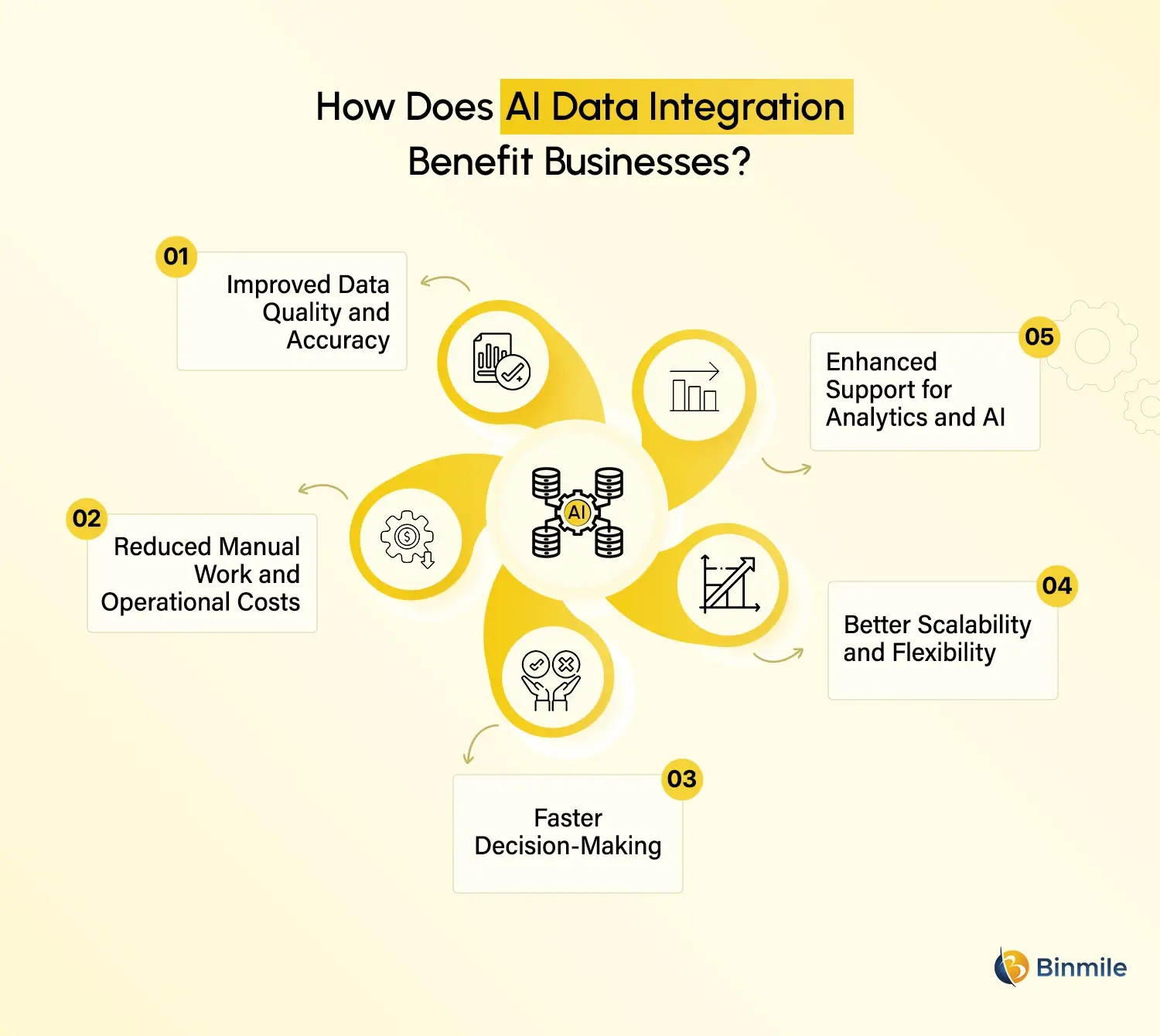
3. Faster Decision-Making
Businesses need up-to-date data in order to respond to shifting consumer behavior and business circumstances.
AI data integration expedites data conversion and transmission so that relevant data can be more rapidly made available to appropriate applications. For example, retailers can analyze sales, transaction, and consumer behavioral data to determine product popularity and then decide on stock levels accordingly. This also strengthens the foundation for data analytics services by making integrated information more accessible.
4. Better Scalability and Flexibility
As a business develops, so too does its data landscape. Additional applications, cloud provisioning, and business divisions can all lead to greater data integration needs.
AI data integration systems automate configuration and flexibly update data integration methodology in response to evolving data. Alongside cloud-native provisioning, this aids in successfully managing an ever-growing data volume and processing workload. Scalable AI data integration platforms can help businesses accommodate these changing requirements.
5. Enhanced Support for Analytics and AI
ML and generative AI functionality requires high-quality and contextually relevant data. AI data integration facilitates the compilation of data so that it can be utilized effectively by a business’s predictive analytics, recommendation engines, and AI systems.
Moreover, it can facilitate the construction of an AI-enabled data landscape, thus allowing an organization to transition from experimental to at-scale AI implementation. This also supports data engineering for AI by preparing enterprise information for advanced AI workloads.
Which Technologies To Rely on For AI Data Integration?
AI data integration relies on multiple technologies that work together to automate data movement, improve processing accuracy, and maintain consistency. These technologies form the foundation of modern AI data integration architecture.
1. Machine Learning (ML)
ML is able to recognize trends, recognize linkages, and predict outcomes based on past and current data. Within data integration, it can be used to conduct data mapping, recognize duplication and to classify and identify data concerns.
For example, ML can recognize that customer_id and client_reference are likely to both refer to the same entity, despite these fields originating in different applications.
2. Natural Language Processing (NLP)
NLP enables computer systems to comprehend and manipulate human language. It is particularly useful for managing unstructured data such as email, customer feedback, service requests, and business documentation.
NLP can recognize pertinent data, categorize data, and reformat unstructured data for analysis.
3. Generative AI and Large Language Models
Generative AI can further automate elements of data integration, such as the production of SQL scripts, advice on data conversion, and interpretation of data mapping documentation. An engineer can specify data integration requirements in natural language, and an assistant powered by an LLM can then develop preliminary SQL conversion code. However, generated material must still be verified prior to implementation. Generative AI data integration can further simplify the development and management of integration workflows.
4. Robotic Process Automation (RPA)
RPA is used to automatically execute labor-intensive, highly structured tasks. Added to AI, this can be used to automate functions including document extraction, data entry, verification, and data transmission, especially with older systems which may not provide contemporary API functionality.
5. Cloud Computing and Data Platforms
The cloud provision provides an elastic environment for data processing and management. Cloud data warehouse and data integration-as-a-service, and technologies such as Apache Kafka and Apache Spark can all back AI data integration. These technologies are also commonly used in the ETL process in data warehousing to move and prepare enterprise data.
What Are the Common Business Applications of AI Data Integration?
It has applications across industries where organizations need to consolidate information, improve visibility, and make data-driven decisions. Businesses can also use Artificial Intelligence as a Service to access AI capabilities that support these integration requirements.
1. Healthcare
Healthcare businesses use a variety of data sources, including electronic patient records, diagnoses, lab results, and hospital management applications.
It can be used to collate this data and present it in a cohesive manner, so that authorized personnel can easily access relevant data. It can then also be used for business analytics, workforce planning, and patient outcome analysis.
2. Banking and Financial Services
Financial bodies hold data relating to transactions, consumers, accounts and regulation within various systems.
AI can be used to collate data to underpin functions such as fraud detection, risk analysis and regulatory reporting. Examination of integrated transaction data can also highlight anomalous behavior.
3. Retail and eCommerce
Retailers use data drawn from online sales, point-of-sale, stock, and marketing systems.
Compiling data in this manner will provide a richer understanding of consumers and goods. Data can then be used to customize offerings for consumers, analyze product demand, and optimize stock levels.
4. Manufacturing and Supply Chain
Manufacturers gather data from production equipment, IoT, warehouse, and ERP systems.
AI data integration can be used to collate data to facilitate predictive maintenance and production and supply chain analysis. Consolidating supplier, logistics, and stock data can also further inform business planning.
5. Telecommunications
Within telecommunications, companies gather data from networks, billing and customer service applications, and usage analysis.
AI data integration is used to collate data, to recognize network performance concerns, and to analyze consumer behavior. It can also be utilized to optimize service provision.
6. Enterprise Business Intelligence
Within many businesses, finance, sales, marketing, and operations each operate with their own data environments.
AI data integration can collate these diverse data sources to inform business intelligence. For example, analyzing sales, marketing spend, and consumer acquisition data can provide business leaders with enhanced understanding of how their business is performing.
Explore how Binmile’s data engineering and AI capabilities can help your business streamline data integration and unlock greater value from enterprise data.
What Are the Main AI Data Integration Methods?
Businesses can choose different AI data integration methods based on their infrastructure, processing needs, and operational goals. The right methods also depend on the organization’s existing data architecture and processing requirements.
1. ETL (Extract, Transform, Load)
This process extracts, converts, and loads data into target locations. AI can conduct data mapping and recognize data concerns.
2. ELT (Extract, Load, Transform)
Raw data is initially loaded into target locations and then converted. AI can again optimize data processing and advise on data conversion. It can also recognize data concerns.
3. Real-Time Data Streaming
Data is constantly streamed between integrated systems. AI can analyze data and recognize behavioral trends. It can then support time-sensitive business functions.
4. Change Data Capture (CDC)
Using CDC, a system can recognize database changes and send updated data to other systems. Again, AI can be used to recognize changes and to analyze and detect data concerns and incompatibilities.
5. Data Virtualization
This allows data to be accessed from different sources via a single interface, without physical data compilation. AI can further ease data exploration, interrogation, and analysis.
Different integration approaches can be combined to facilitate batch data processing, real-time analytics, and AI functionality. The appropriate approach forms an important part of the AI data integration process and can be supported by the right data engineering services.
How Does an AI Data Integration Pipeline Work?
An AI data integration pipeline defines how information moves from source systems to target environments while undergoing processing and validation. An effective AI data integration pipeline is a key component of AI data integration architecture.
A typical pipeline includes five stages:
1. Data Ingestion
Data is extracted from a variety of data sources, which may include databases, APIs, business applications, cloud providers, and IoT, either in real time or in batches.
2. Data Discovery
AI analyzes data to recognize its nature, to establish inter-linkages and to detect data concerns.
3. Transformation and Enrichment
AI can convert data to a uniform format, recognize data duplication, and carry out data mapping. Data can then be enhanced so that it is fit for specific applications.
4. Validation and Governance
Following validation, data is checked for accuracy. Access permissions are also verified, and data management protocols are applied. This ensures that data remains both correct and securely and lawfully managed.
5. Data Delivery and Monitoring
Processed data is distributed to data warehouses, analytics, and AI systems. Continuous monitoring can identify data pipeline and processing concerns and delays.
How Can Businesses Implement AI Data Integration Successfully?
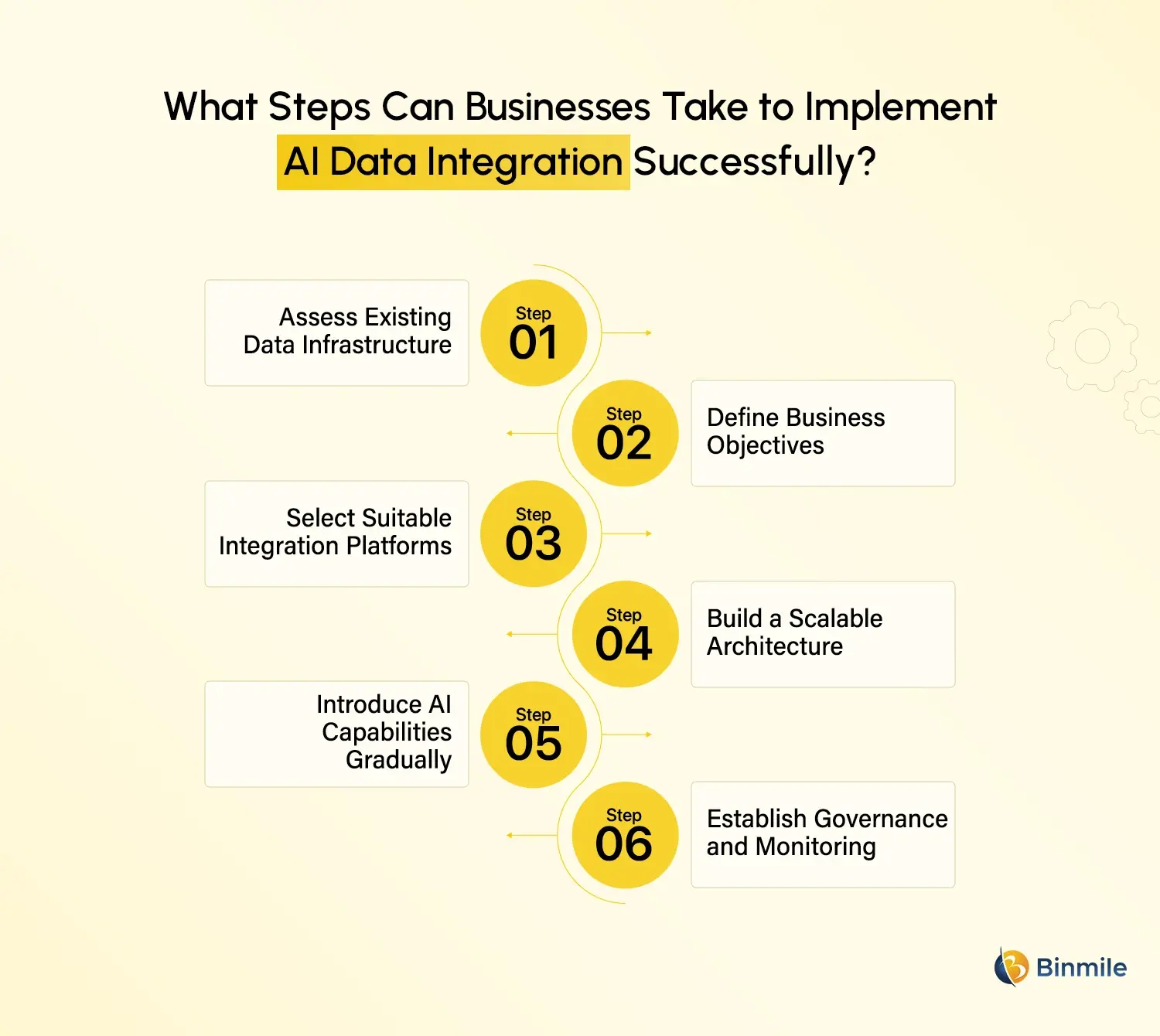
Successful AI data integration implementation requires more than selecting a platform. Organizations must align their integration strategy with existing infrastructure, governance requirements, and business objectives. A structured AI data integration implementation approach can help businesses establish a reliable foundation for future growth.
1. Assess Existing Data Infrastructure
Establish which business applications, databases, and/or cloud provisions are used to create and/or hold data. Investigate existing integration procedures along with current data quality and integration difficulties to identify areas for improvement.
2. Define Business Objectives
Consider what should be achieved via AI data integration. Typical aims can include data compilation (for example, of customer data), improved business intelligence, automated data validation, and preparation of data for generative AI.
Prioritize areas for integration according to their business relevance, intricacy, and data availability.
3. Select Suitable Integration Platforms
When assessing AI data integration technology, consider its suitability in relation to an organization’s existing technology provision. Furthermore, examine how well it can manage a variety of data types. Additional factors to consider include scalability, automation capability, and real-time data processing. Equally important are data validation, monitoring, security, and data governance features.
Ideally, an AI data integration tool will integrate smoothly with an organization’s current technology provision and avoid adding unwarranted complexity. Selecting the right AI data integration platforms is an important part of this process.
4. Build a Scalable Architecture
Produce a data architecture that specifies how data will be ingested, processed, managed, and accessed. Consider, amongst other things, cloud-native provisioning, distributed data processing, modularity, metadata management, data encryption, and access permissions. An effective data architecture will also facilitate the addition of further data sources and AI functionality. An AI-ready data architecture can provide the foundation for this scalable environment.
5. Introduce AI Capabilities Gradually
Initially, implement AI functionality in a controlled way for a key area. For example, an organization may seek to first automate data mapping and duplication detection. Subsequently, it can build on this by applying AI to data pipeline monitoring and conversion. Before wider AI functionality roll-out, it is important to confirm that outputs are both accurate and effective.
6. Establish Governance and Monitoring
Decide who owns data and set out data validation criteria. Access permissions should also be determined. Further, establish data archiving guidance and auditing procedures. Monitor data accuracy, data pipeline efficiency, processing speed, and the cost of data integration. Where AI is being used to conduct data conversion, and this involves sensitive or key business data, human supervision should continue to play an important role.
What Are the Main Challenges of AI Data Integration?
Despite its advantages, AI data integration introduces technical and operational challenges that organizations must address.
1. Data Quality
Poor or inconsistent source data may negatively affect data mapping and hence data and AI output quality.
2. Legacy System Compatibility
Older applications may not have contemporary API provision or data standardization, and so data integration with more modern technology can be problematic.
3. Security and Privacy
As multiple data environments are interconnected, there is an increased need for secure data encryption, access permissions, sensitive data management, and data governance compliance.
4. Implementation Complexity
Appropriate knowledge of data engineering, cloud technology, ML, and business applications is necessary to successfully deploy AI data integration. An experienced AI data integration engineer can help manage these technical requirements.
5. Model Reliability
AI data mapping and conversion may sometimes be inaccurate. Thus, data must be verified, and ongoing monitoring implemented. Human review is also important.
6. Operational Costs
The costs relating to AI data processing, cloud provision, data management, and data integration technology can all rise. Efficient and effective management of resources is therefore key to controlling expenditure.
Good data architecture, data engineering, and data governance are all important for overcoming data integration challenges. A well-defined AI data integration strategy can help organizations address these concerns while supporting the future of AI data integration.
What Is the Future of AI Data Integration?
Future data landscapes are becoming more agile, automated, and context-aware. AI will increasingly be used within self-operating data pipelines to autonomously recognize and analyze data pipeline concerns and to suggest solutions within pre-set business parameters. Likewise, generative AI will further automate data integration by producing data conversion rules, analyzing metadata, and constructing data integration processes using natural language.
Further, agentic AI data integration is emerging. Here, AI ‘agents’ will undertake complex processes which may include data discovery, validation, conversion, and project management. Appropriate access permissions and human supervision will also be in place. Moreover, due to the increasing adoption of data streaming and event-driven data processing, real-time data integration will also become ever more important.
Businesses will moreover continue to place value on creating well-governed, unified and context-aware data landscapes. This will underpin AI-ready data environments, to then further support RAG, enterprise AI and smart applications. Overall, there is a clear trajectory towards even more intelligent data landscapes, and these will need to continue to evolve in response to both business and technological change.
Partner with Binmile to build scalable data integration solutions that support advanced analytics, intelligent automation, and enterprise AI initiatives.
How Can Binmile Help Businesses Build AI-Ready Data Integration Solutions?
Successful AI adoption depends on the quality, accessibility, and reliability of enterprise data. Without a well-connected data environment, even advanced AI applications can struggle to deliver consistent results. Binmile helps enterprises modernize their data environments through data engineering, analytics, and AI-driven development capabilities.
Through its data engineering services, Binmile supports organizations in developing scalable data pipelines, integrating enterprise systems, and preparing information for modern analytics and AI requirements. Whether the objective is to modernize existing infrastructure, establish an AI-ready data architecture, or implement enterprise AI capabilities, the right technology strategy can help organizations turn fragmented information into a valuable business asset. These capabilities can also support Enterprise AI Implementation and the development of AI-ready data environments.
Frequently Asked Questions
AI data integration uses artificial intelligence and machine learning to connect, collect, transform, and manage information across multiple systems. It automates activities such as data discovery, schema mapping, cleansing, validation, and pipeline monitoring.
Its major benefits include improved data quality, reduced manual effort, faster processing, better scalability, and enhanced decision-making. It also helps establish unified datasets for business intelligence, predictive analytics, and AI applications.
Key technologies include machine learning, natural language processing, large language models, generative AI, robotic process automation, cloud computing, and data integration platforms. Apache Kafka and Apache Spark can also support large-scale processing.
Common applications include healthcare data consolidation, financial fraud detection, retail personalization, manufacturing analytics, supply chain optimization, telecommunications monitoring, and enterprise business intelligence.
The main challenges include inconsistent source data, legacy system compatibility, security and privacy requirements, implementation complexity, model reliability, and infrastructure costs.
Businesses should assess their existing infrastructure, identify high-impact use cases, select suitable integration platforms, develop scalable architecture, and introduce AI capabilities gradually. Strong governance, continuous monitoring, and human oversight are also essential.