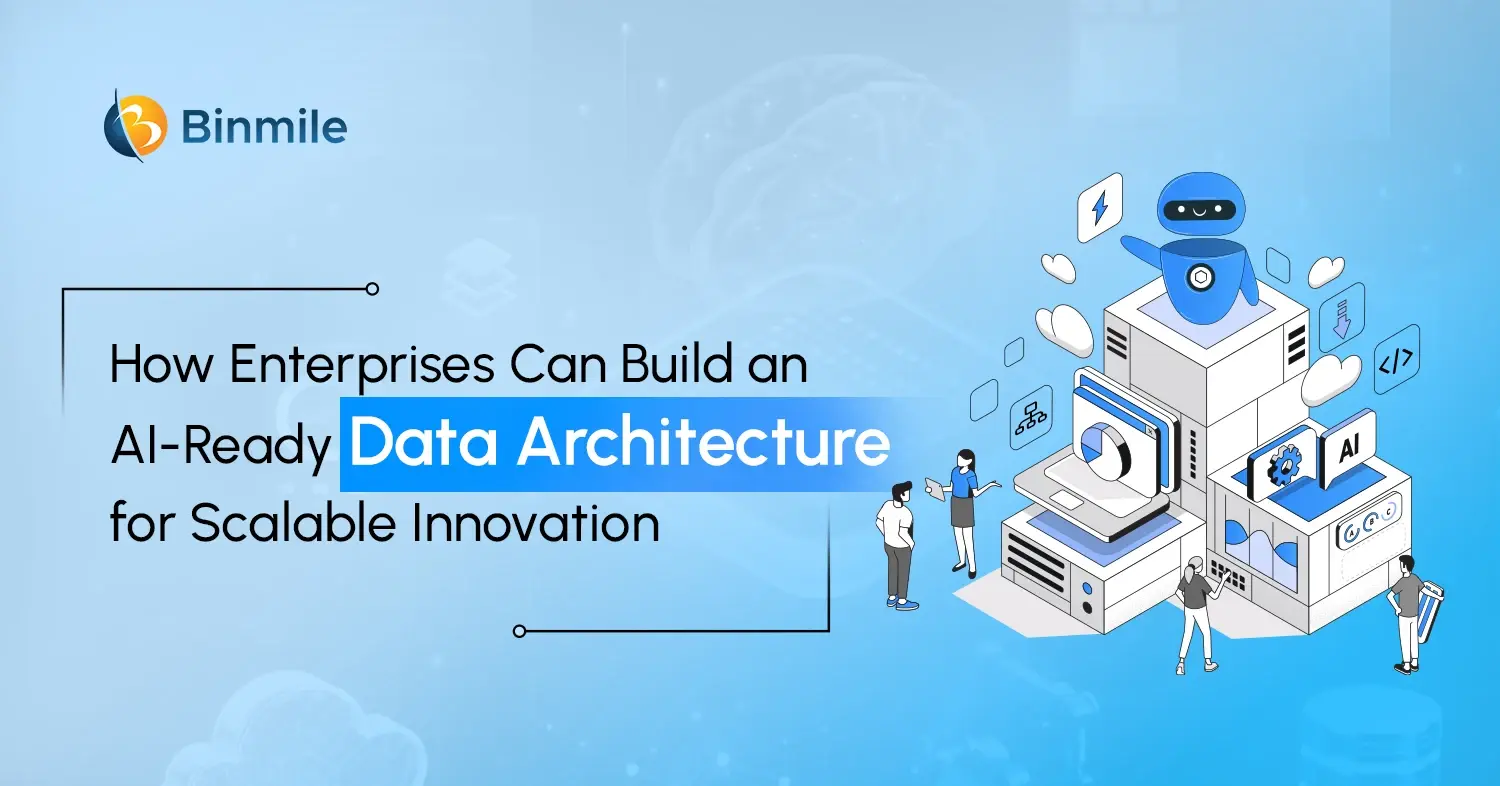
AI projects rarely fail because the model was not powerful enough. More often, they fail because the business data behind the model is scattered, incomplete, duplicated, outdated, poorly governed, or difficult to access. That is why Data Architecture has become one of the most important foundations for enterprise AI adoption. According to IBM, only 29% of technology leaders strongly agree that their enterprise data meets the quality, accessibility, and security standards needed to efficiently scale generative AI. This makes one thing clear: before enterprises scale AI, they need to fix the way data is structured, governed, connected, and delivered.
This blog explains how enterprises can build an AI-ready data architecture that supports business transformation, better decision-making, automation, analytics, and future AI use cases. We will cover what enterprise data architecture means, why legacy systems create challenges, how to identify architecture gaps, which principles matter most, how cloud modernization supports AI readiness, and how businesses can create a practical data architecture blueprint for long-term value.
What Is Enterprise Data Architecture and Why Does AI Need It?
Enterprise data architecture is the structured way an organization collects, stores, integrates, governs, secures, and uses data across business systems. It defines how data moves between applications, cloud platforms, databases, analytics tools, AI models, reporting systems, and user-facing platforms.
This foundation is important for AI as the models are only as good as the data they utilize. AI outputs will be incomplete or erroneous when there are duplicate customer records, when there are different formats for financial records, or when operational data is contained in separate, disconnected systems.
Unified Data Architecture condenses data from different departments, systems, and workflows, giving the AI a cleaner, larger, and better-defined context for the business than does the use of fragmented spreadsheets and standalone systems. Additionally, companies will have the ability to provide a reliable data component that enables analytics, automation, generative AI, and agentic AI use cases instead of having to use disparate data that has not been established as a reliable data component.
Essentially, an AI-enabling Data Architecture converts raw data into a trusted component for smart decisions, quicker workflows, and scalable AI implementations.
What Are the Common Problems in Legacy Data Architecture
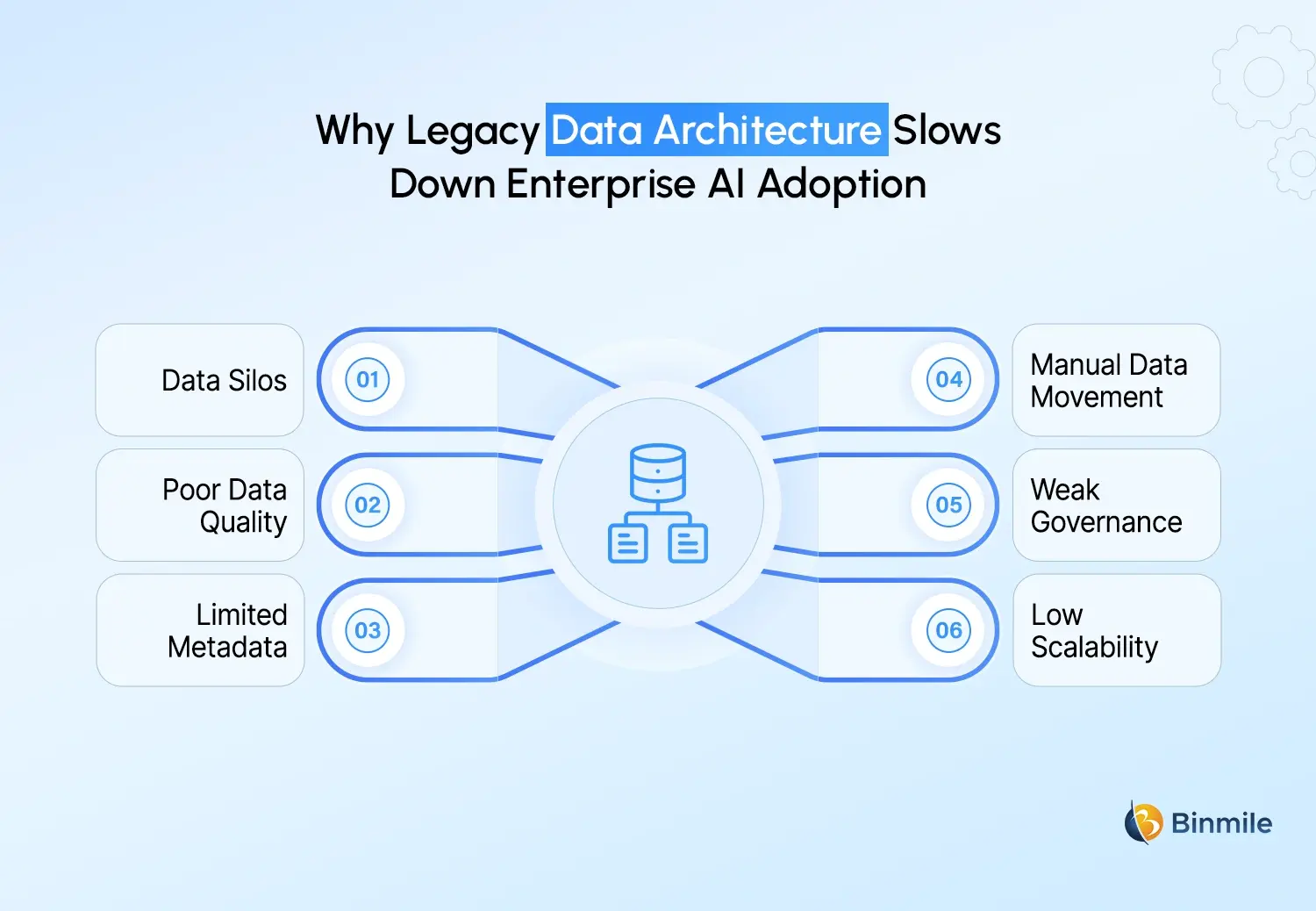
Many enterprises are still working with legacy data architecture that was built for old reporting needs, not modern AI systems. Additionally, these setups may work for basic dashboards, but they often struggle when the business wants real-time insights, automation, or AI-driven decision-making.
Some common problems include:
-
Data Silos
Each unit within the company stores its own data separately from other units, making it difficult for the whole organization to reach one view of the business.
-
Poor Data Quality
Inaccurate, incomplete, and inconsistent data limit your ability to trust the results produced using analytics or AI.
-
Limited Metadata
Team members may not know where the data came from, who owns it, how fresh the data is, or if it can be used for AI.
-
Manual Data Movement
A significant amount of time is spent by data teams in the extraction, cleaning, and preparation of data instead of focusing on building AI use cases that add value.
-
Weak Governance
A lack of ownership, clear access controls, data lineage, and data quality checks exposes the business to increased risk of compliance and security violations.
-
Low Scalability
Legacy systems were originally designed to support limited volumes of data and will not handle large volumes of structured and unstructured data; therefore, they cannot effectively support enterprise-level AI applications.
These issues slow down AI Readiness because they create uncertainty. If leaders cannot trust the data, they cannot trust the AI built on top of it.
What Makes Data Architecture AI-Ready?
An AI-ready architecture is not just a collection of databases and cloud tools. It is a connected system that supports data discovery, quality, governance, access, security, interoperability, and reuse.
Here is a practical view:
| AI-Ready Capability | What It Means | Why It Matters |
|---|---|---|
| Unified Data Access | Data from multiple systems is connected through a common layer. | Helps AI access broader business context. |
| Data Quality Management | Data is cleaned, validated, standardized, and monitored. | Reduces wrong outputs and poor decisions. |
| Metadata and Lineage | Teams know where the data came from and how it changed. | Improves trust, auditability, and compliance. |
| Governance | Policies define ownership, access, privacy, and usage. | Supports responsible and secure AI adoption. |
| Cloud Scalability | Data platforms can handle growing volume and complexity. | Enables faster AI experimentation and deployment. |
| Real-time Integration | Data updates flow continuously across systems. | Supports automation, alerts, and intelligent workflows. |
| Unstructured Data Readiness | PDFs, emails, images, documents, and tickets become usable. | Enables generative AI and enterprise search use cases. |
What Are the Principles of AI-Ready Data Architecture
The Principles of AI-Ready Data Architecture should guide every enterprise data initiative. These principles help businesses avoid tool-first decisions and focus on what AI actually needs to work at scale.
1. Build Around Business Use Cases
Drive your use cases with the business goal first instead of starting with a tech platform. Additionally, understand how AI will help you in forecasting, automating support, reducing risk, and personalizing. Also, prioritize the data you need for those outcomes.
2. Create a Unified View of Data
For an AI project to work successfully, it is critical to create a unified data ecosystem architecture. This combines structured and unstructured data, enabling teams to find, access, govern, and use it readily and efficiently.
3. Treat Data as a Product
With a data-centric approach, the data management framework should be thought of as reusable business assets. Additionally, by making sure that there is clear data ownership, definition, and quality rules. Also, access standards, enterprise data is more consistent and available for Artificial Intelligence initiatives.
4. Make Governance Part of the Architecture
Governance should be included as part of your AI implementation’s infrastructure. By embedding governance in your pipelines, catalogs, access controls, and workflows. You can ensure the security, compliance, and trustworthiness of your data and ensure that it is used responsibly.
5. Design for Real-Time and Batch Needs
When AI projects are implemented, some need batch data, while others need to be updated on a near-real-time basis. AI-ready architectural design should provide both types of data needs. This will have the scalability to meet future AI use cases without having to rebuild the overall foundation.
Ready to turn scattered enterprise data into a reliable AI-ready foundation?

How to Build a Data Architecture Blueprint for AI
A Data Architecture Blueprint helps enterprises move from scattered data systems to a practical, scalable, and AI-ready foundation. Additionally, it gives leaders a clear roadmap instead of random modernization efforts.
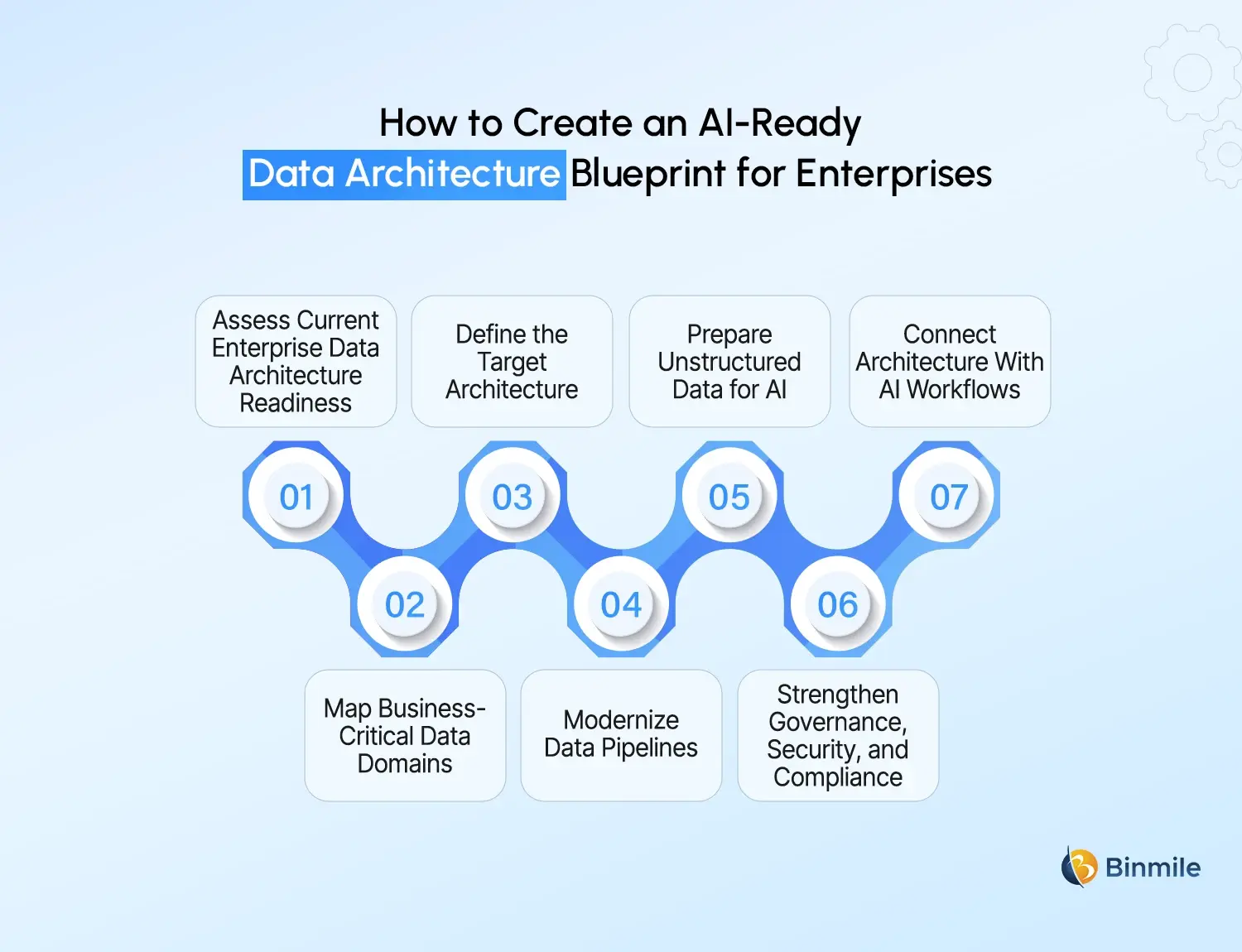
Step 1: Assess Current Enterprise Data Architecture Readiness
Evaluate existing systems, data sources, integration methods, governance processes, security, data quality, and AI Use Cases to determine any gaps, risks, or priorities.
Step 2: Map Business-Critical Data Domains
Identify the key data regions, such as Customers, Products, Transactions, Operations, Employees, or Assets, that are required to effectively support the Business and AI Outcomes.
Step 3: Define the Target Architecture
Define how the data will flow from one system/platform to another and through all the AI Workflows. Additionally, while a general data architecture framework can provide direction on how to create that structure, the result should align with the business needs.
Step 4: Modernize Data Pipelines
Leverage the latest data engineering services to establish automated, scalable, clean, validate, transform, monitor, and deliver reliable data that can be utilized for AI.
Step 5: Prepare Unstructured Data for AI
Actively create access points for PDFs, Contracts, Emails/Tickets/Chat Logs, Manuals, etc. through Extracting, Tagging, Indexing, Metadata Enrichment, Vector Search, Secure Access Controls, etc.
Step 6: Strengthen Governance, Security, and Compliance
Utilize Role-Based Access Control, Encryption, Masking, Retention Policies, Audit Trails, and Classification to Protect Sensitive Data and Enable Responsible AI Adoption.
Step 7: Connect Architecture With AI Workflows
Connect together the Data Foundation, AI Solutions, Data Visualization Tools, Machine Learning Models, and Automation Workflows for Quick Decision Making and Intelligent Operations.
Role of Data Modernization and Cloud Modernization
Modernization of Cloud and data modernization facilitates businesses to convert their outdated, disjointed, and rigid systems to scalable platforms, facilitating analytics, AI, and automation. Additionally, this could include, but is not limited to, transitioning from traditional warehouses to cloud-based data platforms, establishing lakehouse architectures, enhancing data integration efforts, and modernizing legacy databases.
Cloud modernization enhances the data architecture in enterprises by providing teams with scalable storage, elastic computing capabilities, faster integration options, and improved support for AI workloads. Additionally, businesses will be able to manage structured data and use AI for unstructured data more effectively using hybrid or multiple cloud environments.
However, obtaining a cloud standard by itself does not guarantee that the data is ready to be used within an AI-trained environment. Additionally, businesses must still have data governance, data quality management, data integration, data security, and data architectural planning processes in place to use AI effectively. Poorly governed data lakes will ultimately become just another cluttered data storage site.
Agentic AI-Ready Data Architecture
Moving from generative artificial intelligence to autonomous AI agents means an increase in the architectural capabilities of organizations. Additionally, an autonomous AI-ready data architecture must provide real-time context for the agent, secure access to tooling, enforce policy compliance and security, support event-driven workflows, and ensure that every decision is traceable.
AI agents may need to read data, initiate workflows, and modify data within various systems. Also, raise service tickets for IT support, approve an action, or recommend an alternative decision. Thus, governing AI agents and having sufficient control over their actions becomes increasingly important. Additionally, the architecture must define how agents will access data and which actions they will be allowed to perform. Whether human approvals must be obtained before performing any action, and how all actions will be logged.
In addition, organizations will require that the future of AI within their organization is not only dependent on the capabilities of AI models but also on how mature their data architecture is.
Need a scalable data architecture blueprint to support AI, automation, and smarter decision-making?

How Binmile Can Help Build an AI-Ready Data Architecture
Building an AI-ready foundation requires more than selecting a data platform. It needs the right strategy, architecture planning, engineering execution, and governance model. Also, the modernization roadmap. Binmile supports enterprises by helping them assess existing data environments, identify architecture gaps, and modernize legacy systems. Also, design scalable data ecosystems and implement secure, governed, AI-ready data platforms.
From data strategy consulting and data architecture services to cloud modernization, data engineering, AI readiness, data governance, and enterprise application modernization, the team helps businesses create a practical foundation for AI adoption. Additionally, the focus is on building data systems that are not only technically strong but also aligned with business goals and compliance needs. Also, operational workflows and long-term transformation priorities.
Frequently Asked Questions
Enterprise Data Architecture defines how business data is collected, stored, integrated, governed, and used across systems. It is critical for AI because models need clean, connected, secure, and reliable data to deliver accurate business outcomes.
It creates a trusted foundation for analytics, automation, and AI workflows. By connecting data across departments, improving quality, and enabling governance, enterprises can move from isolated pilots to scalable AI-driven business transformation.
Organizations can assess data quality, system integration, governance maturity, metadata availability, cloud readiness, security controls, and AI use case requirements. This helps reveal silos, duplicate data, weak ownership, outdated pipelines, and compliance risks.
Data silos limit AI’s ability to understand the complete business context. When customer, operational, financial, or product data sits in disconnected systems, AI models produce incomplete insights, inconsistent recommendations, and less reliable decisions.
Data governance defines ownership, access, quality rules, privacy controls, lineage, and usage policies. It ensures enterprise data is trustworthy, compliant, secure, and suitable for AI, analytics, automation, and decision-making.
Cloud modernization provides scalable storage, flexible computing power, faster integration, and better support for AI workloads. It helps enterprises manage growing data volumes, modernize pipelines, and support structured and unstructured data more efficiently.
A technology partner brings strategy, architecture, engineering, governance, and modernization expertise together. This helps enterprises avoid fragmented efforts, reduce implementation risks, accelerate AI readiness, and build a scalable data foundation aligned with business goals.