Organizations have ceased questioning whether they want to transition to using the cloud; the question now becomes how quickly they are able to do so in order to remain competitive. According to the Flexera 2026 Industry Report, 73% of enterprises have implemented a multi-cloud strategy, indicating just how much of an impact cloud technology has had on how businesses operate today.
Digital transformation projects have increasingly relied upon cloud technology as the fundamental basis for success. In almost every industry, cloud technologies are used to help modernize legacy applications, develop intelligent software applications, and enhance customer experience. This blog will look at what cloud adoption means to an organization, why it is so important to the success of their digital initiatives, how to implement different architecting models/frameworks/roadmaps for cloud-based solutions, potential issues faced when implementing cloud solutions, tools and resources available to facilitate this process, and the development of an enterprise-wide cloud adoption strategy that supports long-term business expansions.
What Is Cloud Adoption and Why Is It Important for Digital Transformation?
Cloud adoption refers to the process of integrating cloud-based infrastructure, platforms, and services into an organization’s IT ecosystem. Cloud adoption is not exclusively about technology but instead represents an organization’s strategic plan to modernize its operations, increase productivity, and support long-term success.
In addition, through cloud infrastructure’s ability to overcome legacy IT infrastructure constraints, cloud adoption has enabled businesses to make meaningful progress toward digital transformation and cloud adoption. The benefits of using cloud technology, like just-in-time scalability, faster deployment times, global accessibility, integrated analytics capabilities, and lower infrastructure costs, have also allowed companies to innovate and develop better customer experiences while fulfilling their agile business needs at the same time. As such, cloud adoption is the most critical component of a successful digital transformation roadmap.
What are the Key Benefits of Cloud Adoption for Enterprises
Cloud adoption delivers value far beyond IT modernization. It directly impacts business performance, agility, and innovation.
1. Improved Business Agility
Organizations have the ability to quickly adjust their IT resources (scale up or scale down) as needed, as well as build/deploy applications faster and react to changes in the marketplace when utilizing a cloud environment. This level of business improvement can be essential for organizations to continue to remain competitive in an industry where time is often the key to success.
2. Reduced Operational Costs
Using the cloud eliminates the need for organizations to spend large amounts of money upfront on hardware and infrastructure. Businesses can now use a “pay-as-you-go” model, therefore optimizing the economic benefits and minimizing any waste associated with operating an IT (information technology) department.
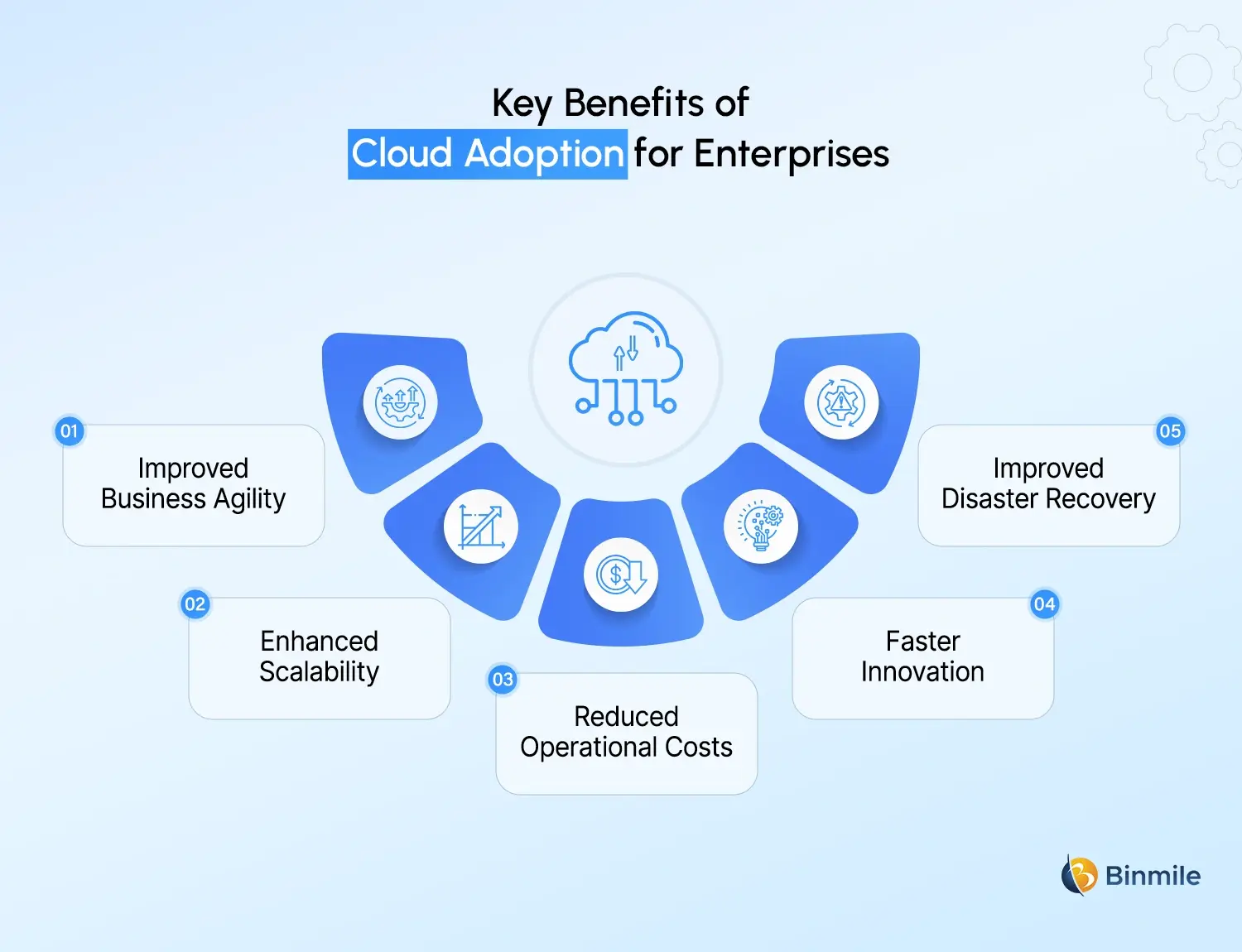
3. Enhanced Scalability
With cloud technologies, businesses have the ability to scale IT resources on demand. This type of dynamic resource allocation is particularly beneficial for companies with changing workloads or seasonal spikes in demand.
4. Faster Innovation
As a result of the use of cloud services, businesses can shorten their time to market due to access to advanced computing resources such as Artificial Intelligence (AI) services, advanced analytics platforms, and automation tools.
5. Improved Disaster Recovery
Since cloud platforms have redundancy built in, organizations can reduce the risk of long-term outages due to a disaster and ensure business continuity through their cloud service provider.
Understanding Different Cloud Adoption Models for Modern Enterprises
Selecting the right cloud adoption models is critical for building a successful strategy. Each model offers different levels of control, flexibility, and scalability.
-
Public Cloud
A hosted service offered via the internet, public cloud environments are third-party managed and shared among multiple consumers. A major benefit of this type of cloud environment is cost savings, as well as the ability to scale and deploy quickly.
-
Private Cloud
The private cloud is a dedicated cloud infrastructure that an organization has authority over, allowing the organization increased control, security, and compliance over its data and systems, which makes it ideal for use by organizations in industries under strict regulatory guidelines.
-
Hybrid Cloud Adoption
Hybrid cloud usage combines the two types of clouds described above, allowing organizations to maintain the security of sensitive workloads while still having the scalability offered by the public cloud for other workloads.
-
Multicloud Adoption
Multicloud usage is defined as accessing services and/or data from multiple cloud providers. By using multiple vendors, organizations reduce their reliance on one specific vendor, improve their ability to withstand a disruption in service, and can select the best service option from the available cloud service providers.
Building a Cloud Adoption Framework for Successful Transformation
A structured cloud adoption framework helps enterprises plan and execute cloud transformation effectively.
-
Strategy and Planning
Develop business objectives, transformation objectives, and predict results prior to initiating the cloud migration process.
-
Governance
Create consistent cost control, compliance, and operational rules in order to provide uniform governing principles for businesses operating in multiple environments.
-
Security
Safeguard your cloud environments with identity management, privacy, and continuous monitoring.
-
Migration Planning
Identify workloads for phased migration using criteria such as business value, complexity, and priority.
-
Optimization
Remain vigilant in monitoring and optimizing cloud-based resources for performance and cost efficiency regularly.
Struggling with legacy systems or unclear cloud architecture decisions? Build a structured cloud adoption roadmap that drives measurable transformation.

Developing an Effective Cloud Adoption Strategy for Enterprises
Enterprises must have strong cloud adoption statistics for technology and business goals to align, define business results – such as improved agility, cost savings, innovation, and better customer experience – before migrating to the Cloud.
Also, to determine the best models, build a scalable and secure architecture, implement a governance framework, and develop a phased migration strategy to reduce operational disruption. Enterprises with a clearly defined Cloud Adoption Strategy can mitigate unnecessary risks, take advantage of their Cloud investment, and ensure the long-term success of their enterprise.
Creating a Cloud Adoption Roadmap for Enterprise Transformation
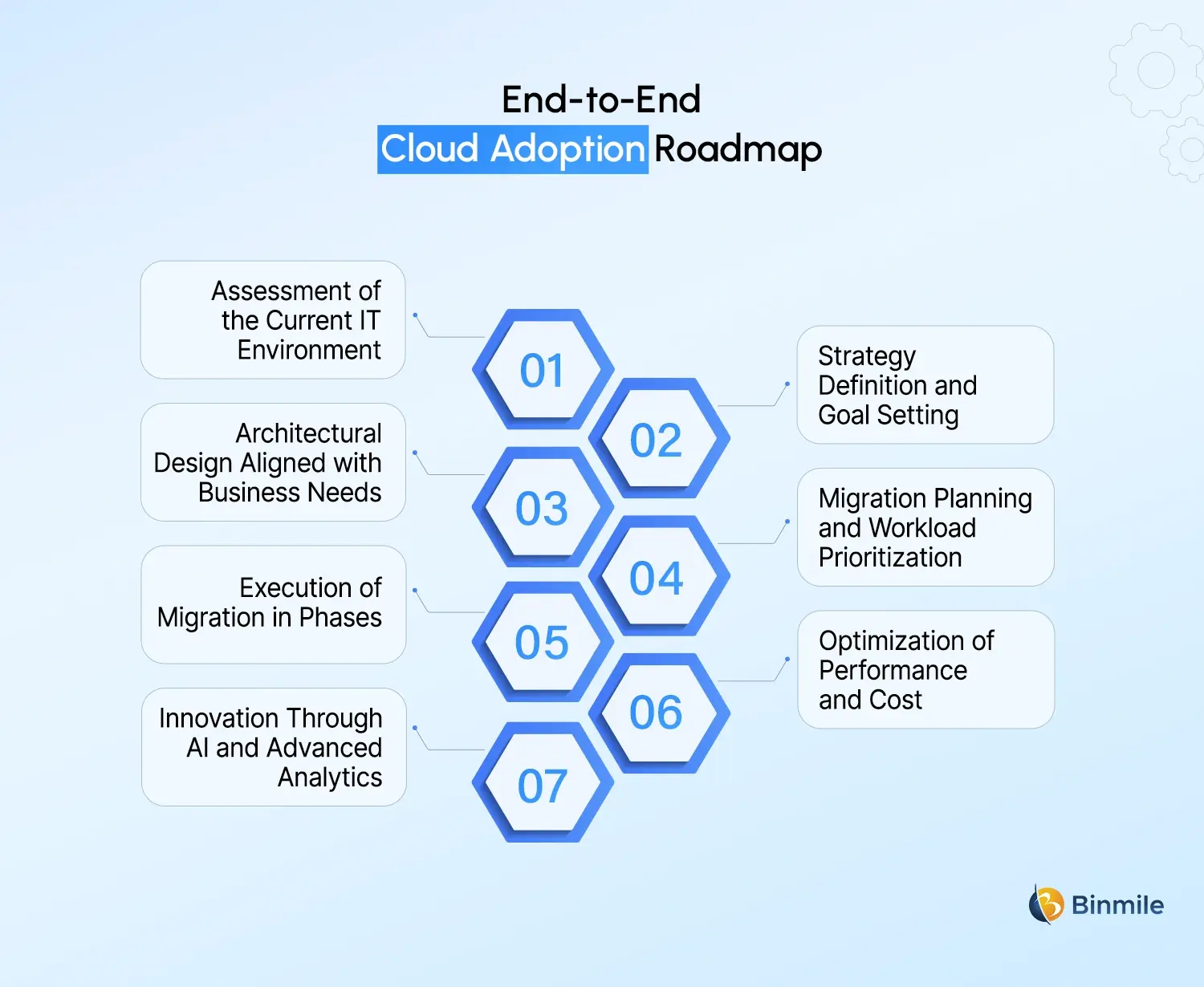
A cloud adoption roadmap provides a structured and phased approach to cloud transformation, helping organizations minimize risks and maximize business value.
-
Assess the Current IT Environment
The first step in migrating to the cloud is to evaluate your organization’s current applications, infrastructure, workloads, and dependencies. This evaluation will help you find opportunities for migration and hurdles that may hinder your path to the cloud.
-
Define Business Goals and Cloud Strategy
Once you have a complete understanding of where your organization is currently, it is time to identify your goals for transformation. This includes the establishment of clear objectives, expected outcomes, and success metrics for transformation efforts. Additionally, organizations should define the role of cloud adoption in cloud computing, supporting overall business priorities.
-
Design the Right Cloud Architecture
With business goals and cloud objectives clearly defined, now is the time to develop the right cloud computing architecture that meets your organization’s scalability, security, compliance, and performance expectations. Choosing the right cloud strategy architecture will be one of the keys to achieving long-term success with cloud computing.
-
Prioritize Workloads for Migration
Not all applications or workloads should be migrated to the cloud at once; therefore, you need to prioritize the workloads you migrate based on the value they add to the organization, their complexity, and their risk level.
-
Execute Migration in Phases
To minimize disruption during the migration process, implement your migration in phases. This will allow you to identify and resolve issues sooner, as well as optimize processes throughout the entire migration process.
-
Optimize Performance and Costs
Once you have successfully migrated your workloads to the cloud, it is important that you continue to monitor your resource utilization, improve your efficiencies, and manage your cloud spending.
-
Drive Innovation Through AI and Analytics
After creating a stable cloud environment, organizations have the opportunity to leverage advanced technologies to further increase the value they derive from their IT investments. Advanced technologies such as enterprise AI strategy, machine learning, and real-time analytics can be utilized to create new opportunities for growth and innovation.
This structured approach reduces complexity and ensures smoother transformation.
Understanding the Major Challenges of Cloud Adoption
There are a lot of pros to adopting the Cloud; however, organizations deal with many obstacles due to things like migrating existing systems, ensuring compliance, maintaining security, controlling costs, and having the right skillset. Some legacy systems need to be updated and improved before they can move to the cloud; a lack of proper monitoring could cause costs associated with the cloud to increase.
Furthermore, a lot of organizations do not have the specialized expertise needed to effectively manage a cloud environment, so having expert support and doing proper strategic planning are both critical components for success when transitioning.
Best Practices for Successful Cloud Adoption
Organizations that achieve successful cloud transformation typically follow a set of proven best practices.
-
Align Cloud Initiatives with Business Objectives
The cloud should be adopted in order to attain measurable (quantitative) business goals such as increasing agility, improving the customer experience, increasing operational efficiency or increasing revenue.
-
Conduct a Detailed Workload Assessment
Before moving workloads to the cloud, it is important to evaluate all applications/workloads to identify their readiness for migration, their dependencies on other applications/workloads, and their potential business impacts.
-
Adopt a Phased Migration Approach
Instead of migrating all workloads at once, migrate them in phases in order to mitigate the risk of operational issues and increase the likelihood of successful migration.
-
Establish Strong Governance and Security Controls
Policies need to be established to ensure that access management, compliance, cost control, and security monitoring across the different cloud environments will be consistent.
-
Continuously Optimize Cloud Resources
Organizations need to monitor their cloud resources regularly to optimize operational performance, minimize waste, and maximize returns from investments in cloud services.
-
Invest in Employee Training and Upskilling
Developing internal cloud expertise empowers organizations with the ability to successfully manage their cloud environment and stay current with evolving cloud technology.
The Role of Cloud Adoption Services in Enterprise Transformation
Cloud transformation is an intricate process that enterprises face when converting their business operations to take advantage of the newest technologies. For enterprises that still utilize legacy systems or have significant data loads managed on-premises, cloud transformation may be complicated. Cloud adoption services provide enterprises with assistance within their cloud transformation process by offering services such as cloud readiness assessments, migration planning, system architecture design (hardware and software), implementation of security functions, and continued optimization of the systems after they are in operation.
With the assistance of expert consultants, enterprises are able to mitigate risks associated with migrating their existing IT systems to the cloud, speed up the process of deploying the new systems, and develop a cloud-first strategy for their cloud deployments that aligns with their long-term business objectives. Additionally, these services support enterprises in selecting the appropriate model (private, hybrid, or public) for their cloud migrations, increasing performance, and maintaining cost efficiency during their cloud transformation process.
Ready to accelerate your cloud adoption journey and build a scalable digital foundation that supports long-term growth?

How Binmile Supports Cloud Adoption and Digital Transformation
Successful cloud transformation requires more than migration. It demands a clear strategy, the right architecture, strong governance, and continuous optimization aligned with business objectives. In enterprise transformation programs, Binmile plays a supporting role by helping organizations design scalable cloud adoption frameworks, modernize legacy systems, and build cloud-native architectures that align with long-term digital goals.
With expertise in cloud modernization, enterprise digital transformation, cloud consulting services, and AI-ready infrastructure, organizations can streamline their migration journey while ensuring performance, security, and cost efficiency remain balanced throughout the process. This structured approach helps businesses move beyond basic adoption and into intelligent, scalable cloud ecosystems that support future innovation.
Frequently Asked Questions
Cloud adoption in digital transformation refers to the process of integrating cloud technologies into business operations to improve agility, scalability, and innovation. It enables organizations to modernize infrastructure and support advanced technologies like AI and analytics.
Cloud adoption improves business agility by allowing organizations to scale resources on demand, deploy applications faster, and respond quickly to changing market conditions. This flexibility enhances innovation and operational speed.
Yes, cloud adoption can reduce operational costs by eliminating upfront infrastructure investments and shifting to a usage-based pricing model. However, proper management and optimization are required to maintain cost efficiency.
Cloud adoption strengthens cybersecurity through encryption, identity management, automated threat detection, and continuous monitoring systems. These tools help organizations protect sensitive data more effectively.
Cloud adoption supports business growth by enabling faster innovation, global scalability, improved operational efficiency, and quicker market expansion without heavy infrastructure limitations.
Cloud adoption improves customer experience by enhancing application performance, reducing downtime, and enabling real-time personalization through data-driven insights.