Artificial intelligence is rapidly becoming a core part of enterprise operations, from customer service and software development to cybersecurity and strategic decision-making. While AI offers significant business opportunities, it also introduces new risks. According to reports, the AI guardrail market is growing from $2.5 billion in 2025 to $3.09 billion in 2026.
As companies increase their use of Artificial Intelligence at scale to improve business, they are starting to see an increased focus on data leakage, incorrect results, compliance failures, and automated decision-making as more serious issues. AI guardrails are an important component of creating safeguards for these types of risks. In this blog, we examine the types of AI guardrails available to organizations and how they can use them in their enterprise risk security management efforts, along with appropriate governance strategies to establish an AI-based system that is trustworthy.
What Are AI Guardrails?
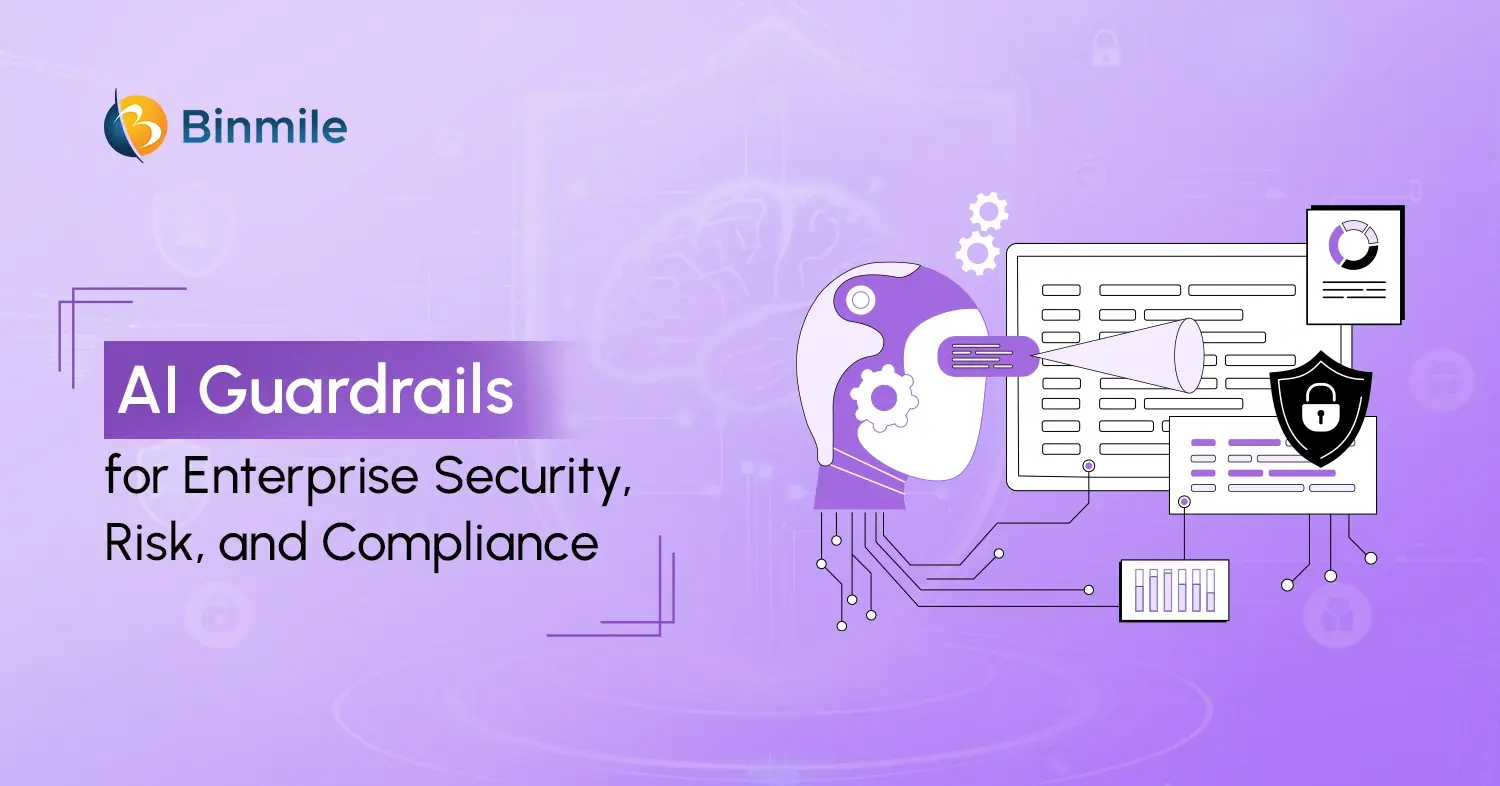
AI Guardrails are policies, controls, monitoring mechanisms, and technical safeguards designed to ensure AI systems operate within predefined boundaries.
Think of them as the safety infrastructure surrounding an AI system. While AI models generate outputs and make recommendations, guardrails determine what is allowed, what should be blocked, and when human intervention is required. Modern enterprise artificial intelligence solutions increasingly incorporate guardrails as a foundational layer for responsible AI adoption.
AI guardrails help enterprises prevent unauthorized data exposure, reduce harmful or inaccurate outputs, enforce compliance requirements, and maintain transparency across AI-driven processes. They also improve trust in AI-powered decisions while protecting organizational assets, customer data, and business reputation. Simply put, AI models provide intelligence while guardrails provide control.
Why AI Risks Are Growing Faster Than Enterprise Controls
Enterprise AI adoption has accelerated dramatically over the last few years. Employees are using generative AI tools for content creation, developers are relying on AI coding assistants, customer support teams are deploying AI chatbots, and organizations are experimenting with autonomous AI agents.
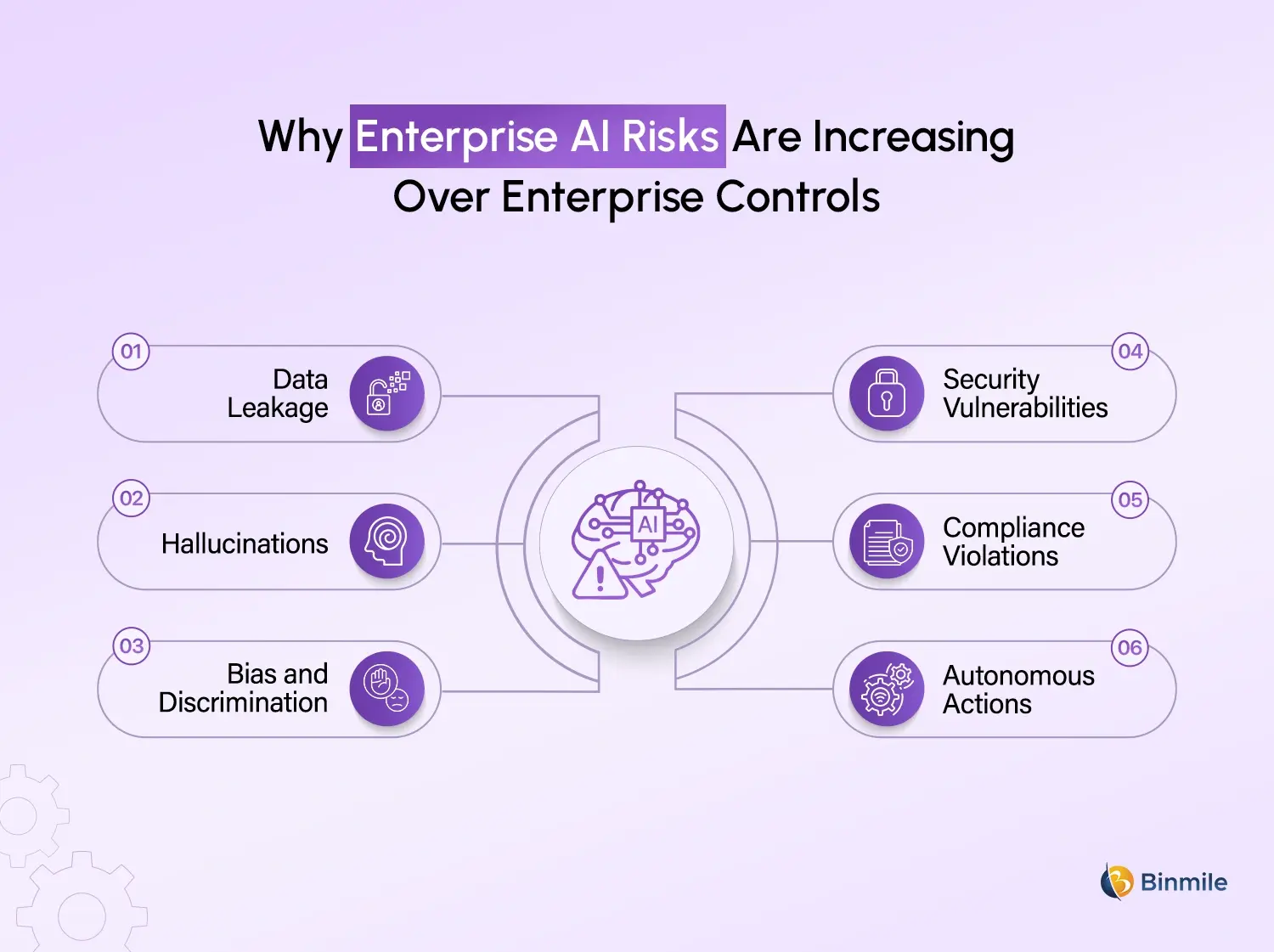
However, governance frameworks have not evolved at the same pace. Some common enterprise AI risks:
-
Data Leakage
AI Systems process many types of Sensitive Data. They can leak sensitive Data as well when adequate controls are not in place, violating Privacy, resulting in Regulatory Penalties, and Loss of Customer Trust.
-
Hallucinations
AI Models may produce AI-generated content that is incorrect but appears to be correct, which ultimately results in poor decision-making, mistakes in operations, and Unreliable Performance when used in the Enterprise.
-
Bias and Discrimination
The use of Biased Data and/or the lack of monitoring of an AI Model may expose the organization to Legal, Regulatory, or reputational risk, whether the outcome is considered an Unfair Outcome.
-
Security Vulnerabilities
Organizations leveraging enterprise cybersecurity solutions are increasingly extending their security controls to cover AI systems and large language models.
-
Compliance Violations
It is the responsibility of the organization to comply with all regulations as they relate to the use of AI Systems; otherwise, the organization may incur penalties, audits, or Legal Liability.
-
Autonomous Actions
As AI technology continues to mature, unattended AI operations will introduce Operational Disruptions and increased Business Risk.
Why Enterprises Cannot Rely on AI Models Alone
Many organizations assume that choosing a reputable AI model automatically addresses governance concerns. However, even advanced models can generate inaccurate outputs, expose sensitive information, or behave unpredictably. Leading AI governance consulting and AI governance framework consulting providers recommend treating AI governance as a business-wide initiative rather than a standalone technology project.
AI models are designed to generate responses, not enforce governance requirements. For example, a chatbot may reveal internal information, a coding assistant may suggest insecure code, or an AI agent may act beyond its intended scope. Without proper guardrail implementation, these issues can quickly translate into business risks.
This is why organizations are increasingly investing in AI governance consulting services and enterprise-wide governance frameworks.
Types of AI Guardrails Every Enterprise Should Implement
Not all guardrails serve the same purpose. Effective AI governance requires multiple layers of protection.
-
Input Guardrails
Input control systems guard inputs (the data to be used by AI systems). They help to stop harmful prompt use, block prompt injections, check that data is correct, and ensure there are controls around confidential data.
-
Output Guardrails
Output control systems audit outputs (the outputs produced by the AI system) before the outputs reach end-users. They help to find incorrect output, remove confidential information from the output, and verify that the outputs conform to the organization’s policies.
-
Access Guardrails
Access control systems govern who (and what) is allowed to access AI systems. Typical access control systems can include: authentication systems, identity verification, and role-based access controls.
-
Human Oversight Guardrails
Certain decisions cannot be fully automated. Having human intervention ensures that critical decisions have a second check, that there is continued accountability, and that high-risk decisions have been effectively approved.
-
Monitoring and Audit Guardrails
Monitoring control systems provides insight into AI systems, allowing an organization to monitor overall system performance, identify breaches of policy, and provide evidence to demonstrate compliance.
OpenAI Guardrails vs Azure AI Guardrails
Many enterprises evaluate multiple AI platforms when building governance frameworks.
| Capability | OpenAI Guardrails | Azure AI Guardrails |
|---|---|---|
| Core Focus | Safe AI interactions and output management | Responsible AI governance within the Microsoft ecosystem |
| Content Moderation | Strong content filtering and moderation capabilities | Built-in content safety controls |
| Prompt Protection | Prompt validation and misuse prevention | Security and governance-focused prompt controls |
| Data Protection | Safety-focused controls | Enterprise-grade data protection mechanisms |
| Compliance Support | Risk mitigation and responsible AI controls | Extensive compliance and governance capabilities |
| Access Governance | Limited compared to broader platform controls | Integrated identity and access governance |
| Monitoring | Output monitoring and safety reviews | Security monitoring and enterprise oversight |
| Best Suited For | Organizations building AI applications across platforms | Enterprises already leveraging Microsoft technologies |
The right choice depends on business requirements, regulatory obligations, and existing technology investments. Organizations evaluating platforms such as OpenAI, Azure AI, or solutions like Claude Mythos should assess governance capabilities alongside model performance.
The Growing Importance of Agentic AI Guardrails
As organizations implement more autonomous AI systems, a variety of challenges will arise. While traditional AI can only produce a response, agentic AI can do far more: It can plan/execute tasks, make decisions, and take action with limited human intervention. While this will present a new and exciting opportunity for businesses to achieve greater efficiency in their operations, it also has the potential to create new risks.
Agentic AI provides guardrails to help organizations regulate autonomous agents’ decision-making authority, resources available to autonomous agents, workflows executed by autonomous agents, interactions with external systems, and escalation procedures between autonomous agents and human operators. Each of these controls, when properly set in place, will assist in ensuring that autonomous agents are operating within a clearly defined set of parameters and are aligned with the goals and objectives of the business. If autonomous agents do not have appropriate oversight, they may inadvertently engage in unsafe activities or create operational disruptions or security breaches.
As enterprises advance their AI capabilities, agentic governance will become a critical component of Enterprise AI Strategy and long-term AI in Business Strategy initiatives.
Ensure every AI initiative is backed by the right governance, security controls, and compliance safeguards from day one.

Technical Guardrails That Protect Enterprise Systems
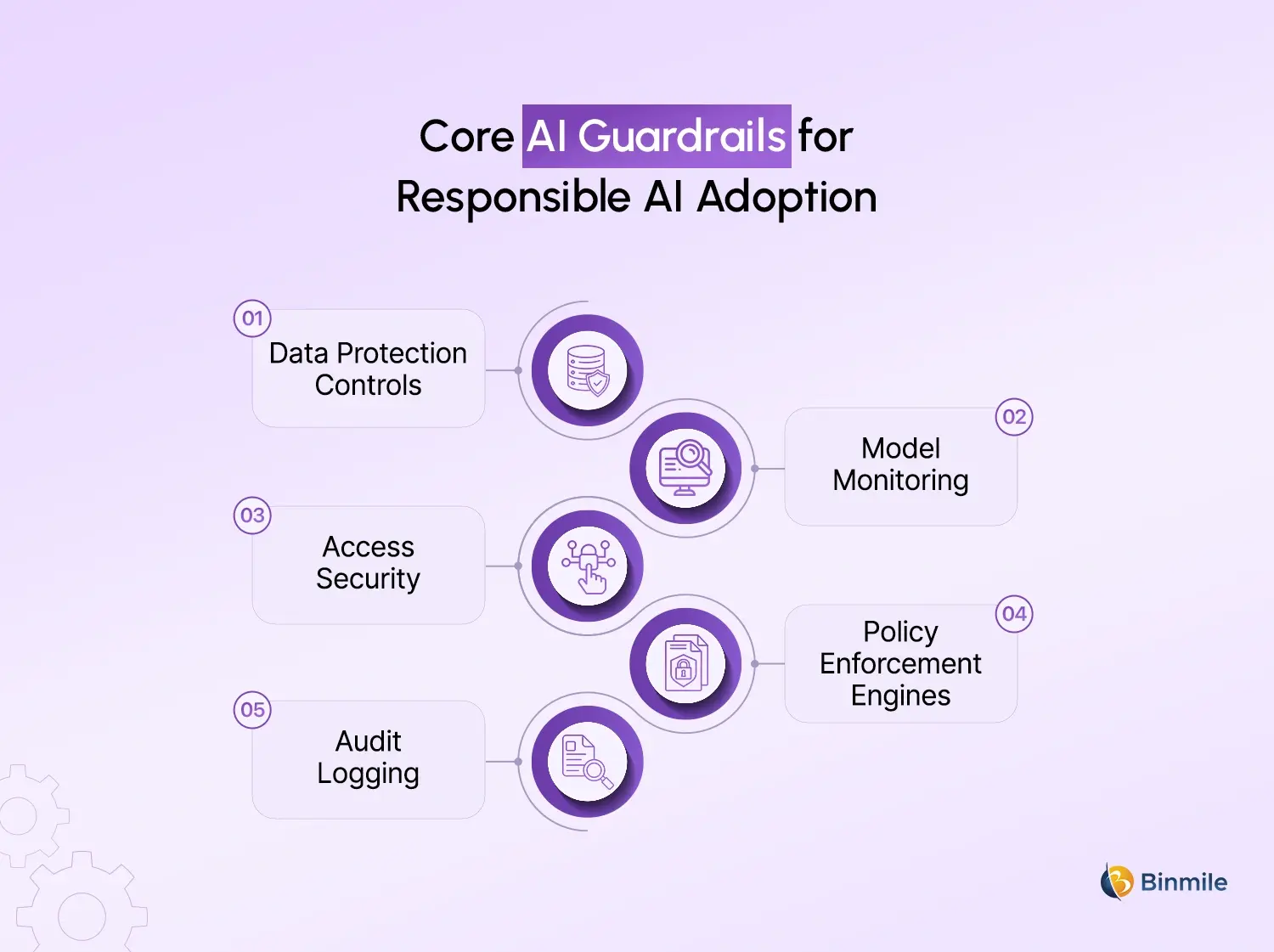
Technical Guardrails form the operational foundation of AI governance. These safeguards work behind the scenes to maintain security, reliability, and compliance. Important Technical Guardrails include:
-
Data Protection Controls
Controls to protect sensitive data during the entire lifecycle of an AI solution include encryption, data masking, tokenization, and data loss prevention. These controls become even more important when AI systems are integrated with Data Engineering Solutions that process large volumes of enterprise data.
-
Model Monitoring
Continuous monitoring allows for the early identification of model drift, abnormal behavior, performance issues, and new risks to prevent disruption of business operations.
-
Access Security
Access security is achieved through multi-factor authentication, identity governance, and role-based access control. These security controls ensure that only authorized users can access the AI system.
-
Policy Enforcement Engines
Policy enforcement mechanisms also complement cloud governance solutions by ensuring consistent compliance across cloud-based AI deployments. These engines automatically evaluate AI activity against the organization’s rules to prevent unauthorized actions, ensure compliance, and send alerts of any violations.
-
Audit Logging
Audit logs contain all information related to the use of AI systems and provide a complete record of all incidents and regulatory compliance that occurred, allowing increased visibility into AI system usage.
The Connection Between AI Guardrails and AI Governance
While most organizations consider ‘guardrails’ to be technical restrictions and ‘governance’ to be a function of business, they actually have a much stronger connection to each other.
AI Governance develops the necessary policy, procedures, accountability frameworks, and risk-management procedures for how the use of AI will be governed within an organization. AI guardrails enforce those governance policies/requirements within the AI systems and workflows in which it is utilized.
Governance provides the overall direction for the use of AI, and without the guardrails, there is no enforcement of the policy, and thus the governance remains on paper. In tandem, these two elements of an overall AI Governance Strategy (Guardrails and Governance) serve as the foundation for a strong governance strategy regarding the use of AI by organizations.
AI Governance Best Practices for Enterprise Adoption
Organizations that successfully scale AI typically follow several common governance principles.
-
Establish Executive Ownership
Executive Ownership of AI will help ensure that AI is aligned with your organization’s objectives, risk tolerance, and compliance needs.
-
Create Clear Governance Policies
Governance Policies are necessary to define your organization’s use of data, privacy, security, Ethical AI practices, and regulatory obligations.
-
Conduct Risk Assessments
All AI initiatives should be assessed for risks prior to deployment. This includes identifying security, compliance, and operational risks early in the lifecycle of an AI solution.
-
Implement Continuous Monitoring
Continuous monitoring also strengthens Cyber Threat Intelligence for Enterprises by helping security teams detect unusual AI behavior and emerging threats.
-
Maintain Transparency
Transparency about how the AI system is working, what data is being used, how decisions are being made, and maintaining accountability through stakeholders helps create trust in AI.
-
Prioritize Human Oversight
For high-risk decisions such as financial, legal, operational, compliance, or other decisions, retaining Human Oversight is critical to validating AI outputs, reducing errors, and ensuring accountability.
Building an Enterprise AI Guardrail Framework
A successful AI Guardrail Framework typically consists of several interconnected layers.
| Framework Layer | Purpose |
|---|---|
| Governance Layer | Policies, accountability, and oversight |
| Security Layer | Data protection and access controls |
| Compliance Layer | Regulatory adherence and reporting |
| Monitoring Layer | Continuous visibility and auditing |
| Operational Layer | Workflow and process controls |
| Human Oversight Layer | Review and escalation mechanisms |
Organizations often partner with an AI governance consulting partner to design frameworks tailored to their specific industry and risk profile.
The framework should align with broader enterprise software solutions, data engineering solutions, enterprise cybersecurity solutions, and cloud governance solutions.
Industry Examples of AI Governance Guardrails
Different industries face different risk profiles.
-
Financial Services
AI guardrails aid banks in preventing fraud, safeguarding customer information, supporting compliance, and enhancing transparency in automated decision-making.
-
Healthcare
AI guardrails are being used by healthcare to protect patient records, minimize errors, and achieve compliance with regulations.
-
Manufacturing
Manufacturers implement AI controls to enhance operational reliability, secure interlinked systems, and oversee automated workflow processes.
-
Retail
Retailers will implement effective AI governance to protect customer privacy, provide accurate recommendations, detect fraud, and maintain brand integrity.
These examples demonstrate how guardrail implementation must reflect industry-specific requirements.
Build a secure, compliant, and scalable AI governance framework that protects your business while maximizing AI value.

How the Right Governance Partner Accelerates Responsible AI Adoption
Building enterprise-grade AI governance requires more than deploying a model or implementing a few security controls. Organizations need a structured approach that connects technology, risk management, compliance, and business objectives. This often involves aligning AI initiatives with broader Enterprise AI Strategy goals, integrating governance into AI in Business Strategy, and ensuring that AI systems operate within clearly defined risk boundaries.
A practical approach combines governance frameworks, security controls, monitoring capabilities, and operational oversight into a unified model. This is where experienced implementation partners can help enterprises move from experimentation to responsible scale. With expertise spanning enterprise artificial intelligence, cybersecurity, cloud governance, and data engineering, organizations can establish governance structures that reduce risk without slowing innovation. Binmile helps enterprises build these governance foundations by combining technical implementation expertise with strategic guidance, enabling businesses to adopt AI confidently while maintaining security, compliance, and operational control.
Frequently Asked Questions
AI guardrails are governance controls, security measures, monitoring systems, and operational policies that help enterprises ensure AI systems behave safely, comply with regulations, protect sensitive data, and align with business objectives.
AI guardrails strengthen security by restricting unauthorized access, preventing sensitive data exposure, detecting risky outputs, monitoring system behavior, and enforcing security policies across AI applications and workflows.
AI guardrails help reduce risks related to data leakage, compliance violations, inaccurate outputs, security threats, biased decision-making, operational disruptions, and reputational damage resulting from uncontrolled AI use.
AI guardrails support compliance by enforcing governance policies, maintaining audit trails, protecting sensitive information, monitoring AI activity, and ensuring organizations meet industry-specific regulatory requirements.
AI governance establishes the policies, accountability structures, risk management processes, and compliance standards that guide how guardrails are designed, implemented, and managed across enterprise AI systems.
Enterprises should begin with risk assessments, establish governance policies, deploy technical controls, implement continuous monitoring, maintain human oversight, and work with experienced governance specialists when needed.