Moving a SaaS application to the cloud is rarely just an infrastructure exercise. It can affect application architecture, databases, integrations, security controls, user experience, compliance, and operating costs simultaneously. The global SaaS cloud migration market is gaining significant momentum. It was valued at USD 42.0 billion in 2025 and is projected to grow from USD 50.5 billion in 2026 to USD 224.7 billion by 2033, registering a 23.8% CAGR from 2026 to 2033.
A successful SaaS cloud migration therefore starts long before workloads are moved. Enterprises need to determine which applications should move, which migration approach fits each workload, what the target SaaS architecture should look like, and how security, performance, availability, and costs will be managed after the transition. This guide covers the SaaS cloud migration strategy, key migration approaches, readiness considerations, technologies, common challenges, security practices, ROI drivers, and a practical SaaS Cloud Migration Roadmap for enterprise teams.
What Is SaaS Cloud Migration?
SaaS cloud migration is the process of moving a Software-as-a-Service application, infrastructure, databases, integrations, and related workloads to a cloud environment. This may involve moving from on-premises infrastructure to the AWS cloud, Azure, or Google Cloud, switching cloud providers, or modernizing legacy components.
Migration does not always mean simply moving servers. Depending on the application, enterprises may choose to rehost, replatform, refactor, rebuild, or replace specific components. The right cloud strategy depends on factors such as application complexity, business goals, compliance, technical debt, scalability needs, and expected ROI.
As a result, SaaS cloud migration should be approached as both a technology and business decision, not just an infrastructure move.
Why Are Enterprises Investing in SaaS Cloud Migration?
Cloud adoption continues to expand because enterprises need technology environments that can respond faster to changing business requirements. However, moving to the cloud only creates value when the migration is connected to measurable business outcomes.
For SaaS businesses, the strongest drivers typically include:
-
Scalability
Cloud infrastructure can provide resources dynamically as application demand changes, helping SaaS products handle traffic spikes and business growth without relying entirely on fixed infrastructure.
-
Faster Product Delivery
Cloud-native services, automation, containers, managed databases, and CI/CD pipelines can reduce the effort required to build, test, deploy, and update applications.
-
Infrastructure Modernization
Migration creates an opportunity to replace aging infrastructure and reduce dependence on systems that are difficult to maintain or scale.
-
Operational Efficiency
Managed cloud services can reduce the operational burden associated with maintaining physical infrastructure, databases, storage, and other foundational components.
-
Business Continuity
Properly designed cloud environments can improve backup, disaster recovery, redundancy, and availability capabilities.
-
Global Reach
SaaS providers can deploy applications closer to customers and expand into new markets without building physical infrastructure in every location.
-
Better Resource Utilization
Cloud environments make it easier to monitor consumption and adjust resources based on actual requirements.
The business case, however, should not be reduced to “the cloud is cheaper.” A poorly planned migration can increase spending. The objective is to build a more scalable, manageable, secure, and economically sustainable technology environment.
What Are the Types of Cloud Migration Strategies Enterprises Can Consider
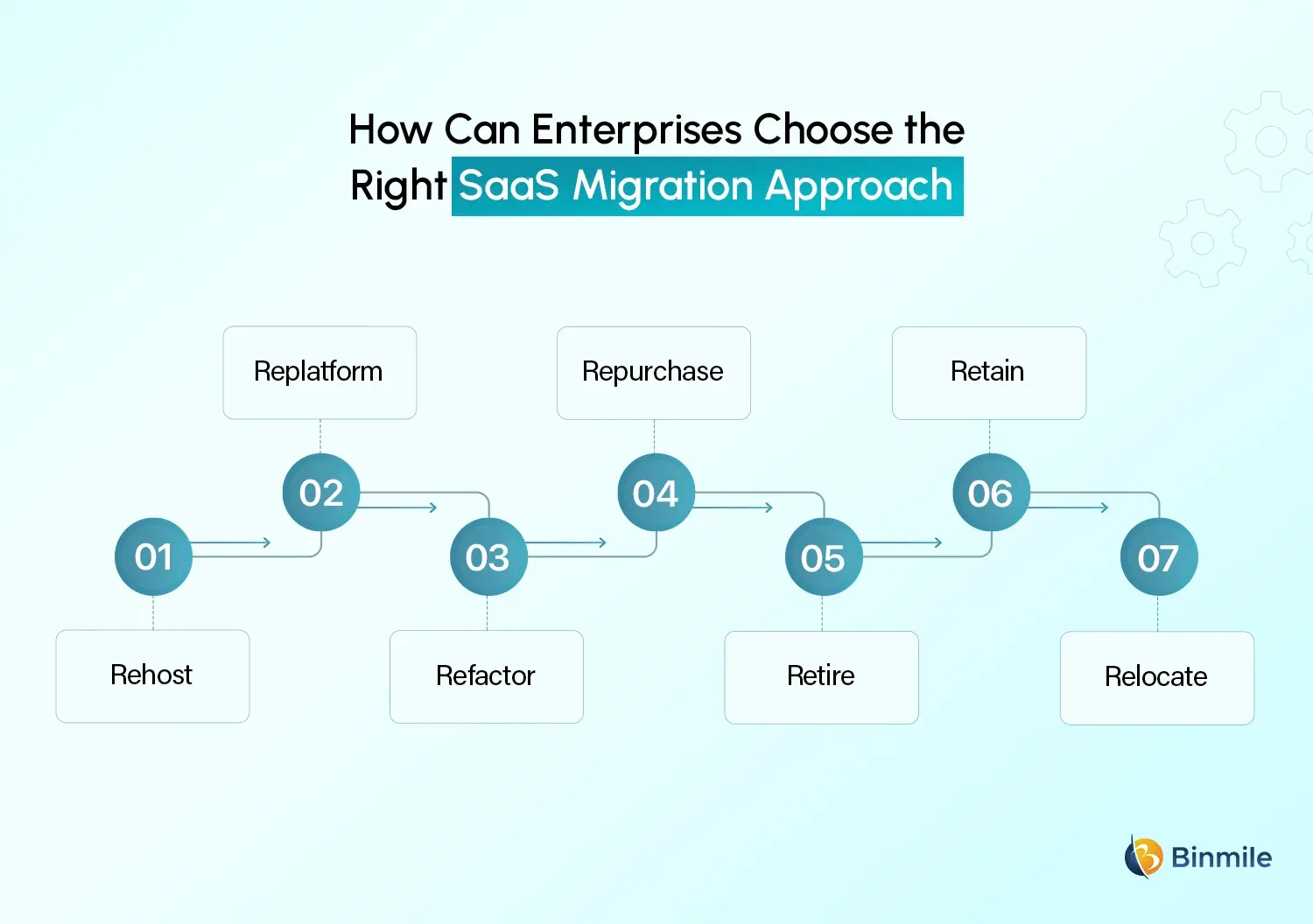
There is no universal migration method. The traditional migration approaches are often described through the 7 Rs, including rehost, replatform, refactor, repurchase, retire, retain, and, in some frameworks, relocate.
For SaaS environments, four approaches deserve particular attention.
1. Rehost
Rehosting, or lift and shift, moves an application to the cloud with minimal changes. It is useful when migration speed is a priority, or the application is stable, but it may not deliver the full cloud migration benefits.
2. Replatform
Replatforming involves making limited improvements while keeping most of the existing application architecture intact. Moving a database to a managed cloud service is one example. It offers a balance between migration speed and modernization.
3. Refactor
Refactoring involves redesigning an application to take advantage of cloud-native capabilities. This can include microservices, containers, managed databases, automated scaling, and modern APIs. It requires greater investment but can improve scalability and long-term performance.
4. Repurchase
Repurchasing means replacing an existing application with a cloud-based application development or SaaS application development alternative rather than migrating the legacy system. This can be suitable when maintaining the existing application is more expensive or complex than adopting a modern solution.
5. Retire
Retiring involves removing applications or workloads that are no longer needed. Before migration, enterprises should identify redundant, outdated, or underused systems. Eliminating them can reduce migration effort and prevent unnecessary cloud costs.
6. Retain
Retaining means keeping certain applications in their existing environment when migration does not currently provide sufficient business or technical value. This may apply to systems with strict compliance requirements, complex dependencies, or applications nearing retirement.
7. Relocate
Relocating moves workloads to a new cloud environment with minimal changes to the underlying architecture. It can be useful when enterprises need to move between infrastructure environments while avoiding extensive application modifications.
How to Maximize ROI From SaaS Cloud Migration
Migration ROI comes from more than reducing infrastructure expenditure. Enterprises should evaluate gains across four areas.
-
Technology ROI
Use the cloud to improve scalability, availability, application performance, automation, and infrastructure utilization. A well-designed environment should support growth without requiring proportional increases in infrastructure.
-
Operational ROI
Automate repetitive infrastructure and deployment tasks to reduce manual effort. Faster deployments, better monitoring, and streamlined operations can help engineering teams spend more time on product development.
-
Business ROI
A scalable cloud environment can support faster product launches, better customer experiences, geographic expansion, and quicker responses to changing market demands.
-
Financial ROI
Optimize resource utilization, capacity planning, infrastructure spending, and cloud consumption. Regular cost reviews can help identify idle resources, oversized workloads, and unnecessary services.
For example, track infrastructure cost per customer, deployment frequency, application response time, incident volume, infrastructure utilization, recovery time, and engineering effort. That turns migration from a technology project into a measurable business transformation initiative.
Ready to turn your cloud migration into measurable business value?

How to Build a SaaS Cloud Migration Roadmap for Enterprise Success
A migration roadmap should provide more than a list of technical tasks. It should establish what happens before, during, and after migration.
Phase 1: Assess Cloud Migration Readiness
Create an inventory of applications, databases, workloads, integrations, and dependencies. Assess business criticality, technical complexity, data, security, performance, costs, migration effort, and cloud compatibility to determine readiness and priorities.
Phase 2: Build the Business Case
Define measurable goals such as reducing infrastructure costs, improving availability, accelerating deployments, increasing scalability, or strengthening disaster recovery. Compare the current total cost of ownership with the expected cloud operating costs to establish potential ROI.
Phase 3: Choose the Right Architecture
The target SaaS Architecture should address scalability, tenancy, data isolation, identity, APIs, observability, resilience, and integrations. Choose a single-cloud, multi-cloud, or hybrid model based on business requirements rather than unnecessary technical complexity.
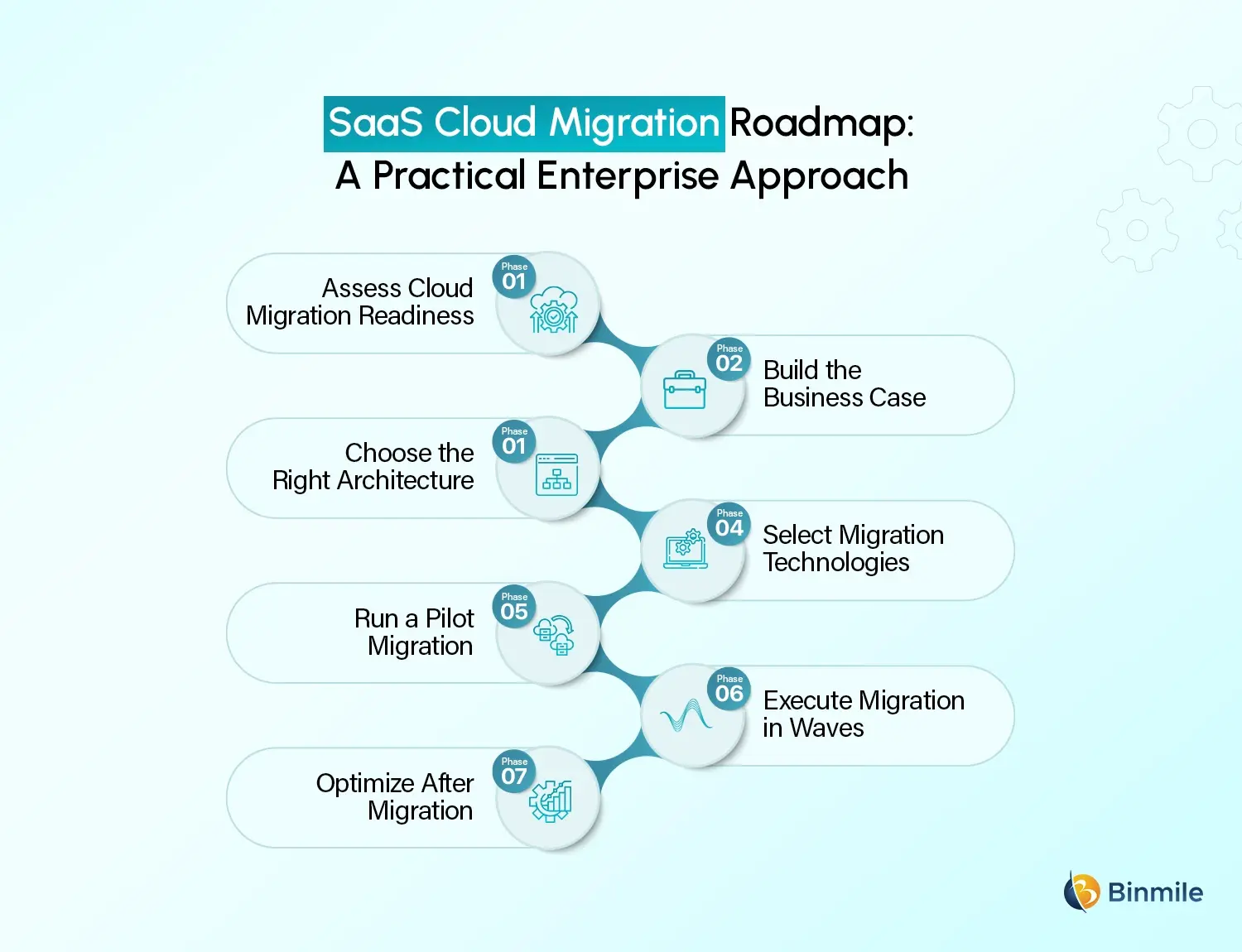
Phase 4: Select Migration Technologies
SaaS cloud migration technologies can support workload discovery, data migration, testing, deployment, and monitoring. Depending on requirements, enterprises may use cloud migration services, cloud data migration tools, containers, Infrastructure as Code, CI/CD, monitoring, and cloud migration solutions.
Phase 5: Run a Pilot Migration
Start with a representative workload instead of migrating everything at once. Test performance, data integrity, security, integrations, costs, monitoring, backup, deployment, and rollback procedures before expanding the migration.
Phase 6: Execute Migration in Waves
Move workloads in controlled groups based on dependencies, business criticality, or technical complexity. Validate each wave before proceeding to reduce disruption and identify issues early.
Phase 7: Optimize After Migration
Continuously monitor performance, security, resource utilization, architecture, and cloud spending. Use FinOps practices, rightsizing, resource scheduling, storage optimization, and removal of unused resources to control ongoing costs.
What Are the Cloud Migration Challenges That Can Reduce ROI
Cloud migration challenges are often less about moving data and more about managing everything connected to the migration.
-
Migrating Without a Clear Business Case
Without measurable goals for cost, performance, scalability, and efficiency, enterprises cannot accurately evaluate migration success or ROI.
-
Underestimating Application Dependencies
SaaS applications often rely on databases, APIs, authentication systems, and third-party services. Missing these dependencies can cause integration issues and delays.
-
Poor Cloud Cost Planning
Oversized resources, inefficient configurations, and unmanaged usage can quickly increase cloud spending. Cost estimation and continuous optimization are essential.
-
Insufficient Testing Before Go-Live
Performance, security, data integrity, integrations, scalability, and recovery should be tested before production migration to avoid costly issues after launch.
-
Security Gaps During Transition
Changes in infrastructure can create vulnerabilities if access controls, encryption, network security, and monitoring are not planned as part of the migration.
-
Failing to Plan for Post-Migration Operations
Migration does not end at go-live. Without ongoing monitoring, governance, cost management, and optimization, cloud environments can become expensive and difficult to manage.
These risks reinforce the importance of migration planning, testing, observability, and phased execution.
How SaaS Cloud Migration Services Can Support Enterprise Transformation
Organizations with complex application estates may choose to work with specialized SaaS cloud migration services rather than handling every stage internally. The value of an experienced migration partner is not simply the ability to move workloads. It is the ability to connect application modernization, cloud architecture, cloud migration security, data migration, DevOps, testing, and cost optimization into one coordinated program.
The right partner can help assess the existing environment, define migration priorities, select appropriate migration approaches, design the target architecture, execute migration waves, validate workloads, and optimize the environment after migration. This is particularly valuable for enterprises dealing with complex SaaS platforms, ERP Cloud migration initiatives, legacy modernization, large databases, or highly integrated business applications.
Need to migrate your SaaS applications without disrupting business operations?
How Binmile Can Help With SaaS Cloud Migration
For enterprises planning a complex cloud transition, the focus should remain on measurable outcomes rather than migration activity alone. Binmile can support this journey by combining cloud consulting services, application modernization, data migration, DevOps, testing, security, and cloud-native engineering capabilities across the migration lifecycle. The approach can be tailored to the organization’s existing architecture, business priorities, application dependencies, and desired cloud operating model.
Whether the objective is to modernize a legacy SaaS platform, migrate enterprise applications, improve scalability, reduce infrastructure complexity, or establish a more efficient cloud operating environment, the migration roadmap should be designed around the business outcome first. A structured assessment, phased migration strategy, strong governance, and post-migration optimization can help enterprises reduce unnecessary risk while creating a cloud environment that continues to deliver value beyond the initial migration.
Frequently Asked Questions
SaaS Cloud Migration process includes moving a SaaS application, databases, infrastructure, integrations, and related workloads to a cloud environment. It may involve rehosting, replatforming, refactoring, rebuilding, or replacing existing components.
Enterprises invest in SaaS Cloud Migration to improve scalability, application performance, operational efficiency, resilience, and speed of delivery. Migration can also support modernization, geographic expansion, stronger disaster recovery, and more flexible infrastructure management.
Businesses can maximize ROI by assessing workloads before migration, selecting the appropriate migration strategy, controlling cloud consumption, automating operations, measuring performance, and continuously optimizing resources after migration instead of treating migration completion as the final objective.
Migration timelines vary based on application complexity, data volume, integrations, security requirements, architecture, and migration strategy. Smaller applications may take weeks, while complex enterprise SaaS environments can require several months or longer.
SaaS Cloud Migration can improve security when the target environment is properly designed and governed. Strong identity controls, encryption, network segmentation, monitoring, vulnerability management, backup, and compliance controls should be incorporated before production migration.
A business is generally ready when application dependencies are understood, business objectives are defined, data and security requirements are documented, the target architecture is established, costs are assessed, and the organization has the technical capabilities required to execute and operate the migrated environment.