As AI agents become more advanced at performing complex tasks in a business environment, you may want to know how to get the most out of multiple AI agents. This can be achieved by utilizing AI agent communication protocols.
These provide a framework for how AI agents can discover, communicate, share context, access tools, and collaborate with each other. For example, a customer service agent can talk to an order management agent for purchase information. An inventory agent can then be used to check stock levels and update delivery information.
Protocols such as the Model Context Protocol (MCP), Agent-to-Agent Protocol (A2A), and Agent-User Interaction (AG-UI) are being developed to support an integrated AI ecosystem. Let’s look at how these protocols work and how you can utilize them in your business.
What Are AI Agent Communication Protocols and Why Are They Important?
AI agent communication protocols are standardized rules that enable AI agents to exchange information, share context, delegate tasks, and coordinate actions with other agents, external tools, and user-facing applications. They define how agents discover capabilities, structure messages, send requests, and manage responses, allowing systems built using different AI models, frameworks, and programming languages to work together. These protocols support AI innovation by helping businesses build connected, scalable AI systems.
For example, in an enterprise setting, a customer support agent can talk to an inventory agent to get order details and to communicate with a billing agent to confirm payment information. Protocols such as MCP and A2A allow for these interactions to be completed. They help reduce the complexity when integrating different systems, improve compatibility, and enable AI agents to work together. They also provide an easy way to share context, scale, and allow user updates.
Overall, AI agent communication protocols help reduce the complexity of creating custom integrations between different agents. This AI agent protocols guide also highlights how shared standards support an AI agent system, improve AI agent interoperability, and establish a consistent AI agent protocol stack. These AI communication protocols capabilities explain why businesses are evaluating the benefits of connected agent environments.
What Are the Different Types of AI Agent Communication Protocols?
Different protocols address different communication requirements across the AI ecosystem. Understanding these AI agent protocol types, or the different AI agent protocol types available, helps businesses select suitable standards for their technical and operational needs. Reviewing an AI agent protocols comparison can clarify how each option fits into a broader architecture, while understanding the AI agent communication protocol components helps teams assess integration requirements.
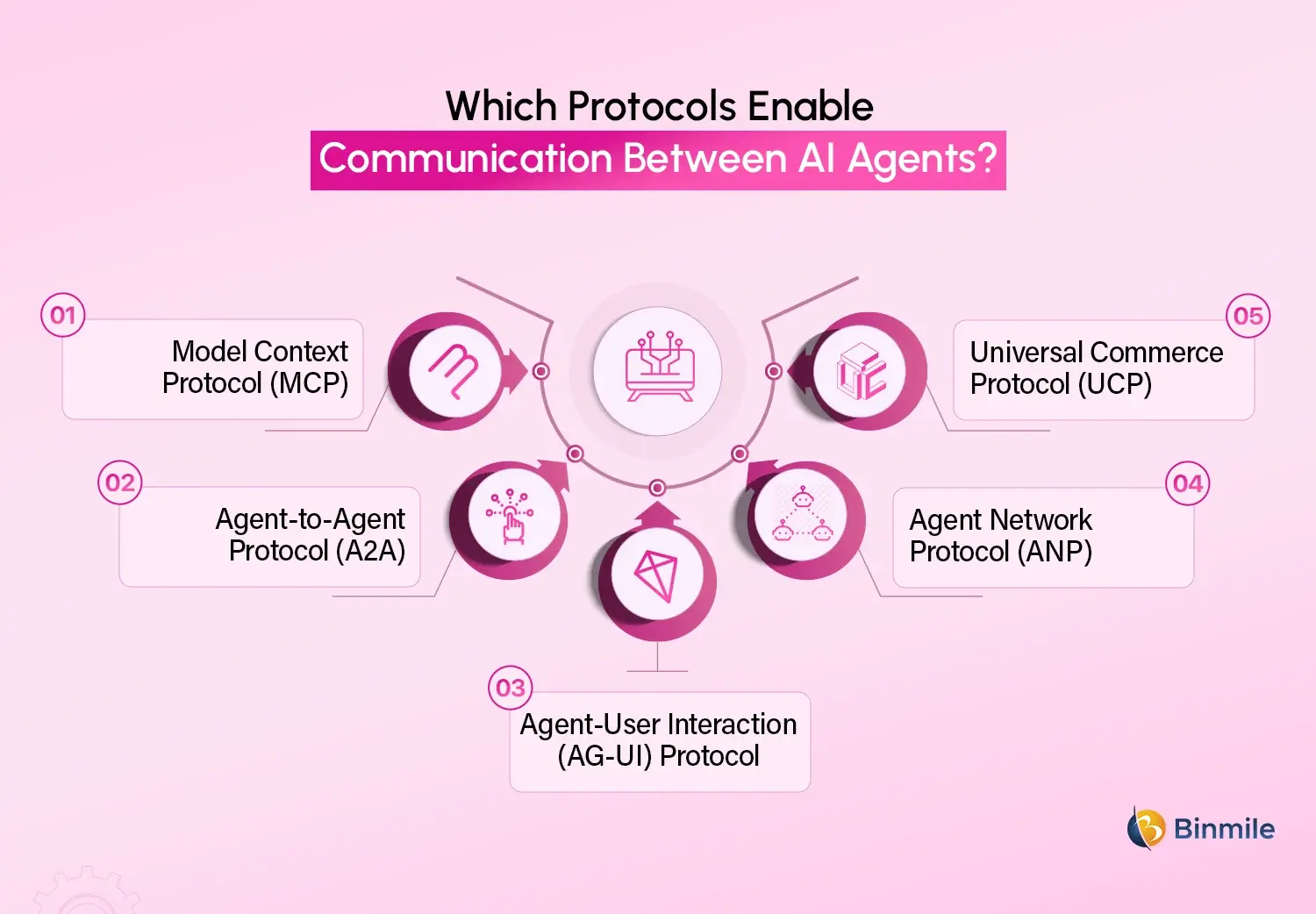
1. Model Context Protocol (MCP)
Anthropic introduced the Model Context Protocol (MCP). It provides a standard for how AI applications can interact with external tools. This uses a client-server model.
For example, an agent could use the MCP to query internal databases for customer information.
The key elements of this protocol include:
- MCP Host: Manages the overall AI application.
- MCP Client: Connects to MCP Servers.
- MCP Server: Connects to tools/resources/prompts.
This protocol helps to connect different AI agents to enterprise applications. MCP is one of the popular AI agent communication protocols and an important part of the broader AI agent protocols standards landscape. Its role in connecting applications and data is also relevant to agentic RAG and artificial intelligence as a service.
2. Agent-to-Agent Protocol (A2A)
This protocol was created by Google and is now managed by the Linux Foundation. It allows independent agents to discover each other.
For example, an e-commerce agent could delegate tasks to other specialized agents for checking stock levels, estimating delivery times, and confirming payment.
This protocol helps different agents discover each other and delegate tasks. It provides a structure for sending messages. This can be useful for multi-agent systems. A2A is a key example of an agent communication protocol designed to support agentic AI and agentic process automation across connected systems.
3. Agent-User Interaction (AG-UI) Protocol
This protocol helps provide a standard for how backend AI agents can communicate with front-end applications using event-based interactions.
For example, a financial assistant could show progress, provide insights, and ask for confirmation before completing an action.
This protocol can be used to provide real-time updates, visibility of tools being called, and a human-in-the-loop. These capabilities are useful when developing artificial intelligence development solutions and generative AI development services that require clear agent-user interaction.
4. Agent Network Protocol (ANP)
This protocol helps provide a decentralized communication protocol for independent agents.
For example, procurement and logistics agents could discover compatible services with other organizations.
It aims to help with agent identification, discovering capabilities, and secure communication. These functions are central to the development of a distributed agent network protocol.
5. Universal Commerce Protocol (UCP)
UCP was created by Google along with industry partners. This provides a standard for interacting with different agentic commerce systems.
For example, AI shopping assistants could be used to help customers find products, compare options, complete checkout, and track orders.
This protocol is mainly for use in retail and e-commerce. It is also known as the universal commerce protocol and addresses commerce-specific interactions within the wider AI agent protocol ecosystem.
How Do AI Agent Communication Protocols Work Together?
The real value of AI agent communication protocols becomes clearer when multiple standards operate within the same AI architecture.
Consider an AI-powered supply chain management system that coordinates inventory, procurement, and order fulfillment. The workflow can operate as follows:
1. Request Interpretation
An employee requests the AI assistant to find items that are running low in stock and organize restocks.
2. Data Access Through MCP
The agent gets information about inventory, suppliers, and purchases by using connected enterprise applications.
3. Task Delegation Through A2A
The main agent delegates tasks to specialized agents to confirm stock levels, compare suppliers, and estimate delivery times.
4. Result Coordination
The agents share updates and results with each other. The primary agent can then consolidate the recommendations.
5. User Interaction Through AG-UI
The front-end shows the results and asks for confirmation from the employee.
6. Action Execution
Once authorized, the system initiates the required operations through approved enterprise integrations.
This is an example of how multiple protocols can be used to accomplish end-to-end business processes. This shows us the many benefits of using AI agent protocols within an agentic AI architecture to manage specialized functions whilst remaining focused on their task.
Ready to make your AI ecosystem more interoperable and efficient for your business?

What Are the Common Applications of AI Agent Communication Protocols?
AI agent communication protocol applications extend across industries where business processes require information exchange and coordination between multiple systems. These AI agent protocol use cases can also inform organizations planning AI agent development and evaluating AI consulting services.
Some practical AI agent protocol use cases include:
1. Customer Service
Support agents can talk to billing, inventory, and logistics agents to assist with customer questions, confirm payments, and get order information.
2. Healthcare Operations
Agents can be used to schedule appointments, register patients, and confirm payments. This would also require the correct security measures in place.
3. Banking and Financial Services
Multiple agents can be used to monitor transactions, analyze fraud, confirm customer details, and report on compliance.
4. Supply Chain Management
Agents can be used to confirm inventory levels, compare suppliers, and organize delivery. This helps to identify any disruptions.
5. eCommerce
Retailers can use connected agents to help with finding products, recommendations, checkout, inventory, and post-purchase.
6. Enterprise IT Operations
Monitoring agents can be used to identify issues within the infrastructure. Tasks can be delegated to diagnostic agents. Agents can then work together to complete authorized actions.
How Can Businesses Implement AI Agent Communication Protocols?
Implementing AI agent communication protocols requires an understanding of business workflows, integration requirements, security policies, and scalability goals. The right approach depends on the intended AI agent protocol architecture, the complexity of the workflow, and the expected AI agent protocol development cost.
Businesses can follow these steps:
1. Identify Communication Requirements
Determine whether agents need to access external tools, collaborate with other agents, or interact with users.
2. Select Suitable Protocols
Select MCP to connect to tools/resources, A2A to talk to agents, AG-UI to interact with the front end, and UCP for commerce.
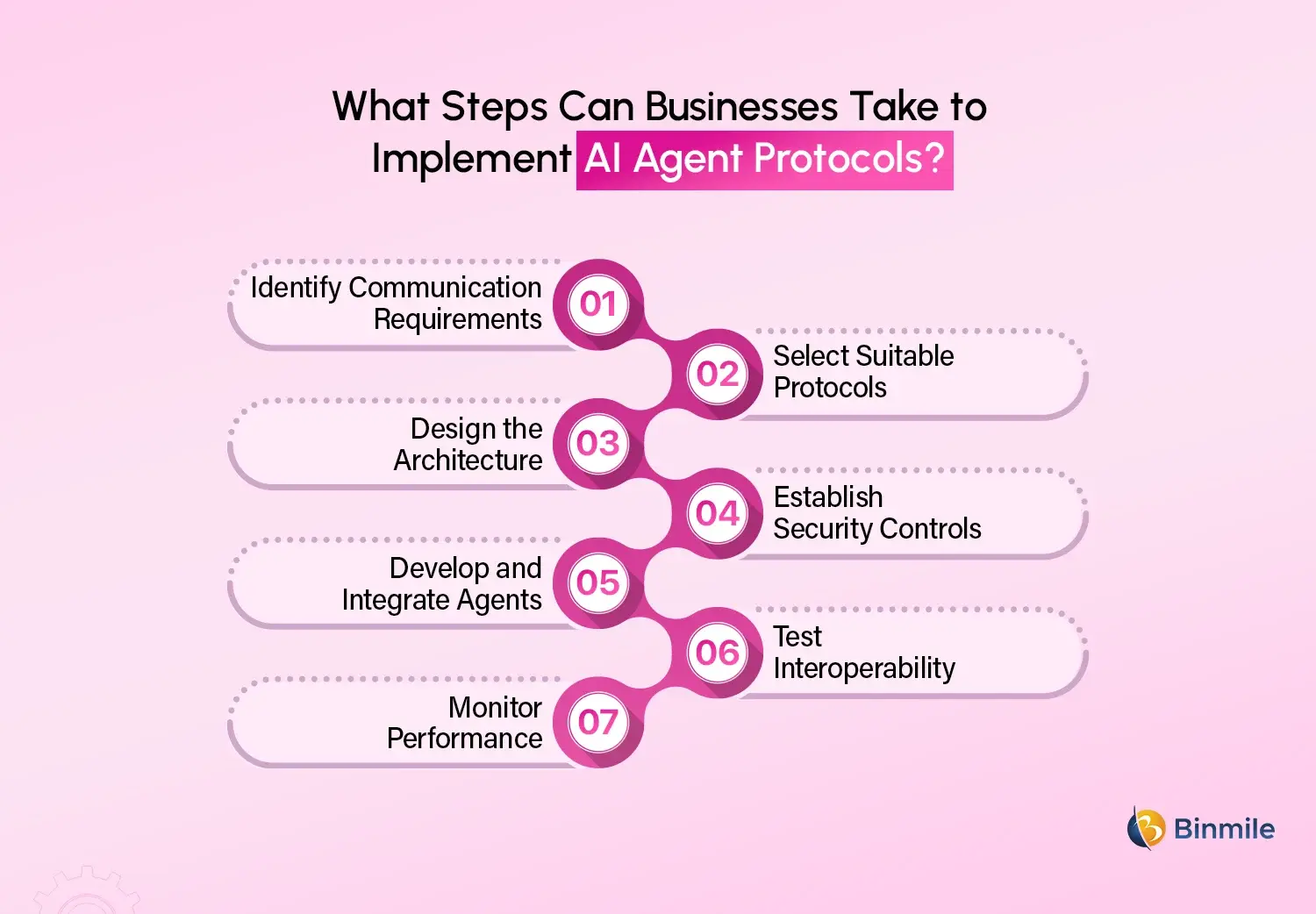
3. Design the Architecture
Ensure you know what each agent will do, communication endpoints, message format, who will own the tasks, and what happens if they fail.
4. Establish Security Controls
Ensure there are authentication, authorization, encryption, and least privilege processes in place. Any sensitive processes should also have an approval process.
5. Develop and Integrate Agents
Create your agents based on what they need to do. Ensure they are connected using compatible protocols and standardized interfaces.
6. Test Interoperability
Ensure communication is accurate, responses are quick, tasks can be completed, failures are handled, and security is maintained.
7. Monitor Performance
Keep track of communication events, agent performance, integration reliability, and resource usage. This ongoing review can help teams identify AI agent protocol development mistakes and address AI communication protocols challenges before they affect business operations.
What Are the Common Challenges in AI Agent Communication Protocols?
Despite their advantages, AI communication protocols introduce technical and operational challenges that businesses must address. Understanding these AI communication protocols benefits alongside their limitations helps organizations make informed implementation decisions.
1. Interoperability Issues
Different versions of protocols may be supported by different agents, making integration difficult.
2. Security and Privacy Risks
Connecting to more agents may open up new areas of exposure. You will need to ensure strong authentication and authorization.
3. Context Management
If agents receive incomplete or outdated information, they may give conflicting responses.
4. Communication Latency
Multiple sequential interactions can increase response times and affect overall workflow performance.
5. Error Propagation
An incorrect response from one agent can influence decisions made by other agents, affecting the entire workflow.
6. Governance Requirements
You will need to have clear processes in place for the agents, what they can do, who is responsible, and monitoring.
What Is the Future of AI Agent Communication Protocols?
As the demand for AI increases, so will the need for protocols to help with compatibility, secure autonomous processes, and working with other enterprise systems. As agentic AI architecture becomes more advanced, protocols will become a key part of connecting agents.
Open protocols will help increase standardization. Collaboration will also increase, allowing agents to communicate between different businesses. As agentic commerce grows, protocols like UCP will help create more connected shopping, checkout, and post-purchase experiences.
Protocols like AG-UI will allow for more interactive AI applications. Enhanced security and governance will also be a key factor in the future to ensure identity management, access controls, auditability, and policies.
Advanced multi-agent architecture will also become popular, allowing specialized agents to work together to manage complex processes. Overall, the future of AI Agent Communication Protocols will aim to create connected ecosystems to allow secure collaboration within set boundaries. The evolution of AI agent communication protocols will also depend on stronger standardization, wider participation in the AI Agent protocol community group, and continued progress in AI agent protocols future developments.
Looking to build AI agents that can communicate, collaborate, and execute complex workflows seamlessly?

How Can Binmile Help Businesses Build Interoperable AI Agent Solutions?
Expertise in business processes, Agent Development, system integration, and security.
As experts in building AI-powered solutions, we work with businesses to investigate and develop solutions using our Artificial Intelligence development services to create scalable solutions that can be integrated within your current applications.
We can help identify the right capabilities to include within your solution, whether you are looking at your first AI agent or multiple agents using our AI consulting services.
Our expert knowledge in AI agent development, agentic AI architecture, and generative AI development services can help your business investigate solutions that will enable intelligent automation. We can also support organizations exploring artificial intelligence development and AI agent solutions that align with their existing technology environments.
Frequently Asked Questions
AI agent communication protocols are standardized rules that allow agents to exchange messages, share context, access tools, and coordinate tasks. They support interoperability across different agents and applications.
They establish common mechanisms for agent discovery, message exchange, task delegation, and data access. For example, MCP connects agents with tools, A2A enables agent collaboration, and AG-UI connects agents with frontend applications.
Common protocols include Model Context Protocol (MCP), Agent-to-Agent Protocol (A2A), Agent-User Interaction (AG-UI), and Agent Network Protocol (ANP). Universal Commerce Protocol (UCP) supports commerce-specific interactions.
Businesses should evaluate communication requirements, existing infrastructure, interoperability, security, scalability, protocol maturity, and ecosystem support.
Businesses should identify collaboration requirements, select compatible protocols, design the architecture, establish security controls, integrate agents, test interoperability, and continuously monitor performance.