Organizations will generate large volumes of data. This can include customer interactions, transactions, operational activity, and digital platforms. To improve decision-making, systems will be needed in place to find patterns, trends, and make sense of the data.
By using statistical analysis, Machine Learning, and data mining algorithms, businesses can make use of large data sets to find hidden patterns, predict outcomes, and make informed decisions. Data mining and statistical analysis can help businesses identify these patterns.
Data mining will help businesses predict customer demands and see areas where improvements can be made.
This guide will look at different data mining techniques, how they can be used, the benefits, challenges, and how to implement them to improve your forecasting.
What Is Data Mining in Business Intelligence?
Data mining is the process of analyzing large data sets to find patterns that have not been seen before. By using statistical analysis, Machine Learning algorithms, and analysis techniques, useful information can be extracted. This approach is also used in data mining for business analytics.
Data mining in business intelligence helps organizations understand their business by analyzing historical and current data. This can help organizations identify trends and opportunities within their business.
Traditional business intelligence systems help organizations analyze and report on their data. These are some of the key capabilities of data mining and business intelligence.
For example, a retail company could use Business Intelligence dashboards to see its monthly sales and what its best-selling product is. By using data mining, they can analyze purchasing behavior, seasonality, and customer preferences to predict what products will sell well in the coming months.
Data mining and business intelligence complement each other. BI provides the analytical environment, while data mining helps uncover deeper insights from business information.
How Does Data Mining Improve Business Intelligence?
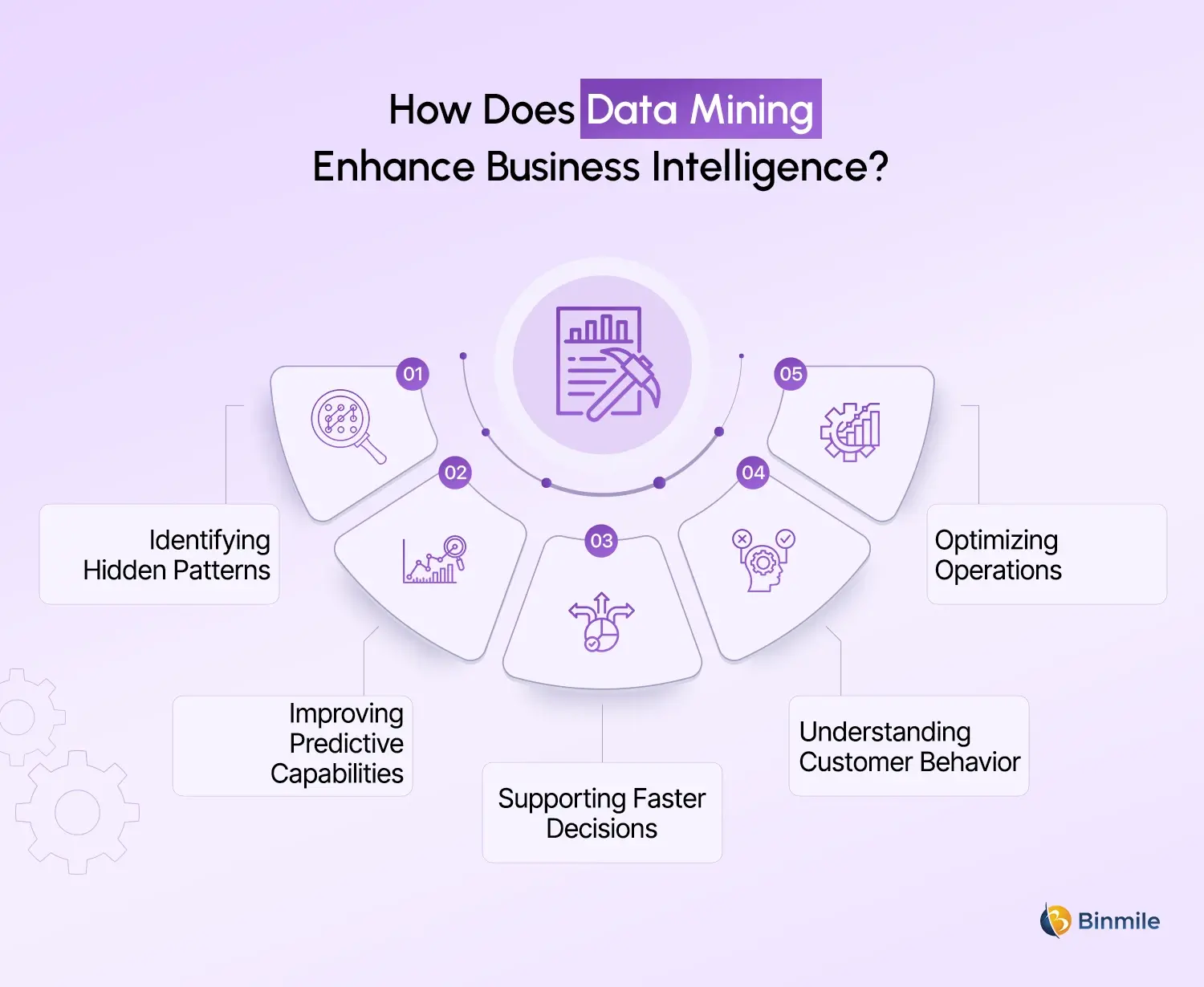
Data mining strengthens business intelligence by transforming historical and real-time business information into meaningful patterns and predictive insights.
Some important ways it improves BI capabilities include:
-
Identifying Hidden Patterns
Using data mining techniques, businesses can find relationships between different areas such as customer behavior, sales, costs, etc.
-
Improving Predictive Capabilities
Using historical data and predictive models, businesses can predict what demand will be like in the future. They can also identify risks of customer churn.
-
Supporting Faster Decisions
Automated analysis means trends can be found more quickly and problems can be investigated faster. This makes it easier for decision makers to get the right insights.
-
Understanding Customer Behavior
By analyzing customer purchase history, businesses can identify customer segments and create relevant marketing strategies.
-
Optimizing Operations
Using data mining, businesses can find patterns of inefficiency, unusual costs, and bottlenecks.
What Data Mining Techniques Are Used in Business Intelligence?
Different data mining techniques help organizations solve specific analytical problems. The selection depends on business objectives, available data, and the insights an organization wants to generate. These data mining methods can be selected based on the required data mining tasks.
Common techniques include:
-
Classification
Used to classify data into specific categories. This can help with customer segmentation, credit risk, fraud detection, and lead qualification.
-
Clustering
Used to group similar data. Retailers could use this to segment customers based on their purchasing behavior, spending, and product preferences.
-
Regression Analysis
Used to identify relationships between variables. Commonly used for estimating revenue, sales forecasts, pricing, and demand.
-
Association Rule Mining
Used to find relationships between items or events that happen together. Retailers could use this to carry out market basket analysis to see what products customers commonly buy together.
-
Anomaly Detection
Used to identify unusual observations. This can help businesses identify fraud, equipment failure, and unusual activity.
-
Sequential Pattern Mining
Used to find patterns of events that occur regularly. This can help businesses understand what customers purchase and how they navigate around a website.
What Are the Main Applications of Data Mining in Business Intelligence?
Data mining applications extend across multiple business functions. Organizations use them to improve forecasting, understand customers, manage risks, and optimize operations.
Some important data mining use cases include:
-
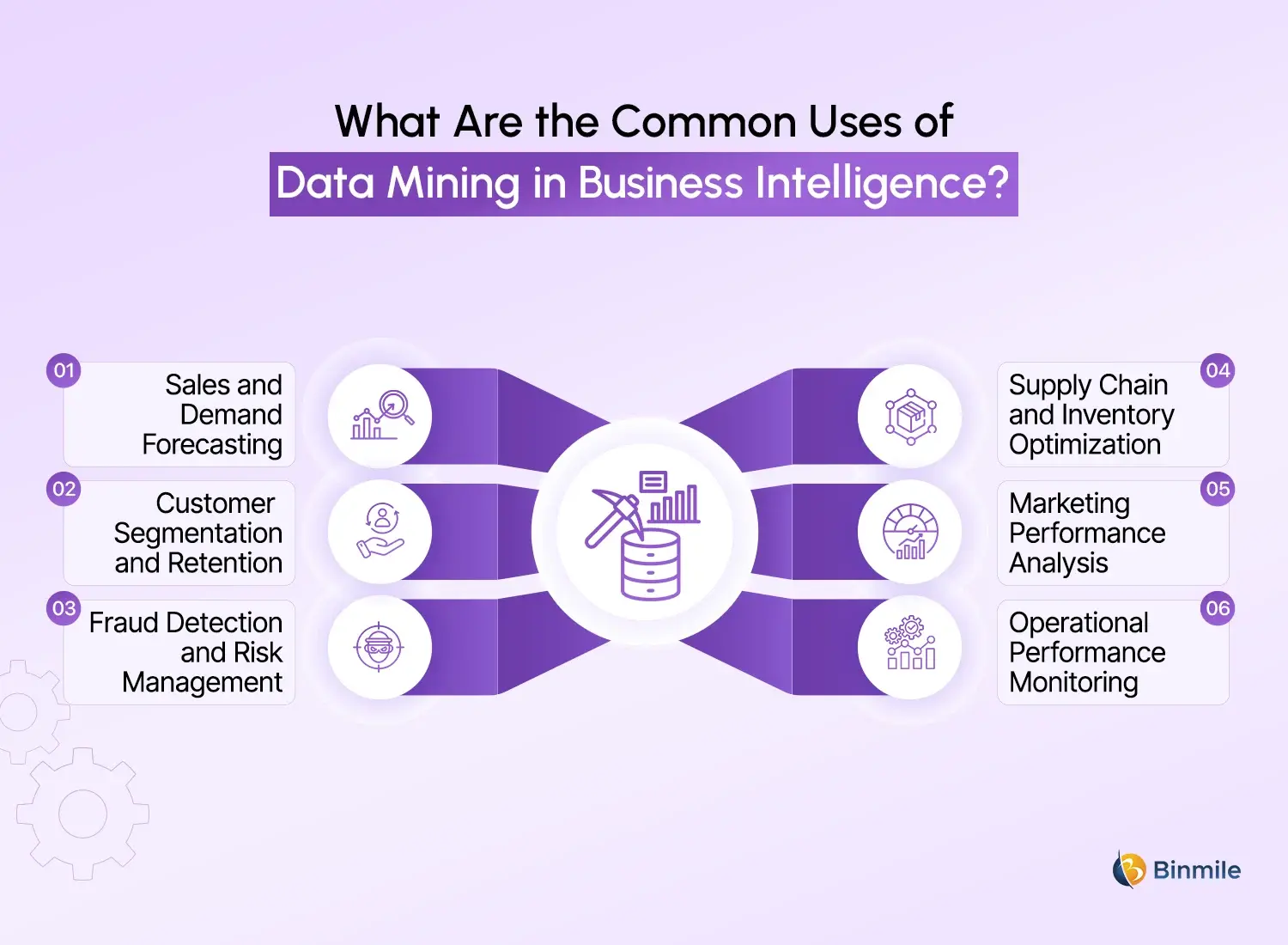
Sales and Demand Forecasting
Historical sales, seasonality, customer purchase behavior, and price changes can be analyzed to predict future demand.
For example, an online retailer can use past sales data and seasonality to predict what product categories may be in higher demand during peak times.
This helps businesses plan their inventory, resources, and purchasing. Using the predictive insights alongside demand forecasting in business planning can help businesses plan their operations.
-
Customer Segmentation and Retention
Using data mining, businesses can identify different customer segments based on how often they purchase, how much they spend, product preferences, and engagement.
For example, a subscription-based business can analyze its customers’ usage to see who may be at risk of canceling. They can then create targeted campaigns to encourage them to stay.
-
Fraud Detection and Risk Management
Financial institutions, insurance providers, and online retailers can use data mining algorithms to identify unusual patterns.
For example, a bank can identify unusual transactions made from unknown locations, unusual amounts, and frequencies.
This helps organizations identify potential risks and strengthen fraud detection.
-
Supply Chain and Inventory Optimization
Using data mining, businesses can identify patterns between their suppliers, stock, delivery costs, and customer demand.
A manufacturer could analyze their procurement data and delivery records to see which suppliers cause regular delays. This can help them choose the best suppliers and plan their stock.
-
Marketing Performance Analysis
By analyzing marketing campaign performance, customer demographics, website behavior, and purchase history, businesses can identify patterns of success.
This can help marketing teams understand which customer segments respond better to certain offers.
-
Operational Performance Monitoring
Using data mining, businesses can identify bottlenecks.
A manufacturing business could analyze its production data, equipment, and maintenance to find patterns of downtime. Service-based organizations can also analyze their workflow data. These are also relevant data mining applications in areas such as data analytics for government.
What Is the Data Mining Process?
Most data mining processes involve these steps:
-
Define Business Objectives
Identify what issue you want to solve. For example, improve sales forecasting, reduce customer churn, or detect fraud.
-
Collect Relevant Data
Collect data from your CRM, ERP, transaction databases, customer data, and external data.
-
Prepare and Clean Data
Ensure there are no duplicates, missing data, or inconsistencies, and that everything is in the correct format. This is an important data mining step.
-
Select Data Mining Techniques
Select the right data mining techniques for your business. For example, classification can help with risk assessment, and regression can help with sales forecasting.
-
Build and Train Models
Use your chosen data mining techniques on your cleaned data to find patterns.
-
Evaluate Results
Test your models to ensure they are accurate, reliable, and useful. Ensure your findings match your business objectives.
-
Deploy and Monitor Models
Implement your validated models into your Business Intelligence dashboards, processes, or systems. Monitor how they are performing.
What Are the Benefits of Data Mining in Business Intelligence?
Data mining offers several advantages when integrated into business intelligence and analytics strategies. These data mining benefits can help businesses improve their analytical capabilities.
-
Better Decision-Making
Provides data-driven insights to help make informed decisions.
-
Improved Forecasting
Find patterns in historical data to help with sales, revenue, and demand forecasting.
-
Greater Operational Efficiency
Identify regular bottlenecks, issues with resources, and inefficiencies.
-
Enhanced Customer Experience
Understand what your customers like and create relevant products/services.
-
Risk Identification
Detects unusual patterns and potential risks before they develop into larger problems.
-
Competitive Advantage
Identify trends and keep up with changing market demands.
-
Better Resource Allocation
Helps with planning by predicting what you will need in the future.
Ready to strengthen your data strategy to improve business intelligence, optimize operations, and uncover valuable insights.
What Are the Common Data Mining Challenges and Pitfalls?
Organizations should address the following issues in data mining:
-
Poor Data Quality
If your data is incomplete, out of date, or inconsistent, this can cause inaccurate patterns and unreliable predictions. You should have good data validation processes in place.
-
Data Privacy and Security
As data mining often involves personal and financial data, you should ensure you have the right controls, encryption, and privacy in place.
-
Integration Complexity
Often, businesses have data spread across many databases and applications. This can be a challenge to integrate.
-
Model Bias and Inaccurate Predictions
Data mining can produce biased results, as it can reflect bias in historical data. If not validated properly, you can get misleading results.
-
Scalability Limitations
As data increases, you may encounter performance issues with your current infrastructure.
-
Skills Gaps
To be successful, you will need to work with data engineers, data scientists, business intelligence experts, and business teams.
Strong data management frameworks and continuous model evaluation help address these challenges. These practices can also help businesses manage common data mining pitfalls.
How Can Businesses Build an Effective Data Mining Strategy?
Creating an effective data mining strategy will help you link your analytical capabilities to your business goals. Before investing in any technology, you should identify where you can gain the most value from data-driven insights.
Here are some important practices:
-
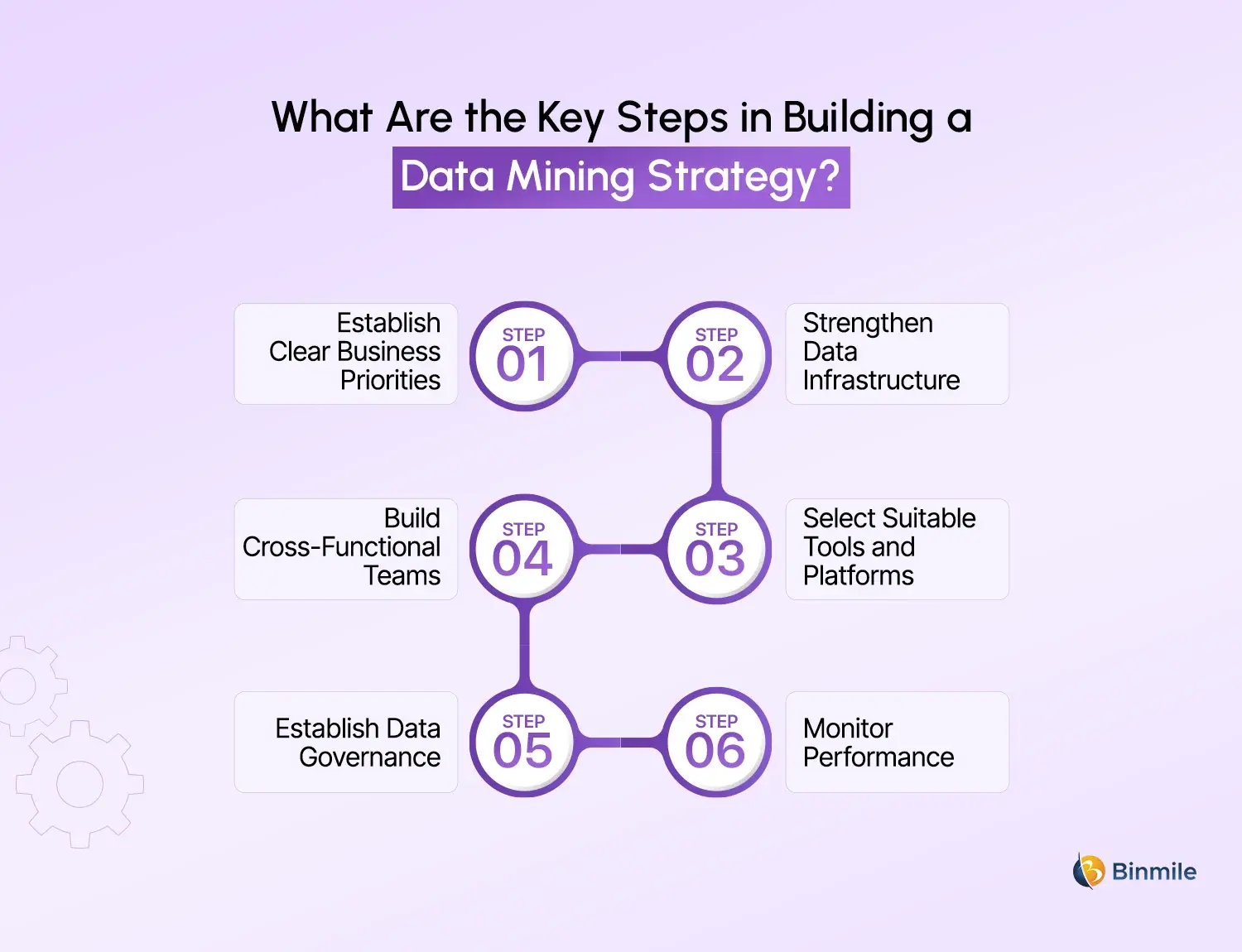
Establish Clear Business Priorities
Identify what issues you want to solve. For example, improve the accuracy of forecasting, reduce customer churn, or detect fraud.
-
Strengthen Data Infrastructure
Create a solid foundation for collecting, integrating, storing, and analyzing your data. Having scalable data engineering solutions will help manage data from multiple sources.
-
Select Suitable Tools and Platforms
Consider what data mining software you want to use. Ensure it is scalable, integrates well, has the right algorithms, is secure, and is easy to use.
Common data mining tools include Python libraries (Scikit-learn), R, Apache Spark, SAS, and IBM SPSS Modeler. SQL is commonly used for querying, transforming, and preparing structured data. These data mining tools and platforms also support different data mining projects.
-
Build Cross-Functional Teams
Get data mining experts, business analysts, data engineers, and subject matter experts to create models that meet your business needs.
-
Establish Data Governance
Define policies for data access, quality, security, privacy, and model management to maintain reliable analytical practices.
-
Monitor Performance
Monitor the accuracy of your models and how they are performing in your business. Regularly review them to understand any changes in your data patterns.
Data strategy consulting can also help businesses align their data mining strategy with their broader business objectives.
What Is the Future of Data Mining in Business Intelligence?
Advancements in artificial intelligence, machine learning, cloud computing, and advanced analytics are expanding the capabilities of data mining in business intelligence. With AI-powered tools, businesses can find patterns more quickly and make predictions. Real-time data helps businesses keep up with changing conditions.
Cloud-based platforms offer scalable solutions for managing large analytical workloads. Natural language makes it easier for businesses to get insights from their data. Predictive and Prescriptive analytics are helping organizations move from forecasting what will happen to evaluating what actions they can take and the impact on their business. This has increased the importance of modern data architecture, data strategy consulting, and scalable analytics.
Looking to make better use of your business data to build scalable data mining and analytics solutions that support smarter decisions and more accurate forecasting?
Conclusion
Using data mining in business intelligence can help organizations find meaningful patterns, improve forecasting, and identify risks. By using statistical analysis, Machine Learning, and reliable data infrastructure, businesses can get more from their data.
To be successful, you will need a clear strategy, high-quality data, scalable infrastructure, and people to make the most of your results.
With the right strategy in place, data mining can become an important part of your business intelligence. Data analytics services can help businesses make better use of their data.
Frequently Asked Questions
Data mining in business intelligence is the process of analyzing large datasets to identify hidden patterns, relationships, trends, and anomalies that support business decisions. It uses statistical analysis, machine learning, and data mining algorithms to generate actionable insights for forecasting, customer analysis, risk management, and operational optimization.
Data mining improves business forecasting by analyzing historical information, identifying recurring patterns, and evaluating relationships between different variables. Businesses can use these insights to predict sales, estimate customer demand, anticipate inventory requirements, and prepare for potential market changes.
Common data mining techniques used in business intelligence include classification, clustering, regression analysis, association rule mining, anomaly detection, and sequential pattern mining. Each technique addresses different analytical requirements, such as customer segmentation, demand forecasting, fraud detection, and purchasing behavior analysis.
Industries such as banking, financial services, retail, healthcare, manufacturing, telecommunications, insurance, and e-commerce benefit from data mining in business intelligence. These industries use it for applications such as fraud detection, demand forecasting, customer segmentation, risk assessment, inventory optimization, and operational performance monitoring.
Businesses can implement data mining by defining clear analytical objectives, collecting relevant information, preparing and cleaning datasets, selecting suitable algorithms, developing and validating models, and integrating the results into BI systems. They should also establish data governance practices and continuously monitor model performance to maintain reliable results.