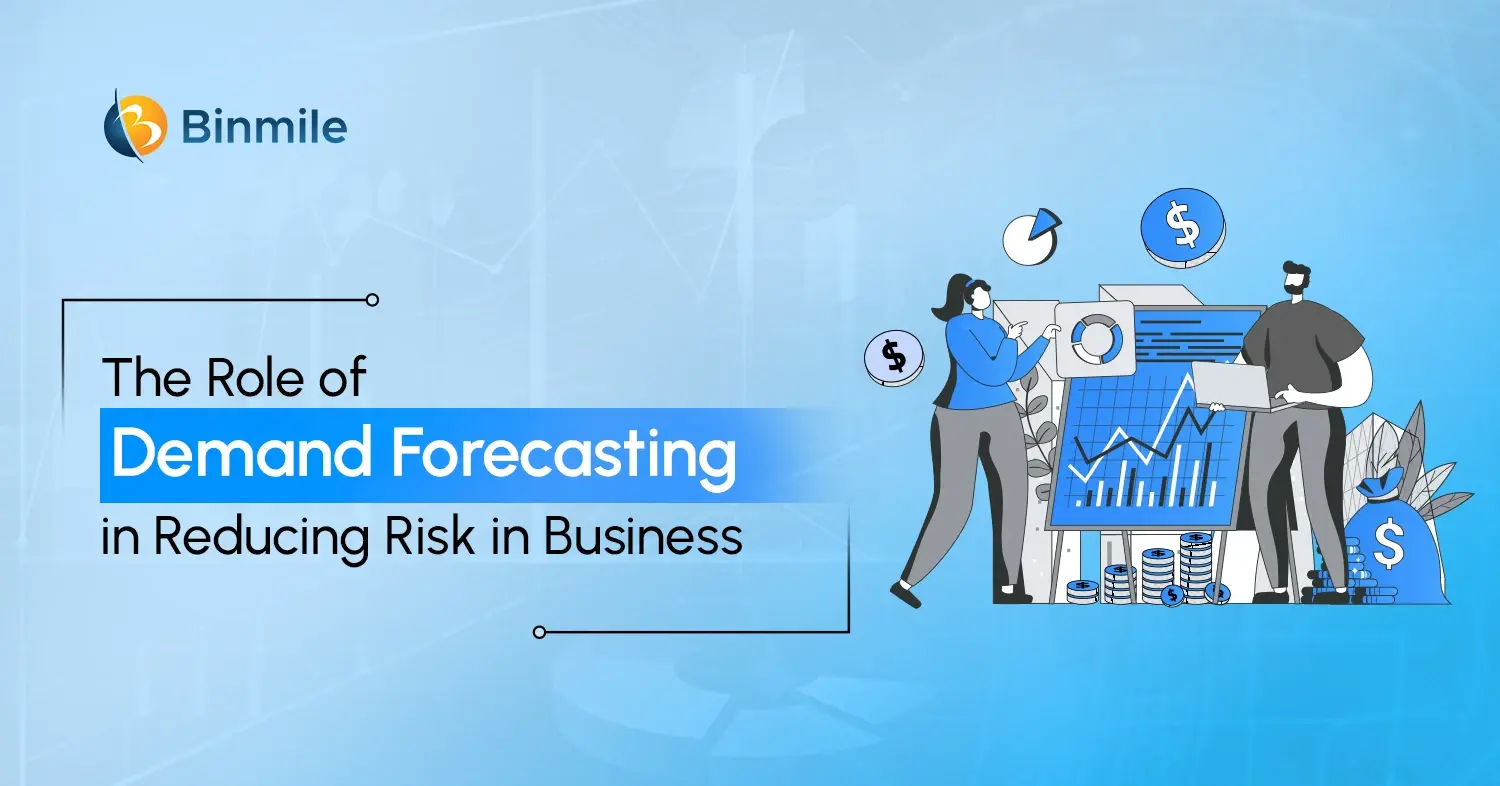
Unexpected demand fluctuations can disrupt operations, increase costs, and impact customer satisfaction. Businesses today are under constant pressure to maintain inventory accuracy, optimize supply chains, and make faster strategic decisions. According to a report by McKinsey, AI-powered supply chain forecasting can reduce forecasting errors by up to 20%-50% while lowering inventory costs significantly.
Today, most modern companies will use advanced demand forecasting software, predictive analytics, and AI-based systems rather than rely solely on spreadsheets or manual estimates to predict future demand. Using these types of tools allows businesses to gain better operational visibility and reduce uncertainty about future operations. This blog will describe how demand forecasting reduces business risk, improves the process of operational planning, and assists with the long-term growth of a business.
Understanding Demand Forecasting in Modern Businesses
Demand forecasting is the process of predicting future customer demand using historical data, market trends, customer behavior, seasonal patterns, and operational insights. Organizations can better manage their operations by using demand forecasts for several things, including better production planning, purchase planning, inventory management, budgeting, staffing requirements, and supply chain processes.
Effective demand forecasting allows organizations to effectively manage their inventory to maintain the right amount of inventory on hand, prepare for fluctuations in customer demand, ensure that they do not run out of stock, optimize their procurement cycles, and improve their overall operational stability. Additionally, if businesses do not use effective demand forecasting, they risk making quick and unplanned changes to their operations and will therefore increase both their financial and operational risk levels.
Why Demand Forecasting Is Important for Risk Reduction
Business risks increase when companies lack visibility into future demand. Poor planning can lead to inventory losses, delayed deliveries, production inefficiencies, and revenue disruptions.
-
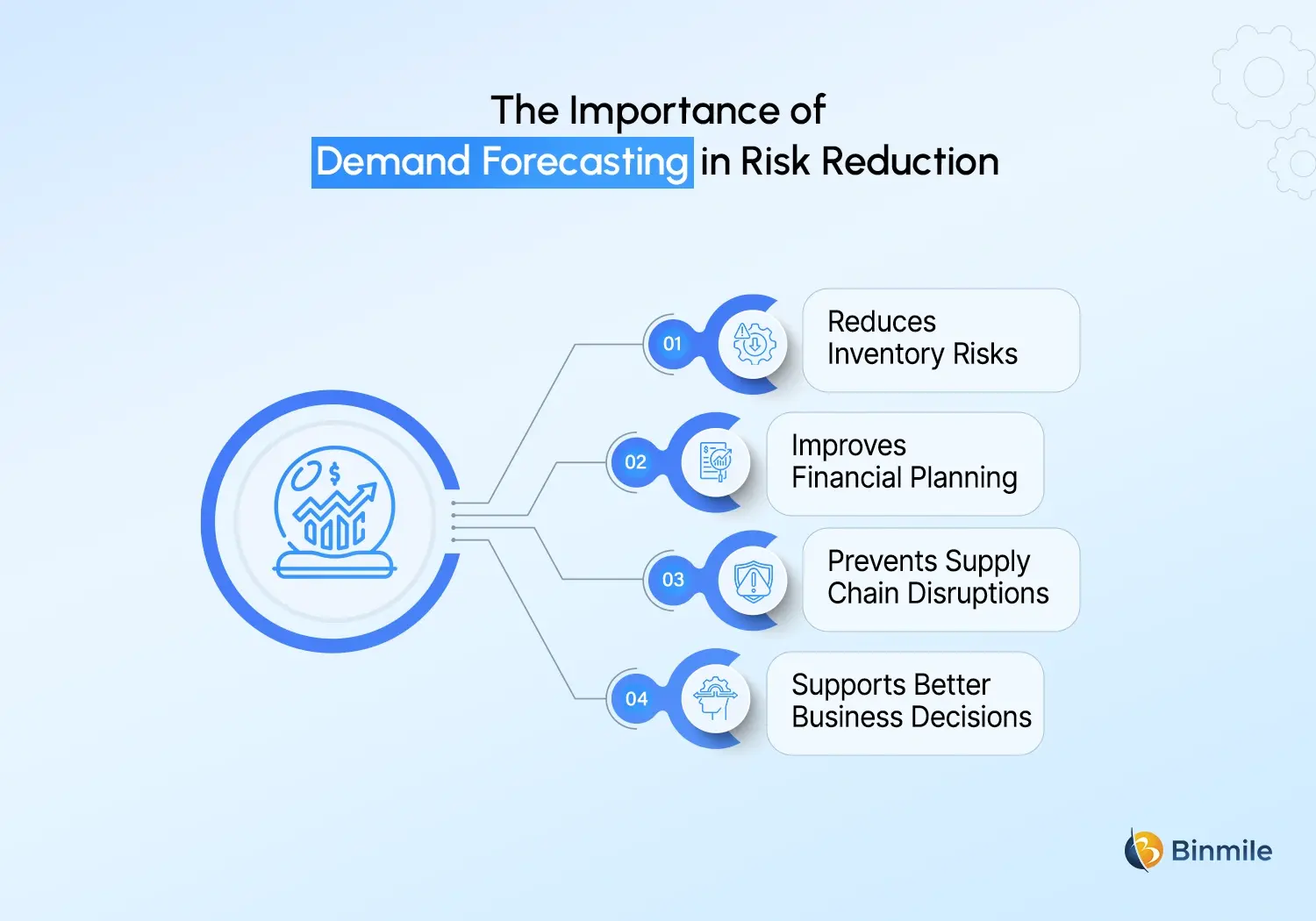
Reduces Inventory Risks
The greatest operational risk facing businesses today is having an unbalanced inventory. Too much inventory can lead to higher storage costs, while too little inventory means a stockout and potentially losing a sale.
Advanced demand forecasting tools help businesses maintain optimal inventory levels by analyzing sales trends and customer demand patterns. The adoption of AI in Inventory Management has further improved inventory optimization through real-time forecasting and automation.
-
Improves Financial Planning
By utilizing accurate demand forecasting, businesses are better able to budget for expenses, utilize their financial resources more accurately, and allocate their resources with greater confidence. Additionally, companies can use demand forecasts to improve the way they purchase products, manage their cash flow, and reduce the risk associated with financial uncertainty.
-
Prevents Supply Chain Disruptions
Effective demand forecasting will help a company to prepare its sourcing, logistics, and inventory strategies well in advance. This capability is critical to manufacturers who are experiencing digital transformation because operational efficiencies in this sector depend on accurate demand forecasts.
-
Supports Better Business Decisions
Forecasting helps executives to develop strategic plans and make decisions about expansions and price strategies, as well as efficiently run their business operations. Additionally, up-to-date demand forecasting systems allow an executive to quickly and accurately gather necessary information to make more confident decisions.
What Are the Challenges in Demand Forecasting
Despite technological advancements, businesses still face several Challenges in Demand Forecasting.
-
Inaccurate Data
Inaccurate or incomplete remote data can reduce the accuracy of your forecasts and lead to poor planning decisions.
-
Market Volatility
Changing customer preferences, economic uncertainty/instability, and global disruptions are rapidly reshaping demand patterns.
-
Supply Chain Complexity
Having multiple suppliers, warehouses, transportation networks, and distribution channels makes forecasting demand much harder for large companies.
-
Technology Integration Challenges
Many organizations are experiencing difficulty integrating demand planning systems with established operational systems due to digital transformation projects.
How AI Is Transforming Demand Forecasting
Traditional forecasting systems often struggle to handle rapidly changing market conditions and large volumes of business data. Additionally, AI-powered demand forecasting techniques are helping organizations improve forecasting accuracy through automation and predictive analytics.
-
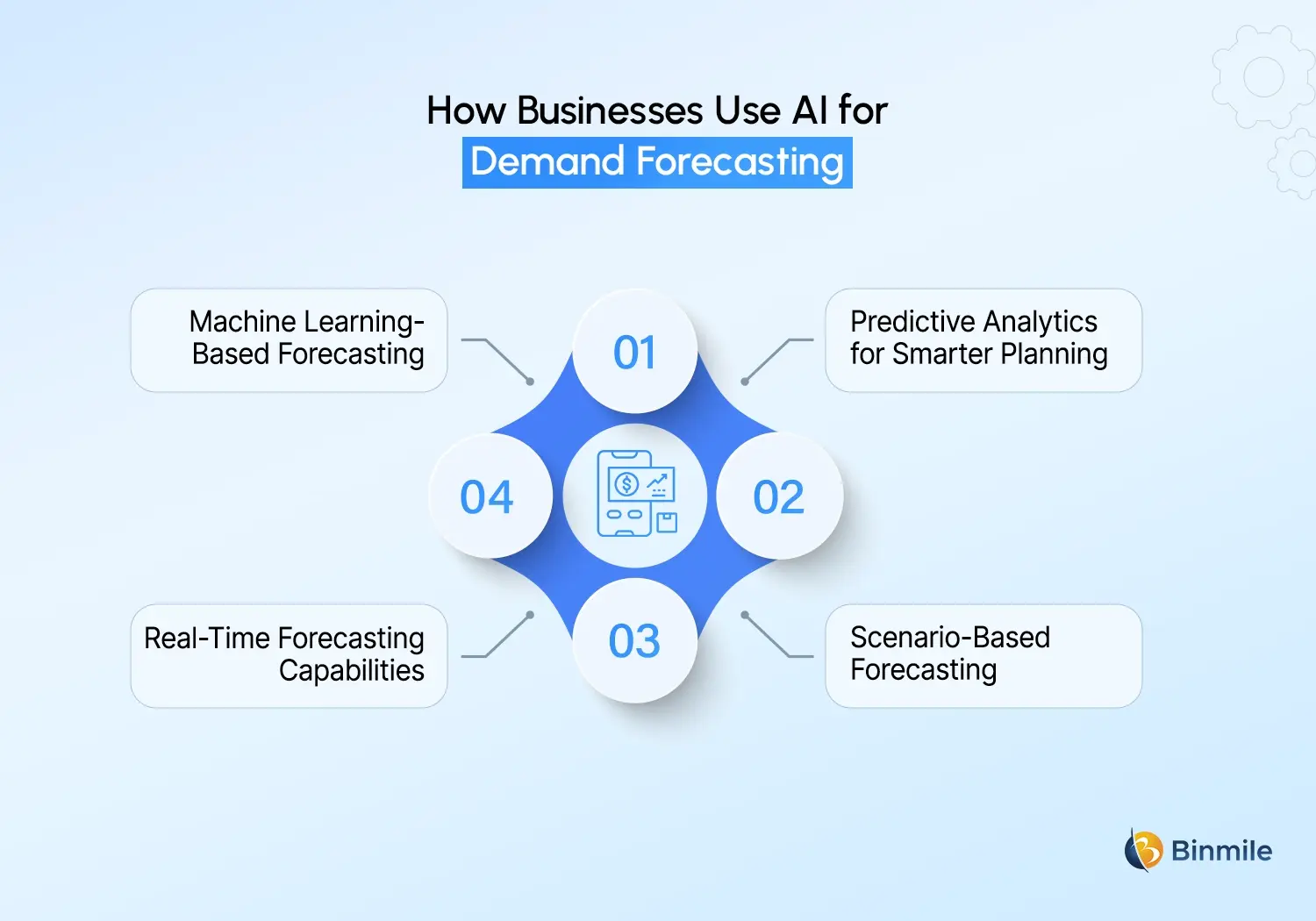
Machine Learning-Based Forecasting
Machine learning can utilize historical information, past and current customer behavior, economic conditions, and market trends to identify hidden demand patterns. Additionally, these inventing prediction systems keep getting better when you put more data into them. As a result, the more a company puts into the data analytics services, the more they use machine learning algorithms to create intelligent forecasting models tailored to the needs of their operation.
-
Predictive Analytics for Smarter Planning
Predictive analytics allows for future outcome prediction based on historical and live data, providing a more accurate planning process and reducing uncertainty in their day-to-day operations, while being able to respond in the event they do take place.
-
Real-Time Forecasting Capabilities
Today’s demand forecasting software integrates with ERP systems, online stores, CRM systems, and the entire supply chain to deliver real-time forecast information. A great example of this would be a retailer using a demand forecasting software product that would instantly alert them to sudden changes in customer demand and allow the retailer to take immediate action on their inventory planning.
-
Scenario-Based Forecasting
More sophisticated demand forecasting systems are able to simulate business scenarios in order to assess the risk involved with making a logistical change. Additionally, companies will be able to forecast how supplier delays, economic downturns, demand spikes, or changes in price could affect their business before making a strategic decision. This also supports enterprise AI in Risk Management.
Types of Demand Forecasting Methods Businesses Use
Different industries require different forecasting approaches depending on business goals and data availability. Understanding the Types of Demand Forecasting Methods helps organizations select the right strategy for operational planning.
-
Qualitative Forecasting
Qualitative forecasting uses experts’ opinions, analyses of the marketplace as a whole, and the behaviour of customers and businesses within their respective industries to predict demand when there is little or no available data from prior periods(e.g., introducing a new product or entering a new market).
-
Quantitative Forecasting
Quantitative forecasting uses historical numeric data and statistical techniques to predict future demand; techniques include time series analysis, moving averages, regression models, and exponential smoothing.
This method is widely used in retail, manufacturing, and ecommerce industries where large volumes of historical data are available.
-
Short-Term and Seasonal Forecasting
Short-term forecasting provides information for businesses to assist in managing inventory replenishment needs, workforce scheduling, and production planning; whereas seasonal forecasting assists with predicting periods of increased demand when businesses are expected to grow significantly due to increased consumer spending, as well as promotional campaigns. In addition, these forecasting methods are extremely useful to the retail and eCommerce industries.
These demand forecasting methods are particularly valuable for retail and ecommerce businesses.
Looking to modernize your supply chain and forecasting strategy with data-driven intelligence?
Key Components of an Effective Demand Forecasting Process
An effective demand forecasting process requires both strong technology infrastructure and reliable business data.
-
Collecting Historical Sales and Operational Data
Businesses will use historical sales information, procurement records, inventory reports, and operating metrics in order to develop their own dependable forecasting models.
-
Selecting Suitable Demand Forecasting Models
Organizations will want to select and implement forecasting methods appropriate to the requirements of their industry, the complexity of their operations, the availability of data, and the objectives of forecasting.
-
Integrating Forecasting Systems With Supply Chain Operations
Demand forecast systems are intended for maximum benefit when they are connected to ERP, inventory, procurement, and supply chain systems, allowing for greater operational visibility and improved speed of decision-making.
Additionally, organizations investing in Data Engineering Services often improve forecasting performance by building scalable and structured data ecosystems.
Benefits of Demand Forecasting for Business Growth
Accurate forecasting improves operational efficiency, financial stability, and customer satisfaction.
| Business Area | Impact of Demand Forecasting |
|---|---|
| Inventory Management | Reduces stock shortages and excess inventory |
| Financial Planning | Improves budgeting and revenue forecasting |
| Supply Chain Operations | Minimizes delays and disruptions |
| Customer Experience | Ensures product availability |
Businesses adopting advanced demand management software often gain a stronger competitive advantage through faster and smarter decision-making.
Demand Forecasting Trends Businesses Should Watch
-
AI-Driven Forecasting
Forecast accuracy is being improved through the automation of data analysis and the ability to quickly identify demand trends with AI.
-
Cloud-Based Demand Forecasting Software
Cloud-based demand forecasting software gives you access to multiple sites, teams, and departments while allowing easy scaling and changing of demand forecasting capabilities.
-
Real-Time Retail and Ecommerce Forecasting
Retail’s increased usage of AI will allow businesses to monitor customer buying behaviour and changes in demand on a continual basis, so retailers can better plan for inventory and their customers.
Choosing the Right Demand Forecasting Software
Selecting the right demand forecasting software depends on business size, operational complexity, and industry-specific requirements.
-
AI and Predictive Analytics Capabilities
Current capabilities for forecasting must be AI-assisted analytical and predictive modeling capabilities to assist in creating better forecasting accuracy and the ability to automate demand planning procedures.
-
ERP and CRM Integration
Forecasting systems need to have an easy interface with other systems, including ERP, CRM, inventory management systems, and on-demand supply chain software, to allow for better operational integration.
-
Scalability and User Experience
From a usability standpoint, businesses should choose forecasting tools that provide ease of use while also having scalable capabilities with an easy-to-read dashboard and real-time report generation.
-
Industry-Specific Forecasting Support
When developing their forecasting systems, businesses should select forecasting solutions that can support the particular forecasting needs of their industry, including manufacturing, retail, ecommerce, transportation and logistics, or health care.
Organizations with complex operational requirements may also invest in demand planning software development to build customized forecasting systems aligned with their workflows.
How Demand Forecasting Supports Digital Transformation
Demand forecasting has become a vital component of an organization’s digital transformation initiative. Businesses that use artificial intelligence, analytics, automation, and/or cloud technologies require demand forecasting systems that will enable them to make operational planning and decisions in real-time.
Advanced demand planning solutions provide businesses with enhanced supply chain visibility; automate the business planning process, improve operational agility, and allow companies to respond more quickly to changes within their market.
Need smarter forecasting systems to reduce inventory risks and improve business planning accuracy?
How Binmile Can Help Businesses Improve Demand Forecasting
Modern businesses need forecasting systems that can process real-time data, improve operational visibility, and support faster decision-making across supply chain and inventory operations. Additionally, building these capabilities often requires expertise in analytics, automation, AI integration, and scalable data infrastructure.
Binmile helps organizations modernize forecasting ecosystems through Data Engineering Services, Data Analytics Services, AI-powered automation, and enterprise digital transformation solutions. Businesses can build intelligent demand forecasting solutions that improve inventory planning, reduce operational risks, strengthen forecasting accuracy, and support long-term business scalability.
For enterprises managing complex manufacturing, retail, ecommerce, or supply chain operations, integrating forecasting with analytics and AI capabilities can create stronger operational resilience and more confident business planning.
Frequently Asked Questions
Demand forecasting in business planning is the process of predicting future customer demand using historical data, market trends, and analytics. It helps businesses make informed decisions about inventory, production, budgeting, procurement, and overall operational planning.
Demand forecasting helps businesses reduce operational risks, improve inventory management, optimize supply chains, and strengthen financial planning. Accurate forecasting also improves customer satisfaction by ensuring products and services remain available when needed.
Artificial intelligence improves demand forecasting by analyzing large datasets, identifying hidden demand patterns, and generating more accurate predictions. AI-powered forecasting systems can adapt quickly to market changes and continuously improve forecasting accuracy over time.
Accurate forecasting requires historical sales data, customer behavior insights, inventory records, market trends, economic indicators, supplier information, and seasonal demand patterns. High-quality and real-time data significantly improve forecasting reliability.
Demand forecasting supports digital transformation by enabling data-driven decision-making, improving operational visibility, automating planning processes, and integrating analytics into business operations. It helps organizations become more agile, efficient, and responsive to market changes.