A single supply chain disruption, cyberattack, compliance failure, or financial forecasting error can cost businesses millions in lost revenue and operational downtime. Many organizations are rapidly investing in Artificial Intelligence for risk management to enhance their decision-making capabilities and diminish the level of uncertainty encountered. According to a report by IBM, the average cost of a data breach globally reached $4.88 million in 2024, highlighting the growing financial impact of unmanaged risks on businesses.
With AI, modern enterprises are increasingly using this advanced technology to identify risks in an expedient manner; improve their decision-making process with enhanced analytics; and help businesses to avoid disruptions before those disruptions have a chance to get much larger than necessary or occur altogether. The use of AI is revolutionizing the approach of businesses to Enterprise Risk Management by increasing the detection of fraud and cybersecurity monitoring, and optimizing supply chains.
In this blog, we will discuss how AI in risk management operates, as well as the primary uses for it across industries; the benefits/challenges of using this technology; and what steps businesses should take to develop a more effective and proactive approach to risk management.
What Is AI in Risk Management
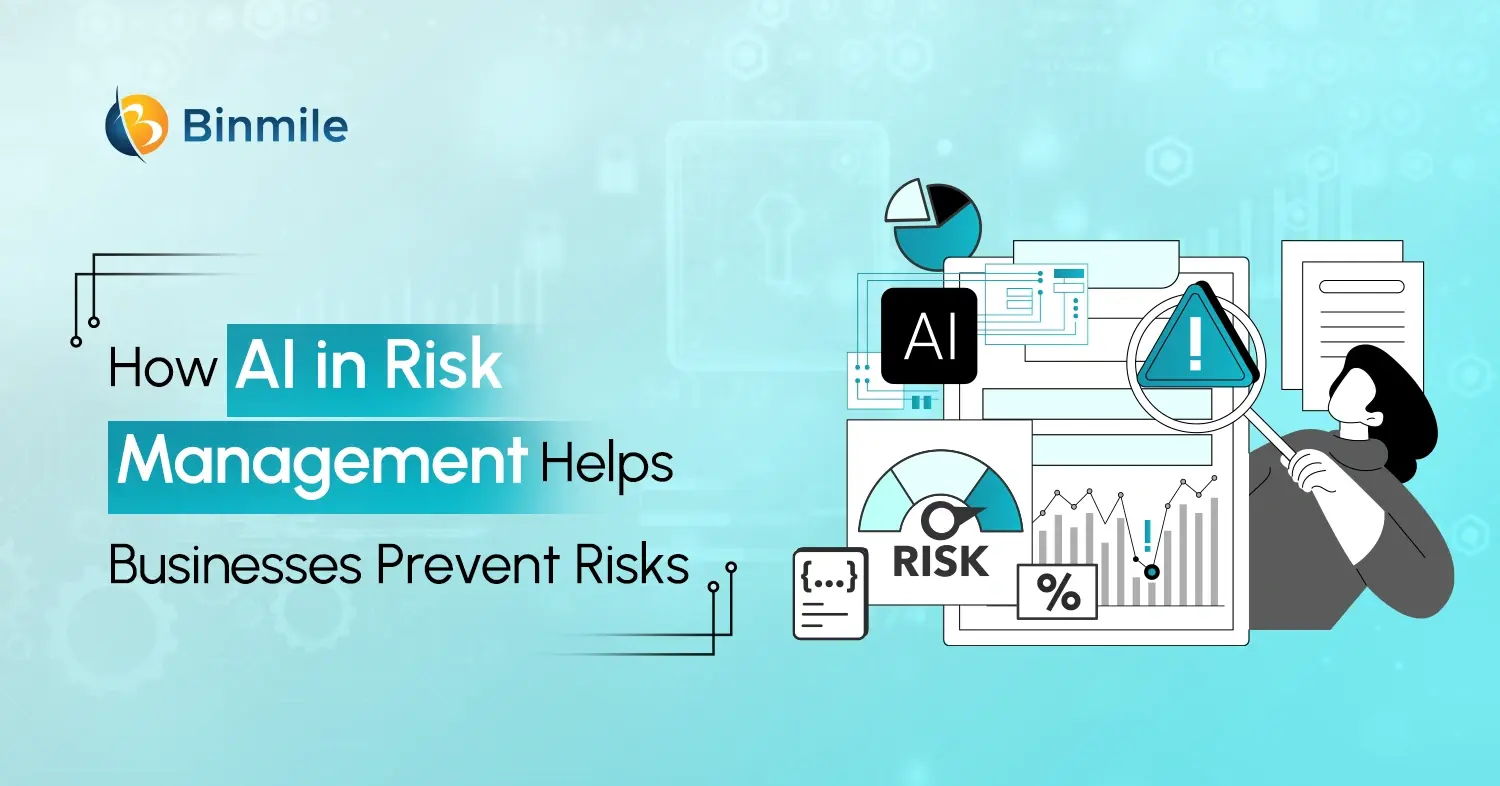
AI in risk management refers to the use of technologies like machine learning, predictive analytics, and automation to identify, assess, monitor, and reduce business risks in real time. AI offers a new way of looking at risk management; it allows for quick analysis of large amounts of data and enhances the prediction of future risks as opposed to past events. Companies today are utilizing AI-based risk management tools to improve various elements, such as financial, operational, cybersecurity, compliance, and supply chain areas, by reducing risks.
AI-based risk management will also allow for a change from reactive risk mitigation to a proactive approach in preventing risks before they occur. The most significant benefit of using AI is the transition from traditional methods of reactive risk management to predictive models.
Key Benefits of AI in Risk Management For Enterprises
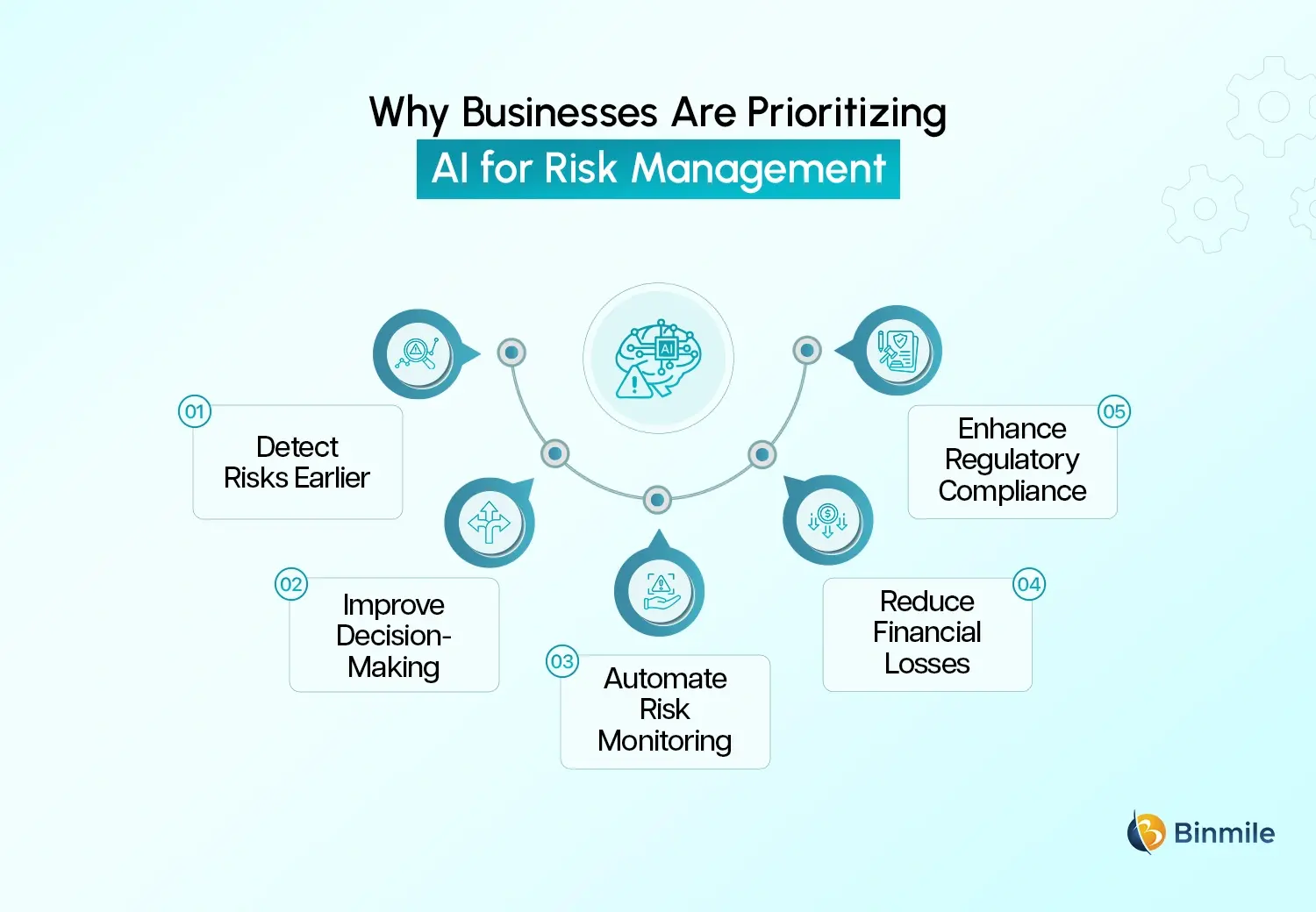
Organizations operate in environments where risks evolve constantly. Market fluctuations, geopolitical instability, cyber threats, and regulatory changes make it difficult for teams to respond quickly using manual systems alone. AI-powered systems help businesses:
-
Detect Risks Earlier
The use of AI models allows data analysis of historical records and real-time data for the purpose of identifying early warning signs. This is helpful for companies to act prior to a problem becoming a major incident.
-
Improve Decision-Making
AI enables businesses to have accurate predictions and data-based recommendations that will help to reduce the amount of uncertainty experienced with strategic decisions.
-
Automate Risk Monitoring
AI has the ability to continuously monitor business operations, automatically eliminating any delays experienced when relying on human effort and improving the productivity of business operations.
-
Reduce Financial Losses
Through predictive analysis, AI provides business leaders with the ability to minimize losses from fraud, downtime, project failure, and disruption in the supply chain.
-
Enhance Regulatory Compliance
Using AI software tools, organizations can efficiently monitor laws and regulations and remain in compliance with both industry standards and governance policies.
What Are the Key AI Use Cases in Risk Management
Businesses across industries are using AI-powered risk management systems to improve operational resilience, reduce disruptions, and strengthen decision-making.
AI in Financial Risk Management
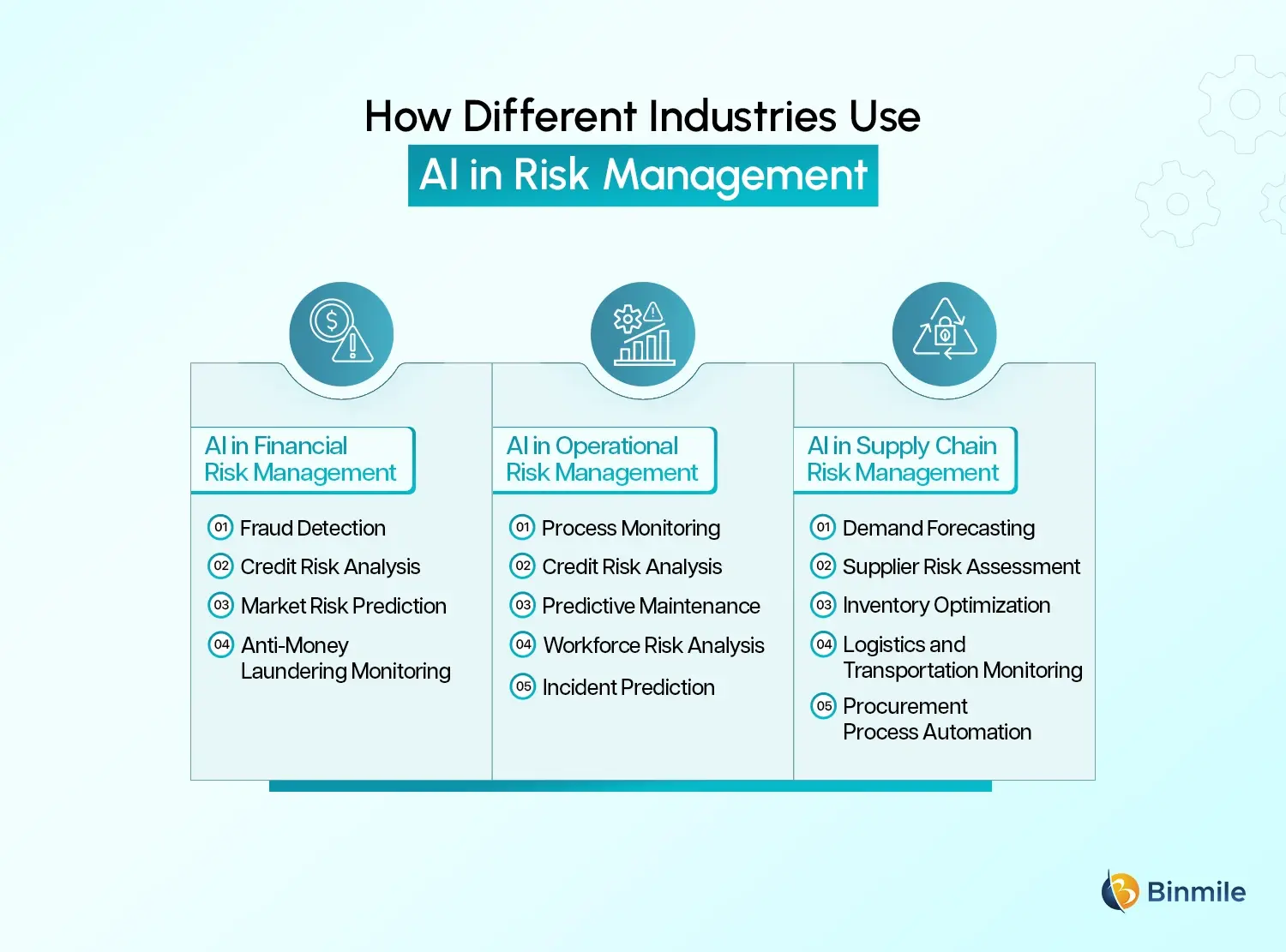
AI in financial risk management helps organizations identify anomalies, detect fraud, and improve credit assessments. Some common applications include:
- Fraud Detection
Real-time analysis of transaction behavior is completed through AI algorithms in order to uncover potentially fraudulent activity; unlike rules-based systems, AI models can continuously adapt as new types of fraud are discovered.
- Credit Risk Analysis
AI is used by banks and other financial institutions to provide a more accurate assessment of borrowers’ spending habits, behaviours, and past financial history than traditional methods.
- Market Risk Prediction
Businesses use predictive analytics models to predict fluctuations in the stock market and other types of investment risk, as well as changes in pricing.
- Anti-Money Laundering Monitoring
AI systems automate the detection of unusual patterns of transactions, which may indicate money laundering activity.
This is also where generative AI in financial services is becoming increasingly valuable. Generative AI can summarize complex financial data, automate reporting, and improve risk assessment workflows.
AI in Operational Risk Management
AI in operational risk management helps businesses improve visibility into internal operations. Some applications are:
- Process Monitoring
Continuous tracking of workflow processes using artificial intelligence tools to identify areas of in-process “bottlenecks” or unusual operational behavior.
- Predictive Maintenance
Manufacturing/Industrial firms can utilize AI systems for equipment condition monitoring and failure prediction.
- Workforce Risk Analysis
The ability of AI systems to analyze employee behavior, work distribution, and production metrics provides organizations with information on how to identify or address operational inefficiencies.
- Incident Prediction
Based on historical incident data as well as operational trend analysis, the machine-learning models of AI are capable of predicting operational disruption due to unexpected events.
Organizations investing in IT risk management are increasingly combining AI with automation to improve infrastructure reliability and reduce downtime.
AI in Supply Chain Risk Management
AI in supply chain risk management helps businesses improve forecasting accuracy and operational continuity. Some practical applications are as follows:
- Demand Forecasting
AI helps improve the accuracy of demand forecasting by analyzing historical sales, seasonal trends, customer behavior, and market conditions. By accurately forecasting demand, businesses can avoid overstocking, understocking, or having unexpected supply shortages.
- Supplier Risk Assessment
AI can help businesses assess the reliability, financial stability, compliance history, and delivery performance of suppliers. By identifying high-risk suppliers sooner rather than later, organizations are able to reduce AI risks in business related to procurement.
- Inventory Optimization
AI-driven systems monitor inventory levels in real-time and automatically provide recommendations for adjustments based on demand changes, storage capacity, and supply chain conditions. Overall, this improves operations and reduces unnecessary inventory costs.
- Logistics and Transportation Monitoring
AI-based solutions can provide insight into possible delays, reroutes, and bottlenecks by analyzing traffic patterns, weather, and logistical data. Businesses are then able to take proactive measures to reduce delays and maintain their business operations.
- Procurement Process Automation
By evaluating supplier data, identifying procurement risk exposure, and streamlining vendor selection processes, AI also provides support in the automation of procurement workflows.
AI-powered supply chain management systems can analyze external and internal data simultaneously to improve resilience and reduce disruptions.
What Is the Role of Predictive Analytics in Risk Management
AI-based Risk Management Systems rely heavily on predictive analytics to assist businesses in forecasting future events through the use of historical data, statistical analyses, and machine learning algorithms.
Using predictive analytics, businesses can identify and predict different types of financial instability, detect cybersecurity breaches, predict operational disruptions, and estimate project-related risks before they become larger-scale issues.
Compared to older forms of analysis, predictive models, as they process more data, keep on improving as they encounter new pieces of data and perform better.
For example, in software development environments, predictive analytics can identify project slippage, security issues, or aspects that could delay an application from being deployed prior to releasing the application to end-users. The result of a proactive approach to risk management through the use of predictive analytics would be enhanced operational efficiency and business continuity.
Looking to strengthen operational resilience with predictive analytics and AI-driven automation?
AI Risk Management Framework: Why Businesses Need One & What It Includes
As AI adoption grows, organizations also need structured frameworks to manage AI-related risks effectively.
Why AI Governance Matters
An AI risk management framework helps businesses:
- Ensure Ethical AI Usage
The use of an AI Risk Management Framework provides assistance for a business’s efforts to mitigate concerns regarding fairness, transparency, and harms associated with AI systems.
- Maintain Regulatory Compliance
By implementing the appropriate alignment of AI systems to industry laws and regulations, organizations will have decreased risks associated with compliance.
- Improve Data Governance
Data Governance is best ensured when businesses establish strong data governance practices that include secure, accurate, and compliant use of data within their AI environments.
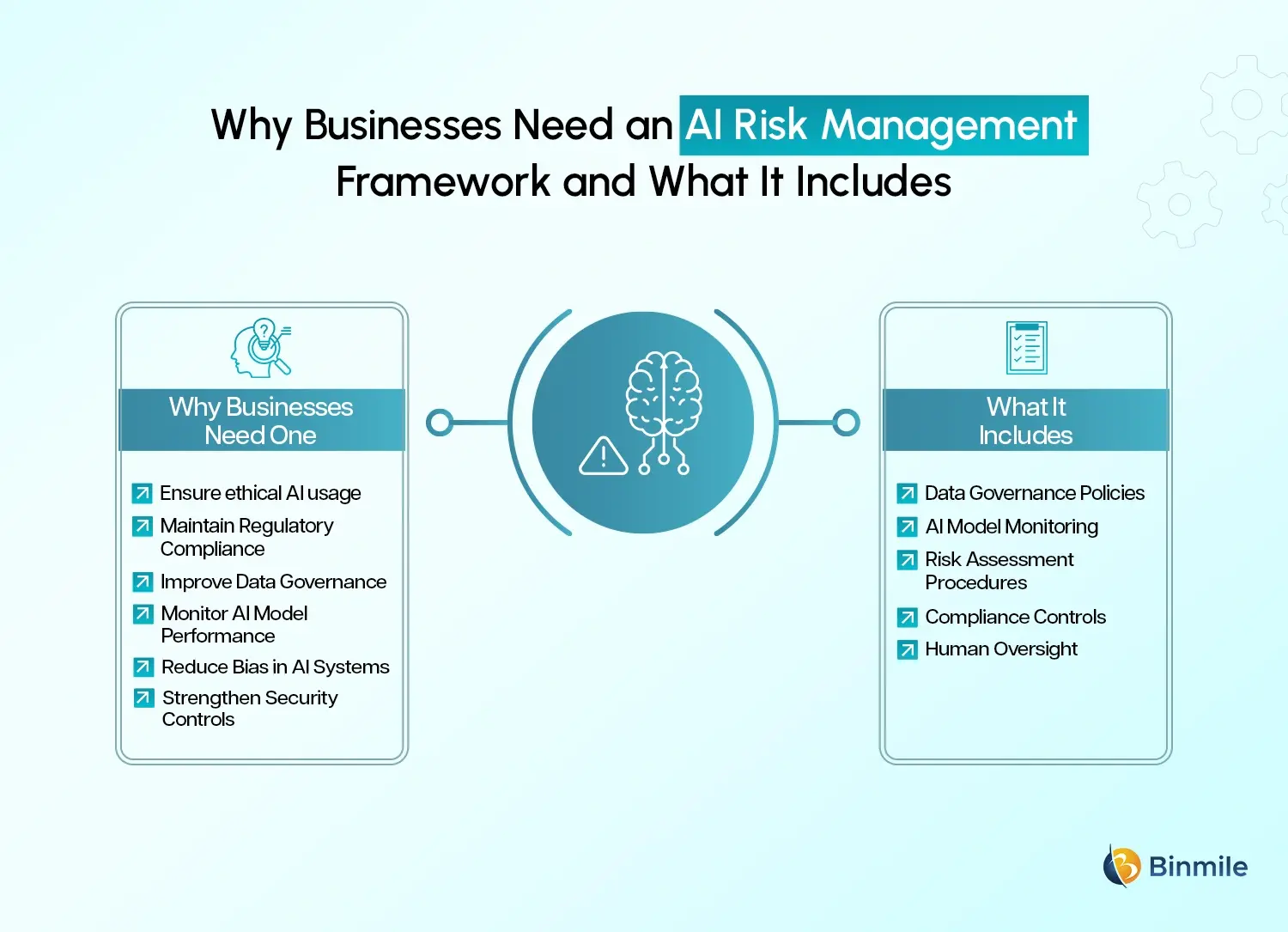
- Monitor AI Model Performance
Continuous monitoring of the performance of AI models that may affect an organization allows organizations to maintain and track their models’ accuracy, detect anomalies, and prevent performance degradation over time.
- Reduce Bias in AI Systems
AI governance frameworks help identify and minimize bias in datasets and algorithms to improve fairness and reliability.
- Strengthen Security Controls
To protect AI Systems, sensitive organizational information, and organizations’ operational infrastructures from cyberattacks, organizations need to implement additional security controls.
What an AI Risk Framework Covers
An AI risk management framework includes:
- Data Governance Policies
Ensure that business data is kept accurate, secure, compliant, and managed correctly through all stages of the AI lifecycle.
- AI Model Monitoring
Ongoing evaluation of AI models helps businesses keep their AI models performing well and workable.
- Risk Assessment Procedures
Using structured assessment processes to identify operational, ethical, and technical risks involved in the operation of AI systems.
- Compliance Controls
Businesses can create controls to make certain AI systems comply with legal regulations, industry standards, and management requirements.
- Human Oversight
The use of human beings in the processing of AI gives more accountability, transparency, and higher-quality decision-making.
What Are the Challenges of AI in Risk Management
While AI offers significant advantages, businesses must also address several implementation and operational challenges.
| Challenge | Impact on Businesses |
|---|---|
| Data Quality Issues | Data that has poor quality can reduce the accuracy of predictions and create misleading insights |
| Integration Complexity | Legacy systems can make it difficult and slow to integrate with AI |
| Privacy and Security Concerns | Cybersecurity and Governance are essential for safeguarding sensitive business data |
| Lack of Skilled Talent | Specialized technical skills are typically needed for the implementation of AI. |
| Bias in AI Models | If datasets are biased, they can produce unfair or inaccurate risk assessments |
| Regulatory Uncertainty | The ever-changing regulations surrounding AI will complicate compliance management for businesses. |
Best Practices for AI in Risk Management For Enterprises
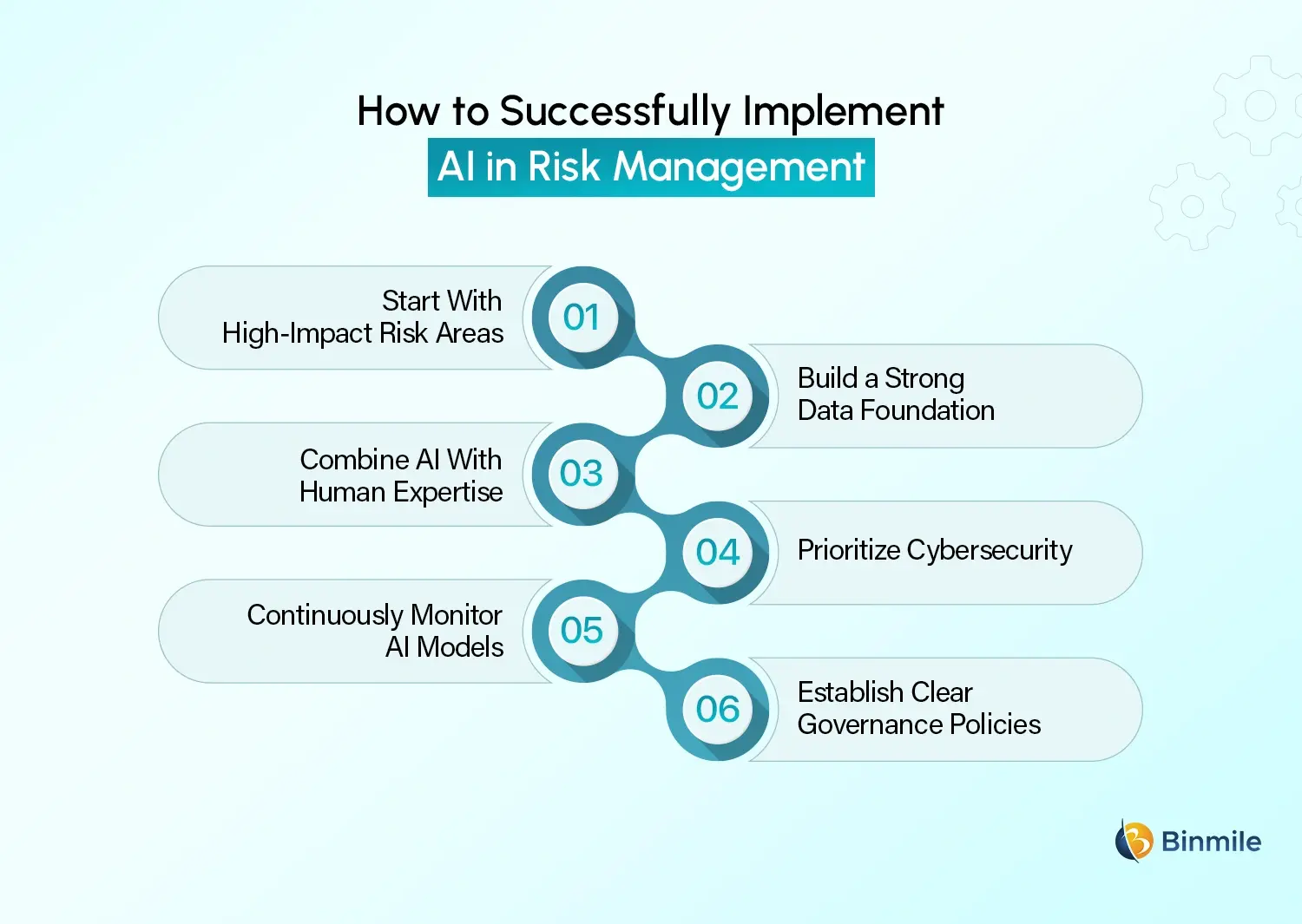
To maximize the benefits of AI for risk management, organizations should follow a strategic and phased implementation approach.
-
Start With High-Impact Risk Areas
Businesses can likely achieve the most benefit from implementing AI technologies when they begin by focusing on operational areas that have the highest potential for measurable improvement.
-
Build a Strong Data Foundation
Top-performing AI systems are built on high-quality datasets. To drive system performance, organizations must therefore invest time and resources into developing an overarching data management structure and creating data governance policies to ensure that the data used to drive AI systems maintains a high level of accuracy.
-
Combine AI With Human Expertise
AI technologies should support (not replace) human decision-making. Human oversight of the decisions made by AI-based systems will ensure responsibility and accountability, as well as provide additional context-based decision-making capabilities and ethics in governance.
-
Prioritize Cybersecurity
Organizations must safeguard their AI-based environments from unauthorized access, cyber threats, and data breaches through the development of robust security controls.
-
Continuously Monitor AI Models
Timely, ongoing evaluation and periodic updates to the performance of AI-based models are essential for maintaining the validity and relevance of those models.
-
Establish Clear Governance Policies
Organizations should develop formal governance frameworks around AI usage and compliance, including ethical use and compliance management, accountability, and operational transparency.
Future of Risk Management With AI
The future of risk management will become more predictive, automated, and intelligent. The use of advanced predictive analytics, such as fully autonomous risk monitoring systems, real-time compliance tracking systems powered by AI, AI-enabled threat intelligence platforms, self-learning fraud detection tools, advanced scenario simulation models, and highly personalized risk assessments, will increase.
With the growing digitalization and interconnectedness of enterprise ecosystems, AI will have a more significant impact on businesses regarding risk management. Early adopters of AI-driven risk management strategies will likely experience improved operational resilience, quicker decision-making, and long-term competitive advantages.
Want to build AI-powered systems that can predict risks before they impact your business operations?
How Technology Partners Can Support AI-Driven Risk Management Initiatives
Implementing AI-based risk management systems requires more than deploying algorithms. Businesses that invest early in AI-powered risk management systems are better positioned to improve operational resilience, reduce uncertainty, strengthen compliance, and make faster strategic decisions.
This is where technology partners with expertise in AI development, predictive analytics, enterprise modernization, and software transformation become valuable. Organizations looking to strengthen operational resilience often require support in building custom AI solutions, integrating AI into legacy systems, improving cyber threat intelligence capabilities, and implementing scalable AI governance frameworks.
Binmile helps businesses approach AI adoption strategically by aligning technology initiatives with operational and business goals. Whether organizations are focused on improving risk management in software development, modernizing supply chain management systems, or implementing enterprise AI solutions, the emphasis remains on building intelligent systems that can predict, prevent, and respond to risks more effectively.
Frequently Asked Questions
AI in risk management uses artificial intelligence technologies to identify, predict, monitor, and reduce business risks. It matters because it helps organizations improve decision-making, automate monitoring, reduce losses, and respond to risks proactively rather than reactively.
Industries such as banking, healthcare, manufacturing, retail, logistics, insurance, and technology benefit significantly from AI-driven risk management because they handle large datasets, regulatory requirements, operational risks, and cybersecurity challenges regularly.
AI assists in risk management by analyzing real-time and historical data, identifying patterns, forecasting potential threats, automating monitoring processes, and providing predictive insights that help businesses prevent disruptions and improve operational resilience.
The cost depends on infrastructure, AI model complexity, integration requirements, data management, and enterprise scale. Businesses may need investments in software, cloud systems, cybersecurity, skilled professionals, and ongoing AI monitoring processes.
Yes, modern AI solutions can integrate with existing enterprise systems such as ERP platforms, CRM software, cybersecurity tools, and supply chain systems. However, integration complexity depends on legacy infrastructure and data architecture.
AI systems can be highly secure when supported by strong cybersecurity practices, encryption, access controls, and governance frameworks. Businesses must also ensure compliance with data privacy regulations and continuously monitor AI environments for vulnerabilities.