ERP projects rarely fail because the software is weak. Most failures happen because businesses struggle with integration complexity, poor data visibility, unclear implementation strategy, and employee adoption issues. Artificial intelligence is changing that reality. Instead of treating ERP implementation as a static IT deployment project, enterprises are now using AI to make implementation faster, more predictive, and operationally intelligent.
The global ERP software market was valued at USD 77.08 billion in 2025 and is expected to reach USD 157.07 billion by 2033, growing at a CAGR of 9.5% during the forecast period. Organizations are no longer deploying ERP platforms only to centralize operations. They now expect ERP systems to forecast demand, automate workflows, improve decision-making, reduce operational risks, and create real-time visibility across departments.
This shift is transforming how businesses approach ERP implementation. Artificial intelligence is now influencing ERP implementation stages, deployment strategies, ERP system integration, forecasting, supply chain management, and long-term operational optimization. In this blog, we will explore how AI is transforming ERP implementation systems, why enterprises are investing in intelligent ERP ecosystems, implementation risks businesses should avoid, cost considerations, industry use cases, and what enterprise leaders should prioritize before selecting an ERP implementation partner.
Why Traditional ERP Implementation Often Fails
For years, businesses treated ERP implementation as a one-time infrastructure project. The focus remained heavily on deployment rather than operational alignment. As a result, organizations frequently experienced delays, budget overruns, poor employee adoption, and disconnected workflows.
Many ERP implementation failures happen because companies underestimate the complexity of integrating enterprise systems across departments. Finance, procurement, operations, HR, customer management, and logistics teams often work with different workflows, databases, and reporting structures. Without intelligent coordination, implementation becomes slow and chaotic.
Some of the most common ERP implementation issues include poor data migration planning, weak implementation governance, inaccurate cost estimation, over-customization of workflows, lack of employee training, integration conflicts between legacy systems, poor scalability planning, and weak post-deployment monitoring.
Artificial intelligence helps address these challenges by introducing predictive analytics, automation, real-time monitoring, and intelligent workflow optimization into the ERP implementation plan.
What Makes AI-Driven ERP Implementation Different?
Traditional ERP implementation systems mainly focused on transaction processing and workflow standardization. AI-powered ERP implementation software goes much further by continuously analyzing operational data, identifying inefficiencies, and automatically improving business processes.
Here is how modern AI-driven ERP systems implementation differs from traditional ERP environments:
| Traditional ERP Systems | AI-Powered ERP Systems |
|---|---|
| Reactive reporting | Predictive analytics |
| Manual workflow approvals | Intelligent automation |
| Static dashboards | Real-time operational insights |
| Human-driven forecasting | AI-powered forecasting |
| Periodic monitoring | Continuous anomaly detection |
| Limited adaptability | Self-learning workflows |
| Manual inventory management | Predictive inventory optimization |
This shift is especially important for enterprises managing complex operational ecosystems and large-scale cloud-based ERP solution environments.
How AI Is Transforming ERP Implementation Stages
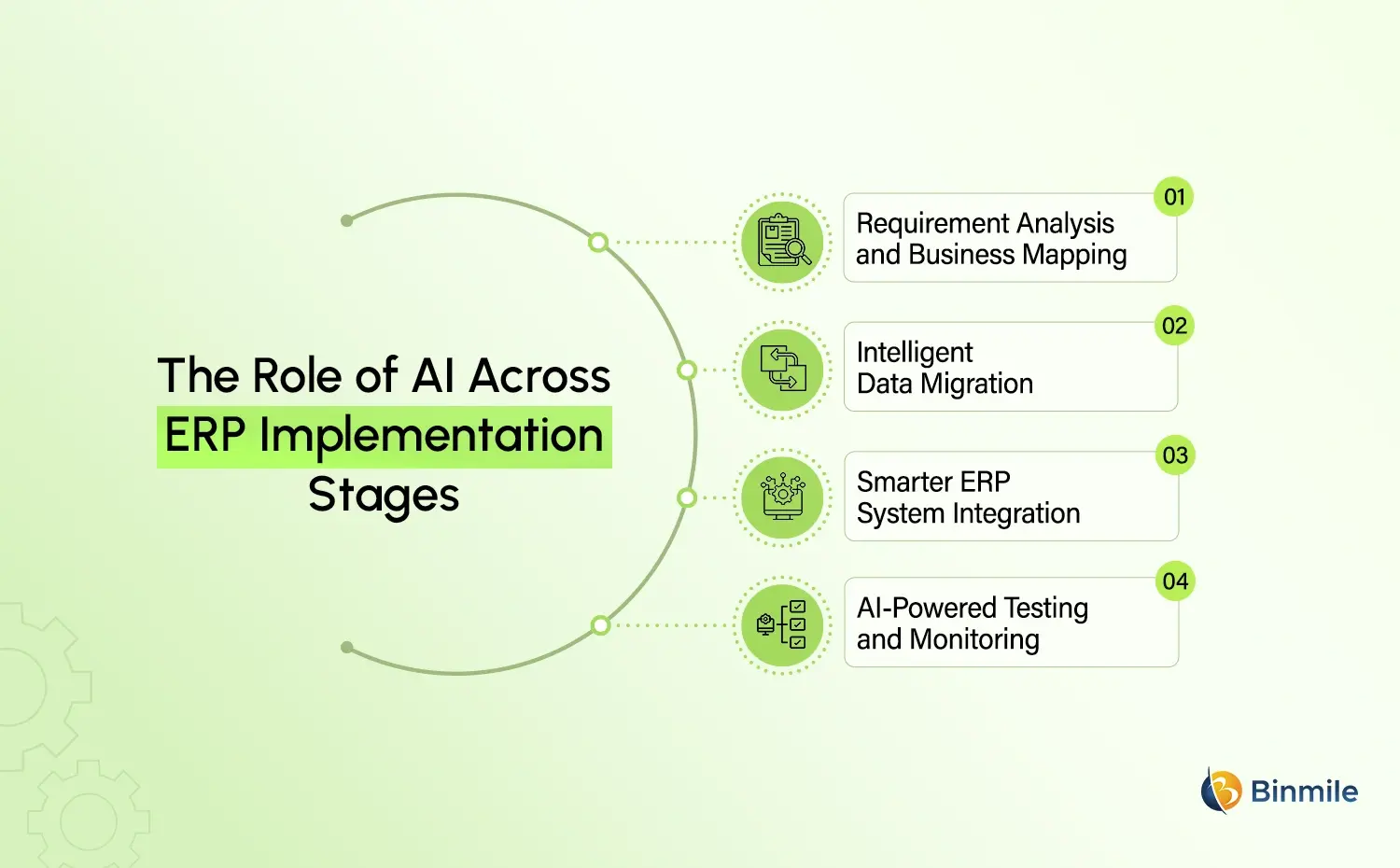
Artificial intelligence now supports almost every ERP implementation stage, helping businesses reduce implementation risks and improve deployment efficiency.
-
Requirement Analysis and Business Mapping
Before starting implementation, businesses must first understand their current operations in comparison to what they wish to achieve (gaps) and therefore establish clear objectives. With its ability to analyze past operational data and identify areas where workflows are inefficient or bottlenecks exist, artificial intelligence will recommend the best way to implement ERP based on the data. This will improve the accuracy of planning as well as reduce the need for unnecessary customizations.
-
Intelligent Data Migration
Data migration can be a difficult part of ERP implementation due to issues such as duplicate, incomplete, and inconsistent data. However, using artificial intelligence will assist in cleaning records as well as organizing data structures, and real-time monitoring of data migration will reduce delays and make the overall system more reliable.
-
Smarter ERP System Integration
Many large enterprises are utilizing many different platforms to conduct their business, such as operations, finance, customer relationship management (CRM), and internal platforms. Artificial intelligence-based tools can assist with ERP system integration by detecting conflicts, improving the ability of API’s to connect, and monitoring synchronization issues, especially during an ERP cloud migration project.
-
AI-Powered Testing and Monitoring
AI-based testing tools can identify gaps in workflows, performance issues, and security vulnerabilities before deployment of the new ERP system. In addition, after deployment of the system, AI will continuously monitor system performance, operational risks, and compliance issues to improve the long-term stability of the ERP solution.
Why Enterprises Are Investing in AI-Driven ERP Systems
Businesses are not investing in AI-powered ERP implementation systems only for automation. They are investing because enterprise operations are becoming too complex for traditional systems.
-
Faster Decision-Making
Executives have started to lose patience with slow report generation and want reports when they happen. ERP systems, powered by AI, provide accurate, up-to-date operational information to help leaders rapidly make decisions regarding their businesses.
-
Better Forecasting Accuracy
AI has improved the accuracy of forecasting through its ability to evaluate the following: customer demand patterns, inventory allocation trends, seasonal fluctuations, supply chain disruptions, and financial performance measures.
-
Reduced Operational Costs
Automating repetitive tasks in different areas, such as purchasing, invoicing, payroll, compliance reporting, and inventory control, can all create cost savings.
-
Improved Customer Experience
Through ERP and CRM integration, businesses are able to provide a more personalized customer experience, shorten their response time, and automate all service departments.
-
Smarter Supply Chain Operations
The efficiency of the supply chain management function using ERP software combined with logistics software is significantly improved by integrating AI-based methods of forecasting, warehouse optimization, and logistics planning.
Real-World Use Cases of AI in ERP Implementation
One reason many ERP blogs fail to rank is that they explain concepts without showing how businesses actually use them. Enterprise leaders want operational relevance.
-
Manufacturing Industry
The manufacturing industry utilizes AI-based ERP solutions for enhanced predictive maintenance as well as optimizing inventory levels. For instance, AI will identify machinery performance issues before failure. As a result, machine downtime is decreased while production efficiency is increased.
-
Retail and eCommerce
Retail and eCommerce rely on AI-driven ERP platforms in predicting consumer demand and managing their inventories dynamically. Instead of adjusting inventory levels by hand, ERP systems can offer automatic recommendations for purchasing adjustments based on real-time purchasing patterns.
-
Healthcare Sector
The healthcare sector employs AI-powered ERP platforms for patient record management, automating compliance reporting, and improving resource allocation.
-
Logistics and Supply Chain
Logistics and Supply Chain companies have become increasingly dependent on intelligence-driven ERP implementations to automate their warehouses, optimize routes, and track their vehicle fleets. AI enhances forecasting capabilities related to shipment demands and the distribution of inventory.
-
Financial Services
The Financial Services sector leverages ERP systems powered by artificial intelligence to automate reporting, monitor compliance, detect fraudulent activity, and enhance financial forecasting.
Looking to modernize operations with cloud ERP, AI automation, and seamless system integration?

ERP Implementation Costs: What Businesses Often Underestimate
ERP implementation costs are rarely limited to software licensing alone. Many enterprises underestimate the operational and infrastructure costs associated with deployment.
A complete ERP implementation plan should account for:
| Cost Area | Description |
|---|---|
| Software Licensing | ERP platform subscription or licensing costs |
| Infrastructure | Cloud or on-premise deployment expenses |
| Data Migration | Data cleansing and migration activities |
| Customization | Workflow customization and integrations |
| Employee Training | Onboarding and adoption programs |
| Security Upgrades | Compliance and cybersecurity investments |
| Ongoing Maintenance | Monitoring, optimization, and support |
AI helps businesses reduce ERP implementation costs by improving resource allocation, automating testing, and minimizing deployment errors.
However, enterprises should avoid over-customization because it increases long-term maintenance complexity.
ERP Implementation Risks Businesses Must Prepare For
Even with advanced ERP implementation software, organizations still face several implementation challenges.
-
Poor Change Management
New operational systems face employee resistance due to a lack of proper communication and training. Without effective means to train employees, adoption rates will decline. Virtual assistants and onboarding systems powered by AI provide better means of streamlining training for employees.
-
Weak ERP Implementation Strategy
Businesses with no clearly defined ERP implementation approach commonly encounter scope creep, delays in deployment, and overall confusion within their operations. Having a structured roadmap for the ERP implementation process is essential to achieving success over time.
-
Vendor Selection Mistakes
Selecting an improper ERP implementation partner could greatly increase the complexity of deployment for a business. Before choosing a vendor, companies should assess the vendor’s prior experience with an industry-specific ERP solution, their ability to integrate multiple software systems, their ability to support application scalability, their knowledge of migrating applications to the cloud, their security practices, and the type of support they will provide after implementation is completed.
-
Cybersecurity Risks
Since ERP solutions typically manage sensitive business data, AI-based tools for monitoring cybersecurity can assist organizations in identifying potential cyber threats and taking appropriate actions to mitigate the risk of operational disruptions.
ERP Implementation Checklist for Enterprise Leaders
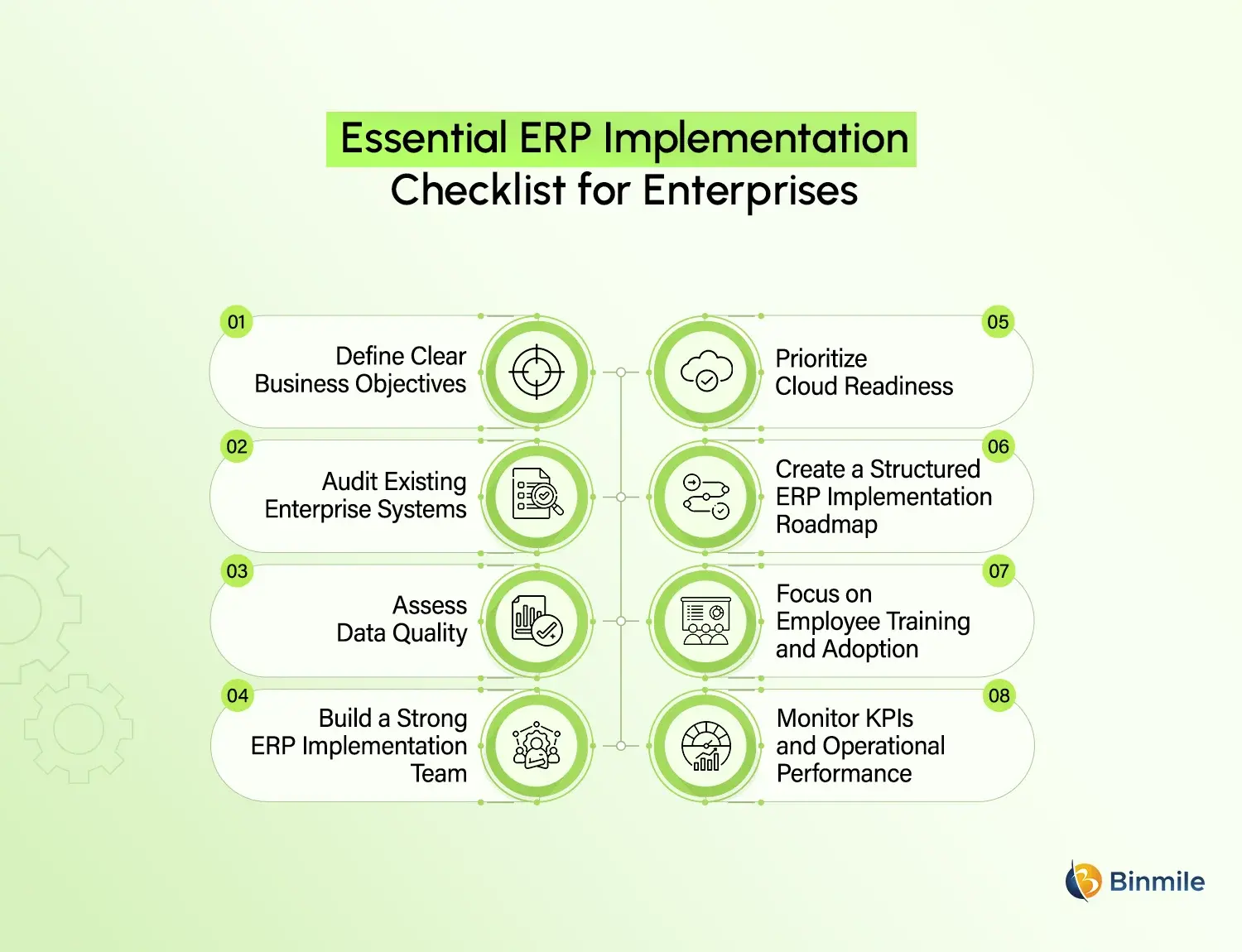
A successful ERP implementation requires much more than selecting the right software. Businesses need a structured implementation strategy that reduces operational disruption and improves long-term scalability.
-
Define Clear Business Objectives
An organization’s first step to implementing an ERP is clearly defining the business objectives that will determine how the ERP will be used to improve current processes. Some business objectives might be: improving operational visibility, automating daily workflow processes, improving supply chain processes, and improving the accuracy of forecasting.
-
Audit Existing Enterprise Systems
Before beginning the actual implementation of an ERP, the organization should review its existing systems in terms of current business processes, software dependencies, and existing bottlenecks. This evaluation will allow you to identify potential challenges (integration issues) associated with the implementation phase of the project.
-
Assess Data Quality
Poor data quality creates major challenges during the migration phase of implementing ERP. Before carrying out the migration, businesses should clean the database to remove duplicate records, standardize the formats of the records, and validate the operational data so that only accurate information is migrated to the new system.
-
Build a Strong ERP Implementation Team
When building a strong ERP implementation team, it is essential to include individuals from various departments (or functional areas) of the business, enabling cross-functional collaboration. A reliable ERP implementation team consists of: IT Leadership; Operations Managers, Financial Stakeholders; Department Heads; Implementation Specialists. Working collaboratively will dramatically increase the overall efficiency of the implementation process.
-
Prioritize Cloud Readiness
Companies that want to grow long-term should ensure that their network infrastructure supports the secure and flexible migration of their ERP to the cloud. In fact, cloud-based ERP solutions often lead to increased operational flexibility and improved scalability of systems.
-
Create a Structured ERP Implementation Roadmap
By developing an ERP Implementation roadmap, businesses can clearly define their timelines, responsibilities, deployment phases, and implementation priorities, which will eliminate confusion and reduce operational delays.
-
Focus on Employee Training and Adoption
No matter how advanced an ERP implementation system may be, it will not succeed if the employees have not received the proper training. Businesses should focus on their onboarding, workflow training, and change management processes to facilitate a successful implementation process.
-
Monitor KPIs and Operational Performance
After the deployment phase is complete, organizations need to continuously measure their Key Performance Indicators (Key Performance Indicator – KPI), operational efficiency, system performance, and workflow efficiencies to determine the success of their ERP implementation.
What CEOs and CTOs Should Evaluate Before ERP Deployment
Enterprise leaders increasingly view ERP implementation as a long-term business transformation initiative rather than a software installation project. Before deployment, CEOs and CTOs should evaluate:
-
Scalability
Will the ERP Implementation system accommodate the future growth of the business operation?
-
Integration Complexity
What challenges exist where existing enterprise tools will integrate with the ERP system?
-
Operational Downtime Risk
How will the implementation affect day-to-day business operations after the system has been implemented?
-
AI Readiness
Does the ERP platform allow for data analysis, automation, and predictive modelling using Artificial Intelligence?
-
Cloud Migration Capability
Does the platform have the capability to safely and reliably perform the ERP’s entire migration to the cloud?
-
Long-Term ROI
How long will it take for operational efficiencies to offset the expense of implementing the ERP system?
Planning an ERP implementation that actually improves business performance instead of creating operational chaos?

Building Smarter ERP Ecosystems for Long-Term Growth
Modern ERP implementation requires much more than software deployment. Businesses now need intelligent, scalable, and AI-driven systems that improve operational visibility, automation, forecasting, and long-term efficiency.
Organizations investing in ERP software development, ERP and CRM integration, ERP cloud migration, and intelligent logistics software solutions often need experienced engineering support to manage complex integrations and enterprise scalability. With AI becoming central to enterprise operations, companies increasingly rely on digital engineering partners like Binmile to build future-ready ERP ecosystems that support operational growth and business agility.
Frequently Asked Questions
Artificial intelligence improves ERP implementation by automating workflows, improving data migration accuracy, simplifying integrations, enhancing forecasting, and reducing implementation risks. It also helps businesses optimize operational efficiency and improve decision-making across departments.
Businesses adopt AI-driven ERP solutions to improve automation, reduce manual errors, accelerate reporting, optimize supply chains, and gain predictive insights that support faster and smarter business decisions across operations.
Industries such as manufacturing, healthcare, retail, logistics, finance, and e-commerce benefit significantly from AI-powered ERP systems because they manage large operational datasets and complex workflows requiring automation and predictive analytics.
AI improves ERP data management by identifying duplicate records, cleaning inconsistent data, automating classification, monitoring anomalies, and improving real-time visibility across enterprise operations and integrated business systems.
AI analyzes historical trends, customer behavior, operational patterns, and market conditions to generate accurate demand forecasts, inventory predictions, financial projections, and supply chain planning recommendations.