Enterprises are no longer debating whether AI belongs in software development. The focus has shifted toward improving engineering scalability, operational efficiency, and software delivery speed. According to a recent McKinsey report, organizations adopting generative AI in engineering are already reporting measurable productivity gains and faster development cycles.
This shift is pushing CTOs and engineering leaders to evaluate how tools like Claude Code fit into enterprise workflows, modernization initiatives, and development operations. From documentation automation to intelligent debugging and workflow orchestration, enterprises are increasingly exploring how Anthropic Claude AI can support large-scale engineering environments.
In this blog, we will explore where Claude Code fits inside enterprise ecosystems, the implementation challenges organizations often underestimate, how enterprises are measuring ROI, and what technology leaders should evaluate before scaling adoption.
Why Enterprises Are Re-Evaluating AI Coding Workflows
Enterprise engineering teams are under growing pressure to deliver faster releases while managing increasingly complex software ecosystems and legacy infrastructure. At the same time, rising technical debt, fragmented documentation, knowledge silos, and increasing software development costs are making traditional development workflows harder to scale efficiently.
This is one of the biggest reasons enterprises are investing in AI-assisted coding solutions. Instead of functioning only as code generation tools, Claude AI Solutions are increasingly being integrated into broader engineering operations to support documentation, workflow automation, debugging, knowledge retrieval, and API integration workflows.
| Enterprise Engineering Challenge | Claude AI Implementation Support |
|---|---|
| Legacy code understanding | Context-aware code interpretation |
| Slow documentation workflows | Automated technical documentation |
| Repetitive engineering tasks | AI-assisted workflow automation |
| Internal knowledge silos | Intelligent engineering search |
| API integration bottlenecks | Claude API integration assistance |
| Large-scale debugging | Multi-file reasoning support |
This shift reflects how enterprise AI adoption is becoming workflow-centric rather than tool-centric. Organizations are no longer experimenting with GenAI in isolated environments. They are evaluating how systems like Claude Code can reduce operational friction across software delivery pipelines and modern engineering operations.
Another major factor driving adoption is the rise of collaborative AI-assisted development practices, in which developers increasingly use AI for architecture planning, debugging, technical analysis, and implementation, rather than only for code completion. This is one reason core Claude models are gaining enterprise attention, particularly in environments where contextual reasoning and understanding of business logic matter as much as code generation itself.
Where Claude Code Fits Inside Enterprise Development Operations
One mistake many organizations make during Code Claude implementation is assuming it belongs only inside developer IDEs. In reality, enterprise adoption is becoming much broader.
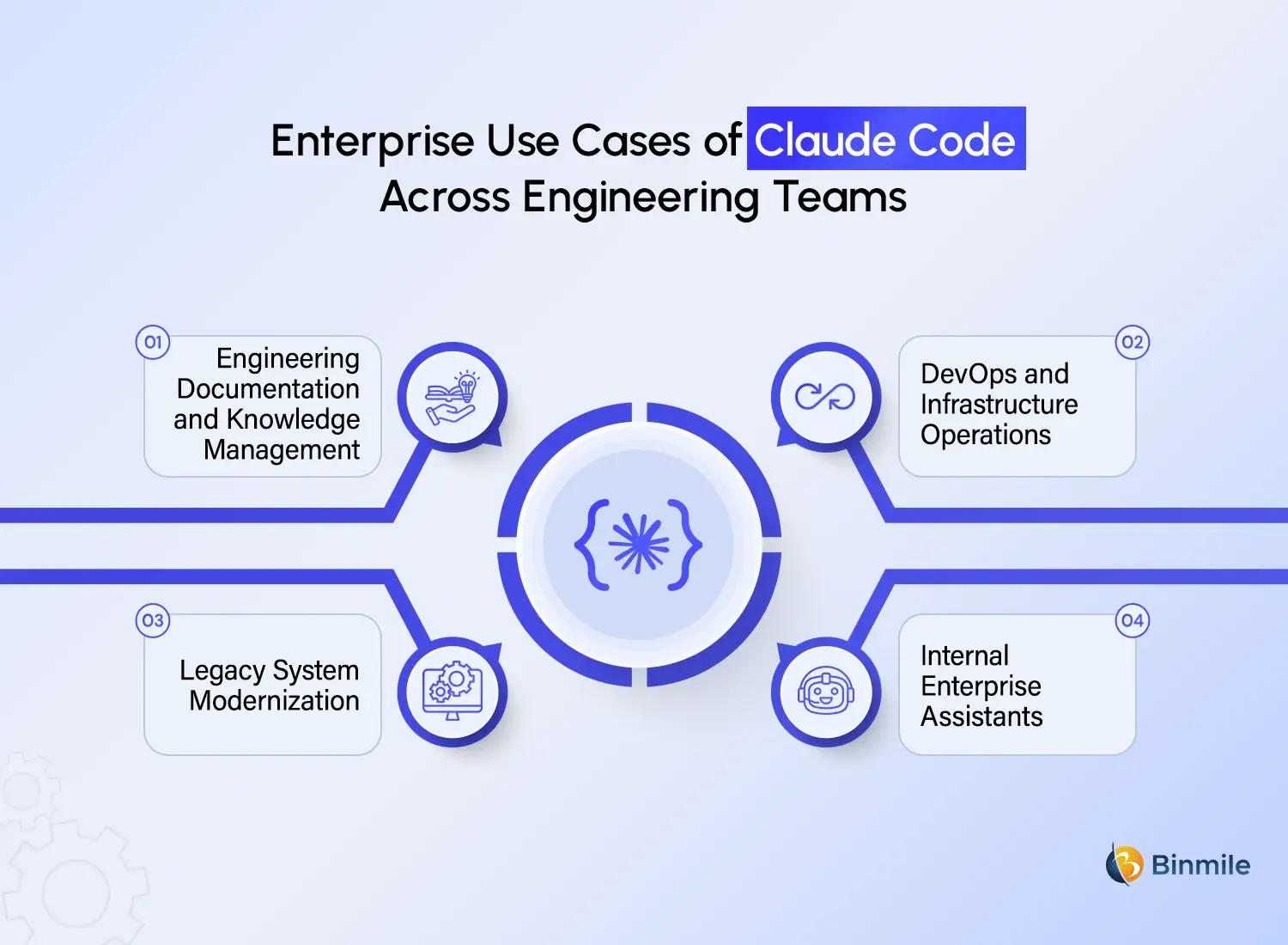
Claude AI Integration is increasingly happening across the full software development lifecycle.
-
Engineering Documentation and Knowledge Management
Many large enterprise companies find their technical repositories containing fragmented knowledge between their technical management and internal wikis, chats, and outdated documentation systems.
Claude AI for Enterprise allows engineering teams to retrieve contextual technical information, such as summary, explanation, architectural understanding, and out-of-date documentation, quickly. This can be especially helpful during developer onboarding, legacy modernization projects, cross-team collaboration, and internal support operations, as accurate technical knowledge will greatly impact delivery speed.
For companies that have widely distributed engineering teams, this significantly reduces reliance upon senior developers for repetitive knowledge sharing between resources.
-
DevOps and Infrastructure Operations
Claude AI automation solutions are also expanding in DevOps environments.
Engineering teams are increasingly using Claude for Workflow Automation support of CI/CD pipeline management, troubleshooting of infrastructure, analysis of deployments, interpretation of logs, summarization of incidents, and guidance of operational configuration. Claude expediates the identification and operational troubleshooting of issues by replacing the previously systematic review of large volumes of infrastructure logs or failures resulting from deployments.
-
Legacy System Modernization
Many enterprises continue to rely upon very old systems that are hard to scale, maintain, or migrate.
One of the best uses for Claude within the enterprise is in aiding engineering teams to better understand legacy applications. Claude code implementation can assist in the interpretation of code bases, the analysis of dependencies, and code refactoring. Many enterprises are also using Claude AI to reduce software code complexity during refactoring and modernization initiatives.
-
Internal Enterprise Assistants
Another growing trend is the development of internal enterprise copilots powered by Anthropic Claude AI.
Organizations are building AI systems that support employees with internal policy retrieval, engineering guidance, workflow assistance, technical troubleshooting, and operational analytics. This is where Agentic Claude deployments are beginning to evolve beyond traditional chat interfaces and into multi-step operational support systems.
The Real Challenges Behind Claude Enterprise Deployment
Most enterprise AI content online focuses heavily on advantages while avoiding implementation realities. But for CTOs and engineering leaders, deployment challenges are often more important than promised capabilities.
A successful Claude Enterprise deployment requires much more than API access.
-
Governance Becomes a Major Operational Concern
The issue of governance is now one of the largest concerns enterprises have when adopting AI.
Without proper governance frameworks in place at the enterprise level, there is often a lack of consistency in terms of how AI is utilized within the organization, leading to a variety of risks, such as exposure to unauthorized use of AI technology, shadow AI adoption, and the associated risks of insufficient protection of sensitive data. Enterprises working with the Claude AI Strategy initiative will have to develop structured usage guidelines, defining who has access to Claude, defining what the prompt governance structure is, how to conduct audits on the usage of policies, and defining workflow restrictions to ensure operational control is maintained.
In regulated commercial sectors, the importance of operational oversight and governance of enterprise AI is of utmost importance.
-
Integration Complexity Is Often Underestimated
Integrating Claude APIs into enterprise ecosystems can be more complex than anticipated.
Enterprise organizations typically have many different legacy systems; operate in multi-cloud environments, use multiple internal APIs; have varying levels of security, i.e., multifactor authentication for employees; have internal compliance frameworks with different internal compliance processes; and have distributed technological solutions. Therefore, if there is no structured implementation roadmap during the integration process, projects for implementing AI could become an operational bottleneck rather than a solution to operational bottlenecks.
This is one of the reasons why many enterprises in the past few years have been working within the Claude AI Development Partner ecosystem to progress their AI roadmaps from the prototype stage to the production stage.
-
AI Adoption Does Not Automatically Mean Productivity
Many mistakenly assume that adopting AI will improve the efficiency of engineering teams.
In reality, many organizations report that their teams did not adopt the technology at a high rate due to improper training for teams using AI-generated outputs, poor integration with existing workflows, distrust by developers in the results produced from AI-generated outputs, governance structures that created friction in the organization’s ability to use the outputs generated, or overly ambitious internal expectations of the productivity gains. The most successful organizations treat Claude AI Adoption as an operational transformation project versus merely a deployment of software.
-
Measuring Enterprise ROI Is More Complex Than Expected
The majority of leadership teams find it difficult to quantify an ROI from AI coding tools because many benefits from using these tools are realized indirectly through workflows. Companies considering the Claude enterprise cost must take into consideration the productivity gains created by using Claude, the decrease in overhead for maintaining AI tools, the increased pace with which developers are onboarded to using Claude, and the efficiencies and speed to market of the documents created via AI tools.
If an organization simply considers the reduction in time to produce code as the only measure of AI productivity, it will miss the additional operational value that will accrue from using these tools.
Planning to integrate Claude AI into your enterprise operations and development ecosystem?

Where Enterprises Are Seeing Measurable ROI From Claude AI
The strongest enterprise AI strategies are tied to measurable operational outcomes.
For most enterprises, the value of Claude AI Implementation is most evident in workflow optimization rather than in isolated engineering metrics.
-
Faster Development Cycles
Through the use of AI-assisted development processes, engineering teams can cut down on the time spent performing manual, repetitive tasks related to creating boilerplate code, writing technical documents, unit testing, and interpreting code, as well as producing technical summaries. As a result, an engineer could spend a greater percentage of their time working on developing the product or architecting, as well as focusing on long-term engineering strategic initiatives.
The rise of vibe coding practices inside enterprise engineering teams is also contributing to faster collaboration between developers and AI systems during implementation, debugging, and technical analysis workflows.
-
Lower Software Development Costs
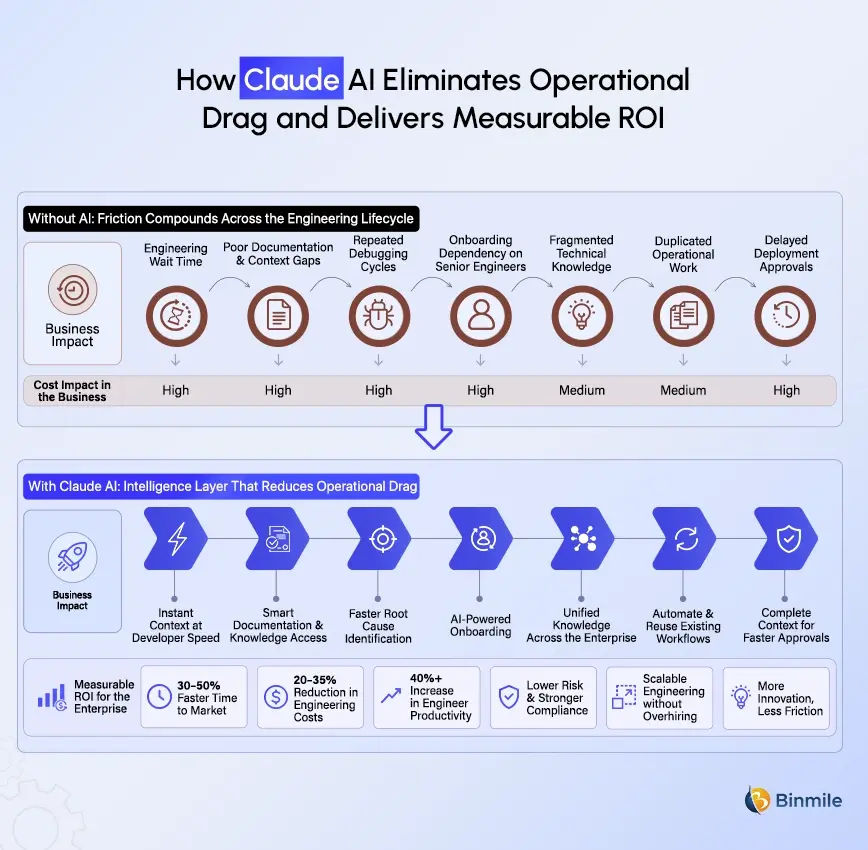
One of the most significant business benefits derived from the use of Claude AI in business automation is that it creates a more efficient operation without proportional growth in the number of employees employed in the development team.
Rather than rapidly increasing the number of employees within an engineering team, companies are working to improve work output through the use of new tools to automate processes, provide intelligent technical assistance, enable faster debugging assistance, and produce automated documents. This allows enterprises to improve engineering efficiency, optimize AI development cost structures, and scale operations without dramatically increasing engineering overhead.
-
Reduced Technical Debt Accumulation
Technical debt becomes costly when teams put off doing documentation, refactoring, and modernization for extended periods.
Claude AI Solutions helps companies to keep their documentation cleaner by improving the readability of their code, speeding up the process of refactoring, and minimizing the burden of repetitive maintenance on the system. As a result, the long-term sustainability of the engineering function will improve over time due to the reduced amounts of operational friction.
-
Improved Engineering Collaboration
Companies that operate in distributed engineering environments often face challenges related to the fragmentation of knowledge sharing and the bottleneck caused by exposing everyone else who would work at the same time to a particular dependent task in the engineering process.
Claude AI for Data Analysis and supporting contextual reasoning assists teams by speeding up their ability to share context related to the technical aspects of the systems they are developing, making it easier to interpret the system, creating a better onboarding experience, and reducing the amount of dependence on a limited number of senior engineers within the team. Ultimately, this provides the team with greater levels of engineering efficiency.
What CTOs Should Evaluate Before Scaling Claude Across Teams
Market trends or competitive pressure should not drive enterprise AI implementation decisions. Before scaling Claude for Business environments, leadership teams should evaluate several operational areas carefully.
-
Infrastructure Readiness
Organizations should determine if their infrastructure, cloud architecture, API environment, security infrastructure, compliance framework, and identity management systems are ready to support enterprise-level AI deployments. Organizations with low levels of infrastructure readiness often create additional operating complexity instead of achieving improved efficiency.
-
Workflow Prioritization
AI solutions do not equally impact workflows. Workflows where there are potential early-stage AI solution implementations tend to provide quicker and more measurable ROI than others. Examples of suitable early implementations include documentation workflows, internal engineering support workflows, legacy modernization projects, and DevOps troubleshooting environments.
-
Long-Term Governance Strategy
AI governance should not be an afterthought. As organizations implement AI solutions across their teams, there should be documented policies concerning the operations of data access, prompt handling, compliance monitoring, workflow permissions, and the accountability of AI.
-
Vendor and Ecosystem Evaluation
Technology leaders need to perform an evaluation of vendors and ecosystems before committing to large-scale deployment strategies based on integration flexibility, enterprise-level support capabilities, security maturity, customization capabilities, and long-term scalability.
Need enterprise-grade AI implementation strategies that improve engineering productivity and accelerate software delivery?

How Strategic AI Implementation Impacts Long-Term Digital Transformation
Digital transformation initiatives often fail because organizations focus heavily on tools while ignoring workflow transformation.
Enterprise AI adoption becomes most effective when it improves operational scalability, simplifies engineering modernization, makes technical knowledge more accessible, automates repetitive workflows, and improves cross-functional efficiency across teams. This is why implementation strategy matters as much as technology selection.
Organizations exploring Claude AI Consulting Services often require support beyond deployment alone. Integration planning, governance frameworks, workflow optimization, and operational alignment all play a major role in long-term success.
Binmile helps enterprises approach AI software development and workflow modernization from a more operational perspective. Instead of treating AI adoption as a standalone initiative, the focus remains on aligning Claude AI Integration, automation workflows, and engineering scalability with measurable business outcomes and sustainable digital transformation goals.
Frequently Asked Questions
Claude Code refers to the enterprise implementation of Claude AI models across software engineering workflows, automation systems, documentation processes, and operational environments. It helps organizations improve productivity, streamline workflows, reduce engineering overhead, and accelerate software delivery cycles.
Enterprises are investing in Claude Code implementation to improve engineering efficiency, modernize legacy systems, automate repetitive workflows, reduce software development costs, and support long-term digital transformation initiatives with scalable AI-assisted operations.
Claude Code reduces software development costs by automating repetitive engineering tasks such as debugging, documentation, testing, and technical analysis. This improves developer productivity and allows enterprises to scale operations without significantly increasing engineering headcount.
Claude Code supports digital transformation by helping enterprises modernize systems, automate workflows, improve operational efficiency, accelerate software delivery, and simplify complex engineering processes through AI-assisted development environments.
Artificial intelligence coding tools are evolving toward workflow automation, autonomous operational assistance, intelligent debugging, and enterprise-wide AI collaboration systems that improve scalability, productivity, and long-term engineering efficiency.