Today, companies are developing Artificial Intelligence systems in an effort to automate operations, improve customer service, prevent fraud, and speed up decisions made by customers. All these innovations rely on frameworks of machine learning, which simplify developing, deploying, and scaling enterprise-wide AI applications. According to Fortune Business Insights, the global machine learning market was valued at USD 47.99 billion in 2025 and is projected to reach USD 432.63 billion by 2034, driven by increasing enterprise adoption of AI-powered automation, predictive analytics, and intelligent business systems.
This blog explores how modern ML frameworks help businesses build scalable AI systems, streamline ML pipelines, support Generative AI, and accelerate enterprise innovation through cloud-native infrastructure and intelligent automation.
What Are Machine Learning Frameworks?
Machine learning frameworks are software libraries and development environments that help developers, data scientists, and ML Engineers build, train, test, and deploy machine learning algorithms efficiently.
To avoid having to create code from the ground up, you can utilize frameworks that offer pre-developed tools, APIs/libraries, and automation to lend an overall simplified development process. Frameworks help with things like preparing your data before training via preprocessing, training your model, hyperparameter tuning, deploying and monitoring your model, and scaling your model.
Modern-day machine learning frameworks work within a cloud-based infrastructure to help developers with automation tools, distributed computing systems, and are vital to aid in companies adopting and leveraging AI.
While some frameworks are specific to deep learning frameworks and/or neural networks, others are geared toward traditional-style frameworks for creating classical machine learning models or predictive analysis models.
Why Businesses Are Investing in ML Frameworks
Organizations today generate enormous volumes of operational, transactional, and customer data. This is why enterprises are increasingly adopting an ML Powerhouse approach powered by scalable machine learning frameworks.
-
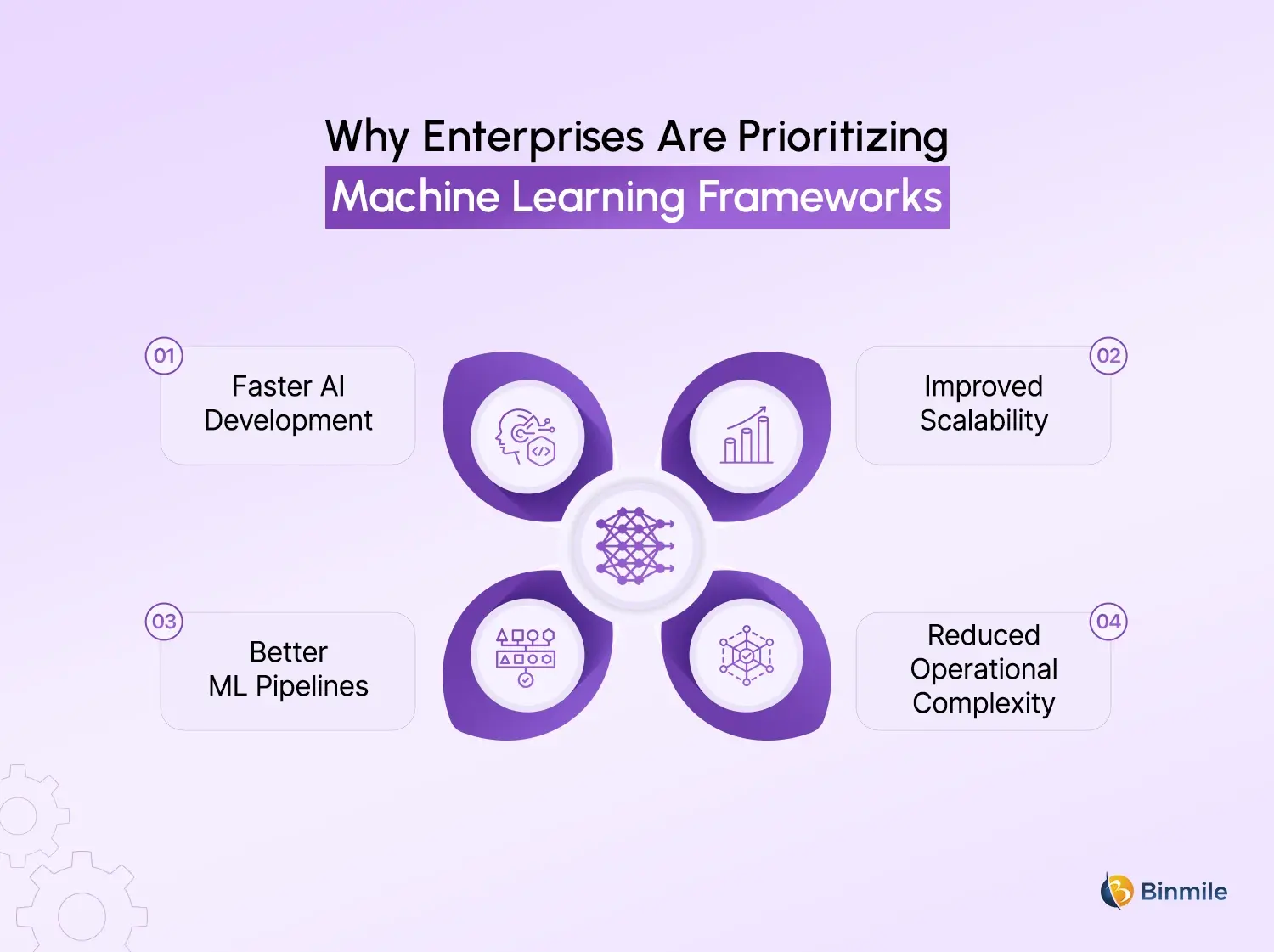
Faster AI Development
Modern ML frameworks make it easy to create and deploy machine learning models through prebuilt tools, APIs, and automation. This makes it easier for companies to develop new models faster than ever before, allowing them to implement all of their AI applications as quickly as possible.
-
Improved Scalability
As companies start using more and more machine learning, they need systems that can efficiently support the growing volume of data and real-time processing requirements. The scalability of machine learning frameworks will be able to support these needs through the use of both distributed computing systems and cloud native workloads.
-
Better ML Pipelines
By creating structured ML pipelines, companies can automate all aspects of their workflow for processing data, training models, deploying models, and monitoring and optimizing them. Creating a structured workflow for each stage of the machine learning lifecycle reduces the number of times an employee needs to manually intervene in the workflow and simplifies the deployment of ML applications.
-
Reduced Operational Complexity
Machine learning frameworks make it easier for development teams, data scientists, and stakeholders within an organization to collaborate on the machine learning development models. Faster experimentation and easier deployment cycles mean that companies are able to move their projects from the prototype stage to production sooner than ever before.
For CEOs and CTOs, this translates into improved agility, faster innovation, and stronger long-term operational efficiency.
Best Machine Learning Frameworks Used by Enterprises
Different frameworks serve different business and technical needs. Choosing the right one depends on project goals, infrastructure, scalability requirements, and team expertise.
| Framework | Primary Use Case | Key Strength |
|---|---|---|
| TensorFlow | Deep learning and enterprise AI | Scalability and production readiness |
| PyTorch | Research and neural networks | Flexibility and ease of experimentation |
| Scikit-learn | Traditional machine learning algorithms | Simplicity and fast development |
| Apache Spark MLlib | Big data machine learning | Distributed computing |
| Keras | Rapid deep learning development | Beginner-friendly APIs |
| XGBoost | Predictive analytics and structured data | High model performance |
| MXNet | Cloud-scale AI workloads | Efficient distributed training |
TensorFlow and PyTorch continue to dominate enterprise deep learning frameworks, while Scikit-learn remains one of the most widely used tools for traditional AI applications and predictive analytics.
Key Factors to Consider Before Selecting a Framework
Choosing the right machine learning framework requires more than evaluating technical performance alone.
-
Scalability and Performance
Businesses must choose frameworks that allow for the rapid growth of AI workloads and large amounts of data while processing in real-time without compromising their level of performance.
-
Cloud Compatibility
Cloud-native machine-learning frameworks make it easier for companies to deploy their applications, manage their infrastructure, and scale their environments to meet business needs; thus, eliminating much of the operational complexity and cost associated with this process.
-
Integration Flexibility
Frameworks should provide seamless integration between an organization’s current enterprise systems, automation tools, ML pipelines, and cloud ecosystems to prevent bottlenecks during deployment of these technologies.
-
Security and Governance
Before implementing AI solutions, organizations that deal with sensitive business data need to assess compliance standards, governance capabilities, monitoring systems, and the security features offered by different platforms.
-
Developer Support and Ecosystem
Strong developer community support through documentation and enterprise ecosystems will enhance the ability of organizations to accelerate development, simplify troubleshooting, and provide for long-term maintenance of their ML applications.
How Machine Learning Frameworks Support Scalability
Scalability is one of the biggest reasons enterprises invest heavily in machine learning frameworks.
-
Distributed Computing
Distributing large datasets over many computer servers enables the reduction of the amount of time required to train a machine while also increasing the efficiency of operation.
-
GPU and TPU Acceleration
Utilizing Graphics Processing Units (GPUs) and Tensor Processing Units (TPUs) can also help to reduce the time that it takes to train and test models built with AI technology.
-
Cloud-Native Architecture
The ability to dynamically allocate resources to meet the demands of the workload will eliminate barriers to scaling resource needs and decrease the costs associated with operating.
-
Automated Resource Management
With the use of Kubernetes-based orchestration systems, machine learning frameworks will be able to automatically allocate computing resources as needed based on demand, as well as to automatically optimize the environment in which the workloads are being executed.
The Role of ML Pipelines in Enterprise AI
AI models alone are not enough to support enterprise machine learning. To be successful, businesses need to create a structured workflow around how they are going to process their data, train their models, deploy them, monitor them after deployment, and continue to optimize them.
ML Pipelines automate the workflow process, allowing organizations to reduce the amount of manual effort needed for model development and to achieve greater consistency in their processes by streamlining operations between development teams, data scientists, and business stakeholders while enabling scalable operations for all of their AI initiatives.
For those companies that have more than one AI system deployed, using a single ML Pipeline is critical to achieving operational efficiency and driving innovation at a faster rate than their competitors.
Want to streamline ML pipelines, deploy intelligent automation, and scale AI faster across your business operations?

Machine Learning Frameworks and Generative AI
The rise of Generative AI has significantly increased demand for scalable and high-performance machine learning frameworks.
-
Large Language Models
Large Language Models have been created by companies utilizing frameworks such as TensorFlow and PyTorch to develop and train large-scale language models for conversational artificial intelligence as a service, enterprise search systems, and intelligent automation.
-
Intelligent Automation
Intelligent Automation has become essential for companies to use Generative AI in order to automate workflow processes, customer interactions through documented processes, and generate multiple types of content at scale.
-
Multi-Modal AI Applications
Multi-Modal AI Applications have been created using modern deep learning frameworks that allow for multi-modal systems to create multiple outputs from inputs containing images, text, audio, and video to support complex enterprise applications.
How Cloud Platforms Support Machine Learning Frameworks
Cloud computing has transformed how enterprises deploy and scale AI applications. Modern cloud environments provide flexible infrastructure, computing power, storage systems, and deployment tools that simplify enterprise AI development.
-
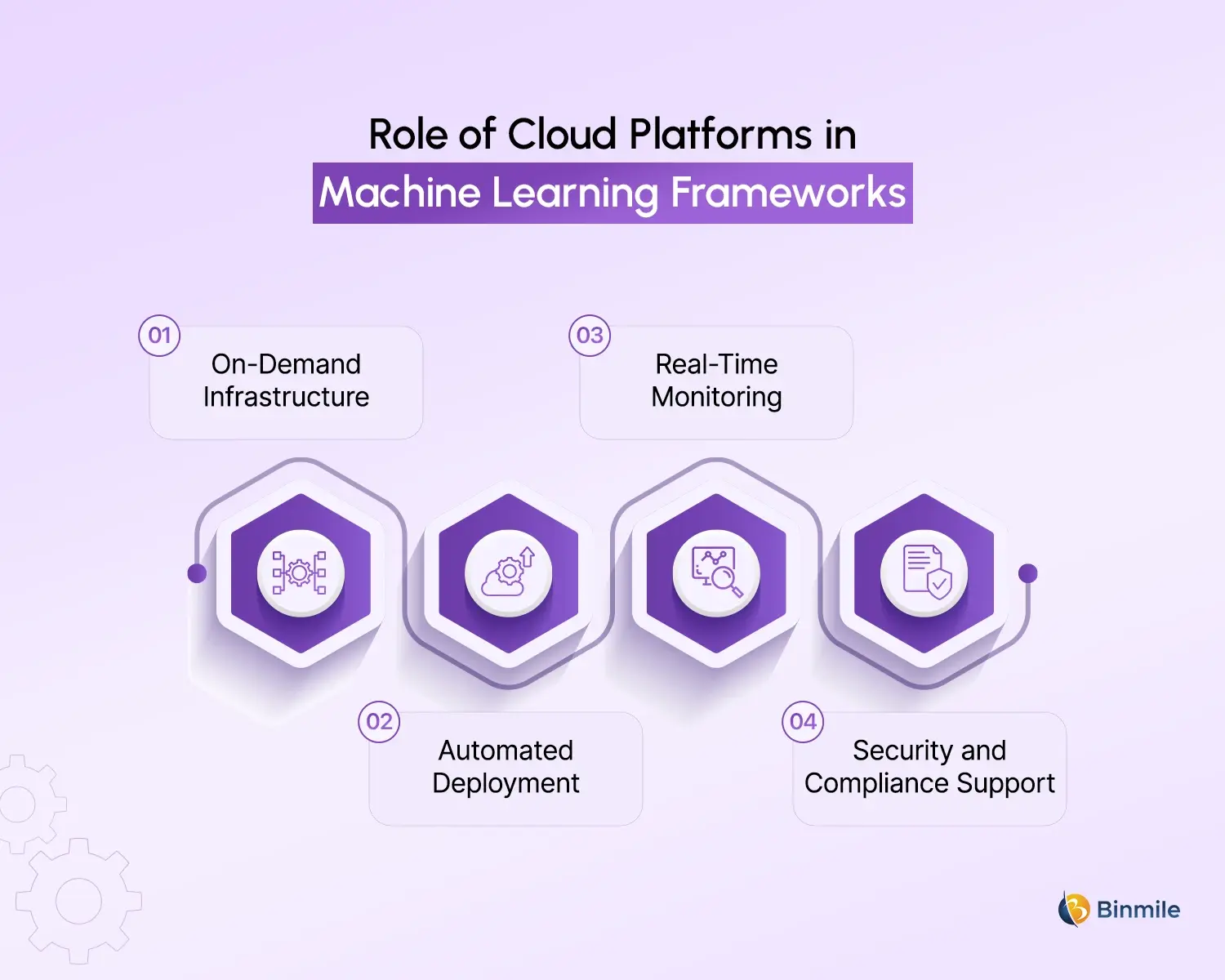
On-Demand Infrastructure
Cloud-based technologies enable firms to grow their computing ability as required via their use of AI algorithms without making huge investments upfront.
-
Automated Deployment
Several automated deployments help simplify the deployment process when using cloud-native ML development platforms and tools by providing facilities that have automated processes for rapid deployment.
-
Real-Time Monitoring
To keep up with developing requirements for monitoring, evaluating, and optimizing all Enterprise AI engine-based systems running at very high volume and speed, the availability of continued system performance monitoring and metrics is essential through unbroken monitoring and optimization.
-
Security and Compliance Support
Cloud provider solutions come complete with embedded security, governance, and regulatory compliance support, as well as regular operation controls that assist customers in protecting their most confidential business information securely.
Real-World Enterprise Applications of Machine Learning Frameworks
Here are the real-world enterprise applications of machine learning frameworks.
-
Machine Learning for Fraud Detection
Machine Learning models are used by financial companies to help detect potentially fraudulent transactions in real-time. By looking at the user’s patterns of behavior and past transactions, as well as looking for anomalies across all users, AI systems can proactively identify when fraudulent activity has occurred before it can actually take place.
Machine learning for fraud detection increases security for users while reducing the number of false positives detected during fraud detection.
-
Predictive Analytics in Retail
Machine Learning algorithms are being used by retail organizations to better forecast demand, optimize inventory, segment customers, and create recommendation engines.
This will allow retailers to improve customer satisfaction levels as well as overall operational efficiencies.
-
Healthcare Diagnostics
AI Technologies (e.g., Computer Vision) are helping to predict disease outcomes, analyze medical imaging data, monitor patients, and plan for the treatment of those patients.
Organizations must provide secure access to their data, especially considering that healthcare organizations are typically very large and hold a great deal of data.
-
Machine Learning in Performance Engineering
Many enterprises have been utilizing AI-based framework technologies to monitor application performance, predict outages, optimize infrastructure utilization, and automate service delivery processes.
As a result, machine learning for performance engineering will help to improve the overall reliability of applications while minimizing the risk of downtime due to operational issues.
-
Manufacturing Automation
Manufacturers are taking advantage of AI frameworks to achieve predictive maintenance, perform quality inspections, and optimize supply chain management.
Using AI to achieve these objectives will help manufacturers reduce their risk of experiencing equipment failure and operational interruptions.
Challenges Businesses Face While Choosing ML Frameworks
Enterprises do not have a simple time identifying the framework that Best accommodates their needs when developing AI solutions. When building AI systems, organizations must take into consideration the following factors: scalability, infrastructure cost, integration into existing systems, security, and long-term maintainability.
In addition to these considerations, many enterprises face challenges recruiting experienced ML Engineering talent that can manage enterprise-wide deployments. Additionally, complexity increases for enterprises attempting to implement AI systems when additional compliance requirements exist from previous legacy systems and as new AI governance standards continue to evolve. As a result, selecting a framework is both a technical decision and a strategic decision for the enterprise.
Looking to build scalable AI systems that improve efficiency, automation, and business intelligence?

Building Enterprise AI Systems That Actually Scale
Many organizations successfully build AI prototypes but struggle when transitioning them into production environments. This gap often exists because enterprises underestimate infrastructure planning, deployment complexity, monitoring requirements, and operational integration.
Scalable AI systems require more than just selecting good machine learning algorithms. Businesses need robust architecture, optimized workflows, automated ML pipelines, cloud scalability, security frameworks, and long-term governance strategies.
This is where strategic technology implementation becomes critical. A strong AI ecosystem aligns business goals with scalable engineering practices, ensuring AI investments deliver measurable business value instead of isolated experimentation.
Organizations looking to accelerate AI adoption often require support across framework selection, architecture design, deployment optimization, and lifecycle management. With growing enterprise demand for intelligent automation, predictive analytics, and Generative AI solutions, experienced technology partners can help streamline implementation while reducing operational complexity. Teams working across machine learning lifecycle management, cloud-native AI systems, and enterprise automation strategies help businesses move faster while maintaining scalability, security, and long-term sustainability. Binmile supports enterprises in building scalable AI ecosystems through machine learning development services, AI-powered automation, and modern engineering expertise tailored to evolving business needs.
Frequently Asked Questions
Machine learning frameworks are software tools and libraries that help developers build, train, deploy, and manage AI models efficiently. They simplify complex coding tasks and support automation, scalability, and faster development of machine learning applications.
Machine learning frameworks support scalability through distributed computing, cloud integration, GPU acceleration, and automated workload management. These capabilities allow businesses to process larger datasets, handle growing workloads, and deploy AI systems across enterprise environments efficiently.
Machine learning frameworks automate tasks such as data preprocessing, model training, deployment, monitoring, and retraining. This reduces manual effort, improves operational efficiency, and accelerates AI development cycles across enterprise workflows.
Cloud platforms provide scalable infrastructure, storage, deployment tools, security features, and managed AI services. This allows businesses to build and scale machine learning applications faster without investing heavily in physical infrastructure.
Machine learning frameworks automate repetitive processes, improve resource utilization, reduce manual errors, and optimize workflows. These efficiencies lower infrastructure costs, improve productivity, and reduce operational overhead across departments.
Yes, machine learning frameworks enable businesses to deliver personalized recommendations, predictive support, intelligent chatbots, and faster services. These AI-driven experiences improve customer engagement, satisfaction, and long-term retention.