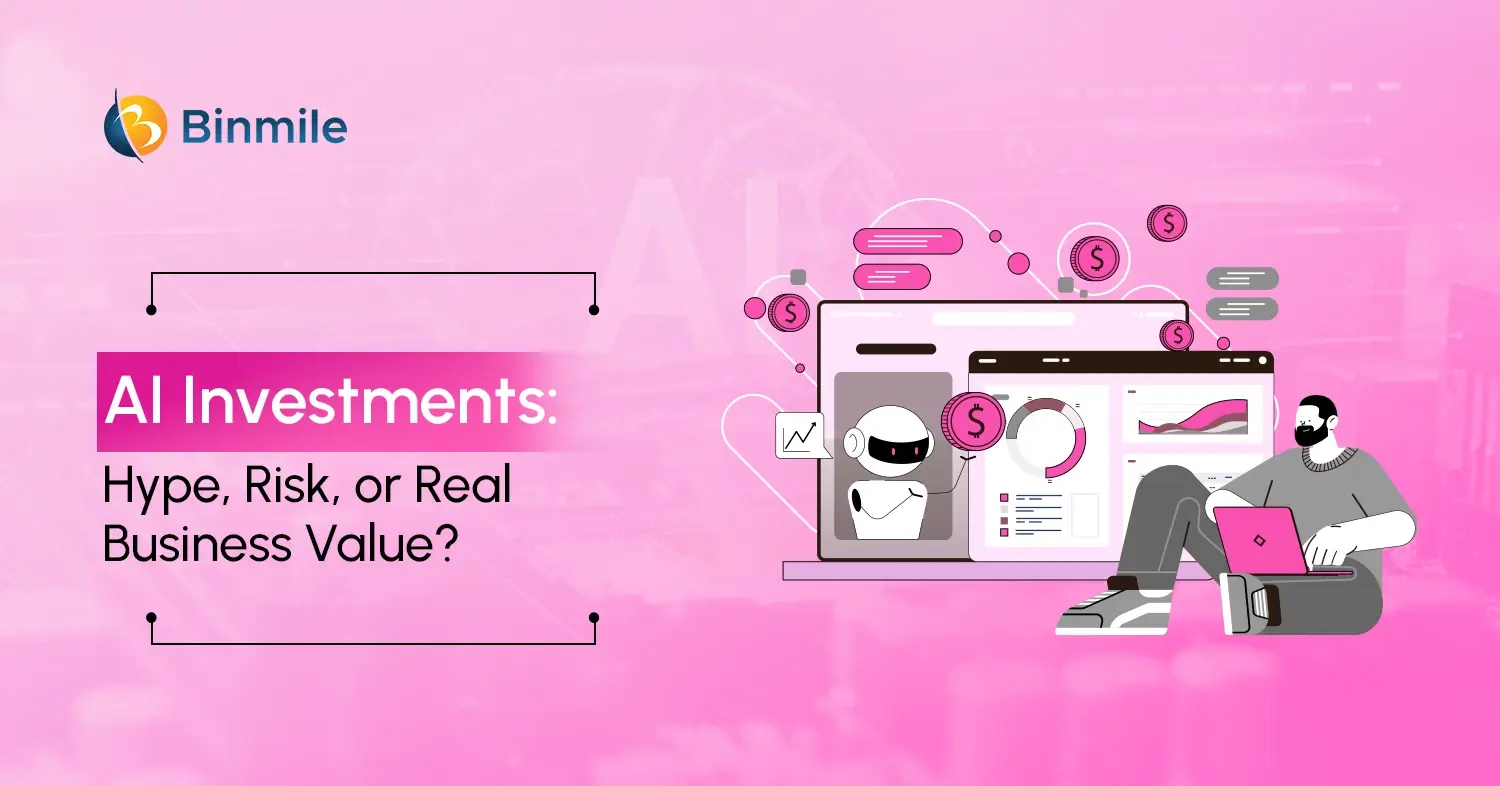
Artificial intelligence has quickly become a strategic priority for enterprises worldwide. According to McKinsey’s latest State of AI report, 78% of organizations now use AI in at least one business function, reflecting the growing role of AI in business operations and decision-making.
At the same time, concerns about an AI bubble continue to grow. Rising investments, soaring valuations, and widespread enthusiasm around generative AI have led many to question whether expectations are outpacing reality. Yet enterprises are already seeing measurable gains in productivity, automation, and innovation.
So, is the AI bubble real or just hype? More importantly, what does it mean for enterprise investments? This blog explores the debate, risks, opportunities, and considerations for business leaders before making AI investment decisions.
What Is the AI Bubble and Why Is It Being Debated?
Before explaining whether AI is overhyped, it is important first to define what an AI bubble is.
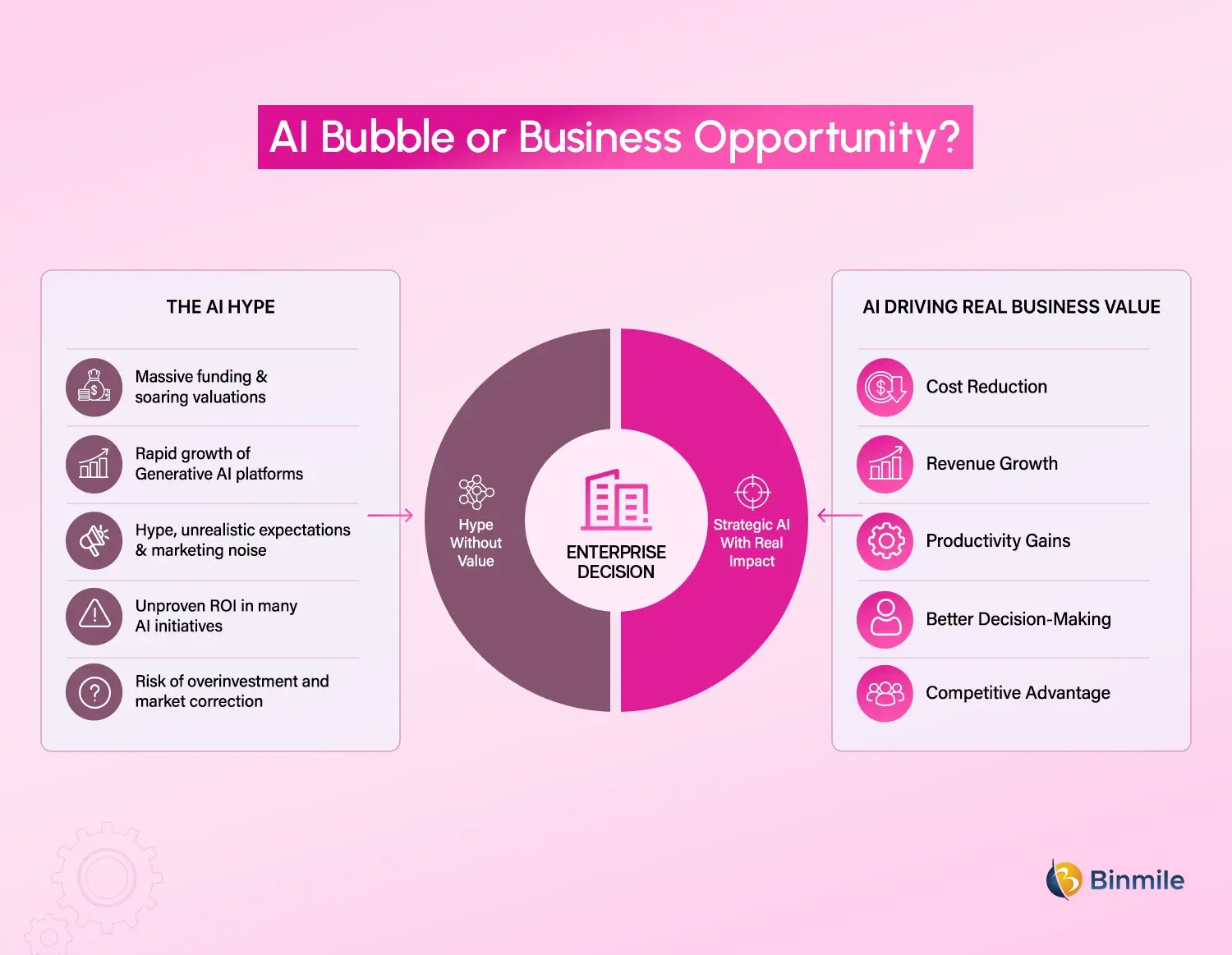
The term AI Bubble refers to a market phenomenon in which investment in AI companies, market enthusiasm, and valuations are rising more rapidly than the actual business value those companies are delivering. This type of situation often triggers inflated expectations of the technology due to the emphasis placed by companies and investors on the anticipated capabilities of AI relative to the current capabilities.
Some of the factors currently driving the AI Bubble theory are enormous investments into AI Startups, exponential growth in the Generative AI space, increasing Enterprise AI spending, and significant increases in the valuations of AI Companies. Many analysts now see these trends as evidence of inflated expectations for the AI market, which, if they develop too far in advance of the actual existing capabilities of AI, could create a crash of the AI Bubble.
Is AI Delivering Real Business Value or Just More Hype?
The strongest argument against the idea of AI being purely speculative is the growing number of successful enterprise implementations generating measurable returns.
-
AI-Assisted Software Development
Using AI to help with code writing, testing, debugging, and documenting software results in a quicker release cycle and better overall development productivity.
-
AI Integration Across Enterprise Systems
Enterprise software applications using AI integration to enhance an organization’s ability to simplify and automate workflows, provide better use of data, and enhance the effectiveness and efficiency of daily operations in their existing software systems.
-
Generative AI for Business Operations
Generative AIs are enabling businesses to automate content development, create knowledge bases, and manage customer relationships while increasing employee productivity.
-
AI-Powered Mobile Apps
AI-powered mobile apps that provide individuals with personalized user experiences, make predictive recommendations to users based on their behavior and preferences, and create intelligent interactions between businesses and their customers.
-
Artificial Intelligence As a Service
Organizations can use Artificial Intelligence as a Service, which will allow them access to high-quality AI products and services without the need for major investments in infrastructure, resources, or expertise, and have immediate access to advanced AI at scale.
Why AI Investment Continues to Grow Despite Bubble Concerns
If discussions about an AI bubble burst are becoming more common, why are enterprises continuing to increase their investments? The answer lies in business impact. Unlike many technology trends that struggled to prove value, AI is helping organizations address some of their most pressing challenges.
-
Competitive Pressure
AI solutions are already being implemented by your competition. If you do not adopt, you risk slower innovation, decreased productivity, and missed market opportunities.
-
Productivity Gains
AI enables the automation of repetitive tasks, streamlining workflow processes, and helping employees access information more quickly; this will result in unprecedented productivity gains for departments throughout the organization.
-
Better Decision-Making
Companies create huge volumes of data daily. AI enables more effective analysis of this data, which facilitates quicker and better decisions.
-
Operational Efficiency
AI is helping corporations to improve operational efficiency and reduce costs through the automation of customer service and optimization of supply chain management.
-
Investor Expectations
Public companies are being asked to show clear signs of an innovation strategy. Companies adopting AI are often seen as a key driver of growth moving forward.
These factors explain why AI investments continue to rise despite ongoing concerns surrounding the AI bubble analysis debate.
The Bigger Risk May Not Be the AI Bubble
A lot of people are debating whether AI is overrated. However, most businesses facing this type of situation will find that the biggest risk to them could be not investing enough money into AI. History shows that losing your lead in the market usually happens from being behind on the adoption of new technologies, not from adopting them too soon.
Businesses that have waited too long to implement AI will suffer from slower product design cycles, lower levels of operational effectiveness, lower productivity relative to their competition, less personalization of their customers’ experiences, and difficulties attracting top-level tech talent. In fast-paced industries, the cost of waiting to adopt AI may at times outweigh the risks of making large capital investments in AI. Again, this does not mean that companies should just pour money into AI without thinking. But it does point to the fact that companies need to adopt an approach that has a strategy behind it. In doing so, your objective should not merely be to jump on the latest fad; rather, you should seek to find areas where you can leverage the use of AI to derive a measurable return on investment.
Signs That AI Hype May Be Outpacing Reality
Despite AI’s potential, enterprise leaders should remain cautious about unrealistic expectations. Several indicators suggest that hype may sometimes exceed practical value.
-
AI Washing
Some vendors advertise their products as being capable of using Artificial Intelligence as a service when they are not, leading to confusion and complicating the evaluation of the solutions that they are selling.
-
Inflated Expectations
Organizations frequently expect AI to provide a quick fix to their most significant challenges; however, successful deployment requires extensive planning, quality data access and governance, and continuous review and enhancement of the deployed solution.
-
Weak Business Cases
Organizational AI initiatives often fail due to a focus on technology rather than on establishing business goals.
-
Overvaluation Concerns
Significant amounts of money invested in AI companies have created a concern that market valuations of AI companies may be overstated.
Ready to turn AI investments into measurable business outcomes instead of uncertain experiments?

AI Bubble vs. Dot-Com Bubble: Is History Repeating Itself?
Whenever a technology experiences explosive growth, comparisons to the dot-com era are inevitable. While there are similarities between the two, there are also important differences.
| Factor | Dot-Com Bubble | AI Boom |
|---|---|---|
| Adoption Stage | Early internet adoption | Broad enterprise adoption |
| Infrastructure | Immature | Mature cloud and data ecosystems |
| Business Use Cases | Often speculative | Proven enterprise applications |
| Revenue Models | Frequently unclear | Measurable business outcomes |
| Enterprise Readiness | Limited | Significantly higher |
Many companies failed when the dot-com bubble burst, but the Internet itself was a transformative force on global economies. We may see a similar pattern with AI. Some startups will fail, valuation levels will be corrected, and there will be several vendors that will not make it through the near-term transition; however, the technology will likely continue to provide benefits to multiple industries.
The main lesson for leaders of companies looking to invest is to avoid hyped investments, while at the same time looking for technology that has the ability to provide long-term competitiveness.
How Enterprises Can Evaluate AI Investments
Instead of asking whether AI is a bubble, enterprises should ask a more practical question: Will this AI initiative create measurable business value?
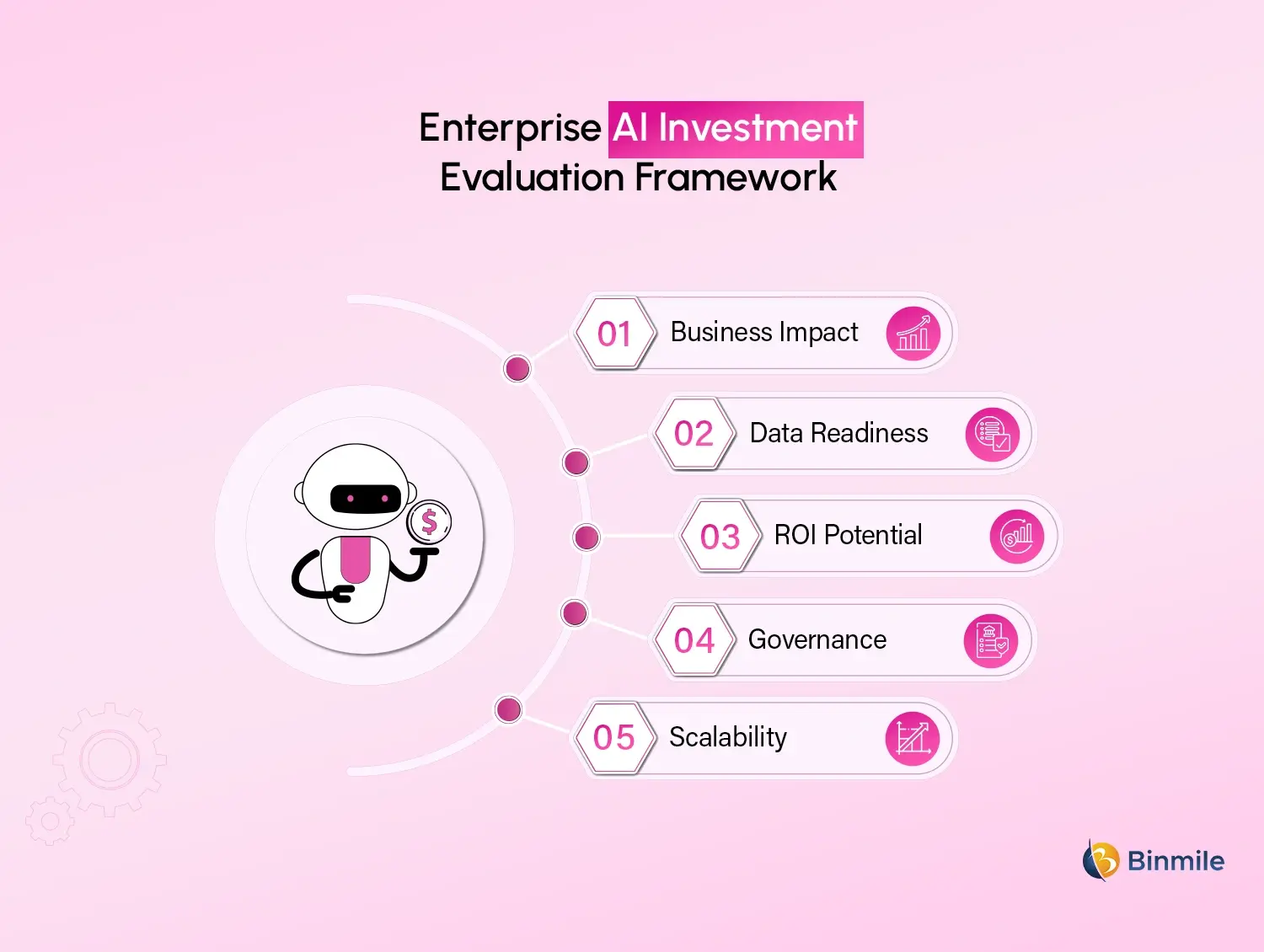
The following framework can help evaluate opportunities.
| Evaluation Area | Key Question |
|---|---|
| Business Impact | Does the solution address a measurable challenge? |
| Data Readiness | Is quality data available? |
| ROI Potential | Can success be quantified? |
| Governance | Are security and compliance requirements addressed? |
| Scalability | Can the solution grow with the business? |
Organizations that evaluate AI through a business lens are more likely to achieve successful outcomes regardless of market conditions.
How Enterprises Can Avoid AI Bubble Risks
Whether or not an AI bubble crash occurs, organizations can reduce risk by focusing on fundamentals.
-
Start With Business Objectives
AI should support strategic goals instead of being an independent initiative.
-
Build a Strong Data Foundation
High-quality data is still the bedrock of successful AI adoption.
-
Establish Governance Early
AI governance helps organizations mitigate risks associated with security and compliance, privacy and ethical issues, and resolve them before they become larger issues.
-
Measure ROI Continuously
Tracking the results of initiatives allows organizations to identify success and stop funding unsuccessful initiatives.
-
Scale Gradually
Organizations can benefit from conducting pilot projects to provide data for successful full investment prior to making large investments.
This disciplined approach helps enterprises maximize value while minimizing risk.
Should Enterprises Build AI Solutions In-House or Partner With Experts?
Should companies create AI solutions internally or collaborate with specialist organizations? As firms increasingly embrace AI technology, they also continue to make decisions about their use of this technology. Once companies have made the decision to implement AI, they face either developing an application in-house or utilizing an external provider to assist with the development. For many companies, if there is an established internal AI team with appropriate experience and a mature operating model, internal development may be feasible.
However, many companies do not have access to this level of internal development success due to issues such as a talent shortage, implementation complexity, and other considerations related to changing technology. By partnering with a qualified AI development company, companies can decrease risk, shorten implementation efforts, and improve the speed of realization for business value.
Using a “hybrid” approach is becoming more common; organizations want to keep their application ownership, but want to utilize experienced external individuals to support and enable the AI development, deployment, integration, and Generative AI consulting efforts.
The most appropriate solution for a specific organization will depend on several variables related to corporate strategy, internal capability, and future technology plan.
What Happens If the AI Bubble Bursts?
The most frequently asked question when it comes to the AI bubble is if and when it will correct itself as a whole. With declining valuations and decreased investment activity, what are a couple of potential outcomes? In general, funding will likely be more selective, e.g., favoring companies with proven business models and measurable results, and there will be some degree of market consolidation as larger players typically acquire smaller competitors or gain additional market share. Enterprises will likely have a more disciplined approach to evaluating AI investments, i.e., favoring business outcomes, as opposed to experimentation.
Most importantly for the future of AI, the technology that enables AI automation, machine learning, natural language processing, and generative models that solve legitimate business problems, so they are unlikely to go away, regardless of the market correction. Although hype around the AI market may be curtailed, the true business value of these technologies has not gone away.
The Future of the AI Bubble
AI will be viewed not as some sort of bubble or boom and subsequent bust, but more as something that has gone through its development phase and become established on a solid footing. Over the next few years, companies will begin to see much more targeted, strategic, and outcome-based enterprise-level AI adoption. Companies will also be experiencing an increasing amount of industry-specific AI solutions; developing stronger governance of their AI initiatives, using AI to support their software development; and having their employees interact with AI tools and utilize the AI systems that are integrated into their other business processes. As the technology reaches a level of maturity, the discussion will change from whether or not companies should invest in AI to how they can maximize the return on their investment in AI.
Organizations that invest in AI for the short-term will begin to be differentiated from those that build a competitive advantage through investment in AI for the long-term.
Planning to adopt AI but unsure where to start or how to measure ROI and create long-term competitive advantage.

Building Sustainable AI Strategies for Long-Term Growth
The debate around the AI bubble often creates a false choice between hype and reality. In practice, both exist simultaneously. Certain areas of the market may experience inflated expectations, while AI continues delivering measurable value across industries. The most successful enterprises are not trying to predict whether an AI bubble burst will occur. Instead, they are focusing on identifying business opportunities, measuring outcomes, managing risks, and building scalable AI capabilities.
This is where the right implementation strategy becomes critical. Binmile helps organizations move beyond experimentation through services such as AI-Assisted Software Development, AI Integration, AI-Powered Mobile Apps, Generative AI, Artificial Intelligence as a Service, and Generative AI Consulting. By aligning technology initiatives with business objectives, enterprises can create sustainable value while navigating an evolving AI landscape.
Frequently Asked Questions
The AI bubble refers to a situation where investments, market valuations, and expectations around artificial intelligence grow faster than the actual business value being generated. It reflects concerns that market enthusiasm may be exceeding current technological and commercial realities.
The answer is both. Some market segments may be experiencing excessive hype and inflated valuations, but AI is also delivering measurable business value across industries through automation, analytics, software development, and customer experience improvements.
Enterprises worry about investing heavily in technologies that may not deliver expected returns. Concerns include implementation costs, unclear ROI, vendor instability, unrealistic expectations, and the possibility of market corrections affecting long-term investments.
AI consulting helps organizations identify practical use cases, evaluate readiness, establish governance frameworks, measure ROI, and create implementation roadmaps. This reduces the risk of investing in AI initiatives that lack strategic business value.
The right approach depends on internal capabilities, project complexity, and business objectives. Many enterprises combine internal expertise with external specialists to accelerate deployment, reduce risks, and achieve faster business outcomes.