Businesses are no longer relying on AI systems that only process text or analyze isolated datasets. Modern enterprises want AI systems that can understand conversations, images, videos, documents, voice commands, and customer behavior together in a connected way. This demand is rapidly driving the growth of Multimodal AI across industries. According to Grand View Research, the global multimodal AI market is projected to grow from USD 1.73 billion in 2024 to USD 10.89 billion by 2030, at a CAGR of 36.8%.
A wide range of industries are already employing multimodal artificial intelligence models, which are changing the way businesses operate. This blog post will define multimodal AI, explain how it functions, and describe the top applications of multimodal AI in different sectors, as well as some examples of enterprise use cases and implementation challenges. Additionally, we will discuss the future of multimodal AI systems and their potential applications.
What is Multimodal AI?
Multimodal AI refers to artificial intelligence systems that can process and understand multiple types of data simultaneously. Instead of relying on only text inputs, these systems combine information from images, audio, video, sensor data, speech, and structured business datasets to generate more accurate outputs and decisions.
For example, a multimodal AI assistant in customer service can analyze a customer’s voice tone, chat history, uploaded screenshots, product images, and CRM records together before generating a response. This enables the system to understand context more effectively and deliver more relevant assistance. This makes multimodal systems significantly more context-aware compared to traditional AI models.
Unlike single-input AI systems, Generative Multimodal Models can connect relationships between different data formats. This ability helps enterprises improve automation, customer experiences, operational efficiency, and business intelligence.
How Does Multimodal AI Work?
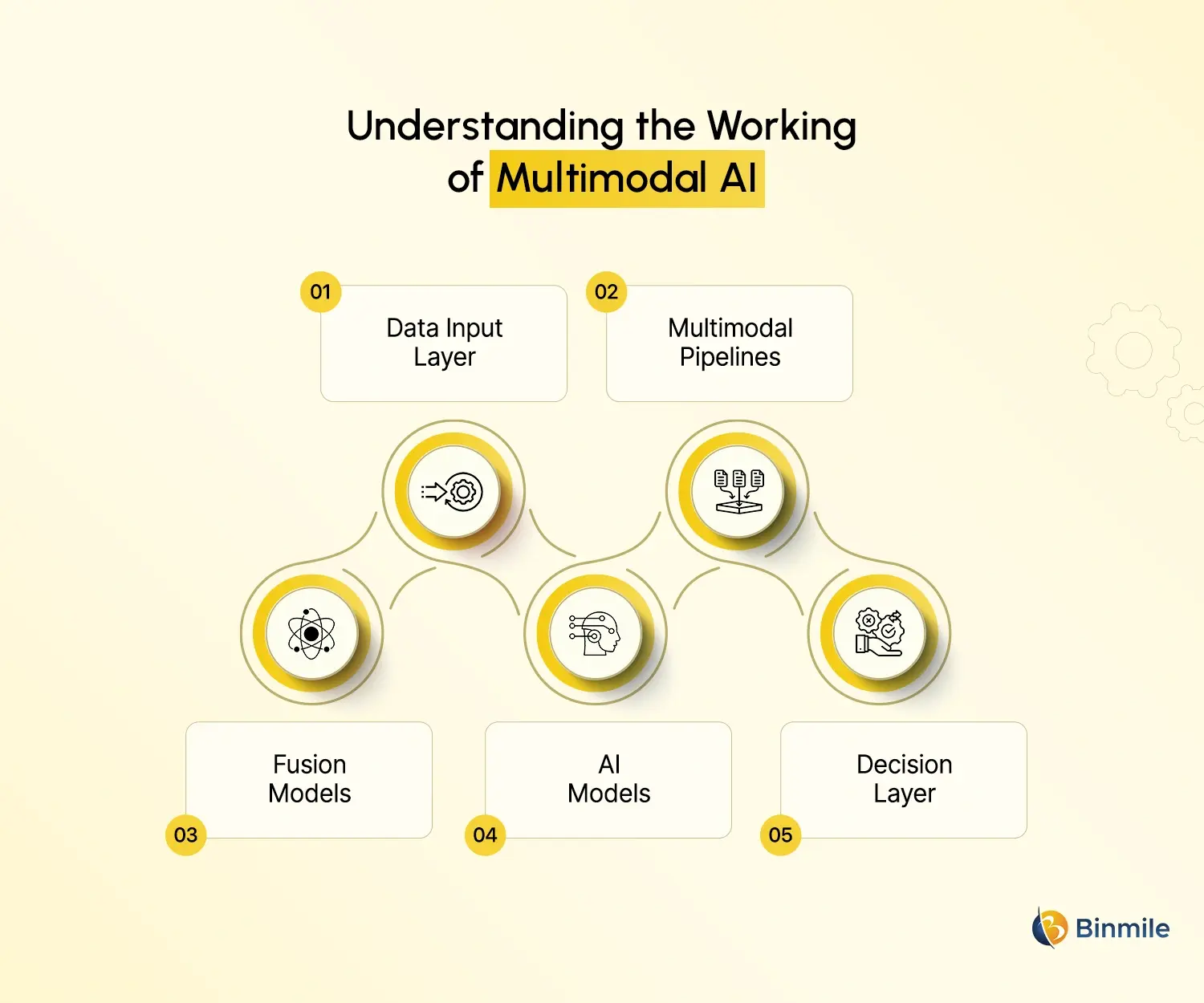
A multimodal AI system combines different AI technologies and Machine Learning Frameworks into one integrated architecture. Multiple layers work together to process, understand, and generate insights from different forms of data.
-
Data Input Layer
The data input layer will start off the process of collecting information from the various types of data and/or information sources like text, images, video/audio, sensor feeds, and company applications (ERP, CRM, etc.).
-
Multimodal Pipelines
The data collected from the different types of data and sources will be transported through multimodal pipelines to organize, clean, and prepare the various data streams for analysis. The purpose of the multimodal pipeline is to provide a way to process the information in the same manner across all sources and data types.
-
Fusion Models
Fusion Models (transform multiple data types into a single presentation) are also a very important layer of the data processing pipeline. Fusion models will help to create relationships and context between the various data types (text, images, audio, and more) so that the output is a better and more complete understanding of the overall context.
-
AI Models
Additional AI models with high levels of sophistication will be used to analyze and process the combined data. The advanced AI models will identify patterns and features in the data, produce forecasts and business decisions, understand intent, and generate actionable insights from the input data.
-
Decision Layer
After completing the process of combining and analyzing the data, the output from the models will be turned into relevant actionable output from the decision layer. Relevant actionable output could include recommendations, automated actions, alerts, forecasting, or business decisions to be made.
Modern multimodal frameworks often combine technologies such as Natural Language Processing, Computer Vision, Speech Recognition, Predictive Analytics, Deep Learning, and Machine Learning Development Models. Together, these technologies help enterprises build smarter multimodal AI agents capable of handling complex real-world scenarios.
Why Enterprises Are Investing in Multimodal AI
Traditional enterprise AI systems often operate separately, with different tools handling text, images, and customer data independently. Additionally, multimodal AI for enterprises eliminates these silos by connecting multiple data sources into a unified intelligence layer, enabling faster decisions and more efficient automation.
-
Better Decision-Making
Better Decisions can be made with accurate data when multiple inputs from various sources are used for decision-making (e.g., AI systems).
-
Improved Customer Experience
When customers use multiple types of communication (e.g., voice, text, images), multimodal chatbots and other AI will be able to better predict what the customer wants.
-
Smarter Automation
Multimodal agents are able to execute processes without the need for a human to intervene; creating smart automation through AI technology will streamline business operations.
-
Enhanced Business Intelligence
Multimodal analysis of structured and unstructured types of data will increase the level of operational insight into how your business operates.
-
Stronger Personalization
Companies are able to create tailored experiences for all customers through the use of technology-based channels (e.g., email, web) using AI tools that enable personalization at scale.
These advantages are making multimodal AI solutions a key part of Digital Transformation strategies across industries.
Top Multimodal AI Use Cases Across Industries
The applications of multimodal AI are expanding rapidly. Here are some of the most impactful enterprise use cases.
-
Healthcare
Multimodal AI is being used by health care organizations to support better diagnoses and recommendations for patients. By combining medical images with patient health records, physician notes, and laboratory test results, multimodal systems help health care providers to more quickly and accurately make decisions concerning patient care. Additionally, assistants using multimodal AI are also able to assist with scheduling patient appointments, creating clinical documentation, and remotely monitoring patient health.
-
Retail
Retailers are utilizing multimodal AI to enhance customer experience and improve the efficiency of their operations. Some of the applications of multimodal AI in retail are: virtual shopping assistants, visual search, personalized recommendations, and customer sentiment analysis. Additionally, these applications enable retailers to gain greater insight into customer preferences and therefore provide more effective engagement with customers.
-
Manufacturing
Manufacturers are adopting the use of multimodal AI in manufacturing to enhance predictive maintenance and operational efficiency. Additionally, by integrating sensor data, images of equipment, and historical records of maintenance for a particular piece of equipment, manufacturers can more quickly detect potential problems and minimize machinery downtime. Additionally, AI agents are being used for quality assurance and optimizing supply chain operations.
-
Education
Educational institutions are using the power of multimodal AI in education to provide more personalized learning experiences to their students. By analyzing responses to teaching material, interaction with instructors and each other, and overall student engagement, multimodal AI systems are helping educators to enhance student learning outcomes while automating administrative tasks, including grading of student assessments and creation of instructional and assessment materials.
-
Customer Support
Customer support is one of the fastest-growing sectors for multimodal AI development. These advanced multimodal chatbots allow for faster and more accurate assistance by analyzing conversations, screenshot data, and contextual information about the customer requesting assistance. Additionally, this ultimately leads to increased levels of customer satisfaction, while also relieving some of the burden of excess workload that customer support representatives carry.
-
Business Intelligence
In business intelligence, businesses are using multimodal AI to gather deeper insights from multiple sources of data (e.g., reports, customer interactions, dashboards, operational records) to improve the quality of their forecasts and aid in decision-making and overall business performance.
Ready to transform enterprise operations with next-generation AI automation?
The Role of Multimodal AI Agents in Enterprise Automation
As enterprises around the world continue to automate their business processes, there has been a recent rise in the popularity of multimodal AI agents. Additionally, these intelligent agents, unlike traditional automation tools, understand context, can process many different types of data, can work autonomously, can interact with users in a human-like way, and continually learn from the enterprise workflow as they go along.
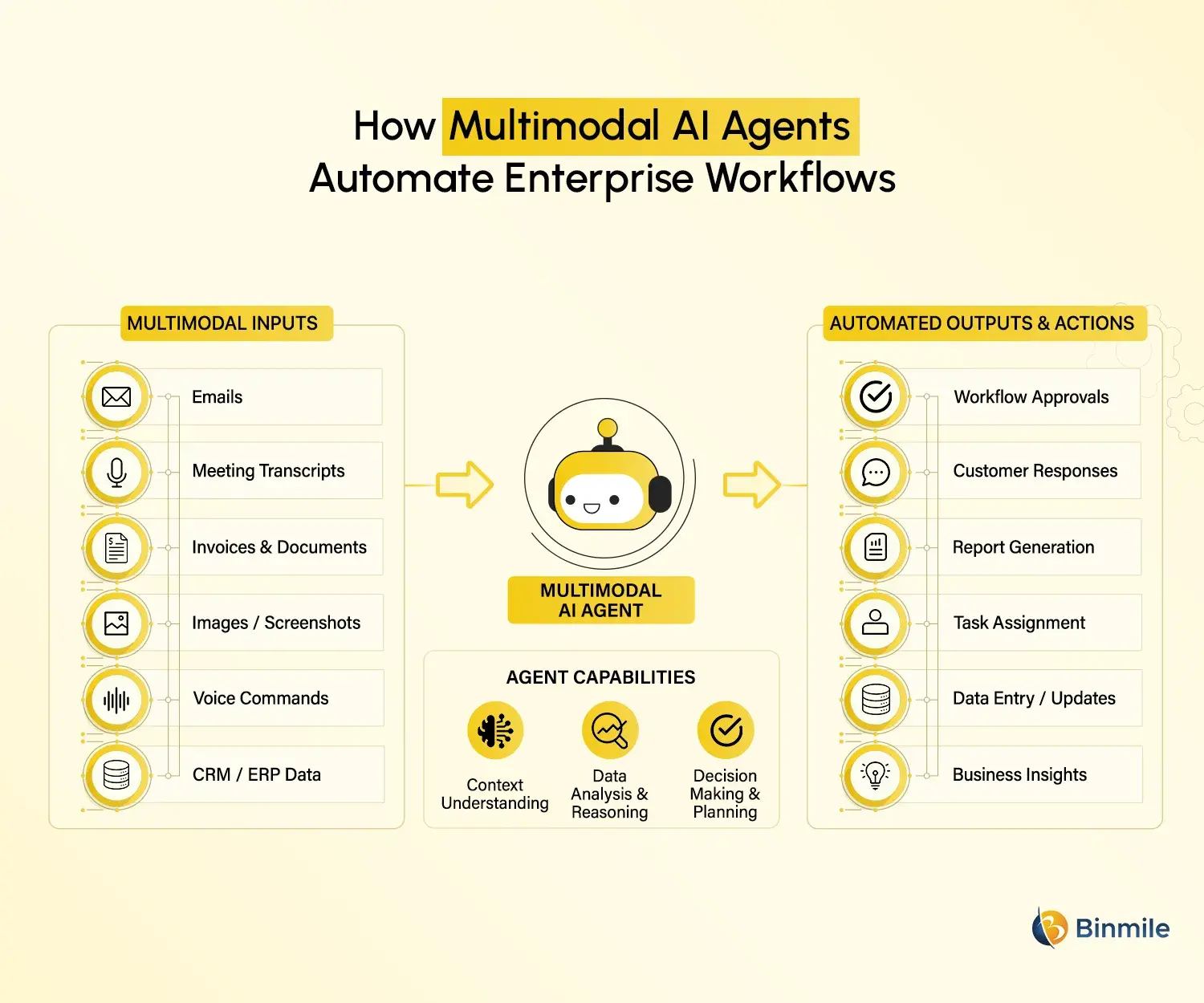
A multimodal AI assistant, for example, is capable of reading email messages, analyzing invoices, reviewing transcripts from meetings, processing screenshots, and triggering approval processes for workflows, all without any human intervention. Because of this, many organizations are changing how they think about automating their work environments.
Multimodal AI Architecture and Enterprise Infrastructure
Enterprise infrastructure is critical for building scalable multimodal AI architectures. Additionally, businesses need to carefully consider how they will integrate data into their enterprise workflows, optimize the costs associated with using cloud computing technologies, scale their AI models as demand for them increases, and comply with all relevant security and regulatory protocols while ensuring that they have the ability to process real-time data.
Cloud Service Providers (CSPs) that provide Artificial Intelligence as a Service (AIaaS) to customers are increasingly being adopted by many organizations to help them deploy multimodal AI agents with minimal complexity. Additionally, cloud-native multimodal frameworks allow organizations to develop and maintain internal capabilities for using multimodal AI at scale without incurring significant capital expenditures on their physical infrastructure.
What Are the Challenges of Multimodal AI
Despite its advantages, there are several Challenges of Multimodal AI that enterprises must address.
-
Data Complexity
You also have many types of media that need to be processed with sophisticated multimodal pipelines.
-
Integration Issues
Integrating AI systems with older enterprise platforms can be challenging.
-
High Infrastructure Costs
Training multimodal AI models requires a lot of computational resources.
-
Privacy and Security Risks
There are risks associated with multimodal AI, such as exposure to sensitive data and compliance requirements.
-
Model Accuracy
Different data formats can sometimes lead to different interpretations from the models processed.
Enterprises must develop clear governance strategies before implementing large-scale multimodal AI solutions.
Multimodal AI vs Traditional Generative AI
Many businesses confuse multimodal AI with standard generative AI tools.
The key difference is that traditional generative AI primarily processes text inputs and outputs. Multimodal AI systems work across multiple formats simultaneously.
For example:
| Traditional AI | Multimodal AI |
|---|---|
| Processes text only | Processes text, image, video, and audio |
| Limited contextual understanding | Rich contextual understanding |
| Single-channel interaction | Multi-channel interaction |
| Basic automation | Advanced enterprise automation |
This makes multimodal AI development significantly more powerful for enterprise applications.
The Future of Multimodal AI in Enterprises
The outlook for multimodal AI within organizations has an extremely positive trajectory. Multimodal AI will play an increasingly important role as organizations begin to leverage autonomous multimodal agents [e.g., systems] with the emergence of autonomous AI-enabled tools called AutoMLs and integrated enterprise AI workspaces. Additionally, future advancements will include enterprise copilots, sophisticated customer intelligence platforms, real-time decision making (automation of real-time decisions), assistance for various business functions through the automation of routine tasks (enterprise copilot), Generative Multimodal Models, and intelligent integrated digital product ecosystems.
Those organizations that are early adopters of multimodal AI solutions will have a competitive edge in their target market as Generative AI in digital product development, thereby establishing a core competency and ultimately becoming a standard part of future enterprise application ecosystems.
Looking to build intelligent AI systems that understand text, images, voice, and enterprise workflows together?

How Binmile Supports Enterprise Multimodal AI Adoption
Implementing enterprise-grade multimodal AI solutions requires more than just AI models. Businesses need scalable infrastructure, secure integrations, optimized cloud environments, and intelligent workflow automation strategies that align with operational goals.
Binmile helps enterprises accelerate Digital Transformation initiatives through customized AI development services, cloud-native architectures, intelligent automation systems, and scalable Machine Learning Frameworks. Additionally, from building multimodal AI assistants and enterprise AI agents to integrating AI in CRM platforms and modern business applications, the focus remains on creating practical AI ecosystems that improve operational efficiency and long-term scalability.
With growing enterprise demand for Artificial Intelligence as a Service, intelligent automation, and next-generation Generative AI Tools, businesses are increasingly looking for technology partners that can bridge innovation with real-world implementation. Enterprise-focused multimodal AI development strategies can help organizations reduce inefficiencies, improve customer engagement, and unlock stronger business intelligence across departments.
Frequently Asked Questions
Multimodal AI combines multiple types of data, such as text, images, audio, and video, into one AI system. It uses machine learning models and multimodal pipelines to analyze different inputs together for more accurate predictions and intelligent automation.
Multimodal AI supports enterprise automation by processing multiple business inputs simultaneously. It can analyze conversations, documents, visual data, and workflows together, helping enterprises automate customer support, reporting, operations, and decision-making processes more efficiently.
The future of multimodal AI includes autonomous AI agents, enterprise copilots, intelligent business automation, and real-time analytics. Enterprises are expected to integrate multimodal systems deeply into operations, customer experiences, and digital transformation strategies.
Yes, multimodal AI improves business intelligence by combining structured and unstructured data sources. This allows enterprises to generate deeper insights from customer interactions, operational reports, images, videos, and enterprise analytics for smarter strategic decisions.
Industries such as healthcare, retail, manufacturing, education, finance, and customer service benefit heavily from multimodal AI. These sectors use multimodal systems to improve automation, operational efficiency, customer experiences, and predictive analytics.
Multimodal AI systems are supported by technologies such as Natural Language Processing, Computer Vision, speech recognition, deep learning, Machine Learning Development Models, multimodal frameworks, and cloud-based AI infrastructure platforms.