Enterprise cybersecurity is evolving rapidly. Security Teams now encounter various forms of cybercrime, such as AI-generated malware, ransomware attacks, insider threats, cloud weaknesses, and multiple types of increasingly complicated attack methodologies that are usually difficult for a company’s establishment to be able to manage.
According to IBM’s Cost of a Data Breach Report, the global average cost of a data breach is USD 4.44 million in 2025. This growing pressure is pushing enterprises toward advanced AI models that can improve threat detection, automation, and security intelligence. One emerging concept gaining attention is Claude Mythos.
In this blog, we will explore what Claude Mythos is, how it improves enterprise cybersecurity operations, its risks, industry use cases, and why enterprise leaders are paying close attention to AI-driven security systems.
What Is Claude Mythos?
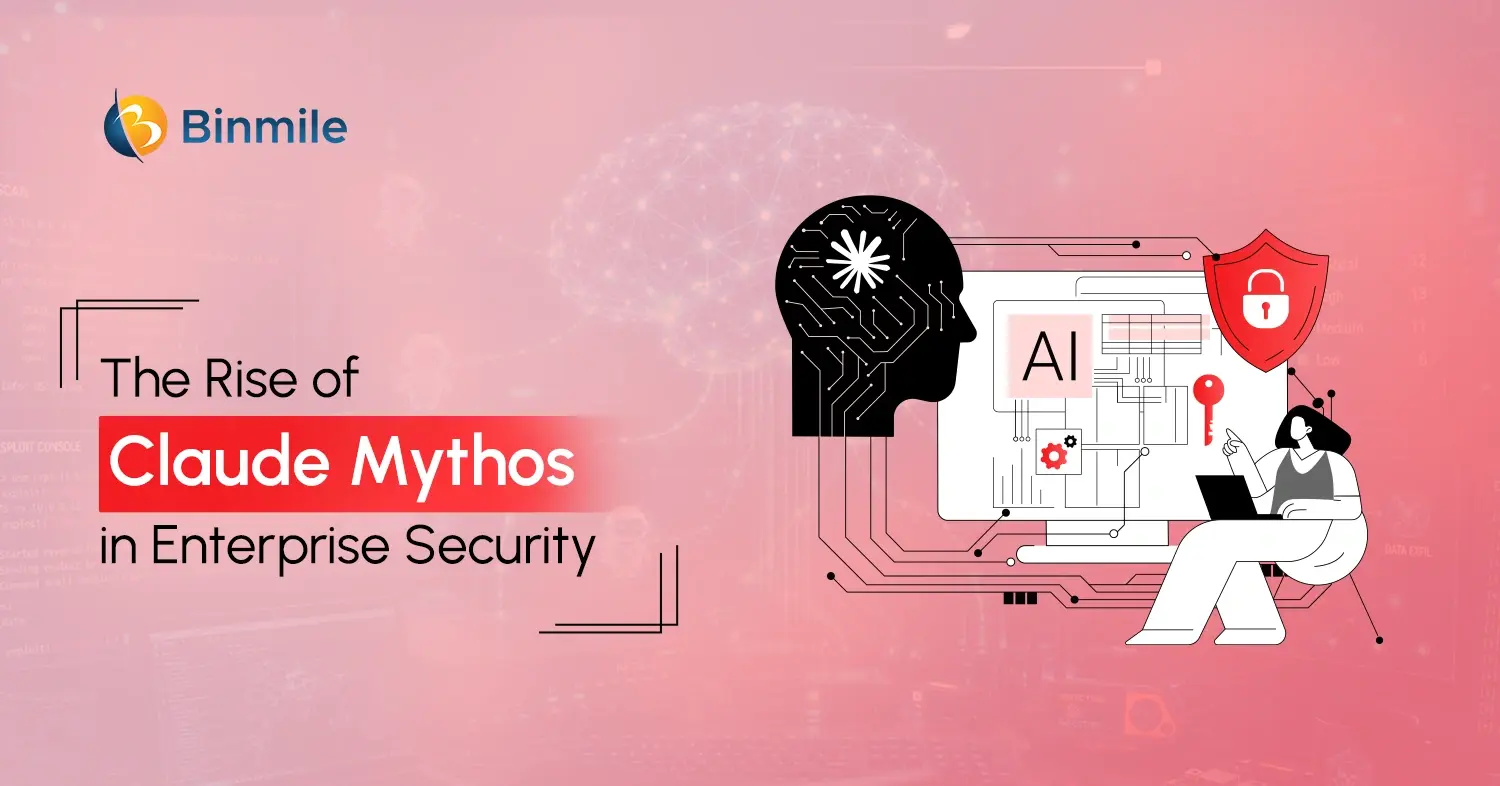
Claude Mythos is being discussed as an advanced AI-driven intelligence framework designed to improve enterprise automation, contextual reasoning, and cybersecurity operations. While the ecosystem around Mythos AI is still evolving, the broader enterprise interest reflects a major shift toward AI-native security infrastructures.
Traditional cybersecurity systems mainly rely on predefined rules and known threat signatures. While effective against familiar attacks, they often struggle against rapidly evolving cyber threat intelligence for the enterprise. This is where Claude Mythos AI becomes important. Instead of relying entirely on static rules, the system is designed to analyze large volumes of enterprise data, identify suspicious behavioral patterns, detect anomalies in real time, improve enterprise-wide visibility, support faster incident response, and strengthen proactive threat management strategies.
For enterprise leaders, this changes cybersecurity from a reactive IT function into a predictive business capability.
Why Enterprise Security Teams Are Looking Beyond Traditional Security Tools
Today, enterprise environments are very widespread or wide-ranging. Security teams no longer protect just the office network or the laptop of employees; instead, they now also protect an organization’s hybrid cloud environment, remote work environments, Software-as-a-Service (SaaS) applications, Application Programming Interfaces (APIs), Internet-of-Things (IoT) devices, integrating with third-party applications, and utilizing artificial intelligence on internal platforms. Each of these additional components adds additional vulnerabilities for the corporation to protect against.
The other challenge is this: Many large companies receive literally thousands of alerts each day; the large majority of which are false positives, as well as many of these alerts masking true threats and/or malicious activity. Human security analysts struggle with being able to efficiently investigate incidents, therefore creating a lag in their ability to respond to incidents due to operational fatigue or numerous other reasons. This is one of the reasons that the use of AI-based cybersecurity platforms is increasing in importance.
How Claude Mythos AI Improves Enterprise Security Operations
The biggest strength of the Claude Mythos AI Model lies in its ability to process and understand enormous amounts of enterprise data simultaneously. Instead of treating security events separately, AI systems connect patterns across infrastructure, applications, users, and cloud environments to generate contextual intelligence.
1. AI-Powered Threat Detection at Scale
Enterprise networks are generating an overwhelming amount of telemetry data every second (e.g., logins, API calls, file access logs, endpoint behavior, network traffic, user behavior). Ensuring that this information can be accurately processed at scale by people is nearly impossible.
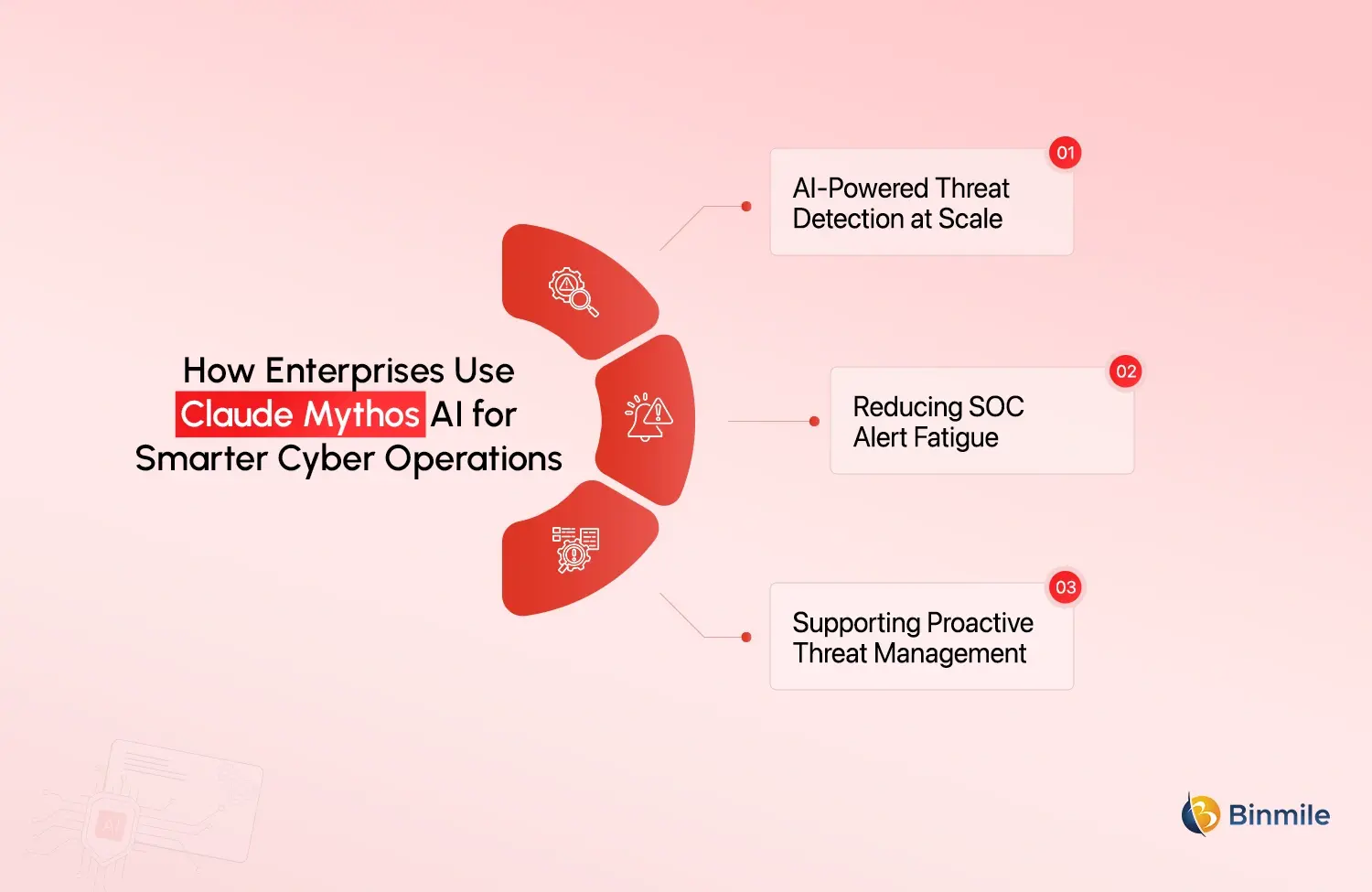
Claude Mythos AI enables enterprises to identify suspicious access patterns, monitor real-time cloud infrastructure, correlate many disparate low-risk indicators to create high-risk threat scenarios, and detect many more types of suspicious behavior. For example, if an employee downloads a sensitive file from three different physical locations at midnight, it may not set off an aged detection rule; however, a real-time AI analysis would pick up this behavior as unusual.
2. Reducing SOC Alert Fatigue
The primary challenge for Security Operations Centers is how to reduce alert overload. Enterprises receive thousands of alerts daily with limited cybersecurity staffing, delays in investigating alerts, and high analyst distress.
Using AI-driven systems promotes efficiency in SOCs by prioritizing alerts based on contextual risk rather than solely on rule-based triggers. Thus, analysts can spend time on critical incidents, active threat campaigns, insider threats, and high-risk attack types while spending far less time on minor-impact alerts. Decreasing the amount of “noise” allows SOCs to respond to incidents in a timelier and more effective manner.
3. Supporting Proactive Threat Management
In enterprise cybersecurity, one of the most significant shifts has been a movement away from reactive defenses to predictive threat management. The value of Claude Mythos in cybersecurity practices in terms of this shift cannot be overstated.
Rather than waiting for attacks to happen and then responding to them, Artificial Intelligence (AI) systems will utilize past attack patterns, exposed vulnerabilities in your infrastructure, threats from threat intelligence streams, anomalies in user behavior, and the ever-evolving tactics that attackers are using in an attempt to exploit weaknesses in your organization’s security to predict and detect potential risks before they happen. All these data sources support proactive threat management strategies that enable organizations to detect possible attack vectors before they are exploited.
For CEOs and CTOs, there is much more than just a technology improvement. Improving the way your organization deals with cybersecurity has a direct impact on the business continuity and financial protection of your organization.
How Multimodal AI Is Changing Enterprise Cybersecurity
Modern cyberattacks no longer happen through a single channel. Threat actors now use emails, voice phishing, fake documents, deepfake content, compromised APIs, and AI-generated communications to target enterprises.
This is why Multimodal AI is becoming increasingly important in cybersecurity environments. The rapid enterprise adoption of Generative AI tools has also introduced new cybersecurity challenges. Unlike traditional AI systems that process only text-based data, multimodal systems can analyze text, images, audio, security logs, communication patterns, and behavioral metadata simultaneously.
This broader contextual understanding significantly improves threat detection accuracy. For example, AI systems can analyze suspicious email content, detect manipulated images, identify unusual communication behavior, and cross-reference activity across multiple enterprise systems. The result is stronger enterprise-wide visibility and faster threat identification.
Want to strengthen cybersecurity operations while accelerating digital transformation initiatives?
Claude Mythos Cybersecurity Use Cases Across Industries
Different industries face different cybersecurity pressures, which is why enterprise AI adoption varies across sectors.
-
Banking and Financial Services
Financial Institutions constantly deal with multiple attempts at fraud, credential and transaction theft, transaction anomalies, and a high level of regulatory compliance. Claude Mythos AI capabilities help to improve financial security operations through real-time fraud detection, transaction monitoring analysis, insider threat analysis, and automated compliance reporting.
-
Healthcare
Holistic delivery healthcare organizations handle sensitive patient-related information on very connected digital infrastructures. Cybersecurity with AI helps healthcare providers in multiple ways, including unauthorized access to data detection, protection of connected medical devices, improved ability to detect ransomware, and enhanced compliance monitoring.
-
SaaS and Technology Companies
SaaS Companies operate highly distributed cloud environments with fast cycle times. Claude Mythos Cybersecurity capabilities improve API security monitoring, visibility across cloud infrastructures, DevSecOps workflows, and Security Automation Enterprise.
-
Manufacturing and Logistics
Manufacturing and Logistics increasingly depend on interconnected infrastructures using IoT technologies. The use of AI-powered cybersecurity allows organizations to monitor operational technology environments, detect abnormal behavior of machines, protect supply chain systems, and reduce any interruptions that may occur as a result of any type of operational disruption.
Claude Mythos Risks Enterprises Must Understand
Despite its advantages, organizations should not adopt AI systems blindly without governance and risk evaluation. Understanding Claude Mythos risks is essential for responsible implementation.
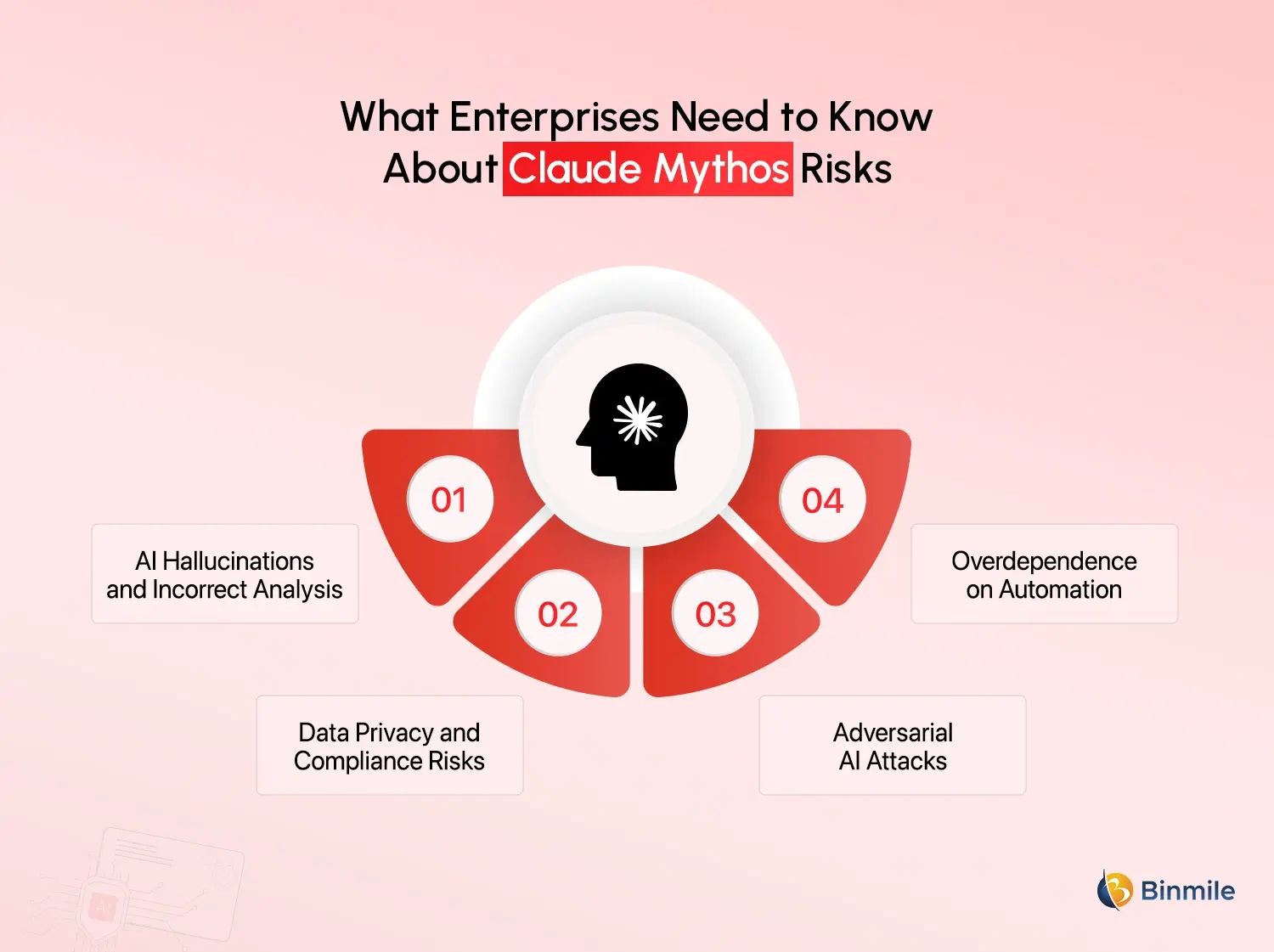
1. AI Hallucinations and Incorrect Analysis
In Cyber Security, the risk of AI systems providing false positives, failing to detect an attack, or providing inaccurate remediation suggestions is heightened. There needs to be a human to verify AI Insights. It is mandatory.
2. Data Privacy and Compliance Risks
Enterprise data is massive; therefore, there are safety protocols in place to keep private data compliant, regulated, and accessible. The added significance increases in sensitive customer/financial data industries.
3. Adversarial AI Attacks
AI systems are now being directly attacked by hackers through prompt injection, data poisoning, model manipulation, and AI-generated social engineering attacks. Therefore, there needs to be strong governance of AI and security monitoring to ensure organizations can leverage AI within their organizations.
4. Overdependence on Automation
AI is very scalable, but AI should not replace all humans from their job roles. There are many areas where experienced analysts will always be needed, such as conducting strategic investigations, providing clarity into complex threats, making decisions using business context, and crisis management. The best Cyber Security models apply both Artificial Intelligence and Human Intelligence.
The Growing Role of Claude Code in Software Development Security
AI is not only transforming cybersecurity operations but also reshaping software engineering workflows. Claude Code in software development is becoming increasingly important as enterprises adopt AI-assisted coding environments.
Development teams now use AI for code generation, bug detection, testing automation, and workflow acceleration. However, AI-generated code can sometimes introduce insecure APIs, weak authentication logic, vulnerable dependencies, and compliance gaps if not monitored properly. As enterprises accelerate software delivery cycles, Modern Applications Security is becoming essential for protecting APIs, cloud-native applications, microservices, and AI-assisted development environments.
This is why secure Claude code implementation is critical. Enterprises should combine AI-assisted development with secure CI/CD pipelines, automated code scanning, human review processes, and DevSecOps governance. When implemented correctly, AI can improve development speed without compromising enterprise security standards.
AI Security vs Traditional Security Operations
| Traditional Security Operations | AI-Powered Security Operations |
|---|---|
| Reactive threat response | Predictive threat detection |
| Manual investigation | Automated analysis |
| High alert fatigue | Intelligent alert prioritization |
| Limited behavioral analysis | Context-aware anomaly detection |
| Slower incident response | Faster automated workflows |
| Static rule-based systems | Adaptive learning models |
This shift explains why enterprises are aggressively investing in AI-driven cybersecurity strategies.
Common Mistakes Enterprises Make While Adopting AI Security
Many organizations try to beat the competitive landscape by adopting AI at an unsustainable pace while failing to build out the necessary infrastructure to support it properly.
Organizations often make significant mistakes with regard to governance by not having appropriate AI governance policies in place prior to deploying the AI system. This exposes them to significant compliance and operational risk.
Additionally, many companies neglect to address data quality issues. Leaders frequently forget that the data quality issues directly impact the accuracy of AI systems and, therefore, can lead to poor decisions based on AI input.
Another significant issue is the over-automation of important processes when there is no human oversight. Automation undoubtedly improves efficiency; however, relying solely on AI has created vulnerabilities when it comes to conducting complex investigations.
Finally, organizations are frequently unsuccessful at adequately training their internal teams, which makes implementation take longer and be less effective.
The biggest mistake organizations make is treating AI as a total replacement for security experts rather than realizing it is an added resource for enhanced operations. To successfully deliver on the desired outcome, strong operational planning, strong governance, and ongoing collaboration between AI systems and human experts are required.
How Enterprises Can Build a Strong AI Security Strategy
Organizations planning to adopt AI-powered security systems should focus on long-term scalability rather than short-term deployment goals.
-
Establish AI Governance Frameworks
Enterprises should establish clear security policies, rules for using data, processes for supervising human involvement in AI, and procedures for managing risk before implementing an AI-based security system. Strong AI governance also supports broader Enterprise Risk Management Strategies by helping organizations identify operational, compliance, and cybersecurity risks before they escalate.
-
Prioritize Explainable AI
To be effective, security teams need to understand the reasons behind an AI system’s recommendation or decision. Greater trust, compliance management, and validation of decision-making processes can be achieved with the use of explainable AI, as well as providing a more verifiable basis for leadership reports from decisions based on AI-generated insights.
-
Combine AI With Human Expertise
The best cybersecurity environments are those that utilize both AI-enabled automated solutions as well as human-led investigating, strategic governance, and ongoing monitoring of the system. A combined approach to this process provides greater operational efficiency and greater resilience for the enterprise.
Looking to modernize enterprise security with AI-driven threat detection and intelligent automation solutions?

How Binmile Supports Enterprise AI Security Transformation
Enterprises adopting advanced Artificial Intelligence Services often struggle to balance innovation, cybersecurity governance, scalability, and operational efficiency. This becomes even more challenging during cloud modernization and enterprise-wide automation initiatives.
A technology partner like Binmile helps businesses build scalable digital ecosystems with strong Cybersecurity Practices, secure development workflows, and intelligent automation strategies. From Modern Applications Security to secure claude code implementation and enterprise AI integration, the focus remains on helping organizations adopt AI responsibly while maintaining operational resilience.
As enterprise adoption of generative AI tools continues to grow, businesses will increasingly require proactive Enterprise Risk Management Strategies and adaptive Cyber Threat Intelligence for Enterprises to manage evolving security risks effectively.
Frequently Asked Questions
Claude Mythos is an AI-driven enterprise intelligence framework designed to improve cybersecurity operations, automation, threat detection, and contextual decision-making across enterprise environments.
Claude Mythos improves cybersecurity by automating threat analysis, prioritizing critical incidents, reducing alert fatigue, and accelerating enterprise incident response workflows.
It analyzes attack patterns, behavioral anomalies, vulnerabilities, and threat intelligence data to help enterprises identify potential risks before cyberattacks escalate.
Claude Mythos supports digital transformation by strengthening cloud security, automating operations, improving scalability, and enhancing enterprise-wide cybersecurity visibility.
Yes. By automating repetitive security tasks, reducing investigation time, and improving operational efficiency, enterprises can lower long-term cybersecurity costs.
Claude Mythos works alongside Multimodal AI, cloud security systems, SIEM platforms, DevSecOps tools, Generative AI tools, and enterprise threat intelligence platforms.