AI has now become integrated into different business systems, influencing customer experience as well as strategic decision-making. Increasing usage is associated with increased risk exposure. For instance, IBM’s Cost of Data Breach Report showed that, for organizations that use AI without appropriate control, there is a high likelihood of increased data breach costs. This illustrates the importance of having structured risk management in place.
As organizations continue shifting the focus of AI technology beyond experimentation, the emphasis has been on control, accountability, and scalability. This blog will focus on how to construct a solid AI risk management framework, how to identify and understand the main risks, the essential elements and the processes involved, as well as the practical approaches of having a consistent and responsible scalable AI.
What Is an AI Risk Management Framework and Why Does It Matter for Businesses
An AI risk management framework is an efficient, structured way to identify, mitigate, and monitor AI-related risks. The aim is to ensure that the AI systems are functioning reliably and ethically and in harmony with the organization’s objectives and relevant legal standards. An example of such a framework is the NIST AI risk management framework, which provides a systematic approach to managing risks associated with all phases of the AI lifecycle.
The primary purpose of this framework is to explain how to analyze risk. Controlling risk is a delicate balance. Without control, risk may get out of hand. AI systems have a lot of potential, but there are even more potential business risks if they are left uncontrolled. Additionally, missing outputs, biased outputs, failures, and regulatory non-compliance are all operational risks that directly impact customer confidence and business continuity.
The ability of a business to implement a well-defined framework is directly correlated with process stability, user confidence, regulatory compliance, and reduced risk when scaling AI.
What are the Key Risks Associated with AI Systems
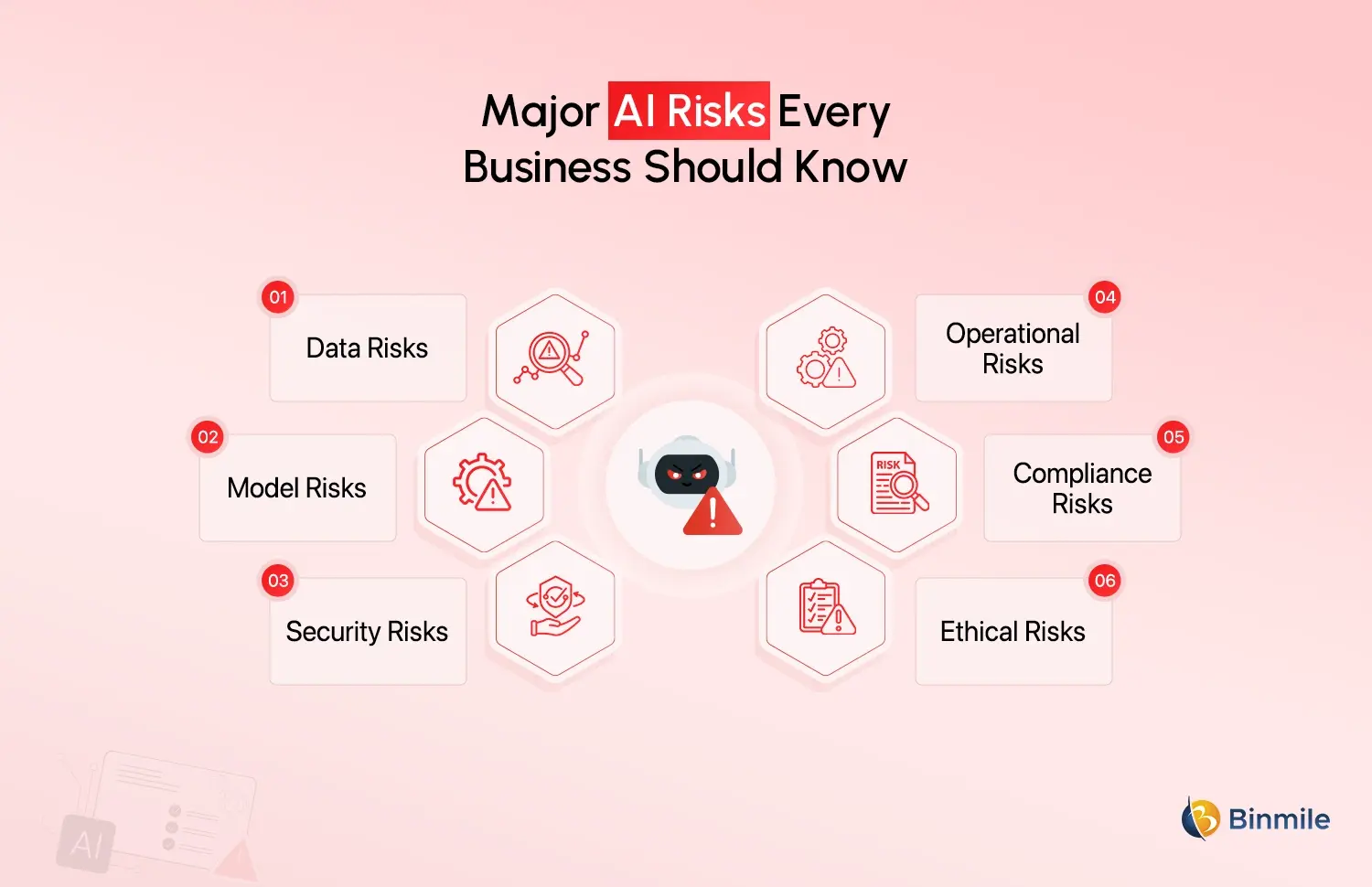
To build an effective framework, it is important to first understand the major AI risks in business enterprises face.
-
Data Risks
AI bias tends to be learned from low-quality data, so data that is bad simply begets bad. Stacked datasets lead to learning from false-positive and false-negative leads. Additionally, these lead to handicaps and detrimental predictive modelling.
-
Model Risks
AI modelling is not fixed. When modelling is updated, external variable data become new facts. Without this new data integration, innovation is lost, and AI modelling becomes outdated and irrelevant.
-
Security Risks
Information and modelling systems become targets themselves. GenAI security risk poses leads to disinformation and irrational modelling, and ultimately leaks sensitive data.
-
Ethical Risks
Injustices can be learned and propagated due to the inherent bias in AI modelling, and lead to discrimination and injustice. Additionally, AI modelling impacts real lives in health care and even the financial system.
-
Compliance Risks
Regulatory modelling and systems should always be respected to avoid future penalties and restrictions that can ground a business.
-
Operational Risks
AI systems that modulate business systems optimally can lead to system disruption and decreased productivity.
What Is the AI Risk Management Process
Building a framework is not a one-time task. It is an ongoing process that evolves with the system.
Step 1: Identify Risks
Begin your risk identification process by mapping all of the potential risks to your data, models, and infrastructure. Additionally, the way you use all of the above to have a clearer picture of your potential vulnerabilities is the start of your AI for risk management process.
Step 2: Assess Risks
Once you have mapped your risks, you will want to evaluate them based on how big the impact of the risk could be and how likely the risk is to occur, thus giving you a way to prioritize the risks that have the biggest impact on your business so you can appropriately allocate resources and deal with the most critical first.
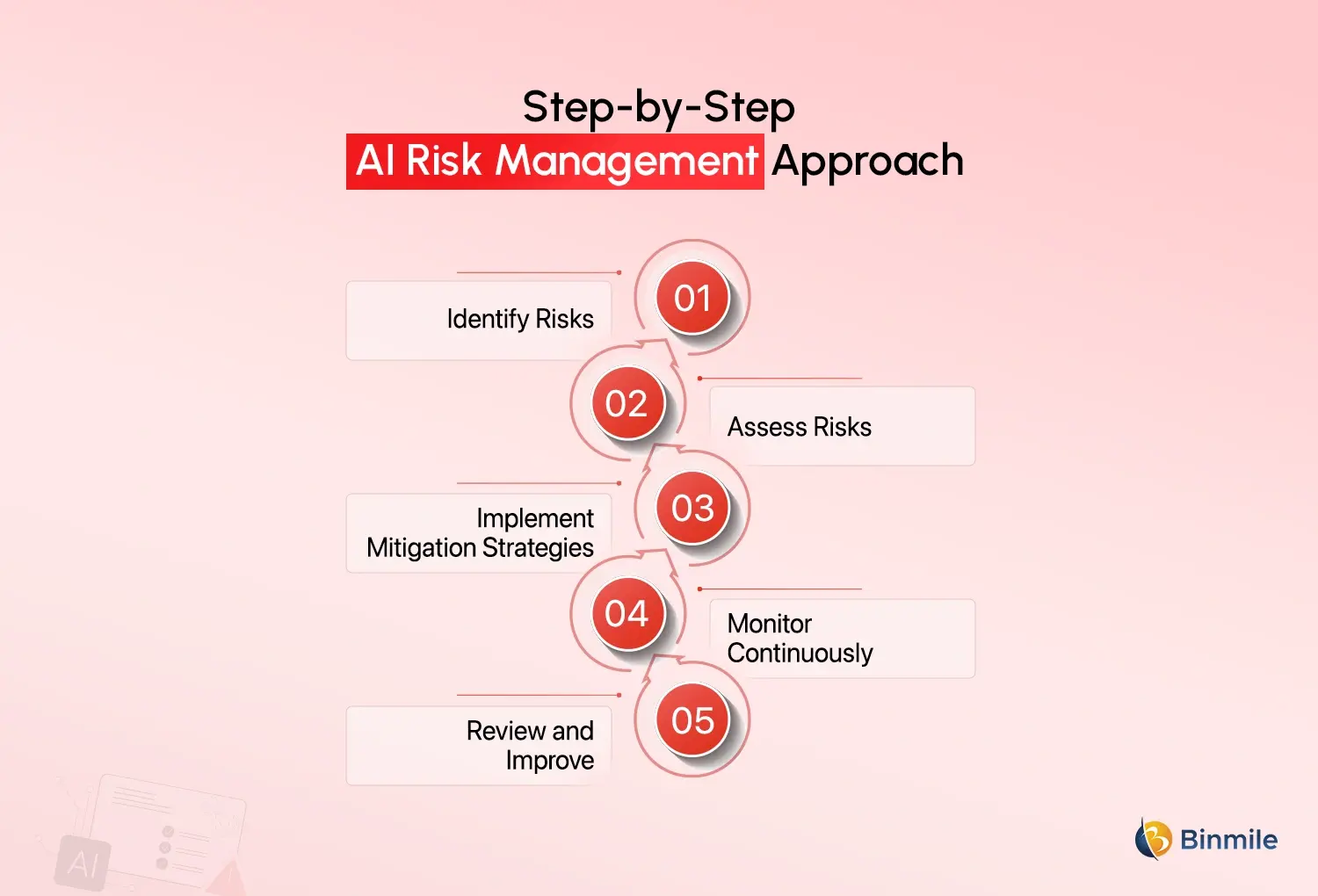
Step 3: Implement Mitigation Strategies
Implement your risk mitigation strategies, including data validation checks to ensure quality data, tools that will identify the presence of bias in your data, model retraining schedules to ensure that the models continue to perform as expected over time, and security controls to minimize the risk of any security threats. Additionally, all of these activities will help reduce both the likelihood of and the impact of your identified risks.
Step 4: Monitor Continuously
Utilize dashboards, alerts, and monitoring tools to monitor the performance of each model in real-time and to identify any anomalies. Additionally, continuously monitoring all of your models will ensure that any issues are identified and resolved as quickly as possible.
Step 5: Review and Improve
Regularly update your framework to include any new identified risks, regulatory changes that occur, and incorporate any evolving business needs into your risk framework. Additionally, continuously improving your framework will help to ensure that you maintain a robust framework throughout time.
Ready to turn AI into a reliable and risk-controlled business asset with the right guidance?

What Are the Tools and Technologies for AI Risk Management
Modern tools make it easier to implement and scale AI risk management software effectively.
-
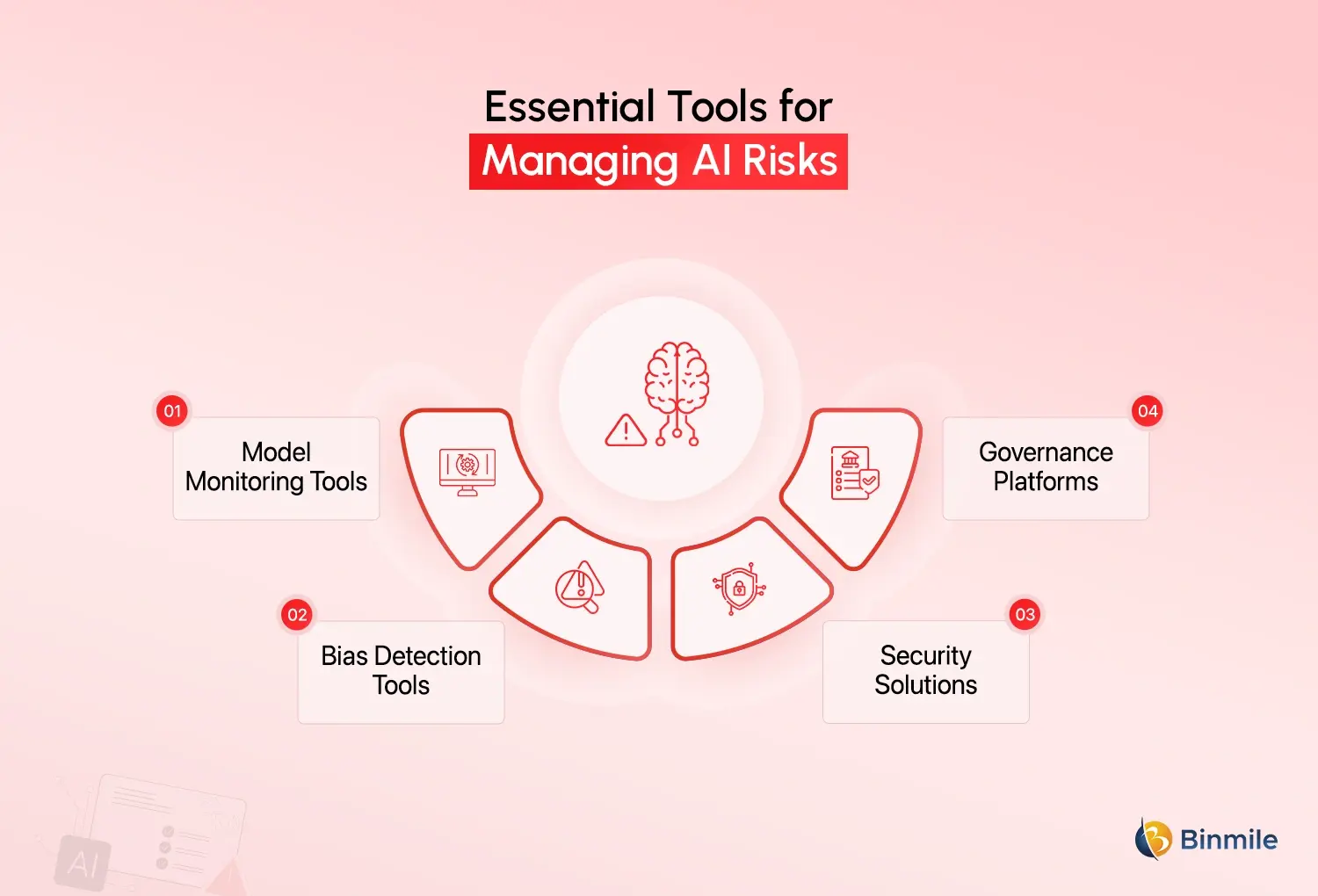
Model Monitoring Tools
These tools are useful for constantly observing the functioning of models in real-time so that anomalies or declines in performance can be detected as early as possible. Additionally, this allows organizations to correct a problem before it adversely affects business operations.
-
Bias Detection Tools
These tools analyze dataset quality and the resulting outputs to uncover areas of unfairness. By utilizing these tools, organizations can minimize ethical risks and make decisions that are more equitable.
-
Security Solutions
These tools act as a safeguard against malicious/cyber attacks and protect the vast number of data records/models stored within an organization.
-
Governance Platforms
These platforms bring together the organization’s documentation and policies and allow for ease of tracking compliance. Additionally, making it easier to manage the implementation of AI systems throughout a given organization.
Both AI and risk management in software can be managed through the use of Artificial Intelligence as a service (AIaaS), as organizations can utilize AI to predict failure points, identify outlying/malicious behaviors, and automate the process of monitoring for improved operational effectiveness.
What Are the Best Practices for AI Risk Mitigation
Effective AI risk mitigation management practices require a combination of technology, governance, and human involvement.
-
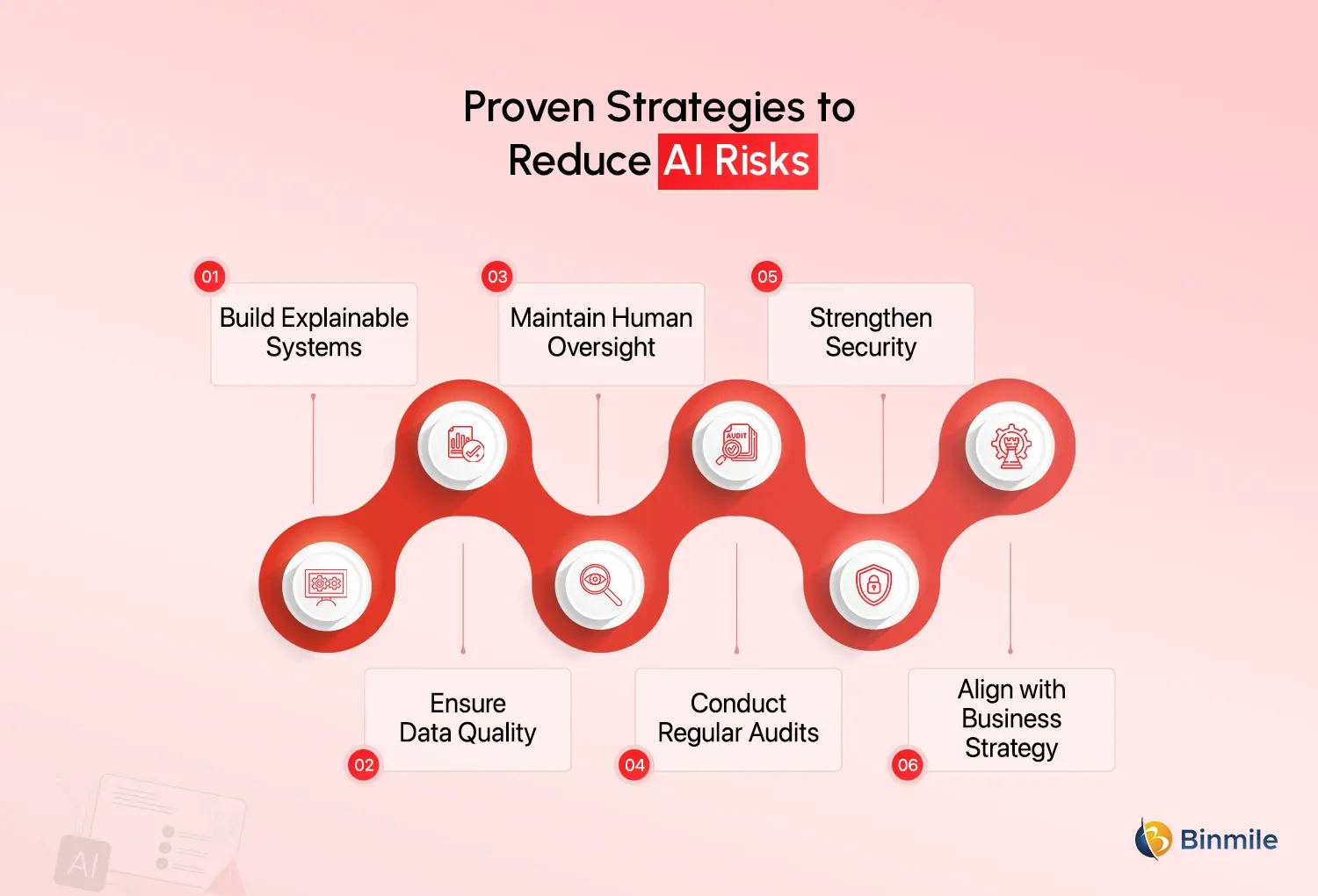
Build Explainable Systems
In developing Artificial Intelligence (AI) Models, transparency and clarity are essential parts in building technology that Authorized Users can have confidence in and establish compliance with regulations.
-
Ensure Data Quality
Minimizing biases and increasing accuracy in AI Models through the use of high-quality, varied data will often increase the accuracy of the Machine Learning algorithms. Additionally, provide many other beneficial results when the data is appropriately cleaned.
-
Maintain Human Oversight
Automated Systems will require an ongoing human verification of significant AI decision output on the basis that it will reduce the number of erroneous decision results from the AI System and ensure that human responsibility continues to be associated with the decisions made within the AI Process.
-
Conduct Regular Audits
Periodic reviews will identify the existence of Model Drift, Bias, and Operating Acceptability to keep up with or improve upon the AI Model’s Performance Expectations over time.
-
Strengthen Security
Implementing Access Control, Authentication, and Encryption are examples of ways to provide a secure AI Model from Cyber Attacks and Unauthorized Access.
-
Align with Business Strategy
Incorporating Risk Management for AI within your broader Risk Management Framework will ensure that your AI Projects will maximise the measurable higher-level objectives of your organization without unnecessary risk.
What Are the Regulatory and Compliance Considerations for AI
Regulation is becoming a key driver in shaping AI risk management frameworks and strategies.
-
Data Protection Laws
Organizations must prioritize the protection of user data by adhering strictly to the privacy regulations that govern the collection and storage. Additionally, the utilization of that data to avoid legal repercussions.
-
AI-Specific Policies
As the use of AI technologies increases, Governments and organizations are developing regulations that aim to ensure transparency, fairness, and accountability. Additionally, organizations need to ensure their AI technologies comply with those regulations.
-
Audit Preparedness
Regulatory compliance is achieved by having the right record-keeping, logging, and documentation AI risk management practices in place.
-
Ethical Standards
When AI systems are designed with accountability and fairness. Additionally, organizations are less likely to perpetuate discrimination and are likely to strengthen the trust of their users and stakeholders over time.
Planning to scale AI across your enterprise without increasing risk exposure?

How Binmile Can Support Your AI Risk Management Journey
In order to build a trustworthy AI Risk Management Framework, only part of the work is technical. One also needs to understand the business side, the regulations, and the risks that are present and evolving. Hence, this is where the right knowledge is important.
Binmile helps companies with practical and scalable frameworks, given their strong capabilities in AI, enterprise software, and digital transformation. Additionally, the aim is to foresee risks and factor mitigation into AI development, so that future compliance does not stifle innovation.
Having a combination of documented AI risk management frameworks and strategies and relevant experience, companies can take action without hesitation. Be it strengthening GenAI risk management strategy or better governance models. Additionally, by adding risk control to existing systems, the strategy is oriented towards sustainable and secure growth of the enterprise.
Frequently Asked Questions
An AI risk management framework is a structured system that helps organizations identify, assess, and mitigate risks in AI systems while ensuring reliability, ethical use, and compliance with regulatory and business requirements.
AI systems face risks such as data bias, model inaccuracies, cybersecurity threats, compliance issues, and ethical concerns. These risks can impact decision-making, operational efficiency, and overall business performance if not managed properly.
Companies manage AI risks through governance structures, risk assessments, monitoring tools, and mitigation strategies like bias detection, data validation, and continuous model evaluation to ensure accuracy and compliance.
AI risks can disrupt workflows, lead to incorrect decisions, damage brand reputation, and cause regulatory penalties. Poorly managed AI systems may also reduce efficiency and negatively affect customer experience.
AI compliance is ensured by following regulations, maintaining transparency, documenting processes, and implementing AI governance frameworks that define roles, responsibilities, and accountability across AI systems.
Best practices include using high-quality data, ensuring model transparency, applying human oversight, conducting regular audits, and implementing strong security measures to minimize risks and improve system reliability.
Industries like finance, healthcare, retail, and technology benefit the most as they rely heavily on AI for decision-making, customer insights, and automation, making risk management essential for stability and compliance.