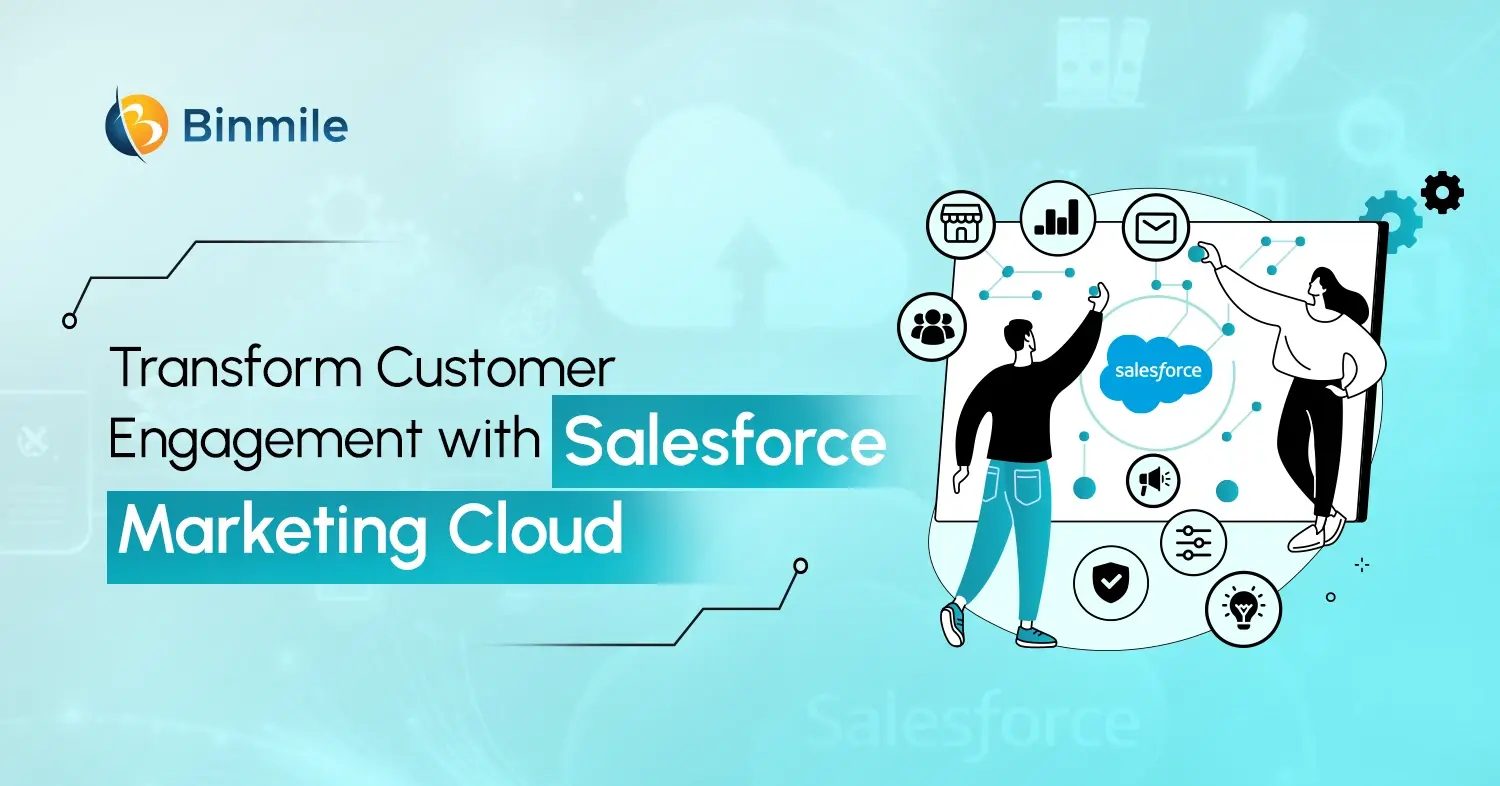
Customers today do not just compare products; they compare experiences. According to a Salesforce report, 90% of customers say the experience a company provides is as important as its products or services. This shift is forcing businesses to rethink their approach to marketing, as traditional methods that rely on mass communication are no longer sufficient. This is where the Salesforce Marketing Cloud becomes essential for businesses that want to stay competitive.
In this blog, we will explore what the Salesforce Marketing Cloud platform is, its significance in today’s business environment, and how it helps enhance customer engagement and marketing ROI. We will also cover its features, benefits, use cases, challenges, and how it compares with traditional tools, so you get a complete understanding of its practical value.
What Is Salesforce Marketing Cloud?
Salesforce Marketing Cloud is a digital marketing platform that helps businesses manage customer data, automate campaigns, and deliver personalized communication across multiple channels.
It captures a piece of the larger Salesforce ecosystem alongside other solutions like Salesforce Sales Cloud, which cater to sales and customer relationship management. While right CRM systems manage customer data and relationships, Marketing Cloud leverages that data to drive impactful marketing initiatives.
Thanks to the Salesforce Market Cloud, disparate systems no longer exist. Businesses can now ensure that consistent communication occurs and build relationships over time, as the entirety of customer engagements is captured in a single system.
What Are the Key Features of Salesforce Marketing Cloud
The platform offers a wide range of features that work together to create a powerful marketing system.
-
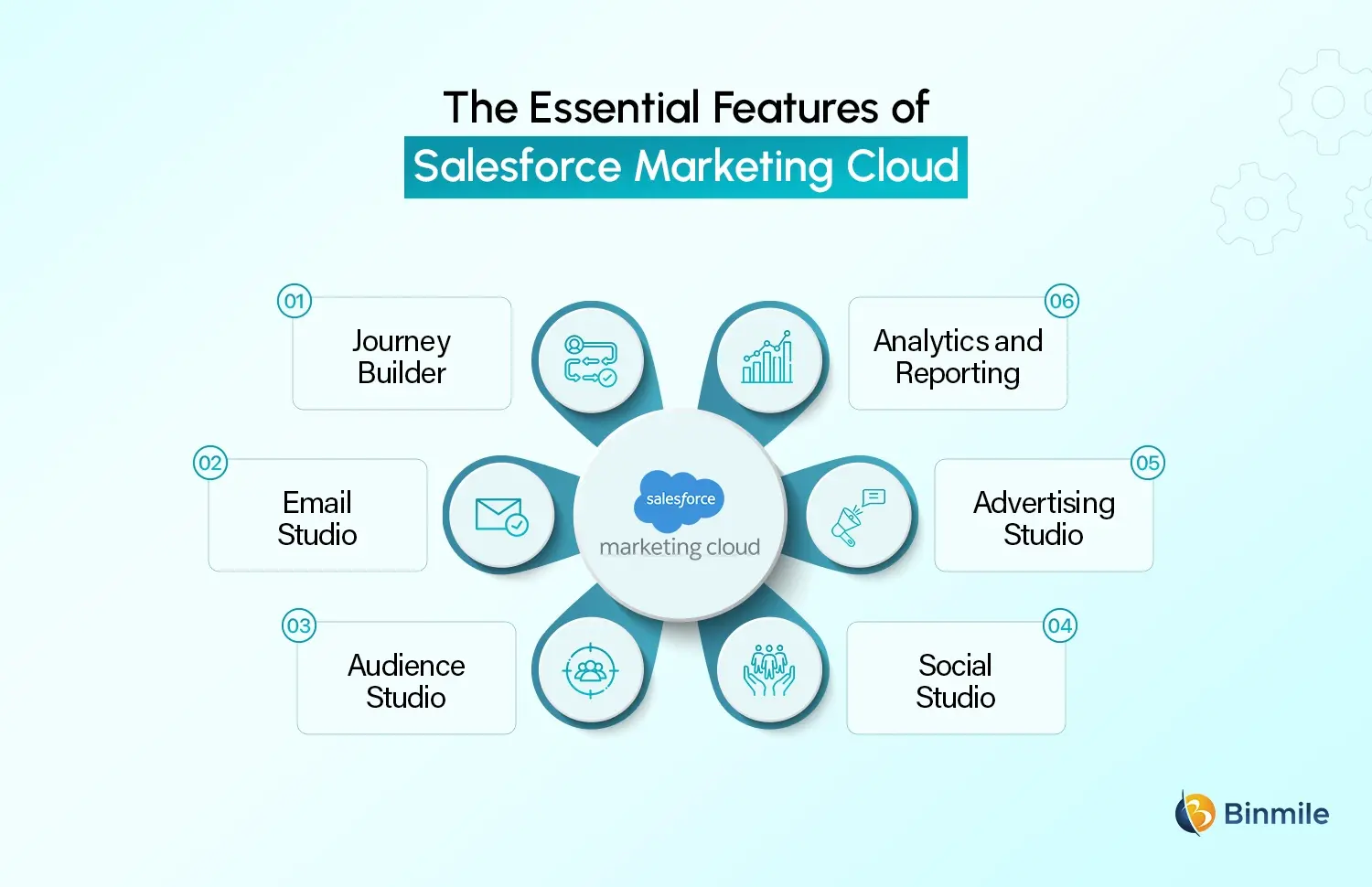
Journey Builder
Using this tool, businesses can design and automate extensive customer journeys. It helps businesses customize communication with customers at each touchpoint, from a first-time buyer to post-purchase engagement, to ensure all communication is appropriate.
-
Email Studio
Email Studio allows massive personalized email marketing. Businesses can customize communications and segment their audience to send more messages, and even resonate with customer preferences to increase open rates and conversions.
-
Audience Studio
This tool is focused on processing customer data from various sources and unifying customer profiles. It also provides more precise and segmented audience targeting, and ultimately more personalized marketing campaigns.
-
Social Studio
Social Studio helps businesses streamline their actions on social media. It assists in structuring responses to customer engagement, as well as tracking and scheduling content in an organization.
-
Advertising Studio
This tool provides intelligent targeting of advertisements based on integrated customer data. This allows more precise targeting and more effective use of marketing budgets.
-
Analytics and Reporting
The platform enables businesses to use reporting and analytics to their fullest potential. Businesses can evaluate campaign performance and customer engagement to better predict ROI and make more effective optimizations to their marketing plan.
All these features together form a strong Salesforce Marketing Cloud architecture that supports scalable and intelligent marketing operations.
How Salesforce Marketing Cloud Improves Customer Engagement
Customer engagement today depends on personalization and timing. Salesforce Marketing Cloud helps businesses deliver both by using real-time data and automation.
-
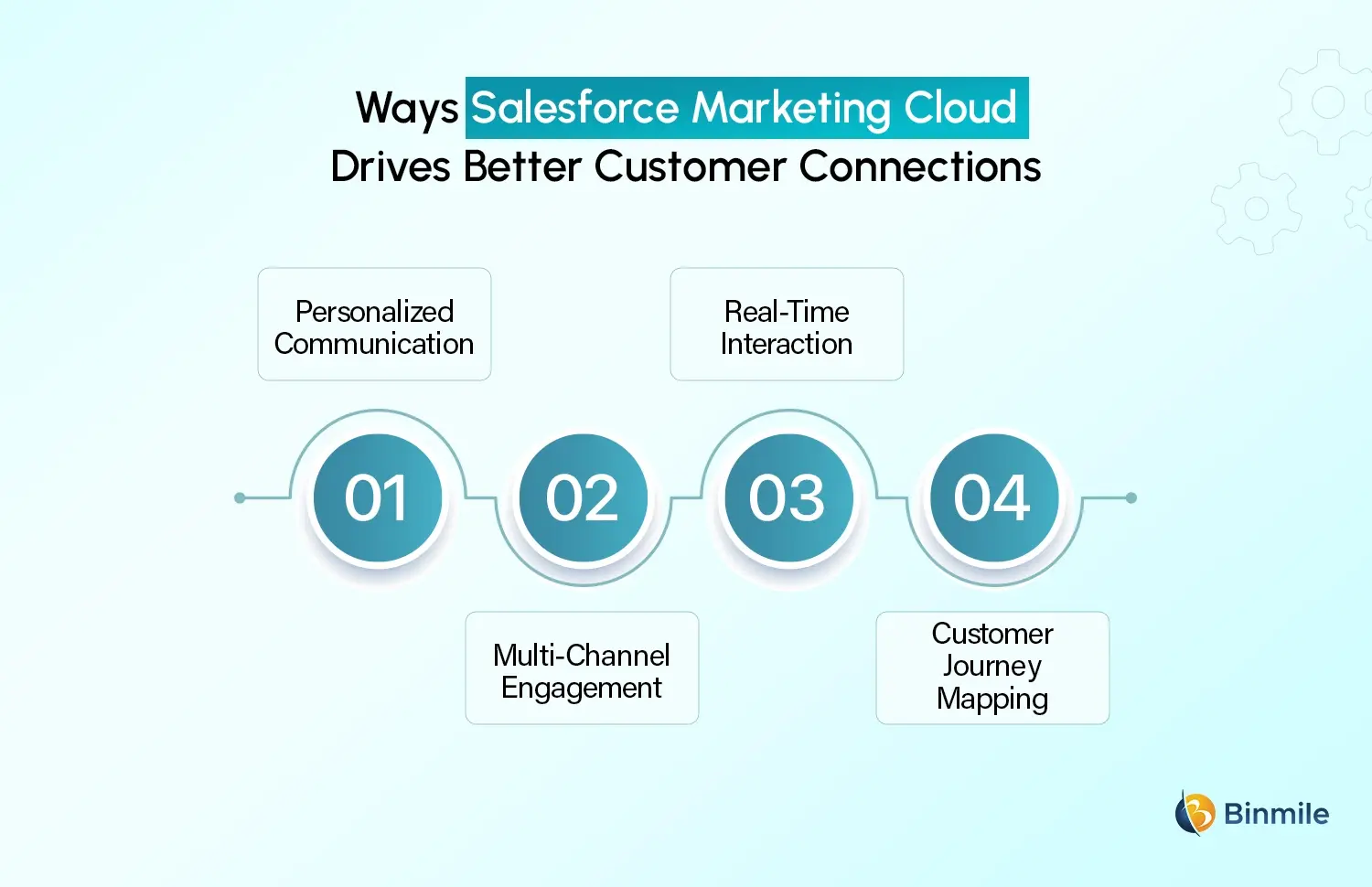
Personalized Communication
Personalized messages containing information specific to a customer’s behavioral patterns and preferences are more likely to elicit a response than a traditional nonspecific message.
-
Multi-Channel Engagement
Customers utilize a variety of channels to communicate with a brand. The platform provides synchronized communication across email, mobile, social media, and advertising.
-
Real-Time Interaction
Customers are able to interact with businesses through a variety of channels, and the platform enables synchronized communication through email, mobile, social media, and advertising.
-
Customer Journey Mapping
Having the ability to see and optimize the customer experience is critical. Customer segmentation becomes easier, and opportunities to close the loops in engagement monitoring become readily evident.
What Are the Benefits of Salesforce Marketing Cloud
There are a great deal of opportunities for businesses, and providing the ability to monitor the performance of marketing activities is most important. Tracking marketing activity and customer response provides businesses with the ability to focus on the most effective marketing activities in the least amount of time.
Perhaps the most complex, yet considerable advantage is improved customer relationships. Through a variety of communication channels, a company utilizes to make customers feel appreciated. Continuity of improved customer relationships and reduced communication interruptions makes customers feel more valued, and as a result, these valued customers are often more lucrative.
Continuity of improved customer relationships and a reduction in communication interruptions are the most important advantages of improved customer relationships.
Scalability is another primary benefit. A business can run both micro and macro campaigns without worrying about the platform malfunctioning. Similarly, with the creation of automated functions, manual involvement is minimized, and operational efficiency is increased, allowing teams to spend more time on big-picture thinking and creativity, as opposed to tactical execution. All of this helps reinforce the value and benefit of Salesforce Marketing Cloud and why it is essential for any modern business.
Looking to make your marketing more personalized, automated, and result-driven?

Salesforce Marketing Cloud vs Traditional Marketing Tools
To understand its value, it helps to compare it with traditional marketing tools.
| Aspect | Salesforce Marketing Cloud | Traditional Tools |
|---|---|---|
| Personalization | Advanced and real-time | Limited or manual |
| Data Integration | Unified customer view | Fragmented data |
| Automation | Fully automated journeys | Basic automation |
| Channels | Multi-channel support | Often single-channel |
| Analytics | Deep insights and reporting | Basic metrics |
Traditional tools often operate in silos. In contrast, the Salesforce Marketing Cloud platform connects data, channels, and campaigns into one system.
What Are the Use Cases of Salesforce Marketing Cloud
Before all else, the flexibility of the platform is a large reason it is so widely adopted across all of the industries it serves. In eCommerce, the platform is used to provide custom product suggestions, recover abandoned shopping carts, and design customer loyalty programs. By directly addressing the prospect and customer issues at various stages of their buying cycle, these functionalities boost revenue.
In healthcare, the platform enables appointment reminder management, patient engagement through calls and emails, and even campaigns for various issues. In the financial services industry, it is used to design structured customer onboarding, targeted communication for financial products, and real-time proactive customer communications.
For the SaaS business model, the platform is critical for user onboarding, adoption of new product features, engagement, and ultimately, retention of users. The platform’s flexibility and focus on customer engagement and revenue growth enable it to be widely deployed across all industries.
What Are the Challenges of Salesforce Marketing Cloud
Despite its advantages, the platform comes with certain challenges that businesses need to consider.
-
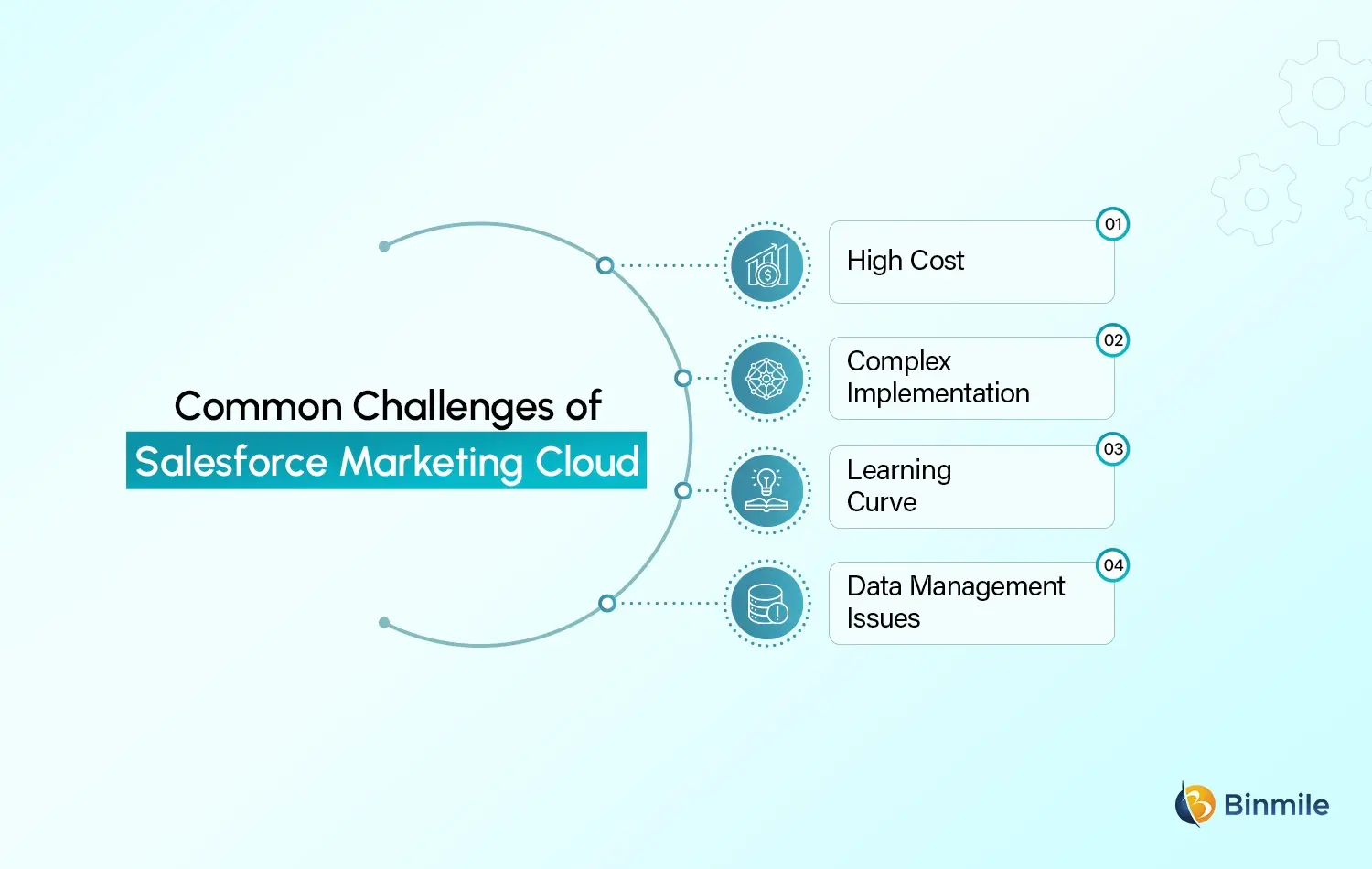
High Cost
Salesforce Marketing Cloud cost is expensive. Even for small businesses and mid-size businesses, the licensing fees, coupled with the more advanced implementation, integration, and ongoing maintenance costs, hinder the ability to justify the investment without having clear business objectives and marketing goals.
-
Complex Implementation
Plug-and-play and instant setup capabilities are not available on the platform. It requires development, data design, and systems integration. Many organizations wish to avoid gaps and misalignment with business objectives by engaging a Salesforce Marketing Cloud consultant.
-
Learning Curve
The platform has so many advanced features that it becomes overly complicated to the point where enterprise teams require formal training. Otherwise, the business may only utilize a small part of the platform’s features, resulting in extremely low value and subsequent return on investment.
-
Data Management Issues
The success of the platform is all about data. Poorer data management and data integrity are more likely to affect the overall marketing effectiveness. With less precise targeting and poorly designed campaigns, these are more likely to suffer from overall marketing effectiveness.
Understanding these challenges of Salesforce Marketing Cloud helps businesses prepare better and avoid common mistakes.
What Are the Types of Salesforce Marketing Cloud
The platform includes different modules, each designed to address specific marketing needs.
-
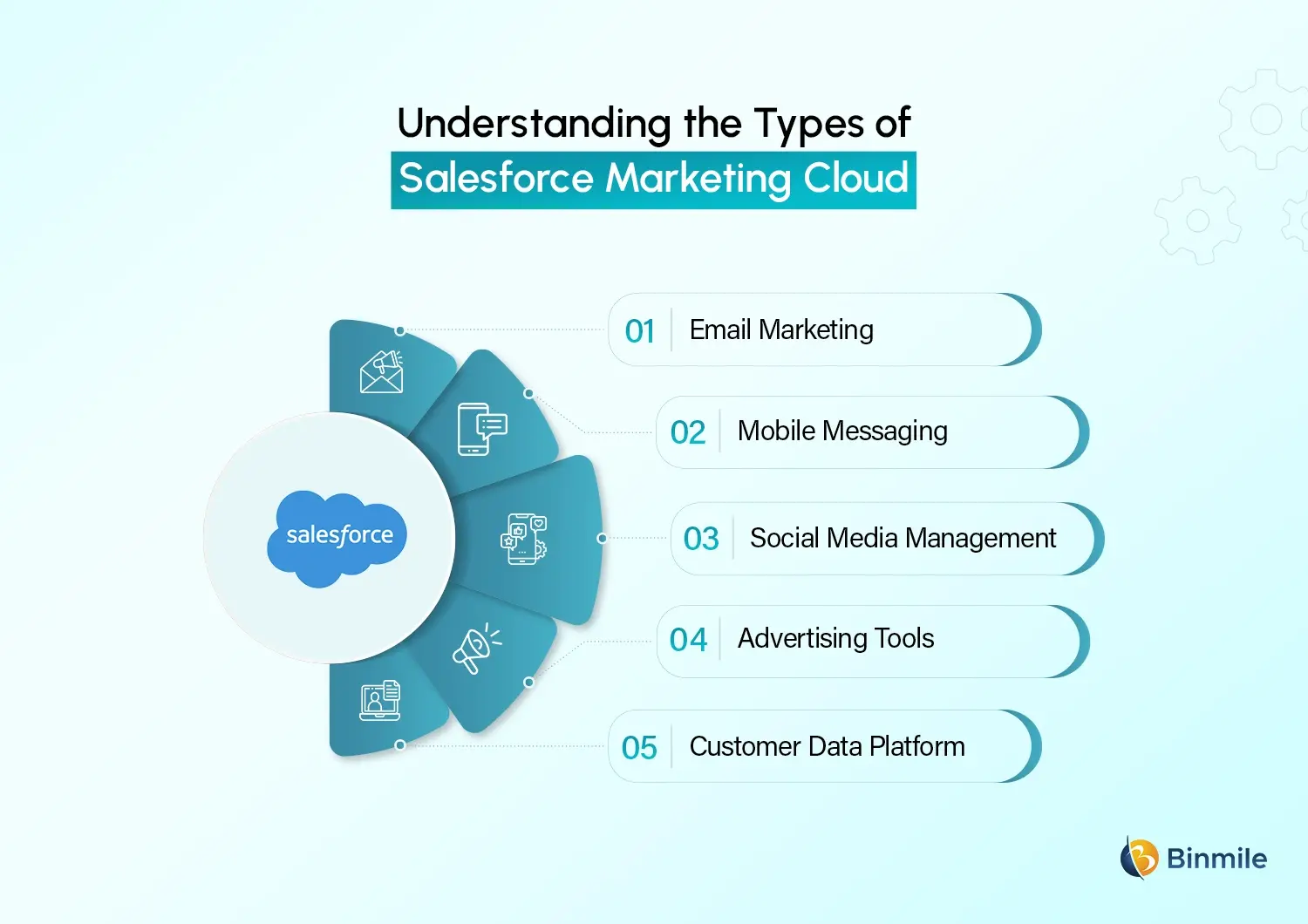
Email Marketing
This module constructs automated, custom email campaigns and advanced personalization. This means email marketing can improve customer engagement, open rates, and conversions. Email Marketing also allows companies to segment their clients by preference and behavioral targeting to further improve the personalization.
-
Mobile Messaging
This module is also called Mobile Communication. Its primary purpose is to communicate via SMS and in-app notifications. For Mobile Communication, time is the most important element. This module is suitable for time-critical communication such as alerts, reminders, notifications, and promotions. Messages sent over mobile communication are read within a few minutes, so this module enables fast and efficient communications for customers.
-
Social Media Management
This module is the best choice if you want to align your marketing strategies and manage social media accounts in an organized way. Your teams can track engagement, schedule posts, manage customer interactions, and overall marketing strategies across various platforms.
-
Advertising Tools
These tools enable businesses to develop and run focused advertising campaigns based on analytics. This allows companies to target their advertising based on specific customer segments rather than a wider, more general targeting approach, which improves overall advertising efficacy.
-
Customer Data Platform
This module is about collecting and consolidating data from various sources about customers. It serves as the basis for the entire system, which then allows for detailed segmentation, customer personalization, and ultimately marketing decisions.
Understanding the types of Salesforce Marketing Cloud helps businesses choose the right mix of features.
What Are the Future Trends of Salesforce Marketing Cloud
The platform evolves with emerging technologies and shifting customer expectations. AI-driven marketing is one of the newer developments. This makes marketing campaigns smarter and more efficient, as AI predicts customer behaviors and automates decision-making.
As marketing continues to evolve, companies are adopting a change that focuses on hyper-personalization. Instead of broad segmentation, companies are striving for high individualization of customer experience. This enhances customer satisfaction and engagement. There is also a move to incorporate privacy-centric marketing. Businesses must adjust their practices concerning the collection, storage, and use of customer data due to stricter data regulations and the increasing awareness of users.
Marketing Automation Systems and CRMs are more integrated than ever for the alignment of marketing and sales efforts and the improved consistency of customer experience. These are some of the trends that point to the evolution of Salesforce Marketing Cloud. Salesforce Marketing Cloud will likely continue to shape the world of marketing for the foreseeable future.
Want to turn your customer data into meaningful engagement and higher conversions?
How Binmile Can Support Your Salesforce Marketing Journey
Salesforce Marketing Cloud adoption is not just a tool purchase; rather, it is a paradigm shift in the marketing aspects of a business. Salesforce Marketing Cloud integration, data alignment, campaign orchestration, and optimization can stymie a customer’s success without the proper experience, and organizations tend to underutilize the platform.
Having no less than a structured plan for the Salesforce Marketing Cloud implementation can aid successful marketing. With deep experience in SaaS applications and cloud consulting, Binmile proves effective in enabling businesses to achieve synergy between their marketing technology and business objectives. Meaningful and measurable results are achieved, and it goes beyond just platform setup.
Marked by the custom-built, scalable solutions that result in a seamless experience, the understanding of existing workflows, and the identification of gaps are all crucial in the process. Automated and intelligent marketing systems with deep customer engagement, improved conversions, and sustainable long-term growth are the result.
Frequently Asked Questions
Salesforce Marketing Cloud is a digital marketing platform that helps businesses manage customer data, automate campaigns, and deliver personalized communication across multiple channels like email, mobile, and social media.
It enables businesses to design and automate customer journeys based on user behavior, ensuring that each interaction is timely, relevant, and aligned with the overall customer lifecycle.
Data is central to the platform, as it helps in understanding customer behavior, segmenting audiences, and delivering personalized marketing campaigns that improve engagement and conversion rates.
It improves ROI by enabling targeted campaigns, reducing manual effort through automation, and providing detailed insights that help optimize marketing strategies and spending.
It collects customer data, organizes it into segments, and automates personalized campaigns across channels. Built on SaaS architecture, it allows businesses to manage marketing activities, scale operations easily, and access the platform without complex infrastructure.
Salesforce CRM development focuses on managing customer relationships and sales processes, while Marketing Cloud is designed for marketing automation, campaign management, and multi-channel customer engagement.