Artificial intelligence has moved beyond experimentation. It is becoming a strategic priority for organizations looking to improve efficiency, accelerate innovation, and create new revenue opportunities. Yet many businesses continue to struggle to scale AI beyond isolated pilot projects. According to Deloitte’s 2026 State of AI in the Enterprise report, 94% of Indian organizations expect to increase AI investments over the next year. However, security, governance, and scalability remain key priorities, highlighting the need for a structured AI maturity model before expanding AI initiatives.
The difference between organizations that successfully scale AI and those that remain stuck in experimentation often comes down to one factor: maturity. An AI maturity model provides a structured way to evaluate where an organization stands, identify capability gaps, and create a roadmap for sustainable AI adoption. In this guide, we will explore the AI maturity framework, the different AI maturity levels, how organizations can assess their current capabilities, and the steps required to build an AI-driven enterprise while ensuring governance, scalability, and long-term business value.
What Is an AI Maturity Model, and Why Do Organizations Need One?
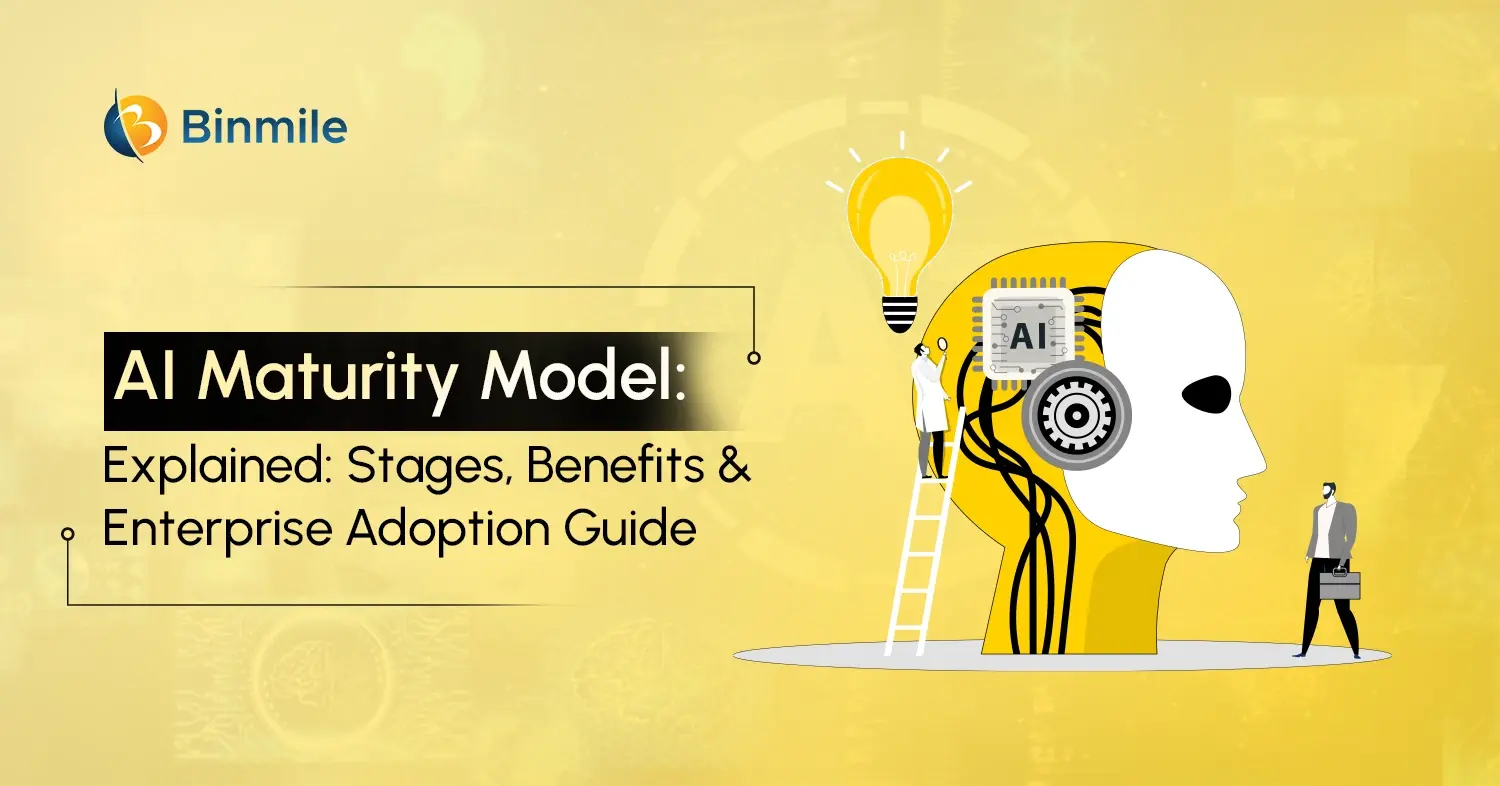
An AI maturity model is a structured framework that measures an organization’s ability to adopt, scale, govern, and optimize artificial intelligence across its operations. It helps businesses understand their current capabilities and provides a clear direction for progressing toward enterprise-wide AI adoption.
Many organizations have already adopted AI through chatbots, predictive analytics, automation, or generative AI tools. The challenge is that these initiatives often remain isolated within individual teams, creating inconsistent processes, governance gaps, and limited business impact.
An AI maturity model helps organizations evaluate how effectively AI is aligned with business strategy, data, technology, governance, and operational processes. It shifts the focus from simply deploying AI tools to building a scalable capability that delivers measurable business value. This structured AI maturity framework also helps leaders identify gaps, prioritize investments, and create a clear roadmap for enterprise-wide AI adoption.
Another useful way to understand maturity is through the AI maturity curve. Organizations rarely transition from basic automation to enterprise-wide AI overnight. They move through progressive stages, gradually strengthening governance, technology, processes, and organizational capabilities as AI adoption expands.
Similarly, the AI adoption maturity model emphasizes that sustainable AI success depends on continuous organizational development rather than isolated technology deployments.
Understanding the Five AI Maturity Levels
Organizations typically progress through five distinct stages of AI maturity. Each stage represents increasing sophistication in how AI is planned, deployed, governed, and integrated into business operations.
Level 1: Awareness
Organizations recognize AI’s potential but have not yet developed a formal strategy. Most efforts focus on learning, exploring use cases, and understanding how AI can support the business.
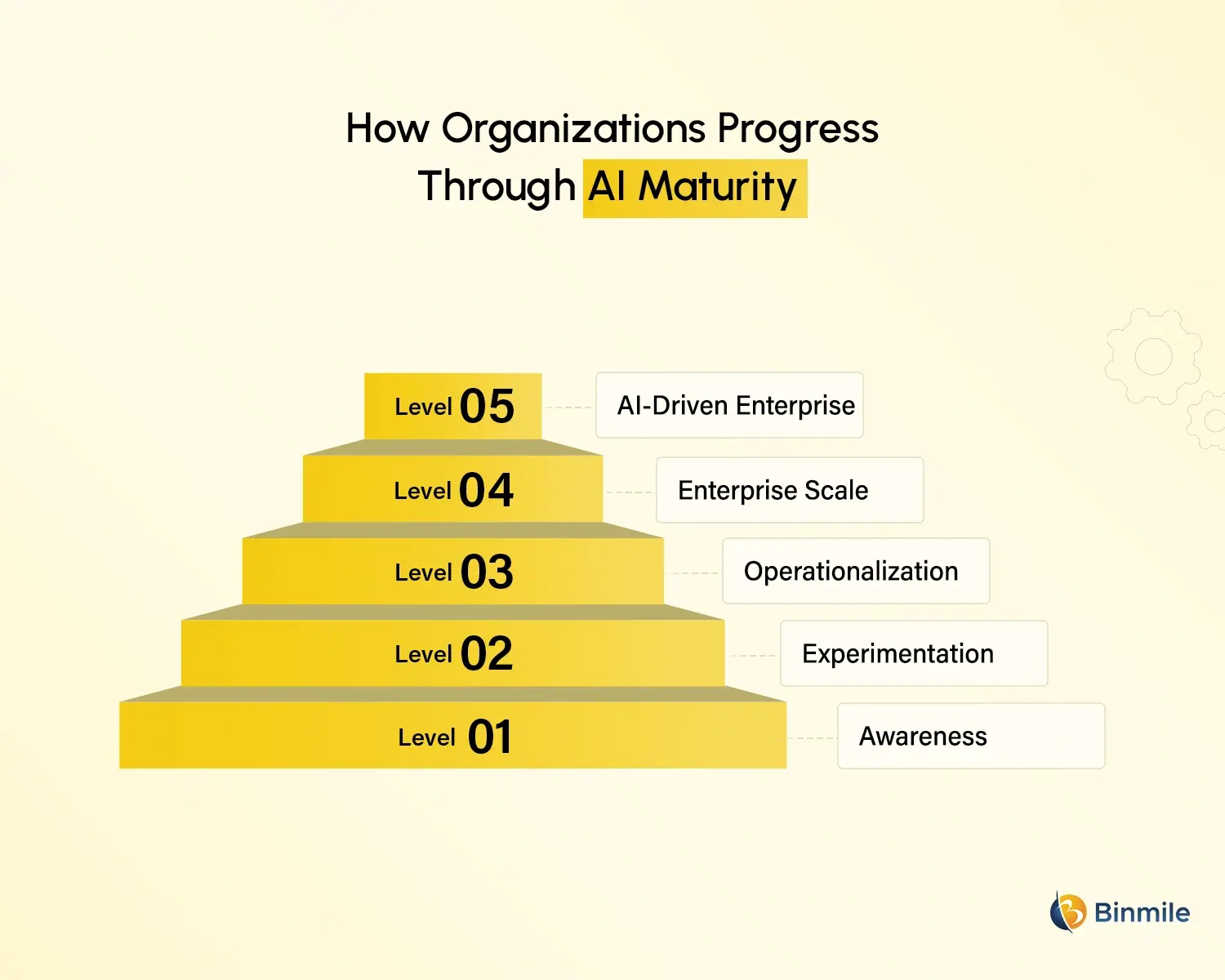
Level 2: Experimentation
Departments begin testing AI through pilot projects and proof-of-concept initiatives. While these experiments generate insights, they often operate independently without centralized governance or consistent success metrics.
Level 3: Operationalization
AI moves from experimentation into production. Organizations integrate AI into core business processes, establish dedicated teams, introduce performance metrics, and begin building repeatable AI capabilities.
Level 4: Enterprise Scale
AI becomes an enterprise-wide capability supported by standardized platforms, shared data, and strong governance. Cross-functional collaboration increases, and Enterprise AI Orchestration enables AI systems to work together across business functions.
Level 5: AI-Driven Enterprise
AI is embedded into strategic decision-making and day-to-day operations. Intelligent systems continuously optimize workflows, support leadership decisions, and drive innovation across the organization.
AI Maturity Assessment: How to Evaluate Your Organization
Knowing that your organization uses AI is not enough. The real question is whether AI is creating measurable business value and whether your organization is prepared to scale it responsibly. This is where an AI Maturity Assessment becomes essential.
An AI maturity assessment helps business leaders evaluate current capabilities, uncover gaps, and identify the next steps required to move toward enterprise-wide AI adoption. Rather than focusing solely on technology, it provides a holistic view of the organization’s readiness across multiple dimensions.
| Assessment Area | Questions Business Leaders Should Ask |
|---|---|
| Business Strategy | Is AI aligned with long-term business objectives? |
| Data Readiness | Is our data accurate, accessible, secure, and governed? |
| Technology Infrastructure | Can our current systems support enterprise AI workloads? |
| Talent & Skills | Do we have the right AI, data, and engineering expertise? |
| Governance | Are policies in place for security, compliance, ethics, and risk management? |
| Processes | Can AI be integrated into existing business workflows? |
| Culture | Are employees prepared to adopt AI-driven ways of working? |
| Business Value | Are AI initiatives delivering measurable ROI and business outcomes? |
Many enterprises also rely on an AI maturity assessment tool to benchmark their current state against industry best practices. These tools provide structured scorecards, identify capability gaps, and recommend priority areas for improvement. However, assessment tools should support decision-making rather than replace strategic planning. The insights they generate are most valuable when combined with business context and executive leadership.
How To Build an AI Maturity Roadmap
Once organizations understand their current maturity level, the next step is creating a realistic AI maturity roadmap. Scaling AI successfully requires a phased approach that aligns technology investments with business priorities.
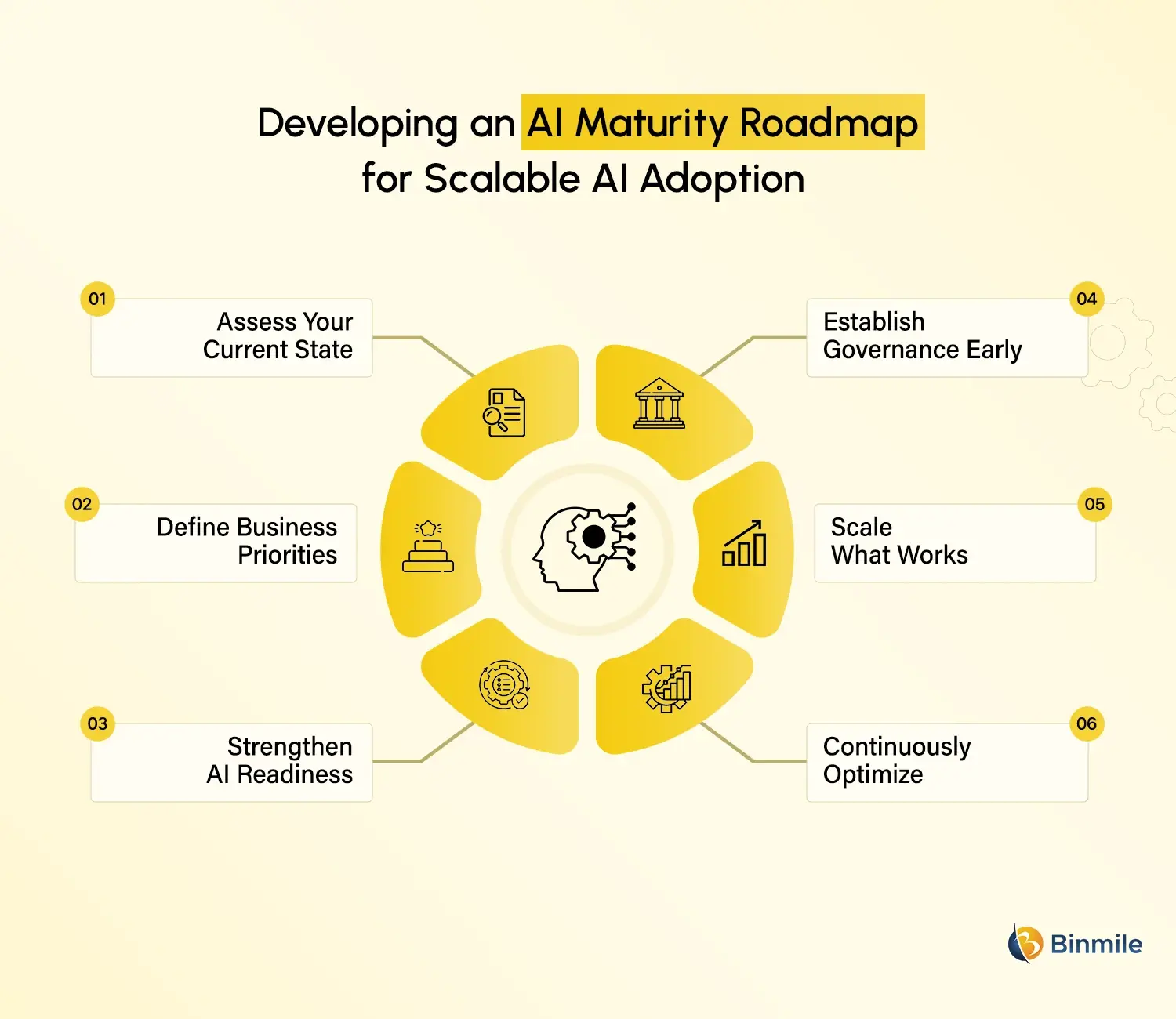
A practical roadmap typically includes the following stages:
-
Assess Your Current State
Begin with a comprehensive evaluation of existing AI initiatives, data quality, infrastructure, governance practices, and organizational capabilities. This establishes a baseline for future improvements and helps prioritize investments.
-
Define Business Priorities
Not every business problem requires AI. Organizations should identify high-impact opportunities where AI can improve operational efficiency, customer experience, revenue growth, or decision-making. Prioritizing business value over technology helps maintain focus and accelerate results.
-
Strengthen AI Readiness
Successful AI implementation depends on strong foundations. Improving AI Readiness may involve modernizing data platforms, integrating business systems, developing internal skills, and preparing employees for AI-enabled workflows.
-
Establish Governance Early
Governance should not be treated as an afterthought. Defining policies for data usage, model validation, compliance, security, and ethical AI early in the journey reduces risks as AI initiatives expand across the enterprise.
-
Scale What Works
Organizations should expand successful AI use cases into other business units using standardized architectures, reusable models, and common governance practices. This approach reduces implementation costs while increasing consistency across departments.
-
Continuously Optimize
AI maturity is not a destination. As business objectives evolve and new technologies emerge, organizations must continuously monitor performance, refine models, and improve governance to sustain long-term value.
The Role of AI Governance in Enterprise Maturity
As AI adoption grows, governance becomes one of the defining characteristics of mature organizations. Without proper oversight, AI can introduce risks related to compliance, privacy, bias, security, and accountability. An effective AI governance maturity model helps organizations establish the policies, controls, and processes required to deploy AI responsibly at scale.
Governance extends beyond regulatory compliance. It ensures that AI systems remain transparent, reliable, explainable, and aligned with business objectives throughout their lifecycle. Mature organizations continuously monitor model performance, detect bias, manage data quality, and maintain clear documentation for auditing and compliance purposes.
Another important aspect is Responsible AI. Business leaders increasingly recognize that customers, regulators, and stakeholders expect AI systems to be fair, secure, and trustworthy. Responsible AI includes ethical decision-making, human oversight, privacy protection, and continuous risk management. Organizations that invest in governance early are better positioned to scale AI confidently while maintaining customer trust and regulatory compliance.
Agentic AI Maturity Model: The Next Phase of Enterprise AI
Enterprise AI is evolving beyond predictive analytics and generative AI toward systems that can reason, plan, and execute tasks with greater autonomy. This shift has led to the Agentic AI Maturity Model, which helps organizations evaluate their readiness to adopt intelligent AI agents capable of collaborating with people and enterprise systems.
Unlike traditional AI applications that perform predefined tasks, agentic AI systems can make contextual decisions, coordinate workflows, and adapt to changing business needs. As organizations mature, they typically progress from AI Assistant Development to intelligent workflow automation, multi-agent collaboration, and autonomous enterprise operations with human oversight.
Achieving this level of maturity requires robust Enterprise AI Orchestration, ensuring AI models, business applications, and enterprise data work together securely while maintaining strong governance and control.
From AI readiness assessments to enterprise-wide implementation, build a strategy that supports innovation, governance, and long-term growth.

What Are the Common Challenges That Keep Organizations Stuck at Lower AI Maturity Levels
Many AI initiatives fail not because of technology limitations, but because organizations encounter barriers that prevent them from scaling successfully.
Some of the most common challenges include:
-
Poor Data Quality and Fragmented Systems
AI models are only as effective as the data they use. Inconsistent, incomplete, or siloed data limits accuracy and hinders enterprise-wide AI adoption.
-
Lack of Executive Sponsorship
Without clear leadership commitment, AI initiatives often remain departmental experiments rather than strategic business programs.
-
Unclear Business Value
Many organizations struggle to define success metrics and measure ROI, making it difficult to justify further AI investments.
-
Skills and Talent Gaps
A shortage of AI engineers, data scientists, and machine learning specialists can slow implementation and create dependence on external resources.
-
Legacy Infrastructure
Outdated systems and disconnected applications make it challenging to integrate AI into existing business processes at scale.
-
Weak Governance
Insufficient policies for data usage, compliance, security, and ethical AI increase operational and regulatory risks.
-
Organizational Resistance
Employees may hesitate to adopt AI-driven workflows if they lack training, confidence, or clarity about how AI will support their roles.
Addressing these barriers early helps organizations progress more quickly through the AI maturity curve and avoid costly delays during enterprise adoption.
What Are the Benefits of Reaching Higher AI Maturity
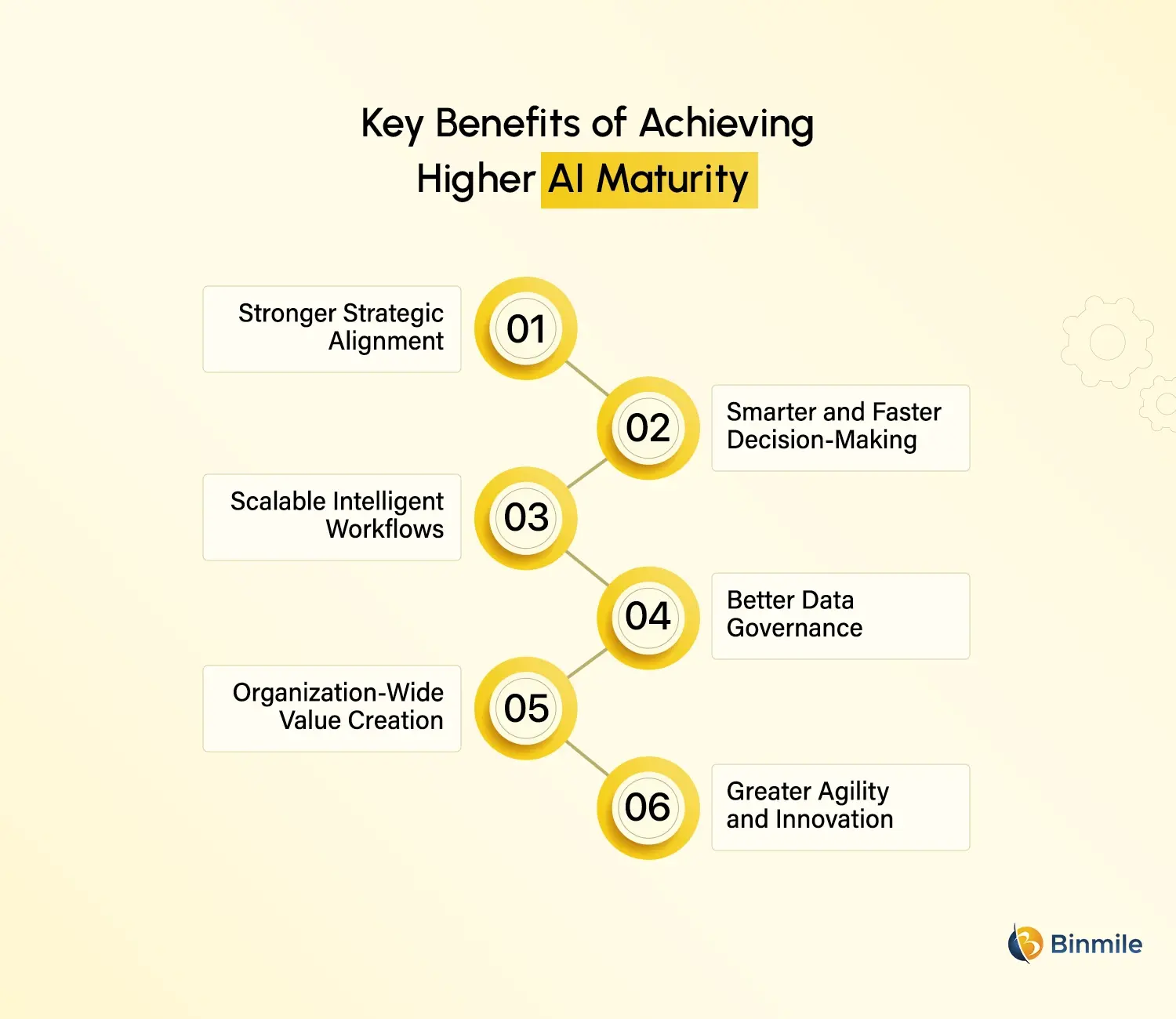
Organizations that advance through the AI maturity journey experience benefits that extend far beyond operational efficiency.
-
Stronger Strategic Alignment
AI initiatives become directly connected to business goals, ensuring investments support growth, efficiency, and competitive advantage.
-
Smarter and Faster Decision-Making
Leaders gain access to predictive insights and real-time intelligence, enabling quicker and more informed decisions across the organization.
-
Scalable Intelligent Workflows
AI moves beyond isolated automation and becomes part of connected, enterprise-wide processes that improve productivity and consistency.
-
Better Data Governance
Higher maturity levels establish standardized data management and governance practices, reducing risk while improving the quality of AI outcomes.
-
Organization-Wide Value Creation
Instead of delivering benefits to a single department, mature AI programs create measurable impact across operations, customer experience, finance, and strategic planning.
-
Greater Agility and Innovation
Organizations can respond faster to market changes, launch new AI-driven capabilities more efficiently, and continuously optimize business performance.
As AI becomes a core component of AI in Business Strategy, organizations move from short-term experimentation to sustainable transformation powered by the Applied AI Revolution.
When Should Businesses Work with an AI Technology Partner?
Building enterprise AI capabilities requires more than choosing the right tools. It involves aligning business strategy, governance, infrastructure, talent, and execution. Organizations should consider working with an experienced AI Development Company when AI pilot projects are not delivering measurable outcomes, enterprise-scale deployment becomes difficult, governance requirements continue to grow, or internal AI expertise is limited.
A trusted technology partner can help modernize legacy systems, design scalable AI architectures, implement governance frameworks, and accelerate deployment while reducing operational risks. For organizations looking to adopt AI without significant upfront infrastructure investment, Artificial Intelligence as a Service provides a flexible and cost-effective path to accessing advanced AI capabilities and scaling them as business needs evolve.
Discover where your organization stands on the AI maturity curve and build a roadmap that delivers measurable business outcomes.

Building AI Maturity That Delivers Long-Term Business Value with Binmile
Achieving AI maturity is not about deploying more AI tools. It is about creating an ecosystem where strategy, technology, governance, and business objectives work together to deliver measurable outcomes. Organizations that invest in structured assessments, scalable architectures, and responsible governance are better positioned to unlock sustainable value from AI while remaining adaptable to future advancements.
Binmile supports enterprises throughout this journey by helping them evaluate AI readiness, define practical AI maturity roadmaps, implement enterprise AI orchestration, develop intelligent AI assistants, and establish governance frameworks that support responsible growth. By combining deep engineering expertise with a business-first approach, Binmile enables organizations to move beyond isolated AI experiments and build scalable solutions that create long-term competitive advantage.
Frequently Asked Questions
An AI Maturity Model helps organizations evaluate how effectively they adopt, govern, and scale AI across the business. It identifies capability gaps, guides investment decisions, and provides a structured roadmap for achieving sustainable business value through AI.
Organizations can conduct an AI maturity assessment by evaluating strategy, data, technology, governance, talent, processes, culture, and business outcomes. Assessment frameworks and maturity tools help benchmark current capabilities and identify areas for improvement.
Most AI maturity models include five stages: Awareness, Experimentation, Operationalization, Enterprise Scale, and AI-Driven Enterprise. Each stage reflects increasing organizational capability, governance maturity, and business integration of artificial intelligence.
Common challenges include poor data quality, fragmented AI initiatives, lack of executive sponsorship, governance gaps, legacy infrastructure, skills shortages, unclear ROI, and resistance to organizational change, all of which can slow enterprise-wide AI adoption.
An AI Maturity Model helps organizations prioritize investments, strengthen governance, improve operational efficiency, scale successful AI initiatives, reduce implementation risks, and align AI capabilities with long-term business strategy and measurable business objectives.
Businesses should engage an AI technology partner when they need help scaling AI initiatives, modernizing infrastructure, implementing governance, developing custom AI solutions, or creating a strategic roadmap that accelerates enterprise-wide AI adoption.