AI readiness refers to an organization’s ability to adopt, deploy, and scale artificial intelligence effectively. It is not limited to having AI tools or hiring data scientists. True artificial intelligence readiness is a combination of strategic clarity, data maturity, technology readiness, and organizational alignment.
According to McKinsey’s State of AI report, 88 percent of organizations now use AI in at least one business function, highlighting that AI adoption has moved beyond experimentation and into mainstream enterprise operations. The study also highlights that a lack of readiness across data, technology, and people is the biggest barrier to AI success.
This insight sets the stage for an important conversation. AI is no longer about experimentation or future roadmaps. It is about preparedness. In this blog, we explore what AI readiness truly means, how it influences enterprise growth, the role of data readiness, frameworks and assessments that matter, and how enterprises can turn readiness into measurable business impact.
Why AI Readiness is a Growth Multiplier for Enterprises
AI readiness directly impacts how quickly and effectively enterprises can grow. Organizations that are prepared do not just adopt AI faster. They extract value faster and at scale.
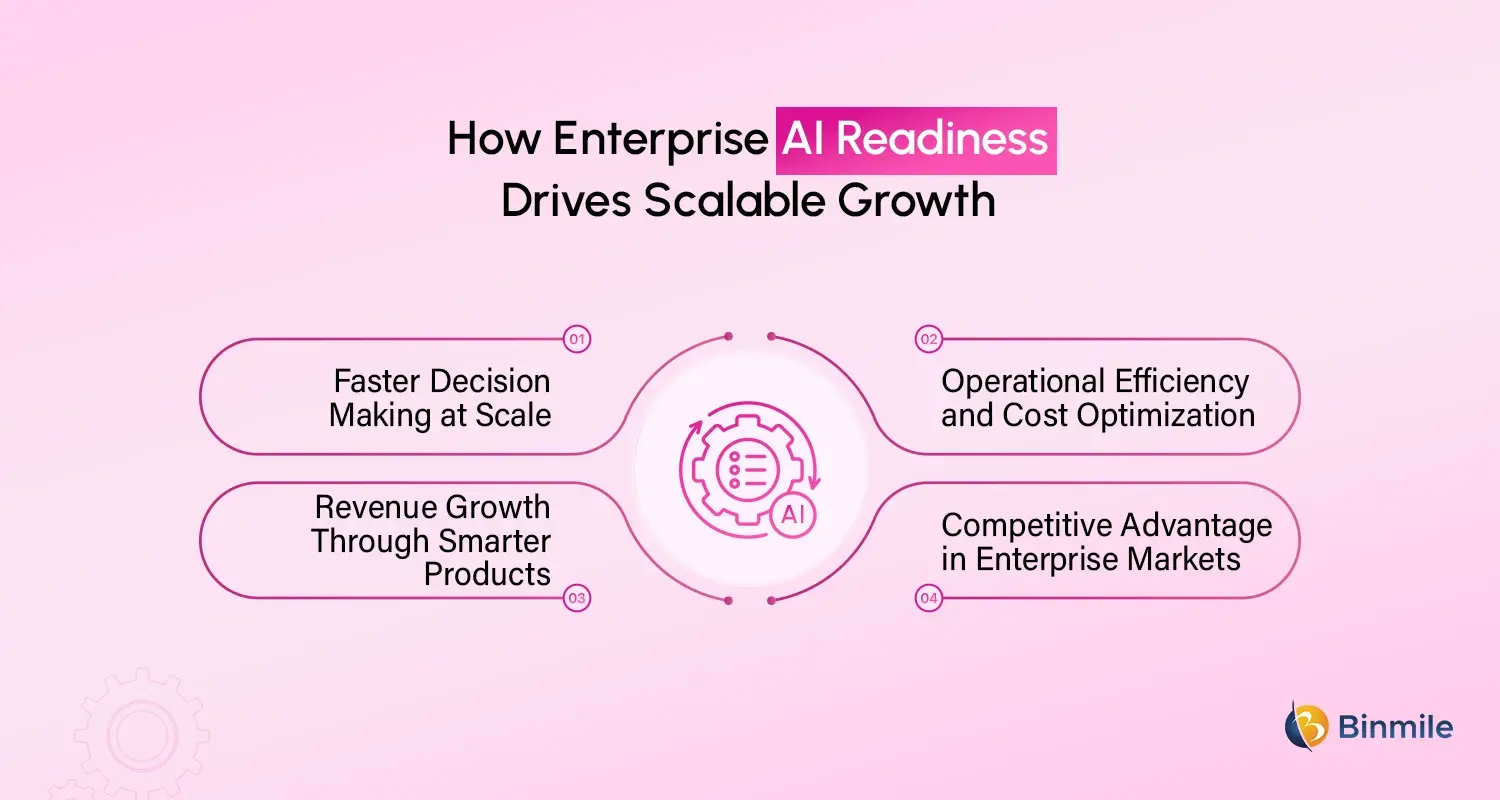
Here is how AI readiness influences enterprise growth in practical terms.
-
Faster Decision Making at Scale
Enterprises that use AI have data-driven frameworks. Decision-makers have up-to-the-minute insights on operations, consumer data, and AI business trends. This speeds up cross-functional decision-making.
-
Operational Efficiency and Cost Optimization
With AI comes the readiness for function-wide automation in areas like IT, customer support, and finance. Moreover, enterprises that use AI in software testing improve quality, decrease defects, and reduce turnaround time.
-
Revenue Growth Through Smarter Products
Enterprises that possess significant readiness for AI transformation infuse intelligence into their services and products. Generative AI in product development accelerates and enhances the innovation process by adding personalization and optimizing user experience.
-
Competitive Advantage in Enterprise Markets
Organizations that have grasped business AI readiness tend to outperform their rivals, especially those still battling with data gaps, outdated systems, and piecemeal AI approaches.
What is the AI Readiness Framework for Enterprises
An AI readiness framework helps enterprises evaluate their preparedness across multiple dimensions. It brings structure to what is otherwise a complex transformation.
Below is a simplified artificial intelligence readiness model commonly used by enterprises.
| Readiness Dimension | What It Covers | Enterprise Impact |
|---|---|---|
| Strategy | AI vision, use cases, ROI alignment | Clear growth direction |
| Data Readiness | Data quality, integration, governance | Reliable AI outcomes |
| Technology Readiness | Infrastructure, cloud, tools | Scalability and performance |
| Organization AI Readiness | Skills, culture, leadership | Faster adoption |
| Governance | Ethics, compliance, risk | Sustainable AI deployment |
This artificial intelligence readiness model ensures AI investments align with long-term enterprise goals rather than short-term experimentation.
What are the Steps to Improve AI Readiness in Enterprises
Improving AI readiness is a structured journey, not a one-time initiative. Enterprises that see real growth from AI follow a clear sequence of steps that strengthen foundations before scaling advanced capabilities.
1. Define Clear Business-Driven AI Objectives
AI Building tactics always start with achieving the business’s objectives and achieving the goals set by the business. AI use cases must align operational efficiency, customer experience, and innovation speed to measure the results after achieving the objectives. This strategy must direct AI investment to aid in tackling genuine challenges and avoid constructing peripheral projects.
2. Strengthen Data Readiness Across the Organization
The difference in the success and failure of AI programs hinges on data readiness. Enterprises must focus on improving the quality, consistency, and availability of data. This focuses on the removal of silos, the standardization of data structure, and the outline of governance to sustain reliable AI data readiness across teams.
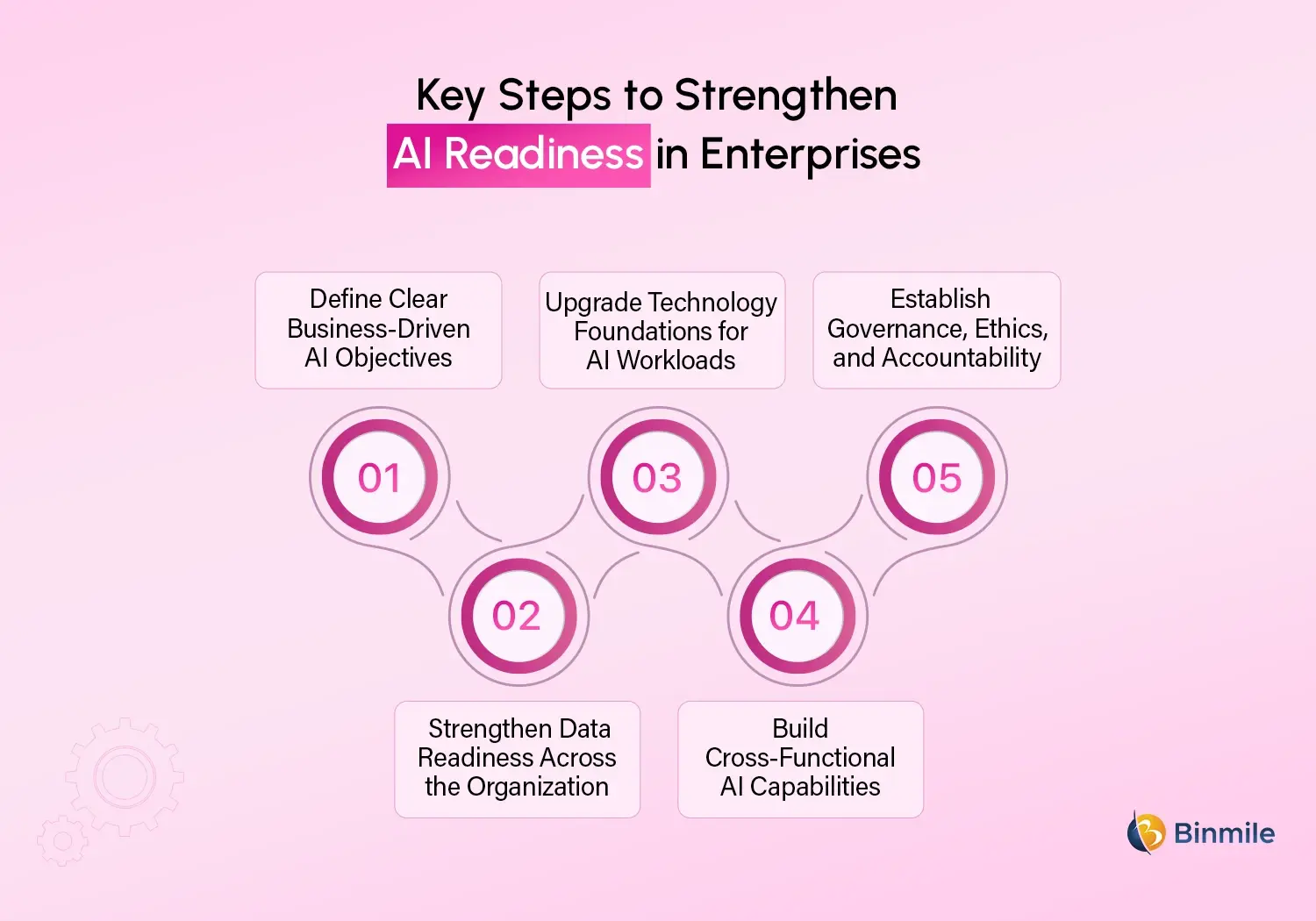
3. Upgrade Technology Foundations for AI Workloads
Systems may limit the scalability of the AI. Improvements to AI readiness evaluation will require the modernization of infrastructure to support large data sets, real-time processing, and model deployment. Cloud and hybrid ecosystems will be instrumental in supporting enterprise-grade AI use cases without making trade-offs on security or performance.
4. Build Cross-Functional AI Capabilities
AI readiness is not exclusive to the technical parts. Business leaders, domain experts, and operations teams are also instrumental in understanding the workflows of AI. Upskilling programs and collaborative processes help bridge the gap between AI development and real-world application.
5. Establish Governance, Ethics, and Accountability
As AI adoption increases, governance becomes essential. Clear ownership, ethical guidelines, and compliance frameworks reduce risk and build trust. Enterprises with strong AI governance are better positioned to scale AI responsibly and sustainably.
Technology Readiness and Enterprise AI Infrastructure
Technology readiness plays a critical role in AI scalability. Legacy systems often become the biggest bottleneck in enterprise AI adoption.
AI-ready enterprises invest in:
-
Cloud-Native and Hybrid Infrastructure
Cloud-native and hybrid environments empower enterprises with the flexibility to scale AI workloads. These configurations enable organizations to meet performance and cost control tradeoffs while remaining within the bounds of regulation. Moreover, they align with enterprise security and availability.
-
Scalable Data Platforms
Modern data platforms form the backbone of AI readiness. They are more accurate when focused on centralized data lakes, real-time pipelines, and analytics. These architectures facilitate access to AI models with data that is up-to-date and highly relevant. When organizations achieve this level of data preparedness, they can expect improved performance and consistency across various use cases.
-
Secure APIs and Integration Layers
Multiple systems working in tandem is the standard for enterprises. Secure APIs and integration layers provide AI solutions the ability to integrate with existing systems in a way that keeps business operations uninterrupted. With this model, AI insights can seamlessly integrate with operational systems to drive decisions.
-
Enterprise AI Orchestration Tools
Automation of enterprise processes is achieved by embedding intelligence through the use of AI orchestration tools to streamline complex workflows across models, data, and business applications. These tools make decisions, monitor, and act on processes. With technology stacks, such as ServiceNow Agentic AI, enterprises are increasingly capable of embedding AI as part of everyday workflows instead of as separate, stand-alone tools.
Technology readiness ensures that AI solutions perform reliably under real-world enterprise workloads.
Explore how strategic AI readiness can optimize operations, improve decision-making, and future-proof your business.
AI Readiness Strategies That Drive Measurable Growth
Enterprises that succeed with AI follow structured AI readiness strategies rather than ad hoc experimentation.
Some proven strategies include:
-
Align AI With Core Business Functions
AI proves its worth best when integrated directly into business functions such as operations, customer experience, risk management, and product innovation. AI initiatives in such functions are likely to deliver value sooner and drive greater ROI.
-
Build Data Readiness Before Model Complexity
No amount of sophistication in AI Models will lead to better results if anchored on weak data. Companies that focus on data in their AI system design are rewarded with better performance, even on less complex models. Greater data quality establishes a strong baseline for future advancements.
-
Start With Scalable Use Cases
AI integration for startups may have a limited scope, but large enterprises must focus on gradual scalability. Use cases must be designed to be repeatable across multiple teams and flexible enough to serve different business units with little to no reengineering.
-
Measure and Iterate
AI readiness will be dynamic and ever-changing. The best way for companies to refine their approach to optimal AI utilization is to continually assess performance, adoption, and business results. This will keep enterprises aligned to evolving tech and market demands.
AI Transformation Readiness Across Business Functions
AI transformation readiness is not uniform across the enterprise. Some functions progress faster due to clearer use cases, structured processes, and higher data maturity.
For example, AI in software testing often sees quick adoption because testing data is structured and outcomes are measurable. This leads to faster release cycles and improved product stability.
Similarly, improving data quality in AI initiatives strengthens analytics and forecasting across finance, sales, and operations. Better data readiness translates into more accurate predictions and confident decision-making.
Artificial Intelligence as a Service further accelerates readiness by allowing teams to experiment without heavy infrastructure investments. It lowers entry barriers while enabling faster validation of AI-driven ideas.
When AI transformation readiness improves across multiple functions, enterprises benefit from compounding growth effects, where improvements in one area enhance performance across others.
What are the Common Barriers to Enterprise AI Readiness
Despite strong intent, many enterprises struggle with readiness due to:
-
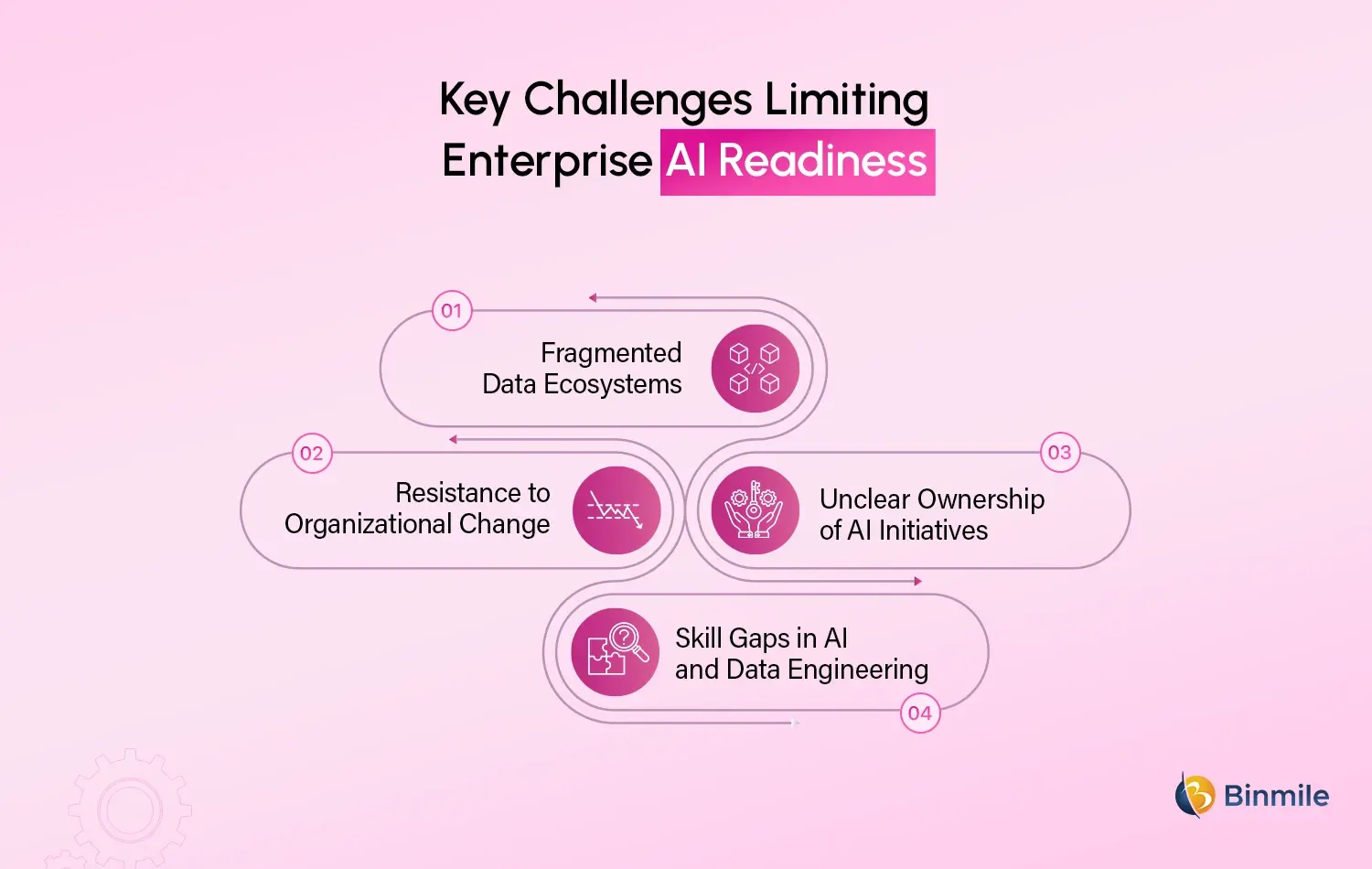
Fragmented Data Ecosystems
Dispersed data makes reliable, repeatable data readiness for AI unattainable. Absent consistent integration and data governance, AI models are left untrained and provided stale information.
-
Resistance to Organizational Change
Shifted workflows and altered decision-making frameworks are byproducts of AI adoption. Even with technology in place, team resistance can bottleneck the adoption rate and diminish its value.
-
Unclear Ownership of AI Initiatives
When no one owns AI initiatives, the loss of managerial attention causes further project dilution. With sufficient ownership and accountability, AI initiatives can be more closely aligned with the desired business outcomes.
-
Skill Gaps in AI and Data Engineering
Inadequate, accessible, and skilled AI resources are the primary reasons for increased reliance on external resources and prolonged project timelines. Developing and sustaining internal talent is critical to achieving AI readiness.
By recognizing and addressing these barriers, enterprises create a stronger foundation for scalable and sustainable AI growth.
Ready to turn AI readiness into real enterprise growth? Assess your AI maturity and build scalable, data-driven solutions.
How Binmile Supports Enterprise AI Readiness and Growth
Enterprises navigating AI readiness often need a partner that understands both technology and business impact. Binmile works closely with organizations to strengthen AI data readiness, modernize technology foundations, and design scalable AI solutions aligned with growth objectives.
By focusing on real-world use cases such as enterprise AI orchestration, AI-driven quality assurance, and Gen AI in product development, Binmile helps businesses move from readiness assessment to measurable outcomes. The emphasis remains on building reliable data pipelines, future-ready architectures, and AI systems that integrate seamlessly into enterprise workflows, enabling long-term growth rather than short-lived innovation cycles.
Frequently Asked Questions
AI readiness is how prepared a business is to use artificial intelligence effectively. It includes data quality, technology infrastructure, skilled teams, and clear business goals that allow AI to deliver real value.
Data readiness ensures AI systems learn from accurate and reliable information. Without clean and well-structured data, AI models produce poor results, leading to incorrect insights and business risks.
Enterprises conduct an AI readiness assessment by evaluating strategy alignment, data readiness, technology readiness, organizational capability, and governance practices across the business.
Technology readiness ensures systems can support AI workloads at scale. Cloud infrastructure, integration layers, and secure platforms are essential for reliable and scalable AI deployment.
Yes. Enterprises with high AI readiness adopt AI faster, improve efficiency, innovate smarter products, and make better decisions, all of which contribute directly to revenue growth.