Running a business profitably is no less of a challenge these days, given the cut-throat competition entrepreneurs are experiencing in almost every industry. They often need help with issues like data overload, conflicting decision-making, resource allocation inefficiencies, and the necessity for real-time insights. These pain points can slow down progress, hamper efficiency, and affect the overall success of an organization.
However, you must know that the integration of cutting-edge technologies, such as AI industry trends, can minimize these plights and take businesses to the next level of innovation and excellence. Take, for instance, Generative AI. It has grown from a futuristic idea to a key business strategy, transforming industries with its practical applications while boosting efficiency and consumer engagement. In this blog, we will discuss major industries using AI and reaping considerable benefits while holding huge potential for future growth. Let’s commence with:
Role of AI Business Trends in Operations
A well-known computer scientist in the USA, John McCarthy, coined the term “Artificial Intelligence” in 1956. He defines AI as the “science and engineering of making intelligent systems.” Artificial Intelligence is the potential of a computer-powered robot to perform tasks that are usually done by intelligent beings, also known as human beings. Resultantly, AI shows powerful abilities, like the ability to reason, find meaning, and learn from every interaction. AI in the business world has introduced many changes, such as automating tasks, analyzing data, and improving decision-making to transform business operations.
By optimizing supply chains, predicting maintenance needs, and providing personalized buyer experiences, Artificial Intelligence helps augment operational efficiency. It plays a crucial role in data-backed decision support, talent acquisition, cybersecurity, and encouraging innovative developments in AI across a wide range of industries. The continuous learning capability of this state-of-the-art technology ensures adaptability to changing business environments, strengthening its role in accomplishing increased productivity, cost savings, and a competitive edge for establishments navigating the complexities of the modern business ecosystem, while also optimizing AI app development costs.
“Over the next three years, 85% of executives say AI will enable business model innovation and 89% say it will drive product and service innovation.” – IBM
The implementation of AI business trends in various industries indicates its versatility, empowering personalized experiences in retail, advanced analytics in healthcare, and predictive maintenance in manufacturing. This is the reason, according to an India & U.S.-based market research and consulting company, the global AI market is growing. This market is predicted to reach USD 279.22 billion in 2024 and will generate USD 1,811.75 billion in revenue by the end of 2030.
Key Industries Implementing AI Business Trends
These are the key industries that are implementing AI Business trends in their day-to-day operations.
1. Retail
In 2027, you will see retailers focusing on areas such as customer service, marketing, and digital commerce, using GenAI agents to improve current human potential and skills. Customer service centers are utilizing AI-first tools that can automate call transcription, produce smart replies, and reply to common queries from buyers. In the marketing department, teams are incorporating GenAI technology to create briefs, brainstorm campaign ideas, and generate personalized brand content at a larger scale. You will also see these abilities coming together in AI-driven customer experiences, supporting personal shopping advisors, developing new product content, and designing engaging, human-like conversational interfaces to take online shopping experiences to the next level.
2. Healthcare
Since the healthcare industry has experienced an extremely challenging regulatory landscape in the past, most medical institutions are embarking on their GenAI journeys by managing use cases that increase productivity and efficiency. GenAI models are suitable for helping with repeated tasks, like appointment scheduling or processing patient intake forms, creating a wealth of opportunities to minimize the administrative workload on medical practitioners.
Among medical institutions, the best use cases offering short-term value are those that expedite clinical operations. For example, GenAI business trends are being employed to streamline back-office tasks, including but not limited to:
- Clinical documentation
- Member and provider communications
- Claims processing
Just so you know, AI-powered agents can deliver round-the-clock support to answer coverage questions, eligibility queries, or claim statuses. You will also see medical service providers in 2027 investing considerably in leveraging GenAI tools to produce more targeted, customized marketing outreach, from forthright explanations and visuals for medical jargon to coding terminology that is seen in health insurance plans.
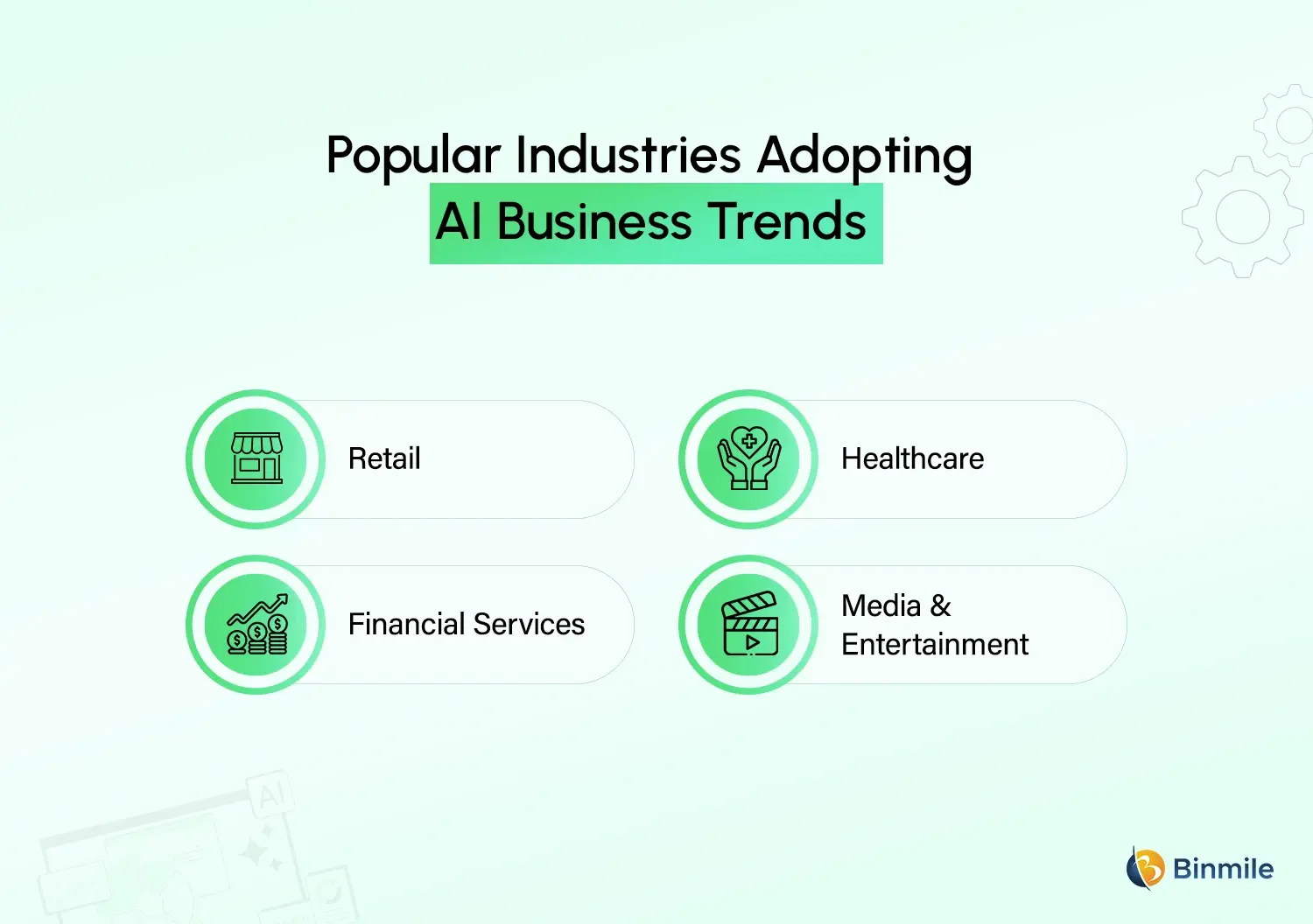
3. Financial Services
Most businesses have achieved early success by making the most of GenAI trends to deliver increased productivity. This entails adopting AI agents and AI-driven search to provide quicker and more precise responses to patron inquiries, speed up incident response by identifying critical fraud alerts faster, and enable professionals to work swifter, smarter, and in a more effective manner. Instead of trying to replace a function on a very large scale, many financial service providers are exploring use cases that offer incremental productivity enhancements and allow current resources to achieve more.
In the long run, experts believe that GenAI trends in business will crop up as a key building block to create products and services that can render financial suggestions and guidance, customized for consumers. As financial organizations have increasingly shifted towards a self-service system, they have grappled with attaining the same volume of sales and levels of customization previously feasible when catering to shoppers in person. Here, GenAI demonstrates great promise for revolutionizing customer experiences online, making it effortless for them to handle accounts and navigate more complicated riddles, such as planning for retirement or choosing a mortgage loan to buy a property.
“While 77% of executives say they need to adopt GenAI quickly to keep up with competitors—only 25% strongly agree that their organization’s IT infrastructure can support scaling AI across the enterprise.” – IBM
4. Media & Entertainment
The paramount use cases in the media and entertainment industry right now focus on embracing point solutions to boost organizational productivity using search, AI agents, and audience personalization. A case in point is that we see enterprises integrating GenAI to automate repeated consumer service tasks for billing purposes, hasten back-office procedures, offer better access to data across organizations, introduce operational and cost efficiencies for marketing, and streamline software creation workflows. Generative AI business trends are also making it simpler to provide more personalized audience experiences through multimodal suggestions and search, and helping with particular content localization jobs, like:
- Dubbing
- Generating captions
- Producing subtitles & audio descriptions
In the future, media and entertainment companies are likely to adopt more advanced generative AI solutions. These solutions can optimize the entire content production workflow. Early adoption already spans tasks such as script analysis, media archive search, and content understanding. It also supports content moderation and monetization efforts.
Emerging applications are further integrating generative AI startup ideas and AI startup concepts into existing workflows. These innovations help organizations improve efficiency, streamline operations, and unlock new creative opportunities.
- Storyboarding
- Post-production processes
- Media rendering
If you are unfamiliar with the term “point solution,” it refers to a specialized technology or business offering. It can be a tool, product, or software designed to solve a specific organizational challenge. Point solutions focus on addressing one particular issue rather than serving multiple business functions.
Step into the future of AI! Explore how industries are adopting transformative trends and let us help you innovate with our expert AI development services!

8 Steps to Implement AI Industry Trends in Business Operations
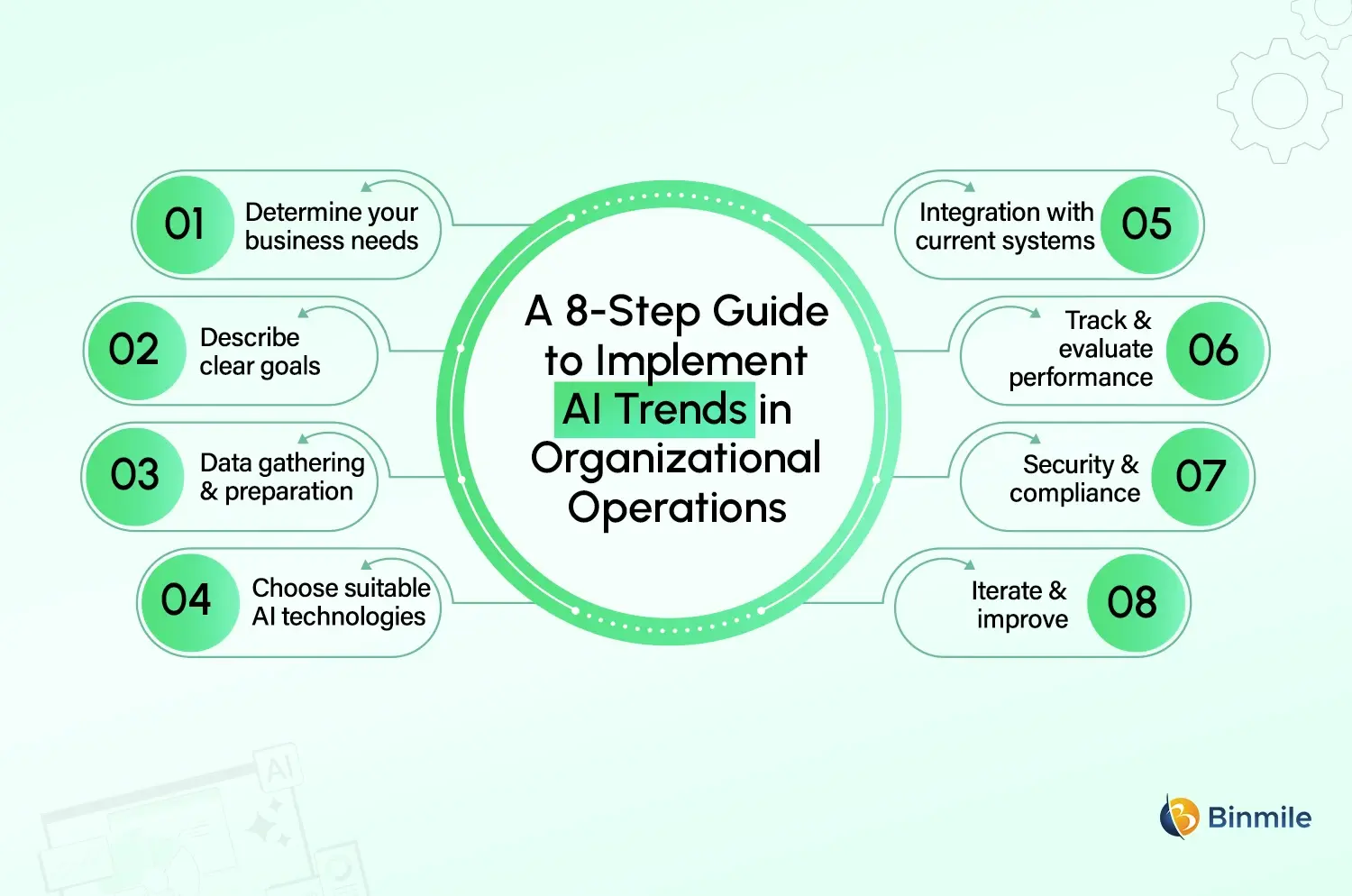
Implementing AI industry trends in business operations requires following certain steps to achieve the perfect integration. Below, you can check out a guide to help you navigate the process:
-
Determine Your Business Needs
Discover specific aspects of your business operations where Artificial Intelligence can add value. This may include customer service, data analysis, decision-making, and process automation.
-
Describe Clear Goals
Clearly define the objectives you want to attain through the implementation of AI business trends. Be it enhancing efficiency, mitigating costs, or improving buyer experiences, being ready with crystal-clear goals will guide your AI strategy.
-
Data Gathering and Preparation
AI systems need a massive amount of quality data for training purposes. Make sure that your data is precise, relevant, and carefully labeled. Do note that data preparation is a significant step in ensuring the success of AI trend implementation.
-
Choose Suitable AI Technologies
Pick the right AI technology based on your organizational needs. This includes ML, NLP, computer vision, or a combination of all. Either build GenAI solutions or rely on pre-built solutions; you can consider both.
-
Integration With Current Systems
Make sure that your AI solution integrates smoothly with your current systems and workflows. This may require working with the executives of your IT department to create connections and secure compatibility.
-
Track and Evaluate Performance
Incorporate monitoring tools to check the performance of your AI systems. Regularly assess the results of AI as a Service against your defined goals and make changes as required.
-
Security and Compliance
Make data security your top priority and ensure compliance with mandatory regulations. Just so you know, AI models often manage sensitive information, and it is important to maintain the highest level of security and privacy. If you wish to make your AI systems highly secure, you can also hire an AI developer.
-
Iterate and Improve
There is no denying the fact that AI is a progressing field. Therefore, it is advised to evaluate your system’s performance after the implementation of AI industry trends, collect users’ responses, and be ready to iterate and optimize your implementation down the line.
Why Partner with Binmile for AI App Development?
Binmile, a prominent AI development company, precisely creates the whole AI strategy for GenAI model development. With multiple locations across the USA, UK, Indonesia, and UAE, Binmile is recognized as one of the top AI development companies in India. The process begins with holistically gauging project needs and ensuring an in-depth understanding of stakeholder expectations. Our tried-and-tested approach covers model selection, training methodologies, and resource allocation, followed by strategic design, development, thorough testing, and continuous optimization. The concluding stage includes proper integration into the client’s ecosystem, backed by ongoing assistance to adapt to changing needs. The team at Binmile has expertise in offering well-thought-out guidance for AI implementation, eliminating unique challenges, and building customized solutions that improve operational efficiency.
Want to stay ahead in the AI revolution? Explore how top industries are embracing AI trends and shaping the future business landscape with Binmile!
Conclusion
Frequently Asked Questions
Industries such as healthcare, banking and financial services, retail, manufacturing, logistics, and telecommunications are leading AI adoption. These sectors leverage AI for automation, predictive analytics, customer personalization, fraud detection, and operational efficiency. Organizations that adopt AI strategically gain a competitive advantage through faster decision-making and improved customer experiences.
AI business trends help enterprises identify new opportunities to automate workflows, optimize costs, improve customer experiences, and make data-driven decisions. Keeping pace with emerging AI technologies enables businesses to remain competitive while creating scalable, future-ready operations.
Common challenges include poor data quality, legacy infrastructure, unclear AI strategies, integration complexities, governance concerns, and talent shortages. Partnering with an experienced AI consulting and development company like Binmile helps organizations overcome these barriers with tailored AI strategies, scalable architectures, and seamless implementation.
Organizations should prioritize AI initiatives based on measurable business outcomes, operational bottlenecks, customer needs, and return on investment. A structured AI assessment helps identify high-impact use cases that align with business goals and deliver long-term value instead of isolated proof-of-concept projects.
Binmile helps enterprises accelerate AI adoption through strategic consulting, custom AI solution development, legacy system modernization, data engineering, AI integration, and MLOps implementation. By aligning AI initiatives with business objectives, Binmile enables organizations to deploy secure, scalable, and ROI-driven AI solutions that support sustainable digital transformation.