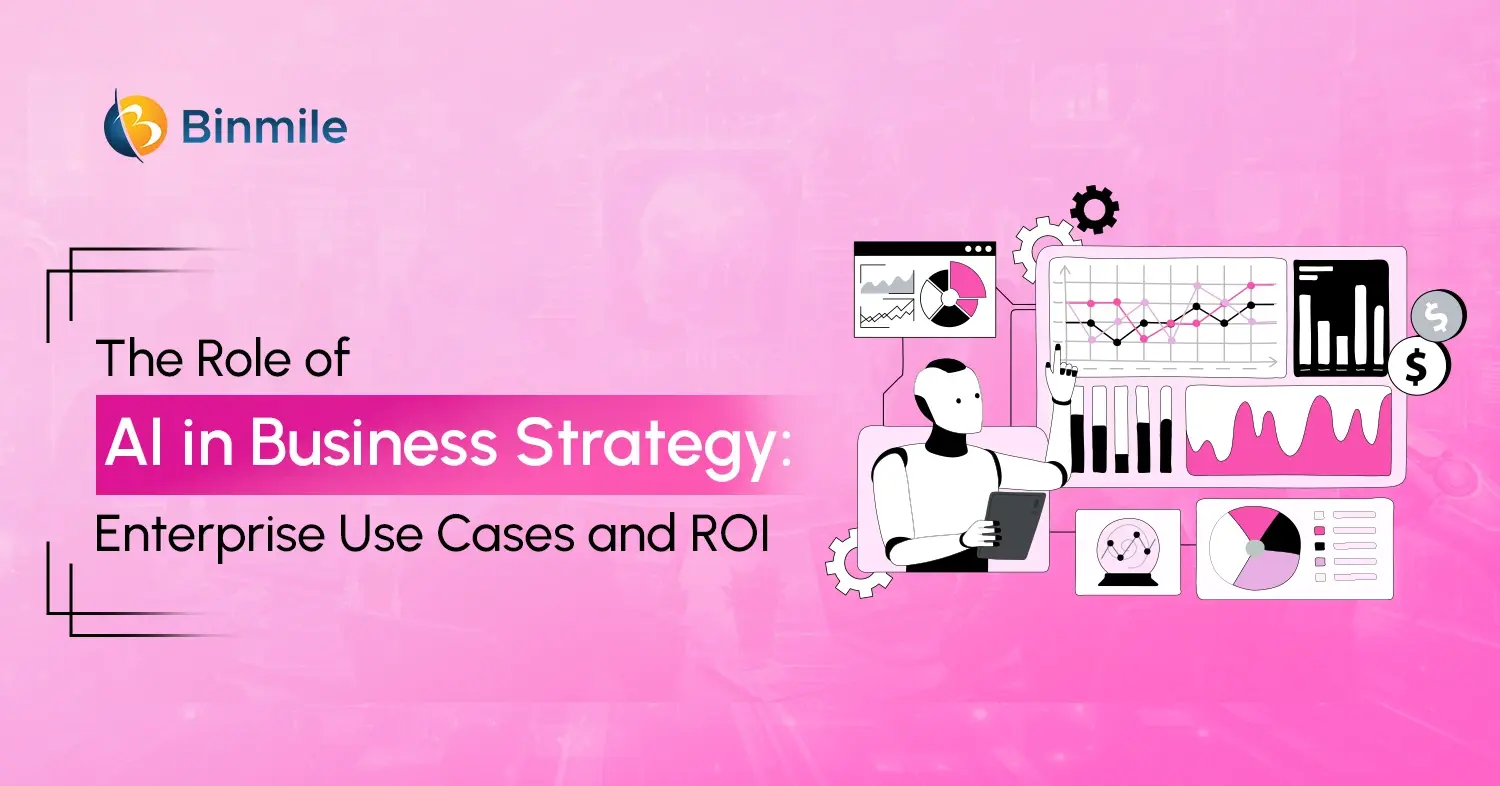
Most enterprises are not struggling to adopt AI. They are struggling to make it matter. AI tools are being added across departments, dashboards are getting smarter, automation is increasing, yet the core business strategy often remains unchanged. Decisions are still slow, reactive, and dependent on backward-looking reports. That is exactly where the gap lies. According to McKinsey, companies that embed AI deeply into their operations and strategy outperform competitors in both profitability and efficiency.
The real advantage does not come from using AI. It comes from building an AI business strategy where intelligence drives decisions, not just supports them. In this blog, we will break down how AI in business strategy actually works at an enterprise level, what changes when it is implemented correctly, where it delivers real value, and how organizations can measure ROI without guesswork.
What AI in Business Strategy Actually Means
Most businesses think AI in business means using tools for automation or analytics. That is only the surface. AI in business strategy is about embedding intelligence into how decisions are made, how priorities are set, and how the business evolves. It shifts strategy from being static and periodic to dynamic and continuously improving.
Instead of relying only on historical performance, enterprises start using predictive and real-time insights to guide business strategy development. This is what makes AI strategies fundamentally different from traditional planning approaches. When done right, AI does not sit as a separate layer. It becomes the backbone of strategic thinking.
What Actually Changes When Enterprises Adopt an AI Strategy for Business
When companies move from experimenting with AI to building a structured AI strategy for business, three deep shifts happen.
-
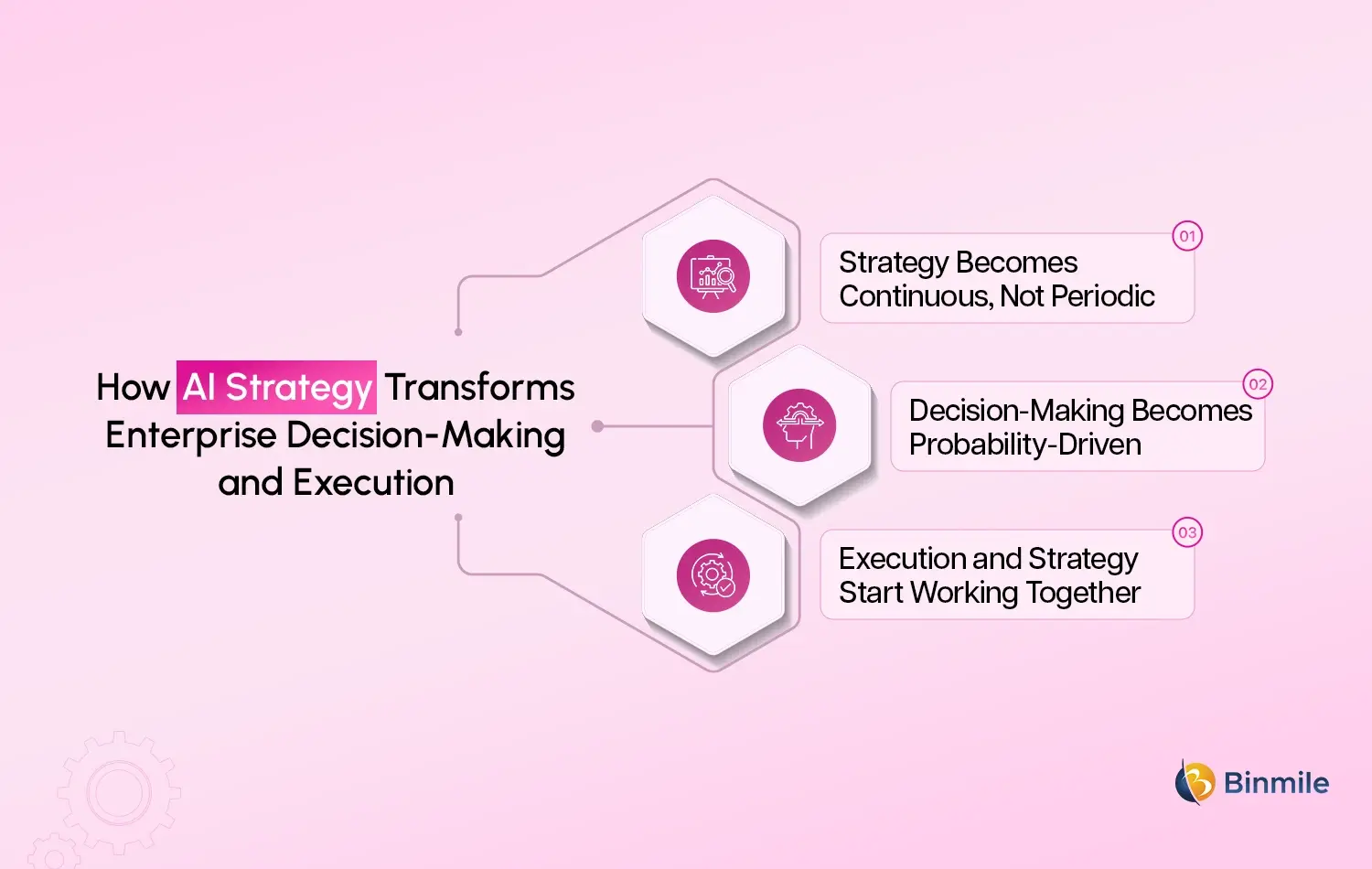
Strategy Becomes Continuous, Not Periodic
Strategy typically follows periodic cycles. Quarterly reviews, yearly planning, and fixed targets represent these cycles. What the advent of AI does is remove this cycle rigidity through continuous data inputs and continuous prediction modeling, resulting in an evolving strategic process. Rather than asking, “What should we do for the next quarter,” organizations will now be able to ask, “What do current data inputs say we should do?” This transformation is what defines the use of AI in modern strategic management.
-
Decision-Making Becomes Probability-Driven
Leaders have always employed intuition in their decision-making processes. While AI does not take away from using intuition, it enhances the use of intuition by providing data-driven probabilities. Rather than simply relying on assumptions about the future of their business, business leaders should be able to rely on AI models to analyze significant numbers of both past and current business patterns and their associated risks and opportunities to better characterize the inherent uncertainty associated with their strategic choices, and thereby facilitate better quality strategic choices. This is one of the primary benefits of AI-enhanced strategic management and competitive positioning for organizations.
-
Execution and Strategy Start Working Together
One of the greatest limitations of conventional business strategies is the disconnect between their development and execution. AI will act as a bridge to connect developed strategies to their actual execution using real-time performance metrics through AI-based automated processes, and then continuously re-optimize executed strategies using continuous performance metrics. This means that organizations not only execute their strategies, but also improve those strategies even while they execute them. This characteristic of using AI to execute and develop strategies will be fundamentally different from traditional approaches to business strategy execution and development.
What Are the Key Areas Where AI in Business Strategy Creates Real Value
Not every AI initiative delivers impact. The value comes from applying AI in the right strategic areas.
-
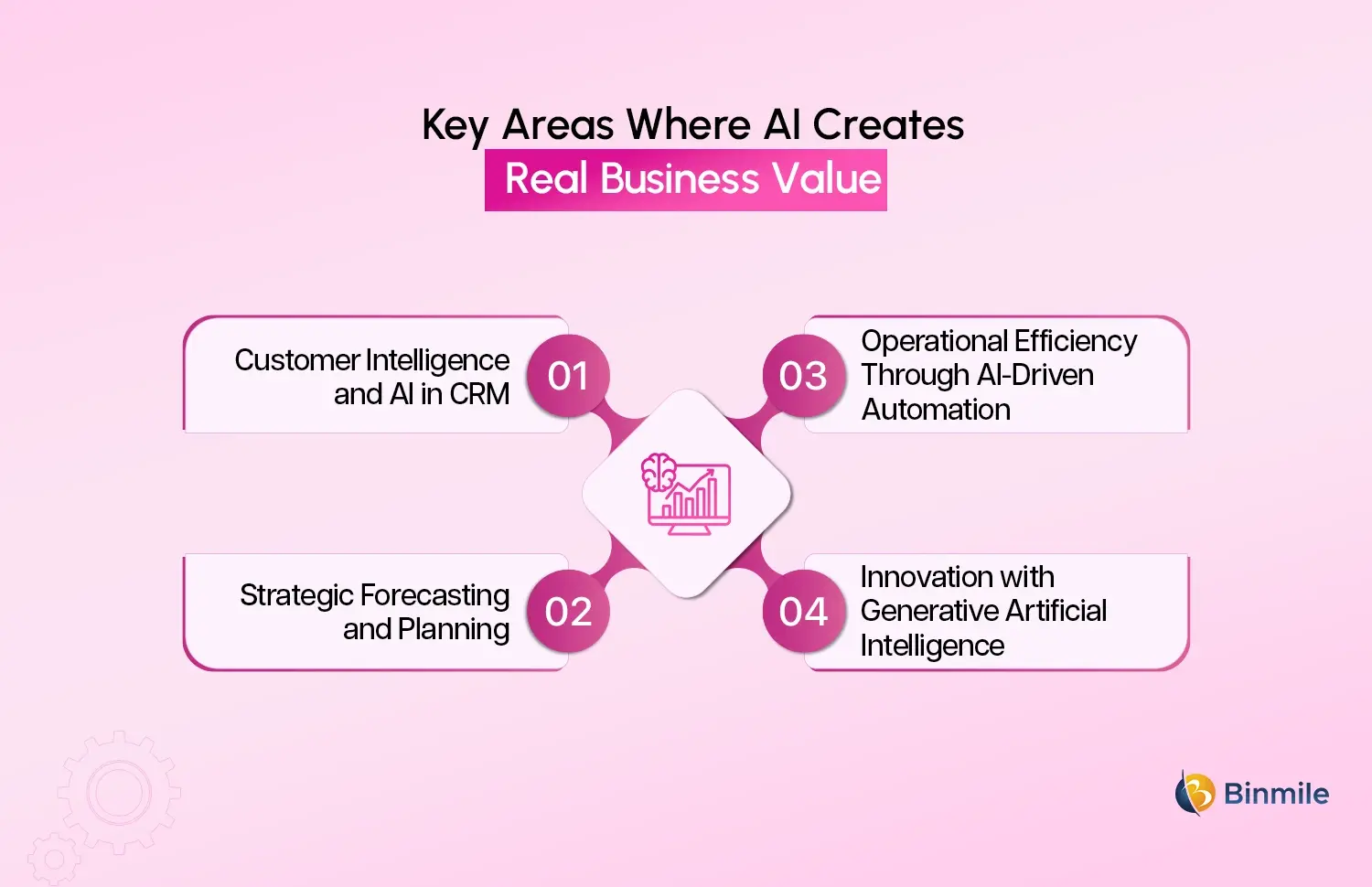
Customer Intelligence and AI in CRM
AI in CRM systems helps enterprises understand customers better than before, not just tracking behaviors, but predicting preferences, and allowing enterprises to provide personalized interactions in much larger volumes than ever. This helps to improve overall conversion rates, retention, and lifetime value. Instead of targeting customers broadly, businesses are using precision-based targeting for engagements.
-
Strategic Forecasting and Planning
AI models evaluate a variety of historical data, current market trends, and other external signals to help forecast what is to come. By analyzing all this data, enterprises are able to estimate future demand, adjust their pricing models accordingly, and identify growth opportunities early through forecasting. Forecasting is becoming less of an exercise of estimating and more about providing companies with a calculated probability of future demand.
-
Operational Efficiency Through AI-Driven Automation
AI-driven automation is helping to eliminate repetitive tasks and streamline processes. The greatest impact of AI-driven automation is that it provides the ability for enterprises to redeploy resources on high-dollar activities, thereby reducing operational friction and giving them the opportunity to scale up without successively increasing their cost structure. This supports long-term growth initiatives directly.
-
Innovation with Generative Artificial Intelligence
Generative AI is allowing businesses to innovate in ways previously unimaginable. Businesses can create content at much faster rates, produce prototypes in much quicker periods of time, and generate new ideas at scale. With generative AI, enterprises can shorten their cycles for innovation and test more ideas than ever with limited cost increases.
Want to integrate AI into your core business decisions, not just operations? Let’s design a practical AI roadmap that delivers efficiency, innovation, and ROI at scale.

AI Strategy Implementation: What Actually Works in Enterprises
Most AI strategies fail not because of technology, but because of poor execution. A practical approach to AI strategy implementation looks like this:
-
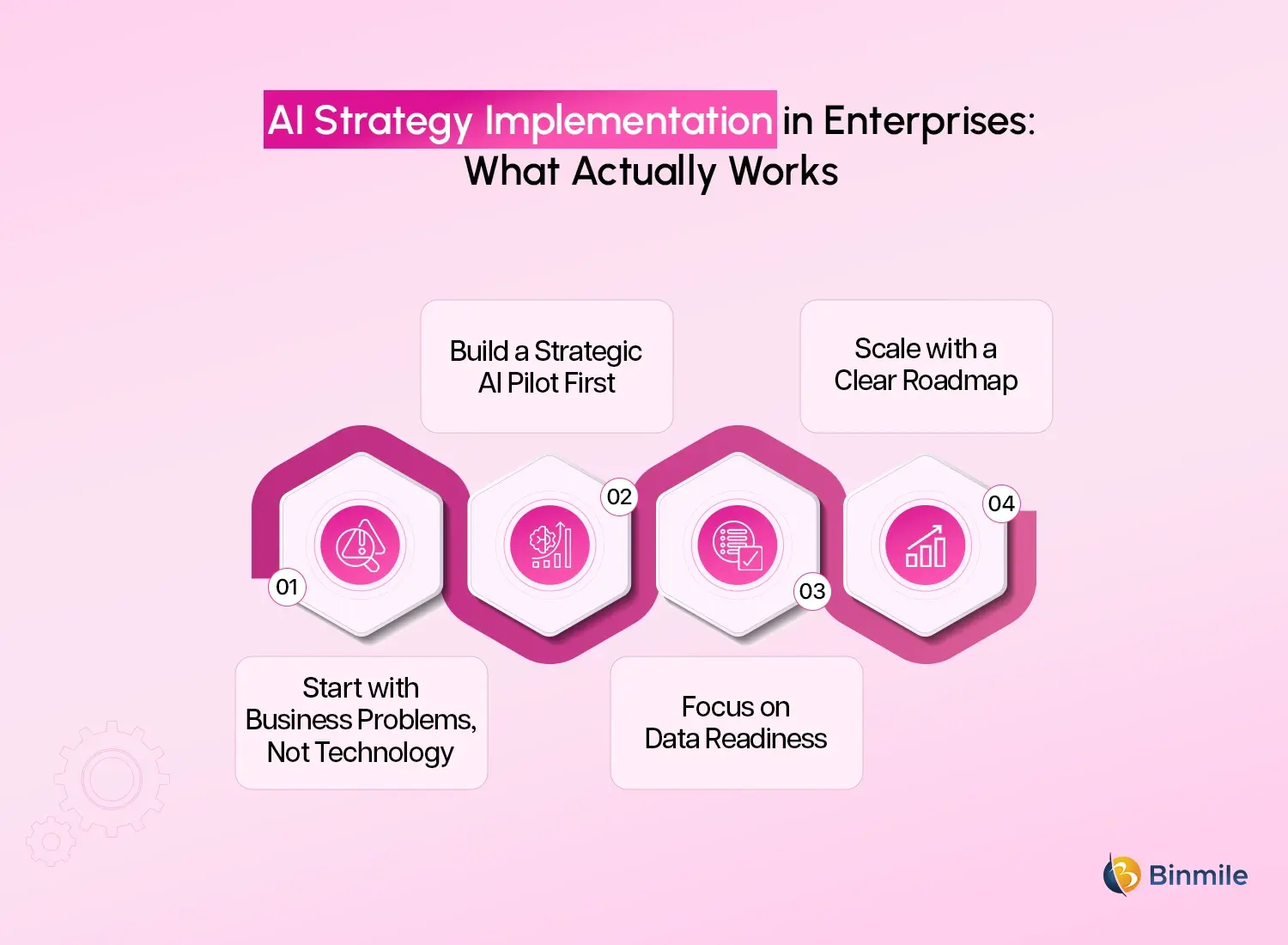
Start with Business Problems, Not Technology
The largest error for companies implementing an AI Solution is to start with the tool rather than identifying where your slow decision-making, inefficiency, or lack of utilization of data exists. You should be using AI to help solve a real business problem or business opportunity instead of just using it as a way to demonstrate what AI can do.
-
Build a Strategic AI Pilot First
Implementing a large-scale AI transformation usually does not work out on the first try. However, if you pilot a strategic AI initiative, you can successfully determine the high-impact area and create a measurable outcome. If you successfully accomplish this project, then you will build the internal confidence needed to implement additional strategic AI initiatives.
-
Focus on Data Readiness
Your AI solution will be only as strong as the data behind it. Organizations should make sure that they have the right kind of data to support their AI solution. Clean, structured, governed, and accessible data across all systems within an organization is necessary for success with AI solutions.
-
Scale with a Clear Roadmap
After you have established enough early successes, you will want to create a structured Digital Transformation roadmap for how to scale your AI solutions. Scaling includes more AI Use Cases, Integration of Systems, and Team alignment. The majority of the Return on Investment (ROI) will occur during the phases of scaling your digital transformation initiatives.
Technologies That Enable AI Business Strategy
A collection of technologies works in harmony to enable an AI Business Strategy. The use of machine learning creates predictive results, while Natural Language Processing enables a system to interpret human language, and Generative AI pushes the limits of creativity. In addition, Cloud Infrastructure creates the ability to scale from small applications to enterprise-level, and Data Platforms drive continuous analysis of data. The collective use of these technologies creates the building blocks for Enterprise-level AI strategy and allows for the ability to implement AI on a large scale.
Measuring ROI of AI in Business Strategy
ROI is where most enterprises hesitate. The key is to measure impact beyond just cost savings.
-
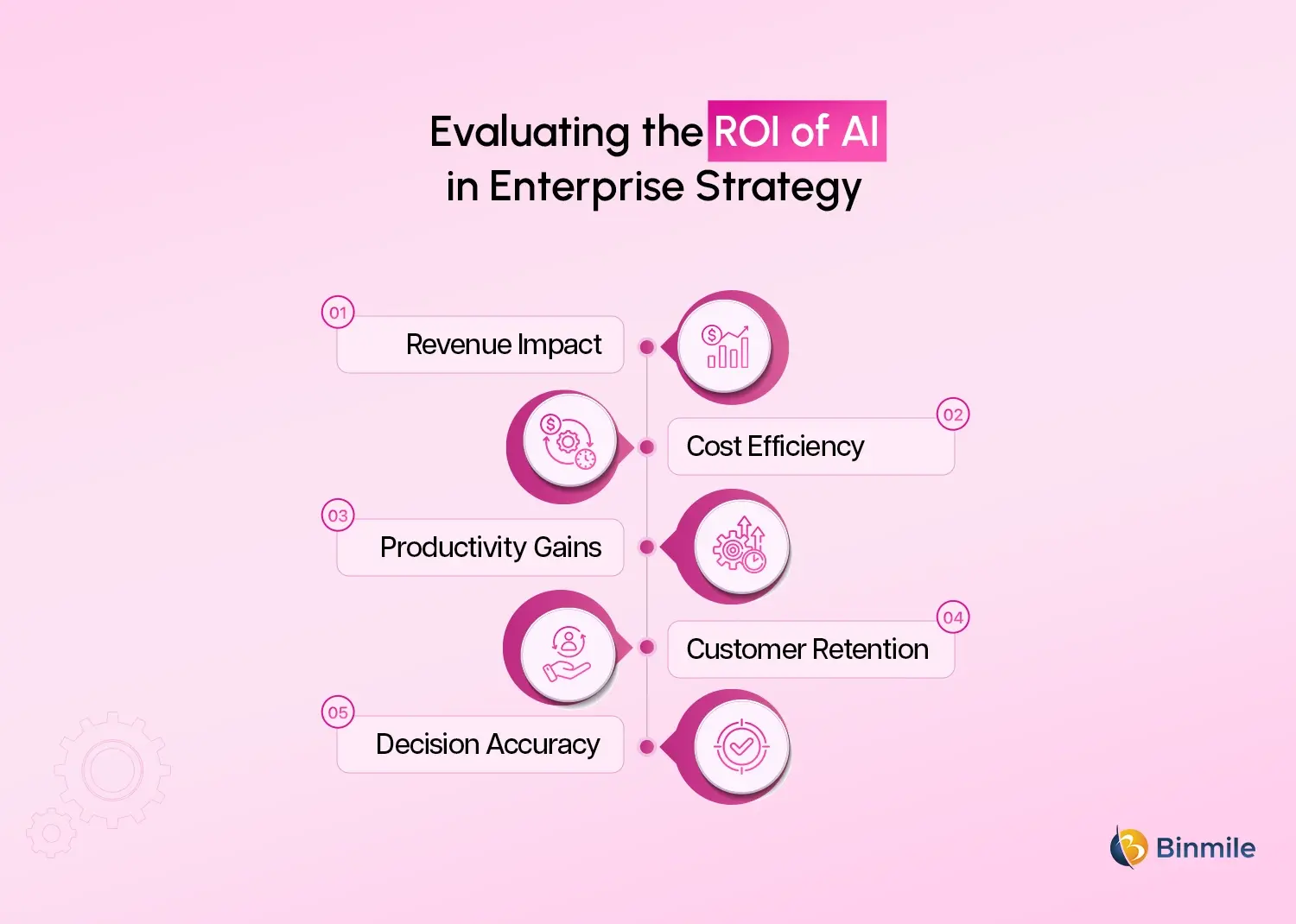
Revenue Impact
AI can support improved targeting, pricing, and personalized experiences for its customers, thus providing greater sales levels and increased profit margins.
-
Cost Efficiency
AI is able to automate many manually completed tasks, therefore spending less time completing repetitive tasks and reducing the associated operational expenses, leading to better than expected profitability.
-
Productivity Gains
Less time is spent performing repetitive work, thus allowing teams to focus their time on more strategic initiatives.
-
Customer Retention
A better customer experience leads to increased customer loyalty and ultimately increased revenue over an extended period of time.
-
Decision Accuracy
Improved accuracy in decision-making helps greatly with reducing risk and more expensive mistakes for the organization.
The most important thing is defining KPIs early in the AI strategy journey. Without clear metrics, ROI becomes difficult to track.
Common Challenges in AI Strategy Initiatives
AI strategy implementation often confronts numerous problems, although many companies have designed AI strategies that include the data used to train the AI as well as example use cases for how they intend to incorporate AI into their operations. Data quality problems can limit how productive a company can be with AI. The integration of AI into current systems can be difficult. The availability of talent, which can be leveraged to effectively utilize AI, is limited and significantly restricts who will support the organization’s request for help in designing and deploying their AI systems.
In addition, many employees may hesitate to trust AI-generated recommendations and decisions, which can further slow down information integration and ultimately hinder adoption of the technology. Strong leadership, clear communication, and ongoing training will all play important roles in addressing these barriers.
Building a Sustainable AI Strategy Journey
AI strategy, as opposed to being a simple project, is a long-term journey. Therefore, it is imperative that the AI strategy initiatives align with the enterprise’s overall strategic vision to provide measurable results and avoid isolated experimentation with AI. Working as a collaborative effort among company leadership, the technology team, and functional business units will maximize the successful use of AI in strategic management as well as reduce the risk of failure and the overall implementation timeline by creating synergy through the entire enterprise rather than using AI in isolation within a single department.
Additionally, to maximize the value of AI, an organization should have a long-term perspective because the greatest benefit of applying AI is from ongoing improvements in various functional areas rather than merely from short-term gains.
Struggling to turn AI initiatives into real business outcomes? Start building a strategy that drives measurable growth and long-term impact.

Turning Strategy into Execution with the Right Support
Many enterprises understand the value of AI but struggle to move from planning to execution. That gap often determines whether AI delivers results or remains an underutilized investment. This is where experienced support can make a difference. With the right guidance, businesses can identify high-impact opportunities, build scalable solutions, and align their AI initiatives with long-term goals.
Binmile works closely with enterprises to translate AI strategies into practical outcomes. By combining AI strategy consulting, enterprise AI strategy, and deep technical expertise, the focus remains on delivering measurable value rather than just implementing technology. The approach is centered on clarity, execution, and continuous optimization so that AI becomes a true driver of business growth.
Frequently Asked Questions
AI in business strategy refers to integrating artificial intelligence into decision-making, planning, and execution processes. It helps organizations use data-driven insights to improve efficiency, predict outcomes, and build more adaptive and competitive strategies.
ROI includes increased revenue, reduced costs, improved productivity, and better customer retention. AI also enhances decision accuracy, which leads to long-term financial benefits and stronger strategic positioning for enterprises.
Companies measure AI success through KPIs such as revenue growth, cost savings, efficiency improvements, customer satisfaction, and prediction accuracy. Defining clear goals before implementation is essential for tracking meaningful outcomes.
AI strategy should be led collaboratively by business leaders and technology heads, such as CIOs or CTOs. This ensures alignment between business goals and technical execution, leading to more effective implementation.
Technologies include machine learning, natural language processing, data analytics platforms, cloud computing, and generative AI. These enable strategy automation, predictive insights, and scalable AI strategy implementation across the enterprise.
Choose a partner with proven expertise, industry understanding, and strong technical capabilities. They should align with your business goals, offer scalable solutions, and support long-term AI strategy initiatives effectively.