Healthcare systems are evolving faster than ever, but the real challenge lies in managing that change effectively. According to a recent report by McKinsey, nearly 70% of digital transformation initiatives fail due to poor change management practices. This highlights a clear reality: technology alone does not transform healthcare; people and processes do.
In this blog, we will discuss the impact that change management has on Digital Health Initiatives. We will have a comprehensive look at what change management is, why it is important, examples of issues related to change management, some of the best practices for managing change within an organization, and future trends in this area. This will be a very useful guide to help organizations prepare for a successful transformation.
What is Change Management in Healthcare and Why It Matters
Change management is a structured approach intended to transition both individuals and teams within any healthcare organization to a new state from a current state. Change management in healthcare is designed to ensure that changes (specifically technology or operations) are smoothly and effectively put into place without any disruption in the continuity of care provided to patients.
Moreover, the process of managing change in healthcare encompasses more than just implementing new technologies. It also involves training and aligning the workflows of employees involved with the implementation through healthcare web development; planning and preparing healthcare professionals for the transition; and a focus on ensuring that implementation occurs with minimal confusion and/or resistance.
The most salient point regarding the importance of change management in healthcare is that healthcare operates in a very high-risk environment, and as such, even small changes in the delivery of healthcare services can have catastrophic implications for patients. Therefore, it is imperative that transitions through the process of change management within an organization be performed with careful consideration of all factors in order to minimise risk and maintain a high quality of care.
Additionally, the ultimate goal of change management within the healthcare industry is to ensure the return on investment (ROI) realised from the investment in technology. As opposed to speed of implementation, the effectiveness achieved in both utilisation and adoption of the technology (or process) will determine the overall success of change management within an organization.
How Change Management Supports Digital Health Adoption
Digital health initiatives like telemedicine, AI diagnostics, and EHR systems are transforming patient care. However, their success depends heavily on change management transformation.
-
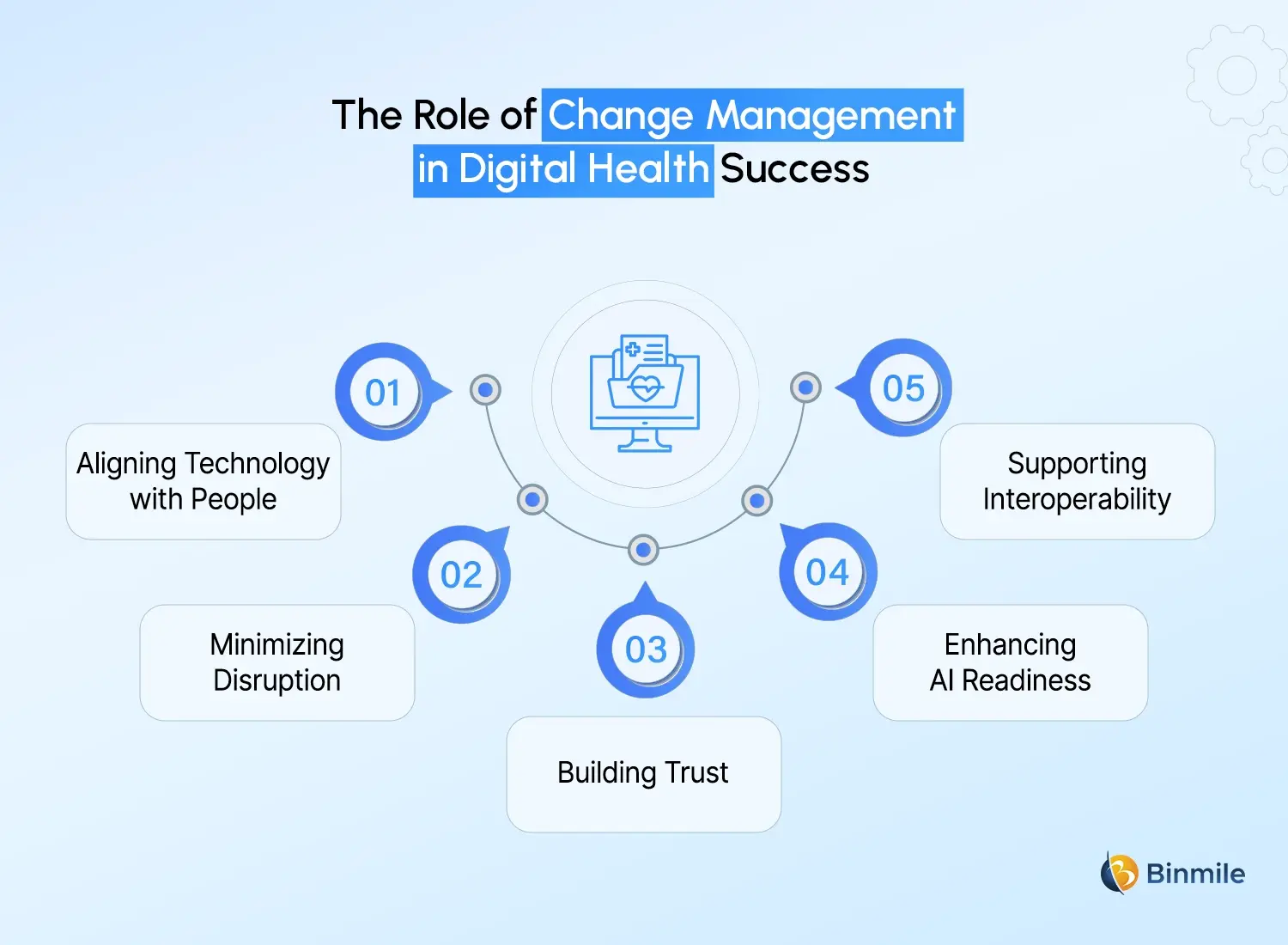
Aligning Technology with People
If healthcare workers are not comfortable with the digital tools that they have available, they will not have success using them. This is where change management comes into play through ensuring proper training and onboarding.
-
Minimizing Disruption
A well-structured change management process in healthcare ensures there is no interruption of patient care while implementing new systems.
-
Building Trust
When your staff understands the reasons and goals of the new digital initiatives, it is much more likely that they will embrace these new initiatives.
-
Enhancing AI Readiness
The successful implementation of AI into your organization requires a cultural shift. Change management will prepare your organization for AI readiness by alleviating fears of AI, developing competencies, and aligning expectations.
-
Supporting Interoperability
Today’s modern healthcare system operates using many more connected systems than ever. Change management helps your organization integrate systems at an optimal level (e.g., EHR in medical billing and revenue cycle systems).
What Are the Core Elements of Change Management in Healthcare
A successful change management framework includes several essential components.
1. Leadership Alignment
Strong leadership will help create a common direction and commitment across the entire organization.
2. Stakeholder Engagement
If you include stakeholders (e.g., physicians, nurses, and administrative staff) early on in the process, you can build trust and reduce resistance.
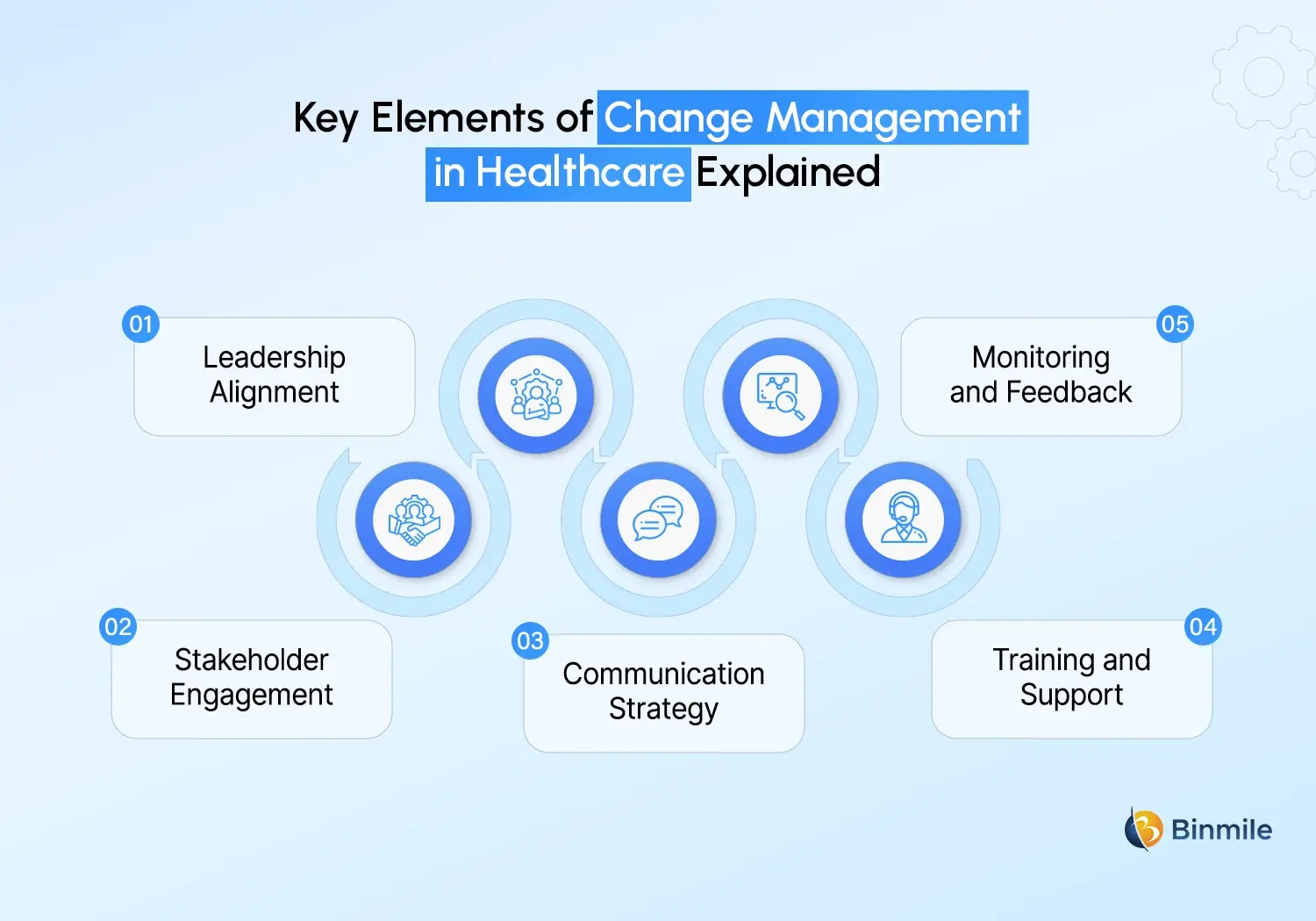
3. Communication Strategy
Communicating in an open fashion will help everyone understand the “why” behind the digital change initiatives your organization is planning to implement.
4. Training and Support
Training ensures your staff have the skills and knowledge to confidently use the new systems that are implemented into their respective workplaces, additionally providing support to ensure an ongoing knowledge and skills level.
5. Monitoring and Feedback
Providing ongoing monitoring and feedback to your staff on the implementation process will provide you with data regarding areas of weakness for improvement.
These elements form the foundation of effective change management techniques in healthcare transformation.
What Are the Key Challenges in Healthcare Change Management
There are several significant challenges when implementing change in healthcare, and addressing them is critical to avoiding delays and/or derailment of transformation efforts. A typical challenge is resistance to change, particularly when healthcare professionals have been accustomed to their own workflow processes and may be concerned about how new systems will impact their routines. The regulatory environment also adds a layer of complexity to the situation because even small changes must be made in compliance with strict standards, creating added time and effort for healthcare organizations. Legacy systems can also create barriers to implementing change because many legacy systems are outdated and incompatible with modern technology. This results in extensive difficulty and time-consuming resource requirements for integration.
Another significant challenge is inadequate training and support. Without adequate training, employees have difficulty adopting new systems and/or processes; adoption rates decrease; and the likelihood of making an error increases. A lack of employee understanding of what a change is and how it will benefit their work. This can create miscommunication, resulting in confusion and disengagement from the process.
Finally, budget constraints are a major natural barrier to implementing change management solutions that work effectively. Also, implementing effective change management requires significant investment in tools, training, and other resources. Therefore, these multiple barriers highlight the necessity of developing a comprehensive change management framework designed specifically for addressing the needs of healthcare organizations.
Looking to simplify healthcare transformation without disrupting patient care?

What Are the Change Management Models and Technologies
Different change management models and tools can be used to implement change effectively in healthcare.
Popular Change Management Models
- ADKAR Model
Awareness, Desire, Knowledge, Ability, and Reinforcement. - Kotter’s 8-Step Model
Leverage leadership to create urgency for change. - Lewin’s Change Management Theory
Based on Unfreeze, Change, Refreeze
These models are widely used as part of change management theory and can be adapted for healthcare environments.
Technologies Supporting Change Management
Modern healthcare transformation relies heavily on digital tools.
| Technology | Role in Change Management |
|---|---|
| Healthcare Web Development | Enables user-friendly digital platforms for patients and staff |
| Healthcare Software Modernization Guide | Helps upgrade legacy systems efficiently |
| Healthcare Revenue Cycle Management Software | Streamlines financial processes |
| EHR in Medical Billing | Improves data accuracy and billing efficiency |
| ServiceNow Organizational Change Management | Automates workflows and tracks change adoption |
| ServiceNow CMDB | Provides visibility into IT infrastructure |
These tools act as enablers of change management solutions, making transformation more structured and measurable.
What Are the Best Practices for Change Management in Healthcare
Implementing change management in the healthcare industry requires a thoughtful approach. Here are some proven best practices:
-
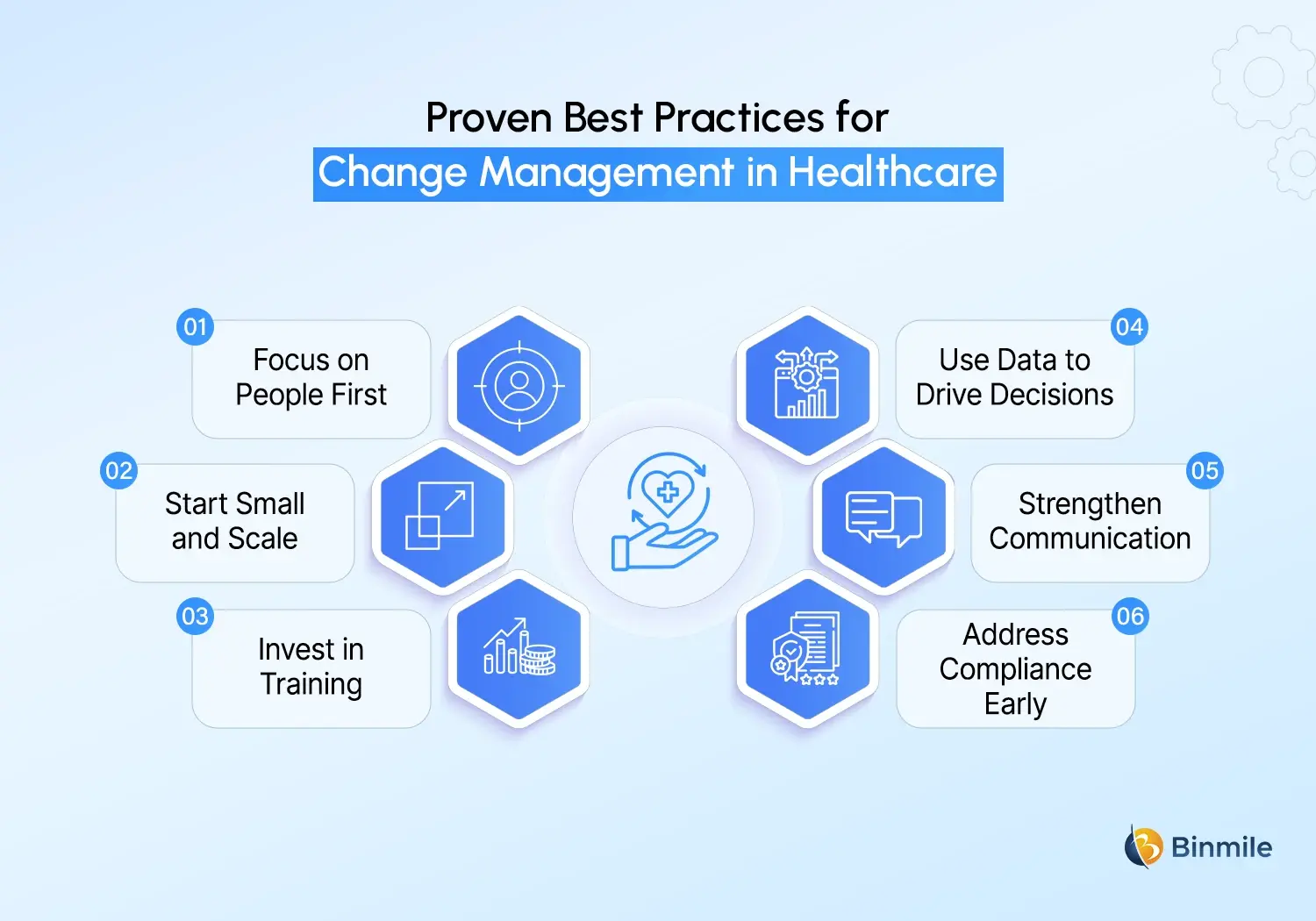
Focus on People First
Although technology is important, it is the individual who creates change. User experience and engagement should be a priority.
-
Start Small and Scale
A pilot program provides a means to test changes before implementing them on a full scale.
-
Invest in Training
Providing ongoing training for employees is critical for long-term success and adoption.
-
Use Data to Drive Decisions
Measuring performance metrics will allow you to evaluate whether or not you are succeeding.
-
Strengthen Communication
Provide regular updates to ensure that everyone has knowledge about what is happening and can stay aligned.
-
Address Compliance Early
To reduce compliance risk, integrate considerations for compliance from the outset of any new initiative.
These change management strategies in healthcare help organizations achieve sustainable transformation.
Future Trends in Healthcare Change Management
Rapid development in technology and the increased expectations of patients and providers are both influencing how change management is done in healthcare, moving into the future. While AI was seen at one time as something that could simply be added on top of current operations, now it has become a key facilitator of transformation within organizations. Additionally, forcing them to focus on AI readiness, building the skills necessary to work with an AI-driven world supported by platforms like ServiceNow CMDB. Also, building a culture that will be adaptable as they continue to deploy AI. Healthcare has also shifted toward being more patient-centered, utilizing digital solutions to create unique care experiences for each individual’s unique needs.
In addition to this, there is a growing emphasis on interoperability as seamless data sharing among systems is imperative to achieve a high level of efficiency and accuracy in delivering care. In concert with this trend, there is also an increasing role of automation in driving efficiencies through the optimization of workflow processes. Additionally, reducing the amount of manual labor required, and improves the overall efficiency of operational processes.
Perhaps the greatest shift from previous years is a transition to a continuous culture of change. Change is no longer seen as a one-time event within most healthcare organizations, but rather a regular part of their operations, helping them to be able to adapt quickly to the constant evolution of their environment. The changes we see today clearly demonstrate that transformation in the way change management is performed will have a long-lasting impact on the way healthcare will be delivered for years to come.
Planning a digital health initiative but unsure about adoption challenges?
How Binmile Can Support Your Healthcare Transformation
Driving meaningful change in healthcare requires more than just technology. The right combination of workflows, compliance, and user behavior must be incorporated into an organization’s process for digital adoption. When an organization receives assistance with the implementation of its digital initiatives. It will be able to handle the complexities associated with this more easily and with an increased likelihood of adoption.
Binmile works closely with healthcare organizations to align digital transformation goals with structured change management practices. In conjunction with modernizing legacy systems, improving healthcare revenue cycle management software, and creating seamless EHR integration opportunities, the emphasis has been placed on reducing friction throughout transitions and maximizing long-term outcomes. By combining technical knowledge with an understanding of frameworks for change management, organizations are better prepared for the resistance they will face. Also, will be able to operate more efficiently and achieve measurable success.
While much of the work done to support digital adoption is implementation in nature, it must also involve creating a culture in which change is integrated into the daily job of the healthcare provider. Doing so will allow the healthcare provider to not only adopt a new technology but also be equipped to use it successfully for the long haul.
Frequently Asked Questions
Change management in healthcare is a structured approach to transitioning systems, processes, and people during organizational changes. It ensures smooth adoption of new technologies while minimizing disruption to patient care and maintaining compliance standards.
It ensures the successful adoption of digital tools by addressing resistance, improving training, and aligning workflows. Without it, even advanced technologies fail to deliver expected outcomes due to poor user acceptance and integration challenges.
It reduces errors, improves workflow efficiency, and ensures accurate data usage. When healthcare professionals adopt new systems effectively, it leads to better decision-making and enhanced patient care quality.
Training equips staff with the knowledge and confidence to use new technologies effectively. It reduces resistance, improves adoption rates, and ensures that digital tools are used correctly to support patient care.
Success can be measured through adoption rates, employee feedback, process efficiency, and patient outcomes. Tracking these metrics helps organizations understand the effectiveness of their change management strategies.
AI and digital tools automate processes, improve diagnostics, and enhance decision-making. They enable faster, more accurate care delivery, making them key drivers of change in modern healthcare systems.