Security threats are becoming more sophisticated, compliance requirements continue to grow, and businesses are expected to respond faster than ever before. However, many organizations continue to use separate, manual security processes and tools that slow their security operations. As shown in IBM’s 2025 Cost of a Data Breach Report, organizations that implement AI and security automation streamline their security controls and reduce overall risk, saving them an average of $1.9 million per breach. This demonstrates the effectiveness of using intelligent security operations.
To meet these challenges, many organizations are now implementing ServiceNow SecOps to automate workflows, increase visibility, and enhance collaboration between IT and security teams. This blog will discuss how ServiceNow Security Operations can assist businesses in improving their security operations through better efficiency, reducing the amount of risk they take, and improving their operational effectiveness.
What Is ServiceNow SecOps and Why Enterprises Need It
ServiceNow SecOps is a security operations solution designed to address these challenges by bringing security tools, threat intelligence, vulnerability management, and workflows into a unified platform. By centralizing security operations with ITOM, organizations can accelerate incident response, prioritize vulnerabilities more effectively, improve visibility, and reduce operational complexity.
Modern enterprises often struggle with fragmented security tools, manual processes, and growing compliance demands. These challenges can slow incident response, reduce visibility, and increase operational costs.
How ServiceNow Workflows Transform Security Operations
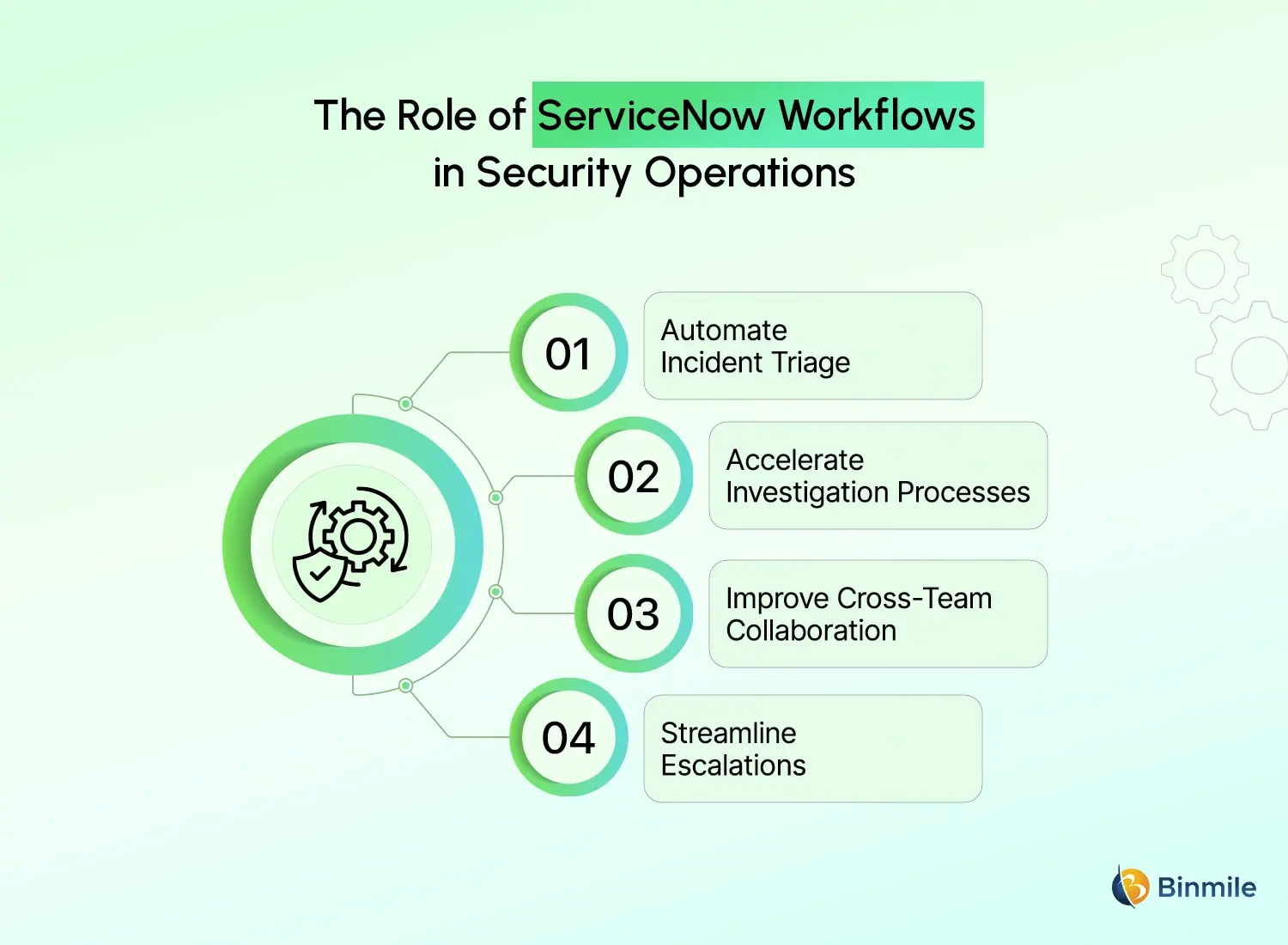
One of the biggest strengths of ServiceNow workflows is automation. By replacing manual processes with intelligent workflows, organizations can accelerate investigations, improve collaboration, streamline escalations, and respond to incidents more efficiently.
-
Automate Incident Triage
Security alerts can all be categorized, prioritized, and assigned to teams according to set rules.
-
Accelerate Investigation Processes
Threat data, asset details, and incident history are collected automatically to help speed up investigations.
-
Improve Cross-Team Collaboration
IT, Security, Compliance, and Operations can all work together from one platform for better communication and faster results.
-
Streamline Escalations
Serious incidents can generate an automatic escalation procedure to ensure serious threats are handled as quickly as possible.
These automated processes significantly improve operational efficiency while helping security teams focus on strategic initiatives.
Key ServiceNow SecOps Features That Deliver Business Value
Organizations evaluating ServiceNow SecOps module capabilities often focus on how the platform supports business outcomes rather than technical functionality alone. Here are some of the most valuable ServiceNow SecOps features:
-
Security Incident Response
Security Incident Response allows for the rapid detection, analysis, and resolution of security threats.
-
Vulnerability Response
Vulnerability Response assists organizations in determining vulnerability priorities and providing mitigation solutions based on business risk.
-
Threat Intelligence Integration
Threat Intelligence Integration increases an organization’s situational awareness of both new and emerging threats as well as attacker behavior.
-
Automated Workflows
Automated Workflows result in decreased manual work performed by analysts, thereby increasing analyst productivity.
-
Risk-Based Prioritization
Risk-Based Prioritization focuses a security team’s efforts on addressing the most critical risks.
-
Security Dashboards
Security Dashboards provide leadership with actionable intelligence and visibility into performance metrics.
-
Compliance Tracking
Compliance Tracking simplifies governance and audit preparation processes.
These capabilities help organizations reduce manual effort while improving overall security effectiveness.
ServiceNow SecOps Architecture Explained
Understanding ServiceNow SecOps architecture helps decision-makers evaluate how the platform fits within their existing security ecosystem. The architecture typically includes:
-
Security Data Sources
Data from various sources is used to collect and analyze security aspects of your business, including SIEM technologies, cloud service providers, vulnerability scanners, and other applications that help you determine whether or not to take action.
-
ServiceNow Platform Layer
The ServiceNow interface serves as a single repository for managing assets, incidents, response workflows, and much more.
-
CMDB Integration
The Configuration Management Database (CMDB) contains essential contextual data regarding the business services and technology assets impacted by security incidents or events.
-
IT Service Management Integration
When combined with ServiceNow IT Service Management, your organization can improve the overall coordination between security and IT departments.
This integrated approach allows organizations to make faster and more informed security decisions.
Improving Threat Detection and Response with Cyber Threat Intelligence
Security teams are often overwhelmed by thousands of alerts every day. Not every alert represents a genuine threat, making prioritization critical. By incorporating Cyber Threat Intelligence into security operations, organizations gain better context around emerging threats, attacker behavior, and potential risks.
ServiceNow Security Operations can correlate threat intelligence with security incidents, identify high-risk threats faster, prioritize investigations based on business impact, and support better decision-making during incident response. This intelligence-driven approach helps organizations focus resources where they matter most.
Explore how tailored ServiceNow SecOps Implementation can strengthen compliance, accelerate incident response, and deliver measurable business value.

The Role of ServiceNow SecOps in Cloud SecOps
Cloud adoption continues to accelerate across industries. While cloud environments provide flexibility and scalability, they also introduce new security challenges. Cloud SecOps focuses on securing cloud workloads, applications, and infrastructure through continuous monitoring and automated response.
ServiceNow SecOps supports cloud SecOps initiatives by helping organizations:
-
Monitor Cloud Security Incidents
Gives you a single pane of glass to evaluate your security events across all of your cloud environments.
-
Track Vulnerabilities Across Cloud Assets
Allows security teams to discover and fix vulnerabilities quickly before they become significant risks.
-
Automate Cloud Security Workflows
Decreases manual labour and increases the speed of response to cloud security incidents.
-
Improve Visibility Across Hybrid Environments
Gives you one view of the security risks in both cloud and on-premise infrastructures.
-
Coordinate Multi-Cloud Incident Response
Helps security teams coordinate quicker and more consistent responses to security incidents across the different cloud platforms they are using.
For enterprises managing AWS, Azure, Google Cloud, or hybrid environments, centralized security operations become increasingly important.
ServiceNow SecOps AI Agents and Intelligent Automation
AI agents and intelligent automation are changing the way companies address cyber threats. The use of AI SecOps agents from ServiceNow allows teams to deal with their ever-increasing workload by automating repeatable tasks and speeding up investigations.
ServiceNow SecOps agents can help security teams reduce time spent on manual work and speed up investigations while also improving overall operational efficiency through functionalities such as enriching alerts, classifying events, prioritizing threats, giving remediation suggestions, and providing automated response processes.
Automating routine administrative functions allows security teams to have more time to focus on strategic portfolio management instead of spending too much time on routine administrative functions, leading to improved operational efficiency and faster response times.
Reducing Operational Costs Through Security Automation
Security leaders are under constant pressure to improve protection while controlling costs. One of the primary advantages of SecOps in ServiceNow is the ability to reduce operational expenses through automation. Organizations can lower costs by:
-
Reducing Manual Work
Automated systems allow the elimination of time-consuming repetitive administrative functions by removing administrative burdens on analysts.
-
Improving Analyst Productivity
Security personnel may now inquire into more incidents without adding people to their teams.
-
Accelerating Incident Resolution
Quicker resolution of incidents decreases disruption to business and decreases potential financial losses.
-
Optimizing Security Investments
Benefits of integrated workflows are realised throughout the enterprise when efficiently utilising existing security technologies.
These benefits contribute directly to boost ROI with ServiceNow and provide more efficient security operations.
Strengthening Compliance and Governance
Compliance management is a top concern for organizations that operate within heavily regulated sectors. Security teams must show compliance with numerous regulations and maintain proper documentation and audit logs.
To support compliance initiatives, ServiceNow Security Ops provides centralized security records; automates the collection of evidence; captures remediation efforts; prepares for audits; and increases the visibility of governance across an organization. By integrating security and compliance functions, organizations doing a ServiceNow GRC implementation will also improve their governance and risk management practices.
Integrating ServiceNow SecOps with Existing Security Investments
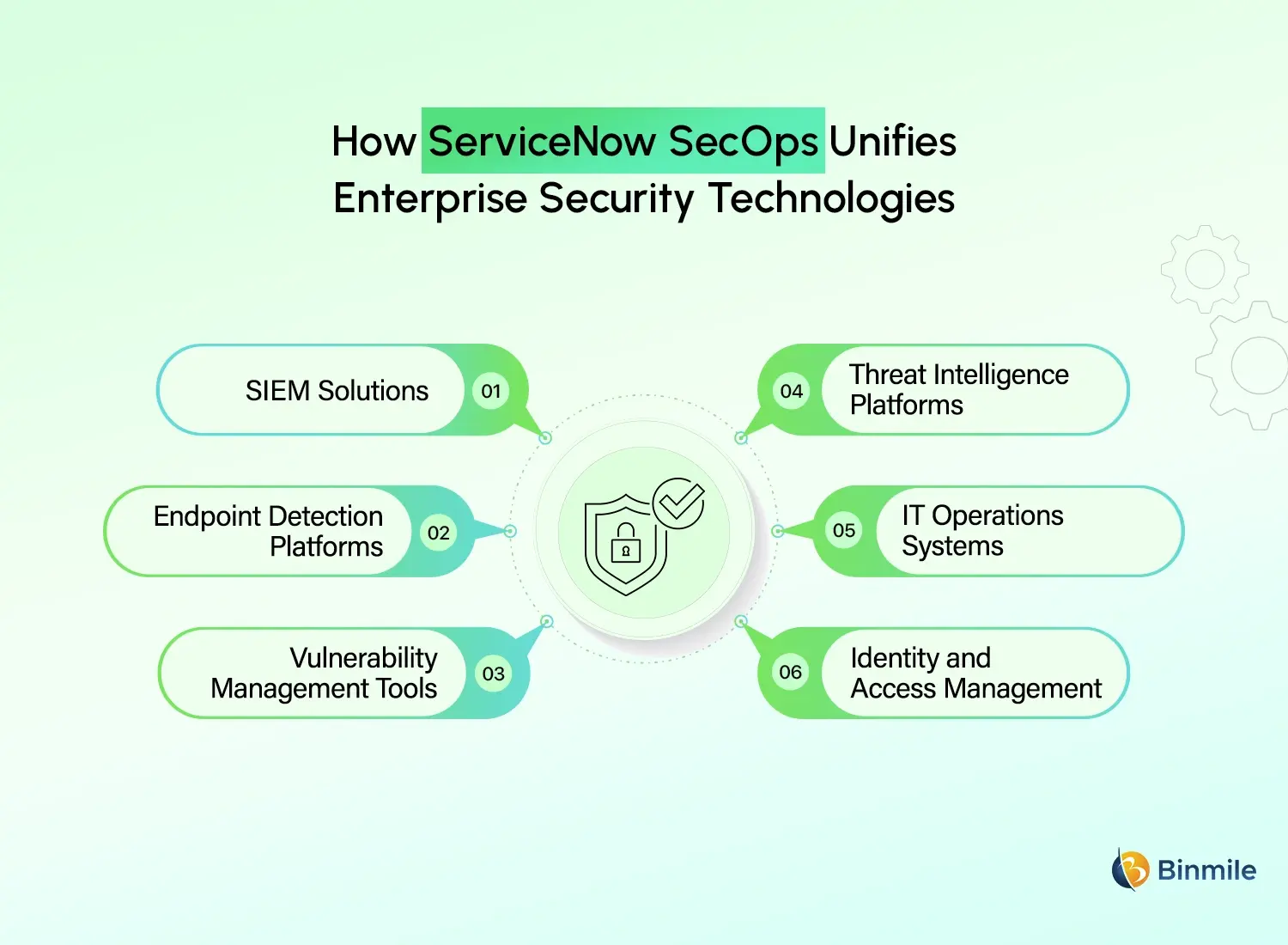
Many organizations hesitate to adopt new platforms because they fear replacing existing tools. Fortunately, ServiceNow SecOps capabilities are designed to complement existing security investments rather than replace them. The platform can integrate with:
-
SIEM Solutions
Security Information and Event Management (SIEM) integration provides the opportunity to connect different types of threat detection solutions with existing security processes.
-
Endpoint Detection Platform
Endpoint Security integration enhances visibility into threats related to endpoints (e.g., computers, laptops, mobile devices).
-
Vulnerability Management Tools
Vulnerability Management integration allows organizations to more effectively prioritize and resolve vulnerabilities.
-
Threat Intelligence Platform
Integration of threat intelligence sources into the analytical environment provides additional context for investigations.
-
IT Operations System
The Integration of IT Operations with Security strengthens collaboration between the Security and Operations teams.
-
Identity and Access Management Solution
Integration of Identity and Access Management (IAM) with Security helps to improve access control measures and response time.
This flexibility allows businesses to build a connected security ecosystem while preserving previous technology investments.
Measuring the Success of ServiceNow SecOps Implementation
For CIOs, CTOs, and security leaders, measuring success is essential.
Several key performance indicators can help evaluate ServiceNow SecOps enterprise performance:
| KPI | Business Impact |
|---|---|
| Mean Time to Detect (MTTD) | Faster threat identification |
| Mean Time to Respond (MTTR) | Quicker incident resolution |
| Analyst Productivity | Higher operational efficiency |
| Compliance Readiness | Reduced audit risk |
| Vulnerability Remediation Time | Lower security exposure |
| Security Incident Volume | Better threat management |
Tracking these metrics helps organizations demonstrate measurable business value from their security investments.
Supporting Broader ServiceNow Transformation Initiatives
ServiceNow security operations can provide much more than just cybersecurity protection. A lot of organizations are using Security Operations as part of their broader ecosystem, integrating Security Operations with ITOM to get infrastructure visibility; ServiceNow IT Asset Management (ITAM) to get insight into their assets; Strategic Portfolio Management to make risk-based decisions; ServiceNow Managed Services to continuously optimize Security Operations; and then working with ServiceNow Consulting and ServiceNow Implementation partner to help speed up deployment and maximize return on investment (ROI).
This broader ecosystem provides further opportunities to transform businesses digitally and increase profitability.
Discover how ServiceNow SecOps can automate workflows, improve visibility, and help your team in reducing cyber risks.

Driving Better Security Outcomes with the Right Implementation Approach
Technology alone does not guarantee successful security transformation. The effectiveness of ServiceNow SecOps depends heavily on implementation strategy, workflow design, integration planning, and long-term optimization.
Organizations looking to modernize security operations often benefit from experienced guidance that aligns security objectives with broader business goals. A well-planned approach ensures that security workflows, automation capabilities, compliance requirements, and operational processes work together seamlessly. Through expertise in ServiceNow Consulting, implementation services, managed services, IT operations, governance, and platform optimization, Binmile helps organizations unlock the full value of ServiceNow Security Operations while building a scalable foundation for future growth and resilience.
Frequently Asked Questions
ServiceNow SecOps implementation involves configuring Security Operations capabilities, integrating security tools, automating workflows, and aligning incident response processes to improve threat detection, response efficiency, and overall security management across the organization.
Yes. ServiceNow SecOps supports integration with SIEM platforms, vulnerability scanners, endpoint security tools, threat intelligence solutions, identity management systems, and other enterprise security technologies to create a unified security operations environment.
ServiceNow SecOps reduces costs by automating repetitive tasks, improving analyst productivity, accelerating incident resolution, minimizing manual processes, and enabling organizations to maximize the value of existing security investments and resources.
The platform helps organizations maintain audit-ready records, automate evidence collection, track remediation activities, improve governance visibility, and support regulatory compliance through centralized security and risk management processes.
Success can be measured through metrics such as mean time to detect, mean time to respond, vulnerability remediation speed, analyst productivity, compliance readiness, reduced operational costs, and overall security performance improvements.
Businesses should evaluate industry expertise, ServiceNow experience, integration capabilities, security knowledge, implementation methodology, ServiceNow managed services support, and the ability to align security operations with business objectives.