Healthcare organizations generate enormous volumes of data every day, from patient records and diagnostic reports to connected medical devices and operational systems. Yet, turning this data into actionable insights remains a challenge. This is where digital twins in healthcare are creating new possibilities. According to Grand View Research, the global healthcare digital twins market is expected to reach USD 3.55 billion in 2030, growing at a CAGR of 25.9% from 2025 to 2030, driven by advances in artificial intelligence, connected devices, and predictive analytics.
As healthcare providers, pharmaceutical companies, and medical technology firms look for smarter ways to improve patient outcomes and operational efficiency, digital twin technology is emerging as a transformative solution. In this blog, we’ll explore digital twin technology in healthcare, its growing importance, key trends, challenges, opportunities, implementation considerations, and how organizations can successfully leverage this innovation for long-term value.
What Is Digital Twin Technology in Healthcare?
A digital twin is a virtual representation of a physical object, process, system, or person that continuously updates using real-world data. In healthcare, a healthcare digital twin can represent a patient, medical device, hospital facility, clinical process, or even an entire healthcare ecosystem.
Medical digital twins use a combination of information from electronic health records, imaging devices, wearables, sensors, laboratory results, and operational systems to simulate real-world behavior and predict future events.
Unlike traditional analytic systems that are focused only on the past, medical digital twins continuously learn and evolve. Because of this ongoing learning process, healthcare providers have the ability to simulate situations in advance, assess risks associated with various scenarios, and make better decisions based on that knowledge prior to applying it in the actual world.
Why Digital Twin Technology Is Gaining Attention in Healthcare
Several factors are accelerating the adoption of Digital Twins in the Healthcare Industry.
-
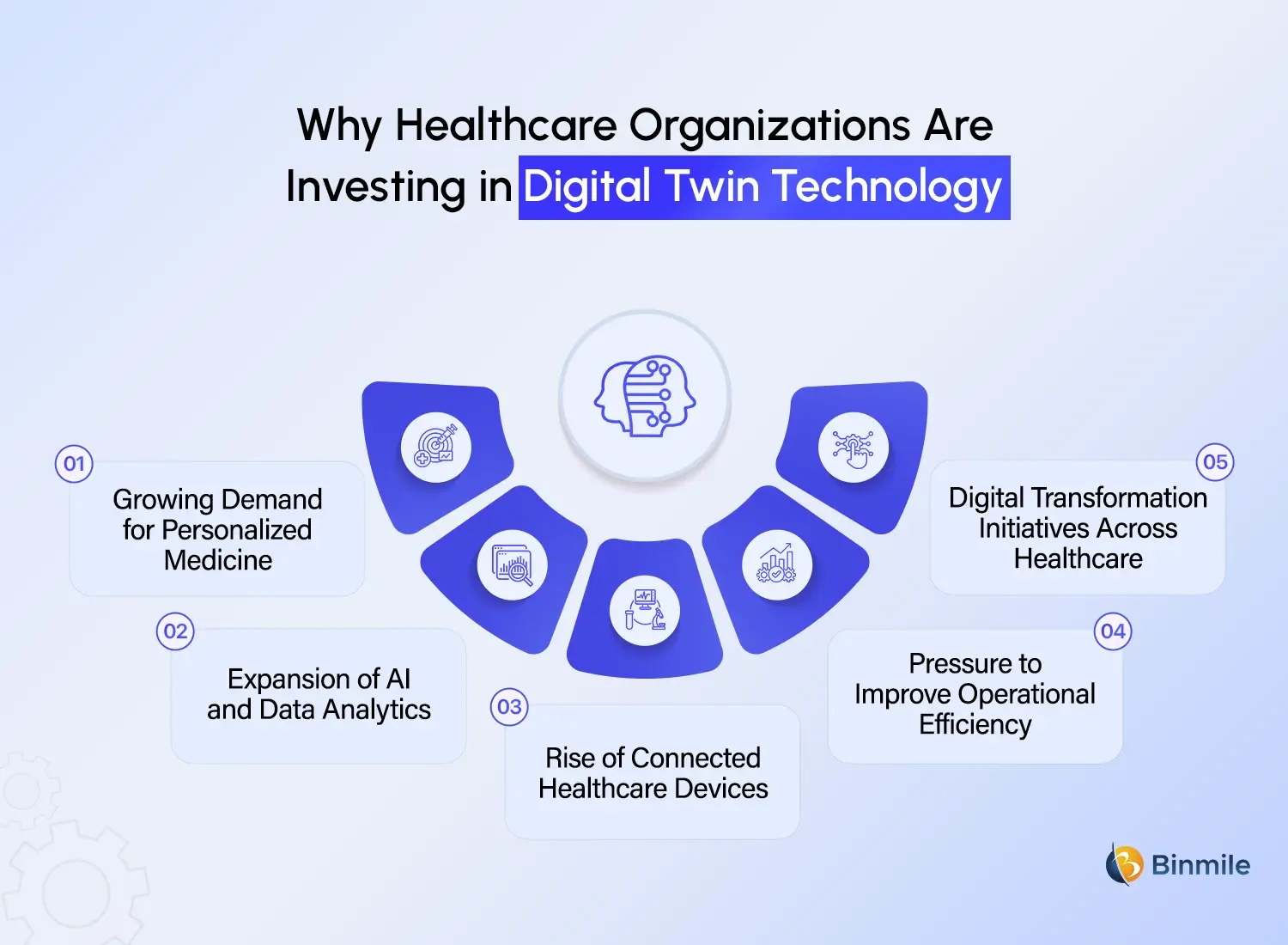
Growing Demand for Personalized Medicine
Healthcare providers are prioritizing individualized care delivery at an accelerated pace. Digital twins simulate the outcome of treatments and support greater personalization in care plans.
-
Expansion of AI and Data Analytics
AI in Healthcare allows for the assessment of virtual twins’ complex data, the uncovering of patterns, and predictive insights that support better decision-making.
-
Rise of Connected Healthcare Devices
The growth of Wearable Technology in Healthcare and connected medical devices sets up the real-time data to render the digital twin accurate and always updated.
-
Pressure to Improve Operational Efficiency
Hospitals are invariably under pressure to lower costs and improve performance. Digital Twins optimize workflow, resources, and day-to-day operations.
-
Digital Transformation Initiatives Across Healthcare
In a scheme wherein healthcare organizations invest in Digital Transformation in Business, digital twins have rapidly become one of the most valuable tools for innovation and modernization.
As healthcare becomes more data-driven, digital twins provide a bridge between raw information and actionable intelligence.
What Are the Key Benefits of Digital Twins in Healthcare
The growing interest in healthcare digital twins is largely driven by their ability to deliver measurable business and clinical value.
-
Enhanced Personalized Care
Improved personalized care can be enhanced by using digital twins to simulate different treatment options to produce high-quality care and positive patient outcomes.
-
Faster and More Accurate Clinical Decisions
More efficient and accurate clinical decisions occur through timely insights from digital twins, enabling fast diagnosis and better treatment planning.
-
Improved Predictive Maintenance
Digital twins support predictive maintenance of equipment, helping find and repair problems before having downtime.
-
Greater Operational Efficiency
They enhance operational efficiency by allowing organizations to make better decisions about resource use, staffing, and workflow management.
-
Reduced Costs and Resource Waste
Digital twins provide organizations with greater clarity regarding operations, leading them to be able to improve efficiency while eliminating wasteful spending and improving the use of resources.
-
Better Support for Healthcare Supply Chains
They are beneficial for enhancing healthcare supply chain logistics by improving inventory planning and reducing disruptions.
-
Continuous Monitoring and Preventive Care
Digital twins enable continuous monitoring of patients when integrated with other Internet of Things healthcare solutions, allowing for earlier intervention.
These advantages highlight the growing Benefits of Digital Twins in Healthcare for both providers and patients.
Understanding Digital Twin Architecture in Healthcare
A robust digital twin architecture typically consists of several interconnected layers that work together to create real-time simulations and insights.
| Layer | Function |
|---|---|
| Data Collection Layer | Captures information from EHRs, IoT devices, imaging systems, and wearables |
| Integration Layer | Consolidates data from multiple healthcare sources |
| Analytics & AI Layer | Processes data using machine learning and predictive models |
| Simulation Layer | Creates virtual representations and scenario testing |
| Visualization Layer | Provides dashboards and decision-making insights |
| Security Layer | Protects sensitive healthcare information |
This architecture enables healthcare organizations to create a scalable digital twin healthcare platform capable of supporting both clinical and operational use cases.
What Are the Major Use Cases of Digital Twin in Healthcare
The practical applications of digital twins continue to expand across the healthcare ecosystem.
-
Virtual Patient Modeling
Digital Twins are also being used in healthcare to create digital twins of individual patients so that healthcare providers can simulate disease progression, evaluate treatment options, and develop customized care strategies for each patient.
-
Smart Hospital Operations
Hospitals can create digital twins of the physical spaces within their facilities to optimize workflow processes, patient flow, equipment utilization, and emergency preparedness.
-
Medical Device Monitoring
Manufacturers can employ digital twins of their products to monitor the performance of the Medical Device, detect and troubleshoot any issues, and improve the design and reliability of the Medical Device.
-
Drug Development and Clinical Trials
Pharmaceutical companies utilize digital twins of patients to model the reaction of patients to various medications. Therefore, they can streamline the process of running clinical trials by decreasing the cost and shortening the lead time in bringing a new treatment to market.
-
Healthcare Supply Chain Optimization
Healthcare supply chains continue to experience significant challenges in inventory management and allocation. By utilizing digital twins, healthcare organizations can model the processes they use to manage the supply chain, predict stock-out situations, and improve purchasing decisions.
-
Remote Patient Monitoring
With the integration of remote patient monitoring and wearable technology in healthcare, healthcare providers can effectively manage and monitor patients remotely using digital twins.
The Role of AI, IoT, and Connected Technologies
The effectiveness of healthcare digital twins depends heavily on supporting technologies.
-
AI in Healthcare
Utilizing artificial intelligence technology will allow for the creation of a digital twin that can find repetitive behaviors, make predictions based on past behavior, and generate suggestions for change from large datasets. As new data becomes available, machine learning algorithms will continuously adapt to improve simulation accuracy.
-
Internet of Things Integration
New Internet of Things health solutions will provide the data along with real-time information that will be required to ensure that the digital twins are in sync with the actual physical environment. Through the use of connected devices, sensors, and monitoring systems, it will be possible to achieve the highest level of accuracy.
-
Wearable Devices
Wearable devices will provide a stream of constant patient health data, including heart rate, activity level, blood pressure, and sleep information, helping to keep the patient’s digital twin current and valid.
Let's discuss how AI, IoT, and digital twin solutions can help your organization optimize processes, improve outcomes, and unlock greater business value.
Digital Twin Implementations in Healthcare: Key Challenges
Despite the potential benefits, successful digital twin implementations in healthcare require overcoming several challenges.
-
Data Quality and Integration
Medical records often come from many different places and in many different formats; therefore, combining this information into one single digital twin is a complicated task.
-
Regulatory Compliance
It is the responsibility of the healthcare provider to comply with the regulations that govern the privacy of patients and the protection of their data.
-
High Initial Investment
Designing and building digital twin solutions requires a large financial investment for the building of infrastructure, management of data, development of Artificial Intelligence capabilities, and creation of integration solutions and services.
-
Interoperability Issues
Many of the healthcare systems still exist in isolation, making it hard to receive or share data.
-
Scalability Concerns
As time goes on and the initiatives to develop digital twins gain momentum, organizations need to ensure that their systems can continue to handle additional growth in the amount of information processed, and an additional number of users will be on the system.
Cybersecurity Considerations for Healthcare Digital Twins
Security is one of the most critical concerns associated with healthcare digital twins. Since these systems rely on sensitive patient and operational data, organizations must implement strong cybersecurity measures. Important considerations include:
-
Data Encryption
Encrypting data helps to keep it safe if it is at rest or being moved, so that only those with proper access can see it, preventing the possibility of a breach of patient confidentiality in the health industry.
-
Access Control Mechanisms
Privilege-based access control allows only those with the proper privilege to view, change, or manage sensitive health data in the digital twin.
-
Continuous Monitoring
Continuous monitoring provides an opportunity for health organizations to discern instances of unusual behavior, identify possible threats earlier, and develop a fast response to a security breach.
-
Secure Cloud Infrastructure
Digital Twins in healthcare are often hosted using public cloud platforms. Cloud Platforms provide security while enabling scalability and performance for the digital twin.
-
Identity and Authentication Management
Strong authentication methods like Multi-Factor Authentication verify a user’s identity while preventing unauthorised access to the digital twin.
-
Compliance with Healthcare Regulations
Regardless of whether the digital twin is sold to a health provider or used as an enterprise application by the health provider. Thus, both must ensure that the digital twin adheres to all relevant healthcare rules and data protection laws to prevent legal and operational risks.
A strong cybersecurity framework is essential for maintaining trust and protecting patient information.
Measuring ROI from Digital Twin Investments
Before adopting digital twins, executives often ask a simple question: Is the investment worth it?
Organizations can evaluate ROI using metrics such as:
-
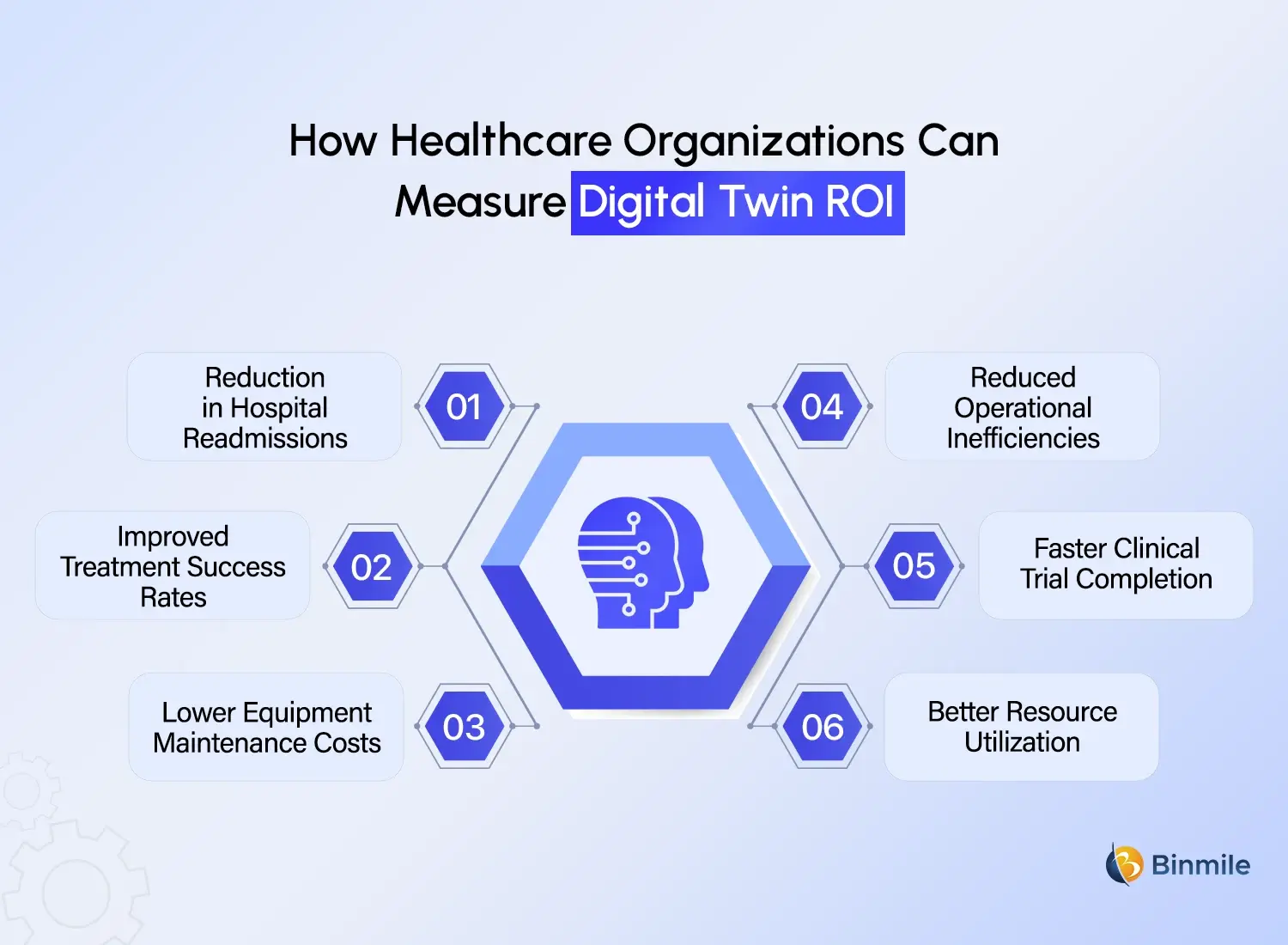
Reduction in Hospital Readmissions
The ability to provide a greater level of accuracy in monitoring and predictive care will allow for a reduction in avoidable hospital readmissions, thus improving overall patient outcomes when using digital twins.
-
Improved Treatment Success Rates
The use of personalized simulation models for treatment can allow healthcare providers to make better-informed treatment decisions, resulting in improved effectiveness of treatments.
-
Lower Equipment Maintenance Costs
The use of digital twins has the capability to provide predictive maintenance for equipment by identifying potential issues with equipment before failure occurs, which can reduce repair costs and downtime.
-
Reduced Operational Inefficiencies
Healthcare organizations will be able to optimize workflow and improve staffing and resource allocation, which will result in improved operational metrics from using digital twins.
-
Faster Clinical Trial Completion
The use of digital twin models for clinical trials has the potential to streamline the process of clinical research. This can help accelerate the timeline from initiation to completion of pharmaceutical and healthcare-related clinical trials.
-
Better Resource Utilization
The availability of real-time data can allow healthcare providers to maximize their use of resources, including staff, equipment, facilities, and other critical resources.
By aligning digital twin initiatives with measurable business objectives, healthcare leaders can demonstrate tangible value and secure stakeholder support.
Ready to turn healthcare data into actionable insights with digital twin technology that enhances patient care and supports long-term innovation.
How Healthcare Organizations Can Accelerate Digital Twin Success
Successful healthcare digital twin development requires more than adopting new technology. Organizations need a clear strategy, strong data governance, and a scalable foundation to ensure long-term success.
Partnering with an experienced custom healthcare app development company can help healthcare providers overcome integration challenges, build secure digital twin solutions, and align implementations with business goals. Combining digital twins with advanced analytics, AI in Healthcare, and Internet of Things healthcare solutions can further enhance value and outcomes.
Binmile supports healthcare organizations in developing scalable digital solutions that drive innovation and improve operational efficiency. Also, accelerate digital transformation while maintaining security, compliance, and long-term scalability.
Frequently Asked Questions
A digital twin in healthcare is a virtual representation of a patient, medical device, hospital system, or healthcare process that uses real-time data to simulate behavior, predict outcomes, and support better decision-making.
Digital twin technology helps healthcare organizations improve patient outcomes, optimize operations, reduce costs, enhance predictive capabilities, and support personalized treatment approaches through real-time data analysis and simulation.
Digital twins create patient-specific virtual models using clinical and behavioral data. Healthcare providers can simulate treatment options, predict responses, and design more personalized care plans with greater accuracy.
Artificial intelligence analyzes large healthcare datasets, identifies patterns, predicts outcomes, and continuously improves simulation accuracy, making digital twin solutions more effective and actionable.
Healthcare organizations must focus on data encryption, access controls, identity management, secure cloud environments, compliance requirements, and continuous monitoring to protect sensitive patient information.
Organizations can evaluate ROI through improved patient outcomes, reduced readmissions, lower maintenance costs, enhanced operational efficiency, better resource utilization, and faster clinical or research processes.