Cloud adoption has become a business necessity for organizations looking to improve scalability, agility, and innovation. However, as more critical workloads and sensitive information move to cloud environments, protecting that data has become a top priority for business leaders. With cyber threats, compliance requirements, and multi-cloud complexity continuing to grow, cloud data protection has become essential for maintaining security, business continuity, and operational resilience.
Businesses face many security, compliance, and operational hurdles when adopting cloud computing services. Enterprises must have a complete strategy for securing their information from potential threats such as ransomware attacks and unintentional exposure of sensitive data, especially in light of the changing regulatory landscape. This guide will discuss basic concepts regarding data protection in the cloud, typical threats that can occur in the cloud, strategies for protecting data, best practices for implementing protection solutions, and how an organization can create a secure cloud computing environment that will allow for continued growth over time.
What Is Cloud Data Protection and Why Does It Matter?
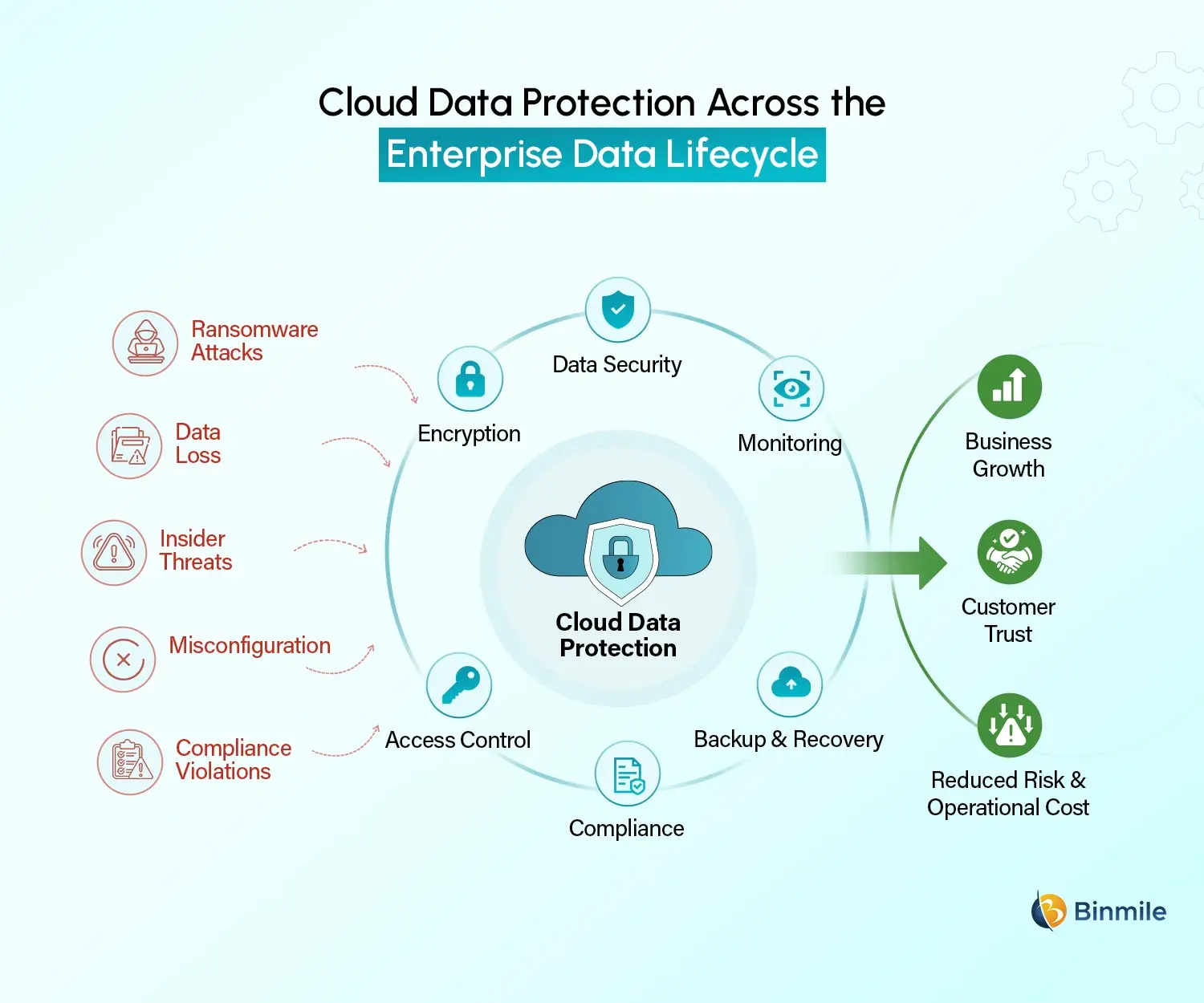
Cloud data protection refers to the technologies, policies, processes, and controls used to secure data stored, processed, and transmitted across cloud environments. The purpose of implementing all of these measures is to prevent unauthorized access to, loss of, corruption of, theft of, and compliance violations related to sensitive or confidential data.
Modern organizations maintain extensive amounts of data in the cloud, including customer information, financial records, intellectual property, operational data, and data analytics workloads. Without adequate security controls in place, this type of data could be at risk from cyberattacks, insider threats, accidental deletions, misconfigurations, or service outages.
Protecting data in the cloud enables an organization to maintain the confidentiality, integrity, and availability of its data while supporting its business continuity and compliance requirements.
What Are the Key Threats Facing Enterprise Cloud Data
Organizations encounter numerous security challenges when managing cloud environments.
-
Misconfigured Cloud Resources
Incorrect configurations, such as storage, databases, or access controls, can lead to exposing sensitive data and posing major security threats.
-
Ransomware Attacks
Due to cybercriminals increasingly targeting cloud environments, strong backup and recovery capabilities are mission-critical for maintaining business continuity.
-
Insider Threats
Employees or third parties with excessive access rights can either inadvertently or maliciously abuse access and compromise sensitive data.
-
Data Loss During Migration
Poorly executed corporate-wide cloud migration may cause data loss/corruption and/or the unauthorized exposure of Key Data.
-
Compliance Violations
Failure to comply with regulations can result in punitive measures, litigation risk, and reputational damage to the organization.
These growing risks have increased demand for advanced cloud data protection software across industries.
What Are the Core Components of an Effective Cloud Data Protection Strategy
A successful cloud data protection strategy requires multiple layers of security working together.
-
Data Discovery and Classification
Classification of data and discovery of sensitive data are vital steps to be able to apply security and compliance controls.
-
Encryption
Encryption technology helps to secure data at rest, in transit, and during a backup from unauthorized access.
-
Identity and Access Management
Identity and access management technologies have strong authentication and access control mechanisms that help to control access to business-critical data.
-
Backup and Recovery
Backup and recovery solutions provide the ability to recover the data very quickly after an incident or disaster.
-
Monitoring and Threat Detection
Monitoring/Threat detection solutions are used for continuous monitoring of systems to detect threats as soon as possible and provide a quicker response to incidents.
Cloud Native Data Protection vs Traditional Data Protection
Modern Cloud Computing Architecture enables organizations to build scalable, resilient, and secure environments that support evolving business requirements. Here is the comparison between cloud native and traditional data protection:
| Aspect | Traditional Data Protection | Cloud Native Data Protection |
|---|---|---|
| Infrastructure | designed for on-premises environments | built specifically for cloud environments |
| Scalability | Limited scalability and manual expansions are typically required | elastic scaling based on workload demands |
| Security Controls | security based on hardware and perimeters | policy-based and fully automated security |
| Visibility | centralized location, infrastructure monitoring | real-time visibility of all distributed environments |
| Management | manual maintenance, including updates | API driven, managed, and automated |
| Compliance | periodic compliance checks | continuous monitoring for compliance |
| Backup and Recovery | Backups are scheduled and take a longer time for recovery | automated failures of the backup process and faster times to recover. |
| Integration | Limited cloud service integrations | fully integrated with all Cloud services |
| Operational Agility | Slower to deploy and change | Faster deployment and greater flexibility |
In the face of increasing adoption of digital transformation by organizations, cloud-native data protection is becoming increasingly common due to the agility, scalability, and security benefits that align with today’s cloud native infrastructure.
How Does Data Protection During Cloud Migration Work
Cloud migration projects often introduce significant security risks if data protection measures are not embedded into the process. As businesses realize the benefits of Cloud Computing, protecting sensitive data across cloud environments has become essential for maintaining trust, security, and compliance. To avoid these risks, organizations should first conduct a risk assessment to identify sensitive data, compliance, and migration scope issues.
Data transferred to the cloud must be encrypted properly with high-quality encryption technologies. Validated processes must ensure that data remains complete and accurate throughout the transfer process. Access to critical data must be restricted to authorized personnel only during the cloud migration completion process. Security must be considered at every stage of cloud data migration tools to reduce risk and enable business continuity.
What Are the Multi-Cloud Data Protection Challenges and Solutions
Multiple cloud providers increase resilience and reduce vendor lock-in for many businesses. However, multi-cloud data protection is more complex than single-cloud models. Common challenges include:
-
Inconsistent Security Policies
Different Cloud Providers have inconsistent security settings, thus making it difficult for the business to enforce its security policy across all cloud providers properly. This lack of consistency creates security gaps as a result of the different configurations in the environment and may increase the risk of misconfigurations.
Solution: Centralized governance and standardized security policies should be established to provide consistent security controls throughout all cloud environments.
-
Limited Visibility Across Environments
Security teams struggle to have a unified view of their assets, user activity, and security events that occur across multiple cloud providers.
Solution: Centralized monitoring/observability platforms should be implemented to provide complete visibility into the entire cloud ecosystem.
-
Compliance Complexity
Regulatory compliance is even more complex when data is located in multiple cloud environments with different security controls.
Solution: Automated compliance monitoring tools and organization-wide governance frameworks should be used to ensure that an organization is compliant with regulations consistently.
-
Data Fragmentation
Data spread out over multiple cloud environments creates operational inefficiencies and makes it more difficult to manage data effectively.
Solution: A unified data governance strategy should be developed to provide standardization of the classification of data, storage policies, and access control of data across all environments.
-
Tool Sprawl and Management Overhead
Managing the various security tools of their cloud providers typically increases operational expense as well as operational administration burden on the company.
Solution: Integrated cloud security platforms and cloud automation tools provide multi-cloud capabilities through a single pane of glass to be developed for the organization.
A successful multi-cloud data protection strategy provides centralized visibility, consistent governance, and stronger security controls across every cloud environment.
How to Build a Cloud Data Security Architecture for Modern Enterprises
A strong cloud data security architecture forms the foundation of enterprise cloud protection. The cloud computing architecture should include:
-
Data Layer Security
Methods of protection for sensitive data, such as encryption, tokenization, and data masking.
-
Identity Security
Providing a full identity management solution to keep unauthorized users from accessing critical data.
-
Network Security
Using network segmentation, firewalls, and a zero-trust approach to minimize the attack surface across a network.
-
Application Security
Ensuring that applications that use cloud-based data are constantly monitored and tested for security flaws.
-
Governance Layer
Establishing policies and compliance controls through auditing functions that help keep your security standards consistent across the enterprise.
An integrated cloud data security architecture enables organizations to scale securely while maintaining operational flexibility.
Looking to strengthen cloud security while ensuring compliance, business continuity, and long-term scalability?
How Cloud Data Protection Supports Regulatory Compliance
Regulatory compliance has become a major driver of enterprise security investments. Organizations must incorporate DPDP readiness implementation to strengthen governance and regulatory compliance to address requirements related to:
-
Data Privacy
Safeguard personal and confidential information per applicable privacy laws and regulations.
-
Data Residency
Ensure data storage locations comply with regional data residency requirements.
-
Breach Reporting
Allow the timely detection, investigation, and reporting of security incidents.
-
Customer Consent Management
Keep records of customer consent and handle data in accordance with agreed-upon permissions.
-
Data Retention Requirements
Keep the required amount of time and securely delete data once it is no longer needed.
Key Cloud Data Protection Controls for Regulatory Compliance
A robust data protection on the cloud strategy supports compliance through several foundational capabilities.
-
Access Controls
Role-based permissions will restrict access to sensitive data to authorized users only.
-
Audit Trails
User activities and system modifications must be tracked for compliance and auditing purposes.
-
Encryption
It is essential to protect sensitive data throughout its life cycle and in accordance with regulatory guidelines.
-
Continuous Monitoring
Compliance gap analysis, security risk assessment, and verification of policy violations must occur continually in real time.
-
Data Governance Frameworks
It is important to standardize data management practices to improve accountability and compliance.
For organizations preparing for evolving privacy regulations, aligning cloud security and data protection initiatives with broader compliance programs is critical.
How to Select the Right Cloud Data Protection Solutions
Finding the right cloud data protection solutions will take into account both existing and best business requirements. Look for a platform that can accommodate an increasing amount of data, as well as be able to monitor across multiple cloud and hybrid environments. The ability of a solution to automate will reduce operational costs while also providing an improved level of security and overall efficiency of the business.
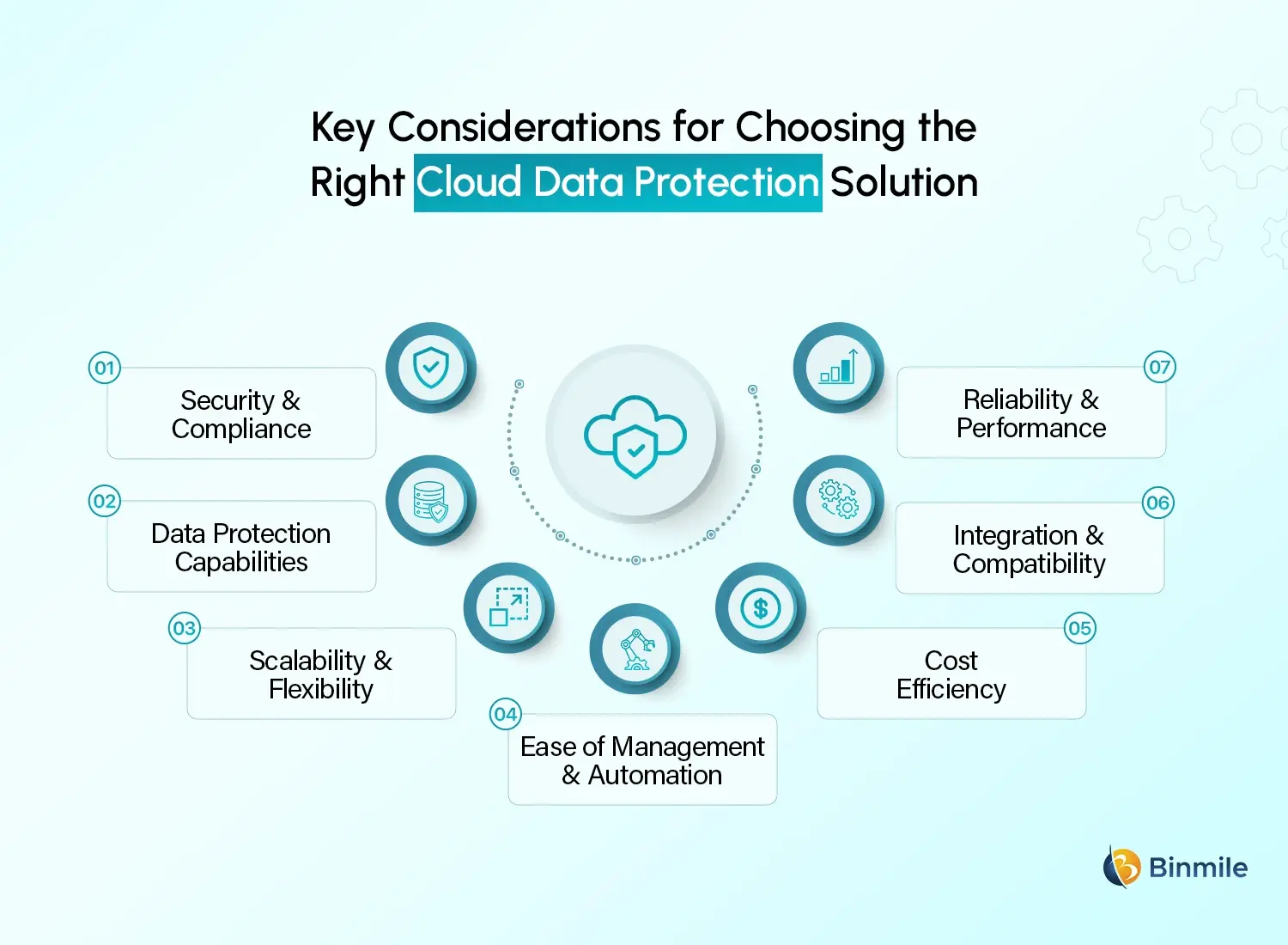
It is essential to consider evaluating compliance features that are in line with your industry standards and reporting requirements before deciding on a specific cloud data protection solution. Additionally, it is important to evaluate recovery features closely to ensure that you will be able to recover your critical systems and data quickly after an event. The ideal solution will align the security objectives of your organization with the overall goals of your organization’s business transformation through cloud modernization.
What Are Cloud Data Loss Prevention and Data Security Tools
Modern enterprises increasingly rely on cloud data loss prevention technologies to safeguard sensitive information. These solutions help organizations:
-
Detecting Sensitive Data
Identifies sensitive data across different cloud environments to enhance protection and compliance.
-
Monitoring User Activity
Monitors user actions to detect any suspicious behavior that may create a risk to the security of your organization.
-
Preventing Unauthorized Data Sharing
Prevention of Sensitive Data Sharing Outside of Approved Channels.
-
Enforcing Security Policies
Automated means of controlling security policies to consistently provide a high level of protection across all areas of the cloud.
-
Reducing Insider Threats
Identifying patterns of access to data to determine if there are any unusual behaviors that may indicate a risk of insider threat.
Several categories of cloud data security tools support enterprise protection efforts:
| Tool Category | Purpose |
|---|---|
| Data Loss Prevention | Prevent unauthorized data exposure |
| Cloud Security Posture Management | Detect misconfigurations |
| Identity and Access Management | Control user access |
| Backup and Recovery Solutions | Enable recovery |
| Encryption Platforms | Protect sensitive information |
| Security Information and Event Management | Monitor threats |
Selecting the right combination of tools depends on business requirements, regulatory obligations, and cloud maturity levels.
Planning a cloud migration or modernization initiative without compromising data security and governance?
How Binmile Supports Enterprise Cloud Data Protection Initiatives
Building a secure cloud environment requires more than deploying security tools. It demands a strategic approach that aligns technology, governance, compliance, and business objectives. Organizations navigating cloud transformation often require guidance across architecture design, migration planning, data governance, analytics modernization, and operational security.
Binmile helps enterprises establish scalable cloud foundations by combining expertise in cloud consulting, cloud migration, data engineering services, data analytics, automation, and regulatory readiness initiatives. By integrating security throughout the cloud lifecycle, organizations can reduce risk, improve compliance, strengthen business continuity, and maximize the value of their cloud investments while maintaining confidence in the protection of critical business data.
Frequently Asked Questions
Cloud data protection refers to the policies, technologies, and controls used to secure data stored in cloud environments. It helps organizations prevent breaches, data loss, compliance violations, and operational disruptions while maintaining business continuity.
Traditional data protection focuses on on-premises infrastructure, while cloud data protection addresses dynamic cloud environments through automation, scalability, continuous monitoring, and cloud-native security controls designed for distributed systems.
Common threats include misconfigured resources, ransomware attacks, insider threats, weak access controls, insecure APIs, accidental deletion, and compliance failures that expose sensitive business and customer information.
Encryption protects data by making it unreadable to unauthorized users. It secures information during storage, transmission, and backup processes, reducing the impact of breaches and unauthorized access attempts.
Organizations can strengthen security by implementing centralized governance, consistent security policies, unified monitoring, identity management controls, encryption standards, and automated compliance processes across all cloud platforms.
Cloud data protection supports compliance through encryption, audit trails, access controls, monitoring, governance policies, and data lifecycle management practices that help organizations meet regulatory requirements and privacy obligations.
Yes. Cloud data protection enables automated backups, geographic redundancy, rapid recovery processes, and disaster recovery planning, helping organizations maintain operations and minimize downtime during unexpected incidents.