Every delayed project has a pattern. A few missed updates, unclear ownership, poor resource visibility, late risk detection, and suddenly the timeline starts slipping. This is exactly why AI in Project Management is getting serious attention from enterprise leaders. According to PMI, 80% of project management tasks are expected to be run by AI by 2030, while only 1% of organizations believe they have reached GenAI maturity. That gap tells a clear story. Businesses are interested in AI, but most are still figuring out how to use it in a practical, measurable, and responsible way.
This blog explores how AI is changing project management, where it delivers the most value, what challenges businesses need to prepare for, and how to adopt AI-powered project management software without creating more complexity. We will also look at AI use cases in project management, the role of automation, risk management, predictive analytics, project portfolio management, and best practices enterprises can follow to make AI useful rather than just impressive on paper.
What AI in Project Management Means and Why Businesses Are Paying Attention
AI in project management means using artificial intelligence to plan, track, manage, and improve project delivery. In contrast to traditional project management software, which is focused primarily on the organization of tasks, an AI-based project management system can use data from projects to analyze and predict delays, identify risks, and provide real-time corrective recommendations as issues arise.
Companies have started to recognize the use of AI in project management because project teams are looking for faster delivery, improved cost management, increased accountability, and clearer visibility across multiple projects. By using an AI-enabled project management assistant, project leaders can identify potential roadblocks, resource gaps, and timelines that are unrealistic before they negatively impact delivery.
The future of AI in project management will move beyond simply automating repetitive tasks. Instead, AI will serve as a decision-making support tool for CEOs, CTOs, and PMOs, allowing these leaders to manage projects more quickly, accurately, and confidently.
What Are the Benefits of AI in Project Management
The real Benefits of AI in Project Management become visible when AI solves actual delivery problems, improves visibility, reduces manual effort, and supports faster decisions.
1. Better Project Visibility
AI leverages every project aspect, including timeline and resources, and tracks these in real-time, allowing project managers to detect delays and risks and assess the overall health of the project.
2. Faster Decision-Making
An AI project management assistant simplifies summarizing project updates and tracks overdue tasks or health reports, giving a project manager more context for making faster decisions.
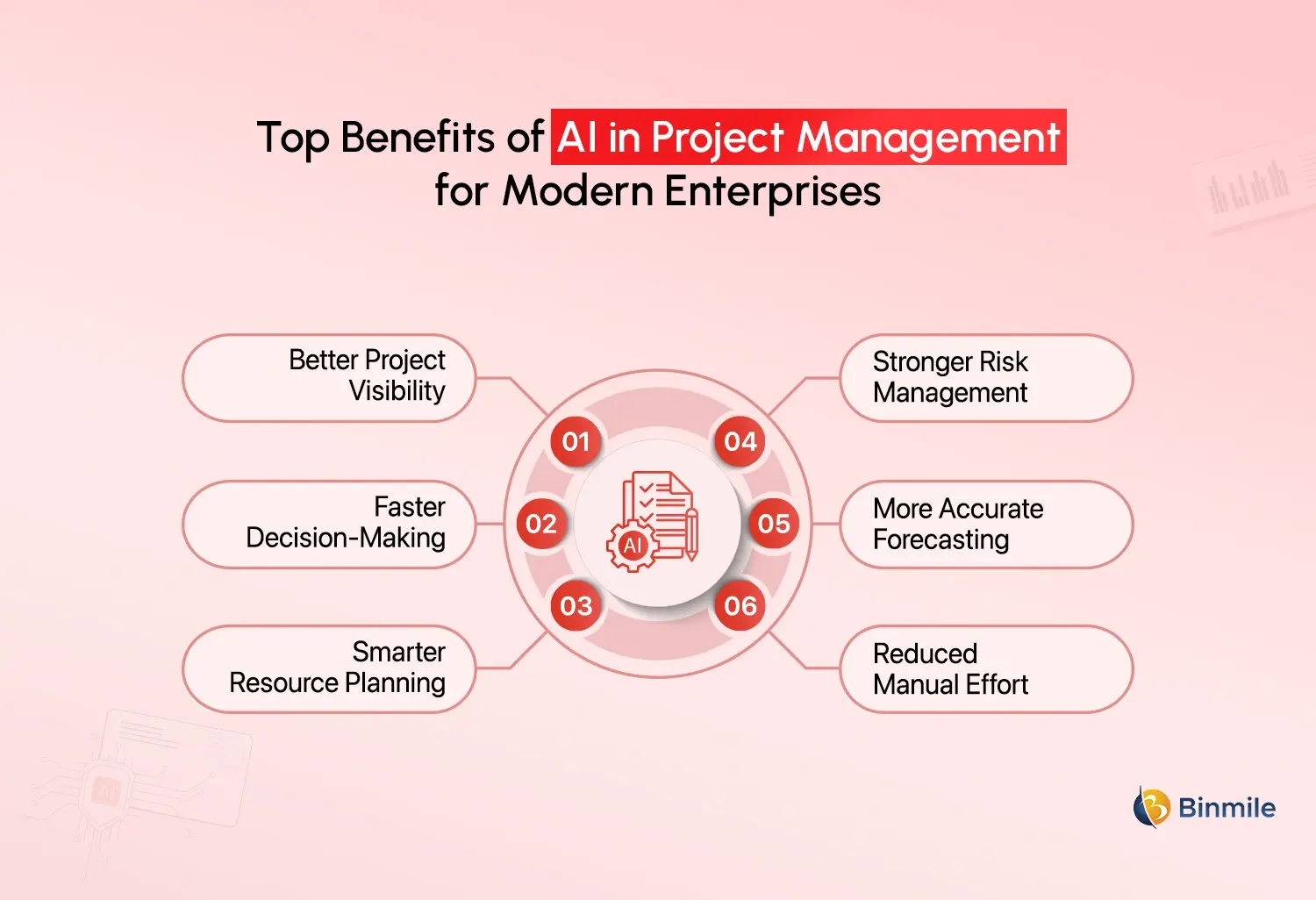
3. Smarter Resource Planning
AI will identify overbooked personnel, alongside any missing competencies, and instigate or monitor more evenly distributed work across a number of projects.
4. Stronger Risk Management
AI detects early warning signs such as delays, budget spikes, dependency gaps, and low sprint velocity before they impact delivery.
5. More Accurate Forecasting
Using predictive analytics, AI can calculate and track any future delays, cost overruns, personnel shortages, and delivery risks based on existing project history, as well as current progress and resource utilization.
6. Reduced Manual Effort
By automating the collection of status updates, meeting notes, reminders, documentation, and reporting, AI relieves the project manager’s workload and allows him/her to concentrate more on managing the workflows and results of each project.
Artificial Intelligence and Automation in Project Management
AI and automation can assist with project management when they reduce redundant work while retaining human decision-making. The following tasks can automate via AI: reporting, meeting summaries, updating tasks, sending reminders, documenting progress or changes, workflow routing, and approval follow-up.
For example, if all other similar projects have taken 14weeks, and the current project implementation time is 8 weeks, AI can point out that this is an unrealistic timeframe. AI can also alert the Project Team if a developer is assigned more than one (i.e., three) high-priority issues in the same sprint. Additionally, if prior projects have been delayed due to a key dependency, AI can flag the dependency before it affects the delivery schedule.
In addition, automation helps automate business process reviews, hand-offs, and escalations. In order to automate workflows successfully, companies must first define their review process (including owners), data flow, and approval process.
What Are the Key AI Use Cases in Project Management
AI use cases in project management are practical when they solve problems that teams face every day. Here are some of the most valuable applications.
| AI Use Case | How It Helps Businesses |
|---|---|
| Project Planning | Creates realistic schedules based on past project data, team capacity, dependencies, and delivery patterns. |
| Risk Management | Identifies early warning signs such as missed deadlines, budget issues, blockers, and poor task progress. |
| Resource Allocation | Helps assign the right people based on availability, skills, workload, and project priority. |
| Predictive Analytics | Forecasts possible delays, cost overruns, delivery risks, and completion timelines. |
| Demand Forecasting | Helps businesses predict future project demand, staffing needs, and delivery capacity. |
| Project Portfolio Management | Gives leaders visibility into multiple projects, priorities, risks, and ROI across the organization. |
| DevOps Project Tracking | Connects sprint data, release progress, defects, deployment frequency, and engineering blockers. |
| Reporting and Documentation | Automates status reports, meeting notes, stakeholder updates, and project summaries. |
| Budget Control | Tracks spending patterns and alerts teams when costs are likely to exceed planned limits. |
| Quality Management | Detects recurring defects, delayed reviews, testing bottlenecks, and process gaps. |
These AI applications in project management are especially useful for enterprises where teams work across multiple tools, departments, locations, and delivery models.
Want to bring smarter automation, forecasting, and resource planning into your project workflows?
What is the Role of Agentic AI in Project Management
Agentic AI will be one of the most important trends in AI-driven project management software. Unlike traditional types of automation, which are limited to simple, repetitive tasks, agentic AIs can take an individual goal, break it down into a sequence of discrete steps to get there, execute the actions promptly, monitor how their progress impacts the original goal, and apply all of that input dynamically against the information that exists at that moment.
For instance, if there seems to be a delay in testing; the agentic AI can check to see if the development team has completed their assignment, determine that there is a dependency issue between testing and development, notify the project manager of the delay, and provide a recommended timeframe for completing the tests and delivering the product to market, all of which are much more than just providing a reminder to get something done.
To effectively use agentic AI in an organization, businesses must ensure that they have instituted proper governance mechanisms around agentic AI usage. The organization should identify where the AI will be allowed to operate autonomously and where human approval will be needed before actions are taken. Specifically regarding large enterprise projects, decisions that can have an impact on the overall success of the project should be supported by the AI as alternatives, and, in no circumstances, should the AI make critical business decisions without the appropriate level of supervision.
AI-Driven Project Management Tools and Software Selection
Choosing the right AI-driven project management tools requires more than checking whether a platform has AI features. Businesses need to evaluate whether the tool improves outcomes, integrates with existing systems, and supports secure, scalable operations.
1. Start With The Business Problem
Establish whether the objective is increased visibility, expedited delivery, enhanced forecasting, more effective resource planning, automated reporting, or lowered risk of project failure.
2. Check Planning And Forecasting Capabilities
A suitable AI-based project management solution must offer support for project scheduling, workload assessment, risk monitoring, tracking project budgets, and demand forecasting.
3. Look For Integration With Existing Systems
The solution must be able to integrate with current project management systems, DevOps transformations, CRM platforms, ERP applications, electronic collaboration tools, and business intelligence tools.
4. Evaluate Data Quality And Security
AI insights depend on clean data, secure access, role-based controls, privacy safeguards, auditability, and responsible handling of project information.
5. Prioritize Usability For Teams
The solution must provide all project managers, developers, delivery teams, and business leaders with an interface that enables them to use the solution consistently.
6. Measure Business Impact
Using the tool should create an improvement in predicted delivery times, resource utilization, and time to produce project status reports, as well as improve the management of the project overall and hold the management team to that standard.
What Are the Challenges of AI in Project Management
The challenges of artificial intelligence in project management vary widely from project delivery improvement to the efficacy of AI based on data quality and governance, as well as responsible use of AI. Project updates to be useful for AI must be complete and not out of date, or exist across multiple disconnected tools, which prevents AI from analyzing data in a reliable manner.
Overreliance on AI can also represent another challenge, as teams will use the recommendations generated by AI without doing any steering away from the business context, stakeholder priorities, and technical constraints. Change management needs careful attention since project managers may resist the use of AI because of their belief that the implementation of AI to monitor their work or replace them.
Finally, security is a significant concern as various AI tools for project management will be processing sensitive data regarding the project, clients, financial, or internal information. Enterprises must provide adequate measures in terms of privacy, access control, auditing, and governance of responsible AI before scaling the use of AI.
What Are the Best Practices for Using AI in Project Management?
Adopting AI in project management should begin with a clear strategy. Businesses need to understand where AI fits, what it improves, and where human decision-making remains necessary.
1. Begin With Clear Business Goals
Before introducing a technology like AI into your organization, you should know your business objectives for AI implementation (e.g., reducing delays, improving visibility, automating reporting, enhancing risk management, and improving forecasting accuracy).
2. Start With Focused Use Cases
You should focus on initial use cases for AI by your organization, such as status updates, risk alerts, planning resources, and forecasting projects, before implementing AI across the organization.
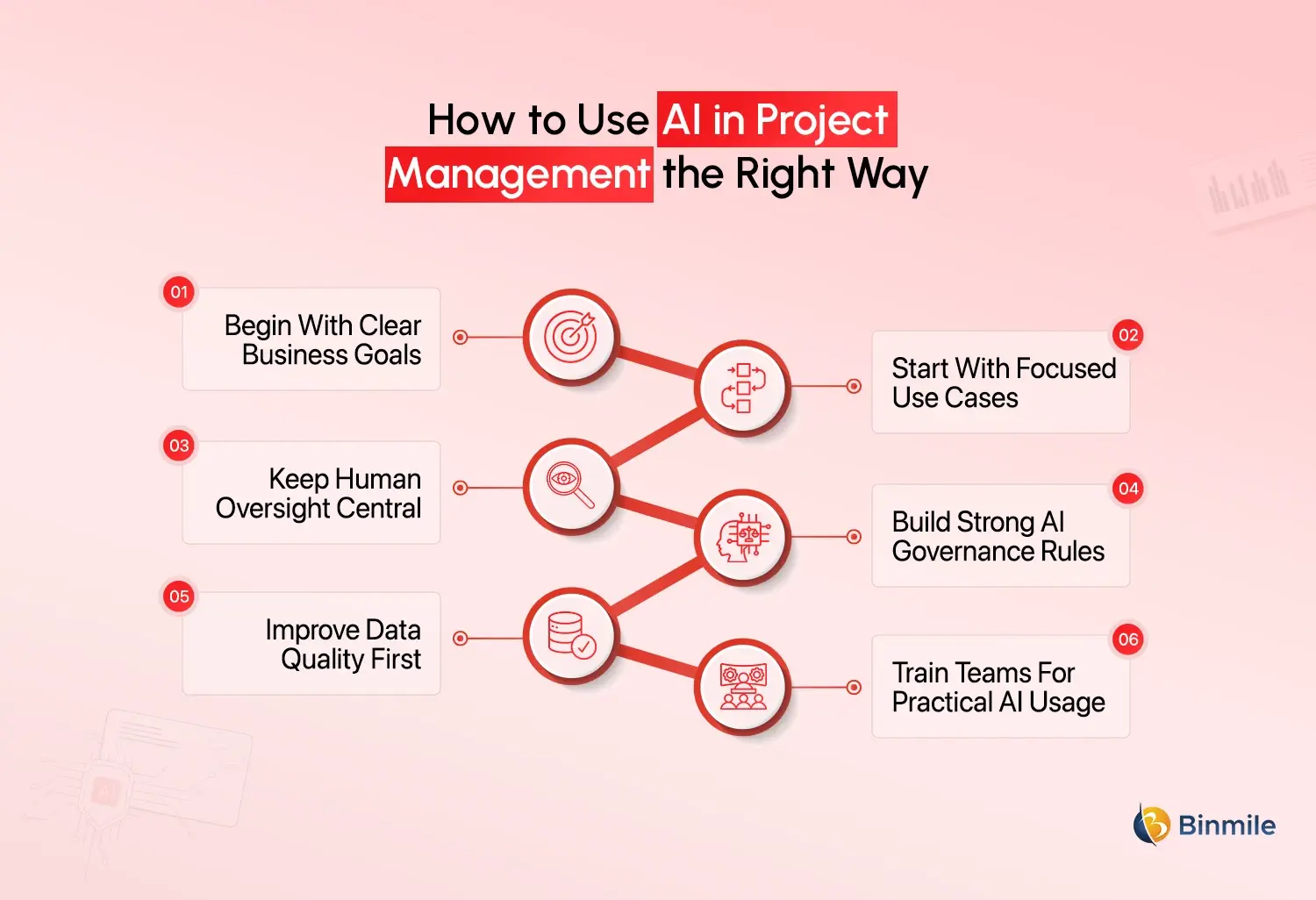
3. Keep Human Oversight Central
While AI can recommend and automate tasks, project managers must make the final decision regarding changes to scope or budget, notifications to stakeholders, and trade-offs in project delivery.
4. Build Strong AI Governance Rules
Define what authorized individuals can use AI and which types of data can be processed by AI; define which actions require approval; define how outputs of AI are evaluated.
5. Improve Data Quality First
Before using AI for insights, it’s essential to improve data quality, i.e., providing accurate updates, clear ownership of data, use of structured workflows, and consistent output reporting.
6. Train Teams For Practical AI Usage
Provide project team members with training regarding where they will have the most value from AI, how the AI recommendation will be generated, and when the AI result will require another person to verify.
What Is the Future of AI in Project Management?
Smarter assistants, predictive planning, automated reporting, intelligent resource management, and agentic workflows shape the future of AI in project management. AI project management trends are moving from simple task automation toward decision support and intelligent project orchestration. AI will also become more connected with project portfolio management, helping leaders identify high-value projects, resource-heavy initiatives, and priorities that need adjustment.
For software teams, AI will support DevOps project workflows by connecting planning, development, testing, deployment, defect tracking, and release management. However, the real value will come from combining AI development with clean data, strong processes, skilled teams, and clear governance.
Need AI-powered project management software to improve delivery visibility, reduce risks, and accelerate project outcomes?
How the Right Technology Partner Can Help
AI adoption in project management works best when it aligns with business goals, existing workflows, and enterprise technology systems. Many organizations do not need another disconnected tool. They need a practical roadmap that connects AI with planning, automation, reporting, governance, and delivery operations.
For businesses exploring AI-powered project management software, Binmile can support AI development, business process automation, custom project management software, intelligent workflow solutions, and integration-led implementation. The focus is on building scalable systems that help teams improve visibility, reduce manual effort, strengthen decision-making, and manage projects with greater confidence.
The right approach begins with current delivery challenges, high-value AI use cases, modernized workflows, and solutions that fit the way teams actually work. That is how AI moves from experimentation to measurable project impact.
Frequently Asked Questions
AI in Project Management means using artificial intelligence to plan, track, manage, and improve project delivery. It helps teams automate updates, forecast risks, manage resources, analyze progress, and make better decisions using project data.
AI improves efficiency by automating repetitive work such as reporting, reminders, task updates, meeting summaries, and progress tracking. It also helps project managers identify delays, allocate resources better, and focus more on decisions instead of manual coordination.
Yes, AI can detect early risk signals such as delayed tasks, budget changes, resource overload, missed dependencies, and poor progress patterns. It helps teams take corrective action earlier instead of waiting until the project is already off track.
AI supports planning by analyzing past project data, team capacity, skill availability, and delivery timelines. It can recommend realistic schedules, identify overloaded team members, highlight missing skills, and improve resource allocation across multiple projects.
No, AI does not replace project managers. It supports them by handling repetitive tasks, improving visibility, and providing useful recommendations. Human judgment is still needed for leadership, stakeholder communication, conflict resolution, prioritization, and strategic decisions.
AI improves forecasting by studying historical project data, current progress, team performance, dependencies, and risk patterns. It can predict possible delays, budget overruns, and resource gaps more accurately than manual tracking alone.