Artificial intelligence is changing how businesses manage operations, analyze information, interact with customers, and make strategic decisions. From generative AI assistants to intelligent automation, organizations are increasingly incorporating AI into everyday workflows. However, as adoption grows, concerns about how these systems collect, process, store, and use sensitive information are also increasing.
Public AI tools offer convenience, but they can introduce data privacy and security risks when employees use them to process confidential documents, customer records, financial information, or proprietary business data. For organizations operating in regulated industries, even unintended exposure can result in financial, legal, and reputational consequences. These concerns are also influencing AI trends and how businesses approach AI privacy and security.
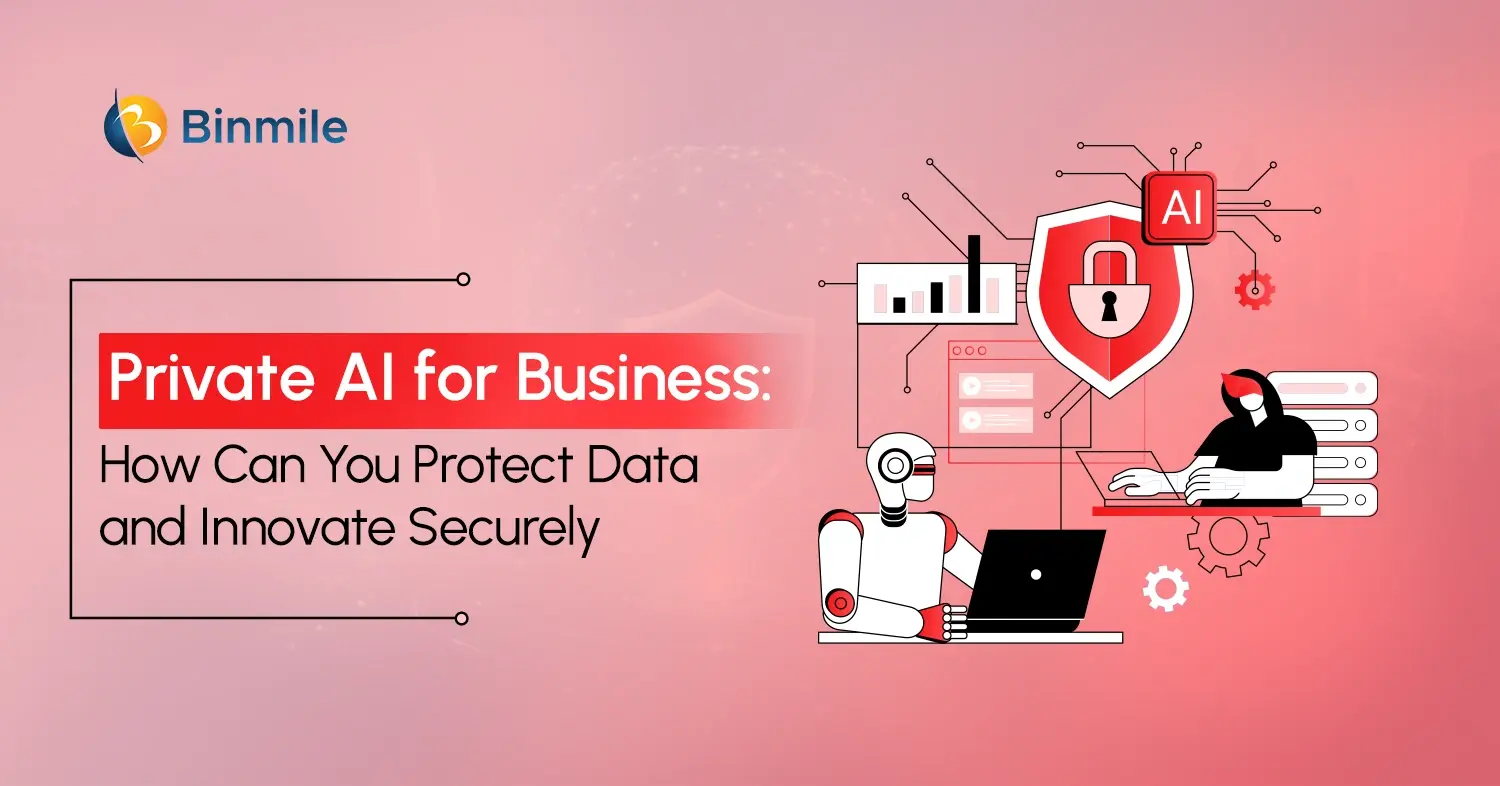
This is where private AI for business becomes important. It allows organizations to use AI capabilities within controlled environments while maintaining greater authority over their data, models, access permissions, and deployment policies. Let’s explore how private AI works, its business benefits, implementation approaches, and the practices organizations can follow to adopt AI securely.
What Is Private AI, and Why Does It Matter for Businesses?
Private AI refers to artificial intelligence systems that operate within an organization’s controlled infrastructure or a dedicated environment managed under its security and governance requirements. Unlike conventional public AI services, private AI gives businesses greater control over how their information is accessed, processed, stored, and used. Additionally, this approach to AI in data privacy is becoming important for organizations that want to adopt AI without compromising sensitive information.
Private AI models can be hosted on in-house servers, in private clouds, or in dedicated cloud spaces. Additionally, the models can be integrated with in-house databases, applications, and information sources, meaning that information within an organization may not be made available to public AI. Additionally, a well-managed private AI environment can also support cloud data protection by keeping sensitive information within controlled infrastructure.
For example, a financial services business might use private AI to analyze reports, summarize customer interactions, and search policy information without unnecessarily exposing confidential information to external systems.
Beyond data, businesses must consider what data is fed into the AI model, whether it is stored, what access is permitted, and whether it is used to train the model. Additionally, as AI becomes more common in business processes, ensuring data privacy and security within AI must be considered from the beginning of implementation. This is also an important part of AI privacy compliance and the wider AI privacy frameworks businesses need to consider.
How Does Private AI for Business Protect Sensitive Data?
Private AI for business introduces multiple layers of protection that help organizations manage sensitive information throughout the AI lifecycle. Its effectiveness depends on the underlying architecture, security controls, and data governance policies. Additionally, businesses can also use AI consulting services to assess their requirements and plan a secure private AI deployment.
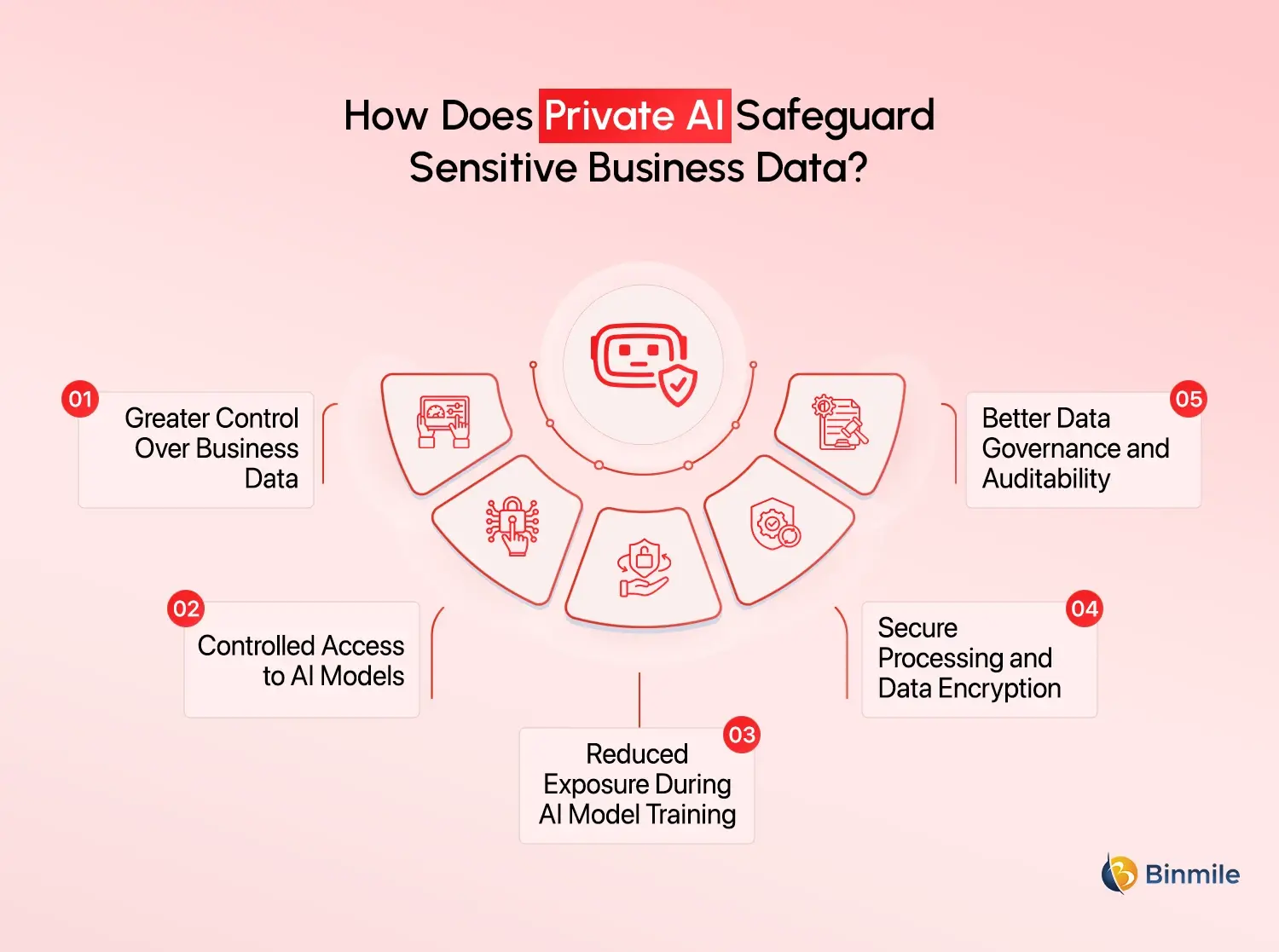
1. Greater Control Over Business Data
Depending on the implementation method in place, sensitive datasets can be stored within internal systems or within dedicated cloud spaces. Appropriate access and retention policies can be set depending on the implementation. Additionally, these measures support AI privacy protection by limiting how sensitive information is accessed and processed.
This is valuable if AI is processing sensitive data such as intellectual property, staff information, financial data, and customer databases. Organizations can also establish data governance practices to define how information is managed throughout the AI lifecycle.
2. Controlled Access to AI Models
Businesses can apply role-based access so that only the correct employees, applications, and systems can access specific models and data sets.
For example, an HR assistant may only be allowed to access approved policy documents for staff, whereas a financial analysis AI may be allowed to search for approved finance information. Additionally, this reduces unauthorized access and improves accountability. Additionally, such controls are particularly important for AI for enterprises that handle different categories of confidential information.
3. Reduced Exposure During AI Model Training
Businesses can put policies in place to limit whether information is used to improve third-party AI models. Alternatively, businesses may also host AI models internally, or use controlled fine-tuning processes to improve models using their proprietary data.
It is important to carefully control whether sensitive data is entered into AI models, as without appropriate security measures in place, this information may be stored within logs or chats. This is an important consideration for LLM AI privacy, particularly when models process confidential business information.
4. Secure Processing and Data Encryption
Data at rest and in transit can be protected through encryption. In addition to this, network segmentation, secure authentication methods, and monitoring can be applied. This means that data is secure as it is passed between different applications, databases, AI models, and users within the business. Additionally, these controls also help address AI privacy violations and reduce unnecessary exposure during private AI integration.
5. Better Data Governance and Auditability
Policies can be put in place within businesses to regulate data access, usage, retention, and monitoring. Additionally, security teams can create logs to monitor access within the system and identify any suspicious activity to improve data management within the organization. Additionally, this improves accountability within businesses and supports AI privacy standards.
What Are the Key Business Benefits of Private AI?
Private AI is not just a security investment. It can also help organizations use proprietary information, improve operational efficiency, and expand AI adoption across business functions. A private AI investment can support private AI transformation when it is aligned with business requirements and long-term objectives.
-
Protecting Intellectual Property
Businesses often operate proprietary data, including source code, product designs, business strategy, and confidential documentation. By using private AI, businesses can develop workflows using this data and ensure appropriate security and access are in place. Additionally, this can be especially valuable for businesses working with Artificial Intelligence development services to build applications around proprietary information.
-
Supporting Regulatory Compliance
Businesses must understand how personal and sensitive data is being handled by AI systems. Using private AI can make it easier to meet data location, access, retention, and auditing requirements.
Within India, the Digital Personal Data Protection Act, 2023, and DPDP Rules, 2025 are important considerations for businesses processing digital personal data. However, simply using private AI may not be enough to meet these regulations. Businesses should also evaluate their DPDP readiness and understand the AI privacy challenges associated with their data processing activities.
-
Improving Operational Efficiency
Private AI can complete tasks such as summarizing documents, searching for knowledge within internal data, creating reports, and categorizing information. Employees can find relevant information to complete tasks more quickly, therefore improving efficiency. Additionally, these applications can also support data security and privacy in GenAI when implemented with appropriate access and governance controls.
-
Enabling Enterprise AI Adoption
Worries around data exposure may mean that businesses are hesitant to move AI beyond experimentation. However, implementing a well-designed private AI solution enables businesses to experiment with AI applications and scale according to internal requirements. This can help organizations manage AI risk in business while expanding private AI adoption across departments.
-
Building Customer Trust
Customers, staff members, and business partners expect businesses to appropriately manage their data. By having transparent data handling, restricting access, and consistently applying security measures, trust can be improved.
What Is the Difference Between Private AI and Public AI?
The primary difference between private AI and public AI lies in the level of control an organization has over infrastructure, data processing, model access, and governance policies.
| Comparison Factor | Public AI | Private AI |
|---|---|---|
| Deployment | Public platforms or APIs | Controlled or dedicated environments |
| Data Control | Depends on provider policies and configuration | Greater organizational control |
| Access Management | Platform-level controls | Enterprise access policies and permissions |
| Customization | Depends on provider capabilities | Greater flexibility for customization |
| Data Governance | Shared responsibility | Policies aligned with internal requirements |
| Infrastructure | Generally provider-managed | On-premises, private cloud, or dedicated cloud |
Public AI does not necessarily mean insecure AI. Additionally, established providers offer enterprise services with encryption, contractual data protections, and options to prevent customer information from being used for model training.
Similarly, private AI is not automatically secure simply because it operates within an organization’s infrastructure. Its security depends on how well the environment is designed and maintained. Businesses should evaluate private AI technologies and AI privacy tools according to their security and operational requirements.
Some organizations may benefit from a hybrid approach that combines public AI services for low-risk tasks with private AI for sensitive workloads. This can help businesses manage AI sprawl in enterprises by defining where different AI applications can be used.
Which Industries Can Benefit From Private AI for Enterprises?
Private AI for enterprises is particularly valuable for industries that process confidential, personal, or commercially sensitive information.
-
Banking and Financial Services
Banks hold data relating to their customers (identities, transaction history, financial details). Private AI can be used to detect fraud, analyze risk, process documents, and improve customer service, while controlling access to sensitive data.
-
Healthcare
Healthcare businesses contain data on electronic health records, medical history, and diagnosis. Private AI can be used to improve clinical documentation, medical research, administrative processes, and information searches, with appropriate privacy measures in place.
-
Retail and eCommerce
Retailers can use private AI to analyze sales data, manage stock, improve demand forecasting, and gain insights into customer behaviors. Customer data can be appropriately protected within this process.
-
Manufacturing
Manufacturers hold proprietary information on products, operational data, and supply chain data. Additionally, private AI can be used to improve predictive maintenance, analyze production data, monitor quality, and improve internal knowledge management.
-
Government and Public Sector
Government bodies hold records on citizens, administrative data, and sensitive public data. Additionally, private AI can improve document management and information searching with appropriate data protection and accountability.
-
Technology and Software Development
Technology companies hold source code, product roadmaps, and technical documentation. Private AI can be used to improve code analysis, software testing, and documentation without unnecessarily exposing intellectual property.
Explore private AI solutions designed to protect sensitive business data while supporting innovation.
How Can Businesses Implement a Secure Private AI Solution?
Adopting private AI requires more than selecting a model or purchasing infrastructure. Businesses need an implementation strategy that considers their technology environment, data sensitivity, security requirements, and long-term objectives. Organizations can also seek AI consulting services to evaluate their requirements before beginning private AI deployment.
1. Identify Business Requirements and Data Sensitivity
Identify the benefits that AI can bring to your business. Determine what type of data will be processed by the AI application.
Classify data as ‘public’, ‘internal’, ‘confidential ’, or ‘restricted’ within the business. This allows businesses to decide which workloads can be completed using public AI and which workloads require private AI.
2. Select the Right Deployment Model
Businesses can choose from different deployment approaches:
- On-Premises Deployment: AI models are run on infrastructure managed by the business. This gives increased control over the computational environment.
- Private Cloud Deployment: AI models are run in dedicated or isolated sections of the cloud. Security measures can be applied.
- Hybrid Deployment: A combination of on-premises, private cloud, and selected public AI implementations.
- Edge Deployment: Models process information closer to where it is generated, reducing data movement and latency for certain applications.
Each approach involves different infrastructure, maintenance, scalability, and cost considerations.
3. Choose Appropriate AI Models and Technologies
Depending on performance, licensing, customization, and infrastructure requirements, businesses must consider using open-weight models, commercial models with licensing, or managed enterprise AI.
Consider whether fine-tuned models or retrieval-augmented generation (RAG) models would be most suitable. Additionally, RAG models can be connected to approved internal data sources, allowing the AI model to search for relevant data in order to produce a response.
When deployed within a secure environment, this enables businesses to make use of proprietary information without including all internal documents within the training data for models. Additionally, the right private AI solution can also support private AI transformation by enabling organizations to use their existing information securely.
4. Establish Security and Privacy Controls
Security should be considered at each stage within the deployment of private AI within businesses. Encryption, multi-factor authentication, role-based access, secure API connections, network segmentation, and monitoring should be implemented. Additionally, businesses should put in place data retention, prompt logging, staff permissions, and third-party integration policies. These measures are important for modern AI privacy and can help businesses address AI privacy and security requirements.
5. Integrate Private AI With Existing Systems
Private AI models should be compatible with existing systems used within businesses. Models may need to be integrated with ERP systems, CRM systems, databases, and document stores.
Carefully planning the integration of private AI means that secure data can be shared with models without granting models unrestricted access to enterprise data. Additionally, businesses working with Artificial Intelligence development services can also evaluate how these integrations align with existing applications and infrastructure.
6. Test, Monitor, and Scale Gradually
Piloting AI within the business can allow businesses to understand the performance, security, accuracy, and infrastructure requirements of models.
During testing, models should be tested for prompt injection, unauthorized data retrieval, and leaking of sensitive data. Once deployed, models should be continuously monitored to understand the models’ behavior, access, and security issues.
What Are the Best Practices for AI Privacy and Security?
Even a well-designed private AI environment requires ongoing governance. Businesses need policies that address privacy risks throughout the AI lifecycle.
Some important AI privacy best practices include:
-
Apply Data Minimization
Only allow AI models to process data required for the task. Do not allow AI to have unrestricted access to databases or document stores.
-
Implement Least-Privilege Access
Only allow users and applications to have access to the data needed for their role. This prevents unauthorized access to sensitive data.
-
Establish Retention Policies
Create policies to dictate how long prompts, outputs, logs, and related datasets should be stored, and when they should be removed.
-
Review Third-Party Providers
Check the security of vendors, data handling agreements, training of models, and data retention settings.
-
Monitor AI Interactions
Keep appropriate logs. If there are unusual patterns of access to data, requests for sensitive data, or unexpected behavior from models, this should be investigated.
-
Conduct Security Assessments
Regularly check AI applications to ensure no data is leaked, prompt injection is not possible, and that no vulnerabilities exist within supporting infrastructure.
-
Train Employees
Clearly define what data staff members can send to AI tools and which systems can be used to complete certain tasks within the business.
What Are the Major Challenges of Private AI Adoption?
Despite its advantages, private AI adoption involves technical and operational challenges. Understanding these AI privacy challenges can help businesses prepare for the requirements of private AI deployment.
-
Infrastructure and Investment Requirements
To run private AI models, specific resources may be required (computing power, data storage, network resources, etc.) Businesses must consider the costs of these resources compared to expected gains.
-
Integration Complexity
Integrating AI models with legacy systems and fragmented data sources can be complex. If integration is poorly planned, security risks may occur.
-
Model Performance and Scalability
Optimizations may be required to ensure models can perform with the accuracy, speed, and scalability required by users within the enterprise.
-
Governance and Accountability
As AI adoption increases, version control, access control, data usage, and managing AI outputs for models become more complex.
-
Technical Expertise
Private AI requires knowledge of AI engineering, cloud infrastructure, cybersecurity, and data architecture. External technical assistance may be required to meet these requirements.
What Does the Future of AI Privacy Look Like?
The future of AI data privacy depends on how well businesses can balance intelligent automation with data protection. Enhancing data privacy can be achieved with techniques such as differential privacy, federated learning, and secure multi-party computation. This means that businesses can analyze and train models with reduced exposure to sensitive data. Confidential computing, with trusted execution environments provided by hardware, can also be used to add further protection to data.
Small, specific models may be used more within AI, allowing them to be deployed easily in controlled environments. However, with more rigorous AI governance in place, assessments of risk, monitoring of models, data traceability, and access control will be more important. As AI agents become more integrated with internal applications, careful consideration must be made of what permissions are given to AI agents, what tools they can access, and the data boundaries. Therefore, within modern businesses, data privacy within AI will be shaped significantly. This will influence how businesses invest in, implement, and integrate private AI. The future of AI privacy will also depend on how businesses respond to evolving AI privacy standards and AI privacy frameworks.
Partner with Binmile to implement private AI solutions aligned with your business goals.
How Can Binmile Help Businesses Embrace Private AI?
AI innovation and data protection do not have to work against each other. Additionally, with the right architecture, security controls, and governance practices, organizations can use AI to improve business processes while maintaining greater control over sensitive information.
Private AI for business offers a practical approach to addressing privacy concerns, protecting proprietary data, and supporting responsible enterprise AI adoption. However, its success depends on selecting the right deployment model, integrating appropriate security measures, and continuously evaluating risks.
At Binmile, we help organizations explore secure, scalable AI solutions aligned with their business objectives. Our teams can support this journey through Artificial Intelligence development services, enterprise AI integration, and strategic consulting.
Frequently Asked Questions
Private AI refers to AI systems deployed within an organization’s controlled infrastructure or dedicated environment. It gives businesses greater control over data access, processing, and storage while supporting secure automation and decision-making.
Private AI for business can protect sensitive information through encryption, network isolation, role-based access controls, secure model deployment, and defined data retention policies.
Public AI generally operates through provider-managed platforms and APIs, whereas private AI runs within controlled or dedicated environments. Private AI offers greater control over data handling, infrastructure, and access policies.
Banking, healthcare, insurance, manufacturing, retail, government, and technology companies can benefit from private AI because they frequently process sensitive customer information and confidential business records.
Yes. Private AI is suitable for enterprises that need greater control over sensitive information, model access, data governance, and AI deployment. It can support applications across departments with appropriate infrastructure and security measures.
Businesses can implement a secure private AI solution by identifying data sensitivity requirements, selecting an appropriate deployment model, evaluating AI technologies, establishing security controls, integrating existing systems, and continuously monitoring performance and risks.