As AI adoption expands across customer service, finance, HR, development, and operations, enterprises face growing risks from the increasing number of tools, models, and agents operating across their business functions.
Different teams may decide to implement AI platforms, agents, or automation processes to improve productivity; however, this can cause issues with fragmentation, duplicated spend, and security.
This becomes a growing challenge as enterprises expand their use of AI across business functions. CIOs, CTOs, and CISOs will look to centralize, structure, and put in risk-based controls so they can manage this growing AI ecosystem without impacting innovation.
What Is AI Sprawl in Enterprises?
AI Sprawl refers to when there are too many AI tools, models, applications, agents, and workflows being used without any central visibility, control, or ownership. Departments may start to implement their own AI solutions, causing fragmentation and inconsistencies in security.
This can be caused by using multiple AI platforms, multiple models across the cloud, AI apps being developed independently, and agents without visibility. Employees may also begin using shadow AI without authorization.
As systems start to become integrated, managing AI sprawl becomes much more complex. This can cause vulnerabilities, data exposure, compliance issues and can cause problems.
AI Sprawl vs. AI Agent Sprawl: What Is the Difference?
Although the terms are closely related, they describe different aspects of enterprise AI adoption.
| Aspect | AI Sprawl | AI Agent Sprawl |
|---|---|---|
| Scope | AI tools, models, applications, and systems | AI agents and agent-based workflows |
| Primary Concern | Fragmented AI ecosystem | Uncontrolled autonomous or semi-autonomous activity |
| Common Example | Multiple teams using different AI platforms | Multiple agents accessing shared systems without coordination |
| Key Risks | Cost duplication, inconsistent governance, data exposure | Excessive permissions, conflicting actions, unpredictable behavior |
| Governance Priority | Enterprise-wide AI visibility and control | Agent identity, autonomy, permissions, and lifecycle management |
AI agent sprawl is particularly challenging because agents can do more than generate content or provide recommendations. Depending on their configuration, they may execute transactions, update records, trigger workflows, or interact with other agents.
An agentic AI architecture can help define how these agents interact with enterprise systems and each other.
As a result, managing AI sprawl requires organizations to govern both the technologies they deploy and the actions those technologies can perform.
Why AI Sprawl Is Becoming an Enterprise Challenge
AI adoption is becoming increasingly decentralized as teams can access AI through SaaS platforms, cloud services, and low-code tools. While this accelerates innovation, it also makes it harder for IT and security teams to maintain visibility and control.
Gartner predicted in April 2026 that the average global Fortune 500 enterprise could have more than 150,000 AI agents in use by 2028, compared with fewer than 15 in 2025. It is also reported that only 13% of organizations believed they had the right AI agent governance in place.
Several factors are driving enterprise AI sprawl.
1. Decentralized AI Adoption
This allows departments to independently adopt AI tools without centralized procurement or governance, often leading to duplication.
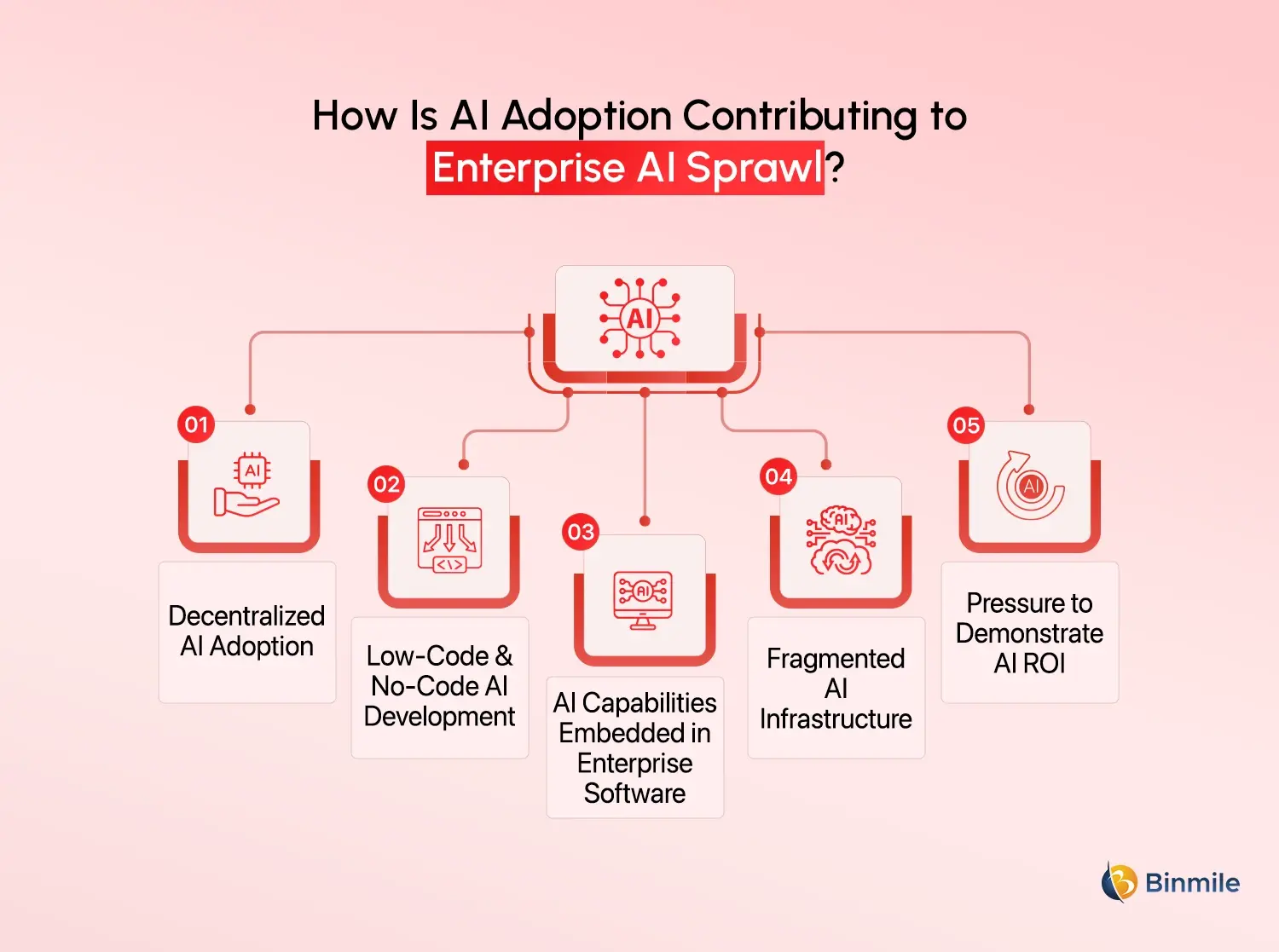
2. Low-Code and No-Code AI Development
AI agent builder tools make it easy to develop applications & workflows but can cause issues with security as AI is being developed quickly.
3. AI Capabilities Embedded in Enterprise Software
AI assistants and copilots are becoming prevalent within enterprise applications. New features and upgrades can encourage wider AI adoption across the enterprise.
4. Fragmented AI Infrastructure
AI workloads often run across multiple cloud platforms, SaaS applications, and models, which can make monitoring, control, and cost management difficult.
Organizations using Artificial Intelligence as a Service must also consider the AI tools, models, and integrations introduced through external providers.
5. Pressure to Demonstrate AI ROI
Teams may adopt new AI tools for quick productivity wins without considering what they already have, creating duplication.
What Are the Key Risks of AI Sprawl in Enterprises To Be Addressed?
Unmanaged AI sprawl can expose enterprises to security vulnerabilities, data breaches, rising costs, compliance gaps, and operational disruptions. As AI becomes embedded in business-critical workflows, these risks can affect both business performance and customer trust.
1. Expanding the Enterprise Attack Surface
Using a lot many AI applications, models and agents can cause security issues. If left unchecked, there may be over-permissioning, insecure integrations, and access to sensitive data.
This can be exploited by agents if they have been compromised or are incorrectly configured.
Enterprise Implication: AI security must cover identities, permissions, integrations, and execution environments, not just AI models.
2. Data Exposure and Privacy Violations
AI often deals with sensitive data within the enterprise. If there is no consistent access control in place, then this can cause data to be exposed through unauthorized applications, incorrectly configured agents, and third-party platforms.
This can cause issues with privacy and can cause problems with regulations such as GDPR and India’s Digital Personal Data Protection Act.
Enterprise Implication: Data governance must control how AI systems access, process, retain, and share enterprise information.
3. Excessive Agent Permissions and Uncontrolled Actions
AI agents can perform actions across the enterprise, causing issues with too many permissions.
For example, if an agent is used for procurement and has full permissions they can change purchase orders. If multiple agents are not working together, this can cause conflicts and incorrect transactions.
Enterprise Implication: AI agents need defined permissions, autonomy limits, human approval mechanisms, and controls to stop or reverse high-impact actions.
4. Rising AI Infrastructure and Operational Costs
Having too much AI can increase costs by having duplicate subscriptions, duplication, duplicate applications, and models not being used efficiently.
Agents with autonomy can cause unexpected costs by calling models multiple times, having multi-step workflows, and loops.
Enterprise Implication: Organizations need visibility into AI usage, infrastructure costs, licensing, and cost per business outcome to identify inefficiencies.
5. Regulatory and Governance Gaps
Having multiple AI solutions can cause difficulties ensuring consistency across the enterprise. It may be difficult to identify who owns what, what data is being used, ensure there are humans involved, and meet regulations.
Organizations may struggle to identify system owners, document data usage, demonstrate human oversight, or meet applicable regulatory requirements.
An AI risk management framework can help organizations identify, assess, and address risks across their AI systems.
Enterprise Implication: AI governance must include enforceable policies, documented responsibilities, continuous monitoring, and audit-ready records.
6. Reduced Trust in AI-Driven Decisions
Multiple AI solutions may give conflicting recommendations due to different data sources, model versions, and assumptions.
Without consistency in evaluating this, employees and leadership may struggle to know which outputs are reliable.
How to Detect and Assess AI Sprawl Across the Enterprise
Managing AI sprawl starts with understanding the enterprise AI footprint. Organizations must identify approved and unauthorized AI tools, models, agents, and workflows to assess risks, duplication, and governance gaps.
Step 1: Discover AI Systems Across Enterprise Environments
Identify AI tools, models, applications, agents, and integrations across your cloud platforms, SaaS applications, internal projects, and workflows. Look at procurement, API, and cloud usage to identify shadow AI.
Step 2: Create a Centralized AI Inventory
Maintain a centralized inventory to track AI systems, their ownership, purpose, data access, integrations, and risk levels. Keep the inventory updated as AI systems evolve.
Step 3: Assess AI Agent Risk and Autonomy
Evaluate your AI agents. Consider what data they have access to, how autonomous they are, permissions, business criticality, and the impact of incorrect actions.
If your agent is read-only, then fewer controls will be needed. However, if they have the ability to approve payments or change live systems, then you will need to consider risk-based controls.
Step 4: Identify Redundancy and Governance Gaps
Look through your list to identify duplication, multiple agents, unauthorized models, over-permissioning, and lack of ownership.
The objective is to eliminate unnecessary complexity while retaining capabilities required for business continuity and specialized workloads.
Step 5: Establish an Enterprise AI Sprawl Baseline
Define measurable indicators to assess the extent of AI sprawl and track improvements over time.
Key metrics to include are how many AI systems you have identified, percentage owned, unauthorized applications, over-permissioned agents, duplication, costs, and how many live agents have monitoring & auditing in place.
An AI maturity model can help assess these capabilities and identify areas where enterprise AI governance needs to improve.
These metrics help enterprise leaders prioritize remediation and measure governance effectiveness.
Build a scalable AI governance strategy that minimizes risks, reduces tool duplication, and drives measurable business value.

What Are the AI Sprawl Governance Strategies for Enterprises
Managing AI sprawl requires a governance model that supports innovation while maintaining security, accountability, and control.
1. Establish an AI Governance Framework
Ensure you have clear policies in place for approving, developing, monitoring & decommissioning AI. Ensure ownership across IT, Security, Compliance, and Business.
2. Apply Risk-Based AI Agent Governance
Put controls in place based on how autonomous your agents are and how business-critical they are. If your agent is just retrieving information, then basic access controls will be needed. If the agent is performing sensitive actions, then approvals, monitoring & auditing will be needed.
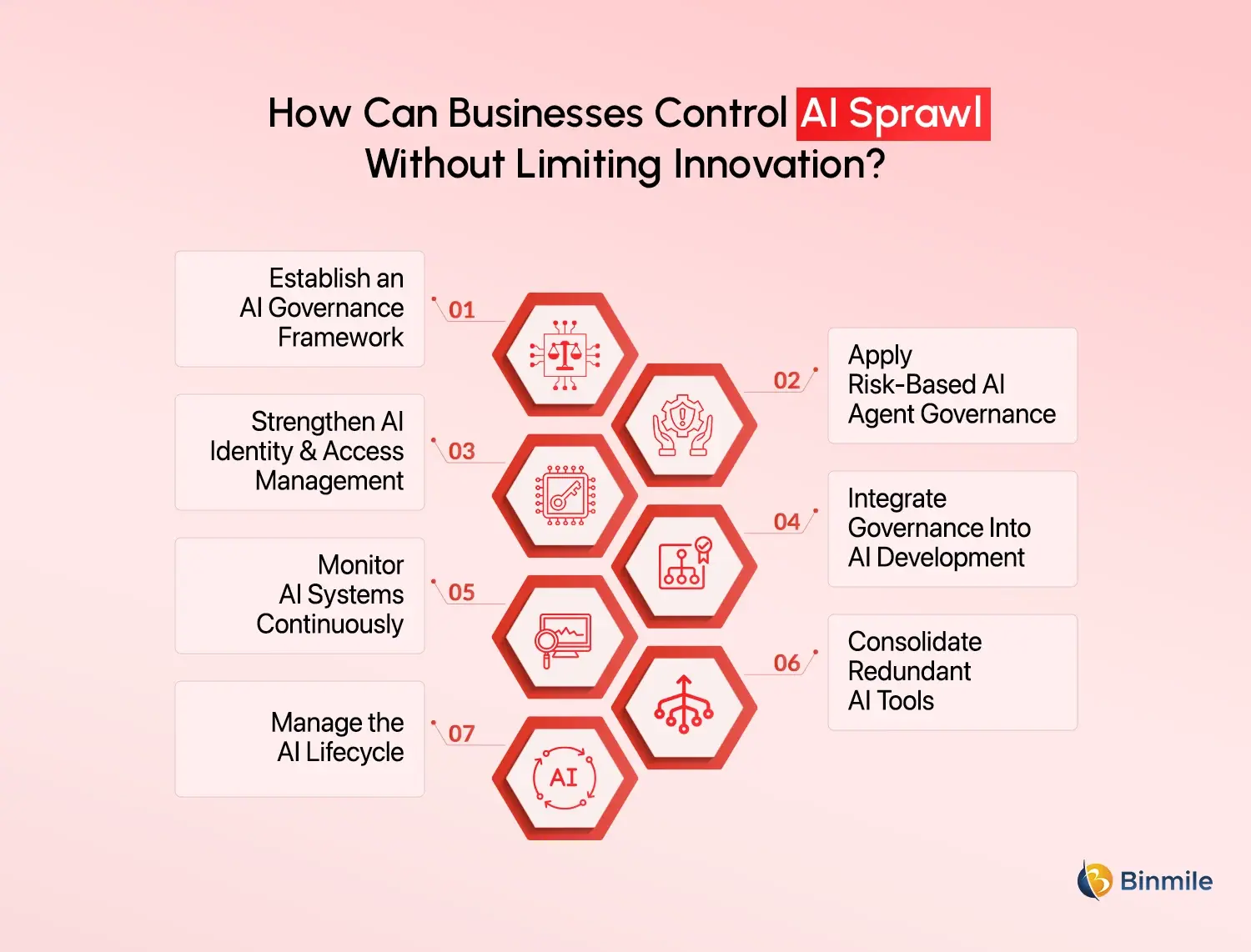
3. Strengthen AI Identity and Access Management
Ensure every agent has an identity, ownership, and least privilege. Regularly review permissions and decommission if the agent is no longer in use.
4. Integrate Governance Into AI Development
Ensure risk assessment, security testing, data validation, and approval are considered during development. Ensure clear boundaries are in place for any agent interactions and sensitive actions.
5. Monitor AI Systems Continuously
Monitor agent activity, model performance, data access, policy breaches, and resources. This can help identify risks and pause/restrict agents.
6. Consolidate Redundant AI Tools
Look across departments to see if there are any duplicate AI applications. This can help reduce costs, improve governance, and improve visibility of security.
7. Manage the AI Lifecycle
Ensure there are processes in place to register AI, deploy, update, change ownership, and decommission.
How To Build an Enterprise AI Governance Architecture
Governance becomes more effective when supported by an architecture that connects AI discovery, identity, security, orchestration, monitoring, and lifecycle management.
-
AI Discovery and Inventory Layer
Identify AI applications, models, agents, and integrations across your enterprise. This will help identify any unauthorized or duplicate AI.
-
Identity, Access, and Policy Layer
Ensure controls are in place for identities, permissions, and policies. Determine what data, applications, and actions each AI has access to.
-
AI Orchestration and Execution Layer
Manage how your AI models & agents interact with your enterprise. This will help with workflow management, access to tools, boundaries, and approvals.
Agentic Process Automation can connect AI-driven actions with enterprise workflows while maintaining appropriate controls.
-
Monitoring and Audit Layer
Have visibility into your AI. This will help identify issues, ensure auditing, and improve governance.
-
Enterprise Data and Integration Layer
Ensure your AI is integrated with your enterprise applications, databases, APIs & workflows. Ensure controls are in place for data access to ensure AI cannot access more than it should.
The architecture should be designed around the organization’s existing technology ecosystem, security requirements, and AI maturity rather than implemented as a standalone governance platform.
How Enterprise AI Governance Supports Business Outcomes
AI governance is often viewed as a compliance requirement. However, effective governance can also improve the business value of AI investments.
With visibility into their AI ecosystem, enterprises can make informed decisions about where to invest, which systems to consolidate, and which use cases are ready to scale.
| Governance Capability | Business Outcome |
|---|---|
| Centralized AI inventory | Better visibility into AI investments |
| Risk-based controls | Reduced exposure to AI-related risks |
| AI cost management | Improved control over expenditure |
| Standardized development | More consistent AI deployment |
| Clear ownership and monitoring | Stronger accountability and oversight |
An AI governance framework can help enterprises establish consistent policies, responsibilities, and oversight across their AI ecosystem.
The objective is to make AI adoption more predictable, secure, and measurable.
Ready to Govern AI at Scale? Partner with Binmile to build secure, scalable AI solutions aligned with your enterprise goals.

How Binmile Can Help Manage AI Sprawl in Enterprises
AI sprawl is more than a technology challenge. It requires a coordinated approach to AI engineering, architecture, security, and governance.
Binmile’s Artificial Intelligence development services help enterprises build AI solutions aligned with their business goals, existing systems, and security requirements.
From assessing AI ecosystems and closing governance gaps to designing scalable architectures and secure agentic workflows, Binmile helps organizations manage AI adoption with greater control. Our approach also supports AI tool consolidation, continuous monitoring, and lifecycle management.
For enterprises exploring Artificial Intelligence as a Service, the goal is to scale AI capabilities without adding unnecessary complexity. A well-governed AI ecosystem can help businesses move from fragmented adoption to a more coordinated enterprise strategy.
Frequently Asked Questions
AI sprawl in enterprises refers to the uncontrolled growth of AI tools, models, applications, and agents without consistent visibility, ownership, or governance. It can lead to security risks, data exposure, duplicate costs, compliance gaps, and operational complexity.
AI sprawl can increase security vulnerabilities, expose sensitive data, raise technology costs, and create compliance gaps. Unmanaged AI agents may also perform unauthorized actions or disrupt business workflows.
Enterprises can assess AI sprawl by creating an inventory of AI tools, models, and agents across their systems. Reviewing ownership, data access, usage, costs, and risks helps identify unauthorized or redundant capabilities.
Enterprises can control AI sprawl through centralized governance, AI inventories, risk-based agent controls, and least-privilege access. Continuous monitoring, tool consolidation, and lifecycle management help maintain oversight as AI adoption grows.
Businesses should seek professional support when AI adoption expands across departments, sensitive data is involved, or AI agents begin performing autonomous tasks. Consulting can help identify governance gaps, design scalable architectures, and establish controls aligned with business goals.