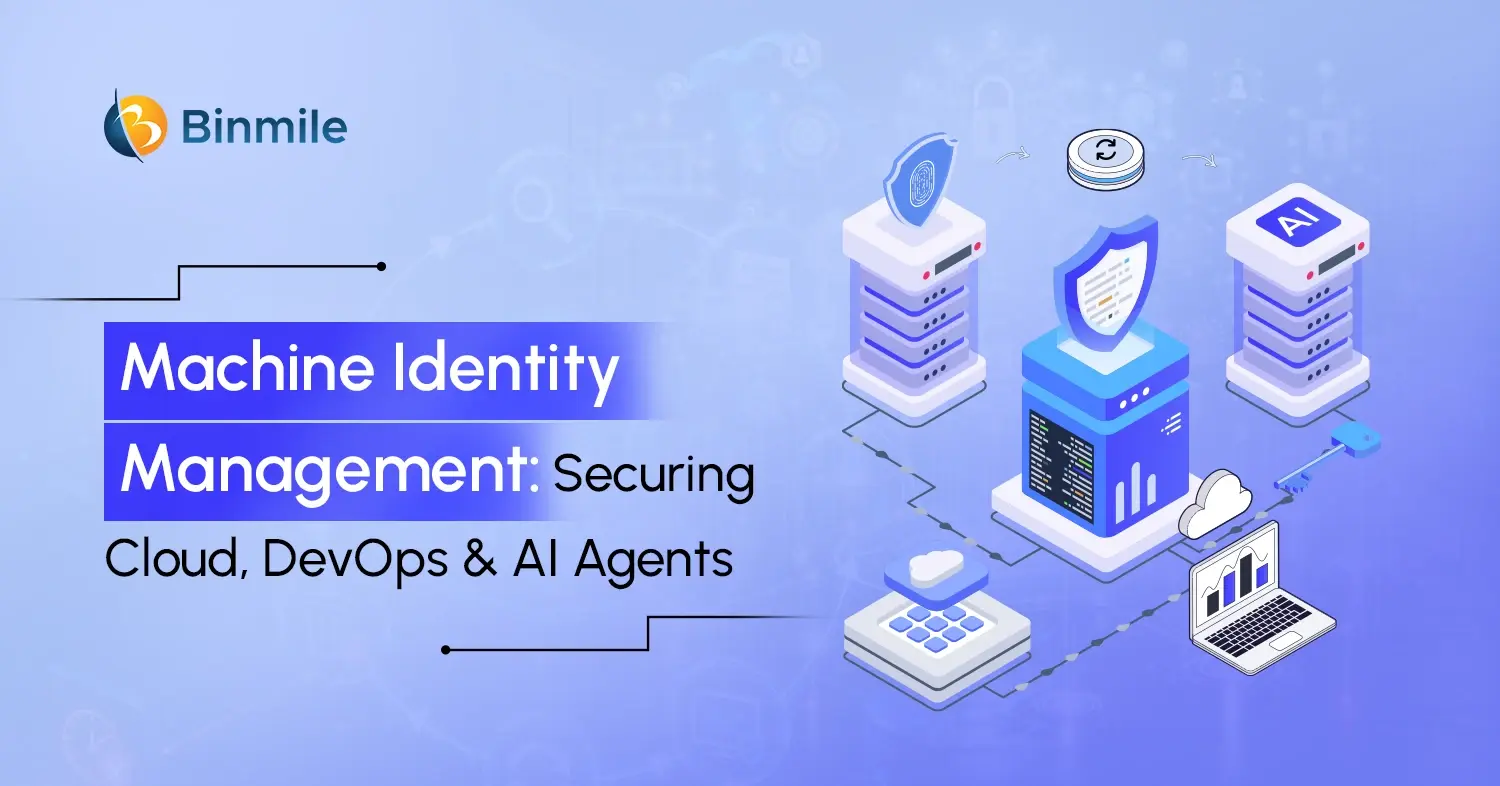
Every time a cloud application pulls data, a CI/CD pipeline deploys code, or an AI agent calls an API, a digital identity helps establish trust. These machine identities are linked to applications, containers, virtual machines, APIs, and automated processes. As organizations grow, the volume of these entities increases, which makes managing credentials and access permissions challenging and exposes them to unauthorized access and security leaks. Managing these identities helps enterprises maintain control over how these entities authenticate, access, and revoke permissions from resources throughout their lifecycle. An effective machine identity strategy helps organizations address these challenges while strengthening machine identity security across their technology environments.
For CIOs, CTOs, and CISOs, it is becoming a security priority as the adoption of cloud, DevOps automation, and AI-driven workflows proliferates. In this guide, we explore the key risks, implementation strategies, and best practices around securing machine identities, including non-human identity management and machine identity governance.
What Is Machine Identity Management?
Machine identity management consists of the processes, tools, and technologies involved in creating, authenticating, monitoring, and retiring machine identities used by applications, devices, workloads, and automated services to securely communicate. Unlike human identities, machine identities make use of credentials such as certificates, cryptographic keys, tokens, and service accounts to authenticate. These machine credentials establish trust between systems, while public key infrastructure (PKI) establishes the trust infrastructure by issuing and validating digital certificates.
For instance, a cloud application could make use of a managed identity or a short-lived token to access a database without embedding a permanent secret in its code. The process of issuing, authenticating, revoking, and rotating these credentials and ensuring that each one has the required access is what machine identity management entails. Enterprises utilize it to govern a growing and dynamic non-human identity landscape, reduce the risks of unauthorized access, and maintain control. This process also supports the machine identity management lifecycle by ensuring that identities remain secure from creation to retirement.
Why Is Machine Identity Management Important for Modern Enterprises?
As enterprises adopt cloud computing, DevOps automation, and AI-driven workloads, the number of identities used to secure the interactions among applications and systems is proliferating. This necessitates the need to secure machine identities in order to reduce the attack surface and maintain access governance over these resources. Organizations can strengthen their security posture by incorporating machine identity management into their broader cloud strategy and enterprise cybersecurity planning.
1. Reducing the Attack Surface
Exposure of credentials and excessive permissions increases the organization’s attack surface. Enterprises utilize machine identity security to reduce the risks associated with the proliferation of secrets and ensure that identities only have the least access required to perform their functions. Identifying machine identity security risks early also helps security teams prioritize remediation.
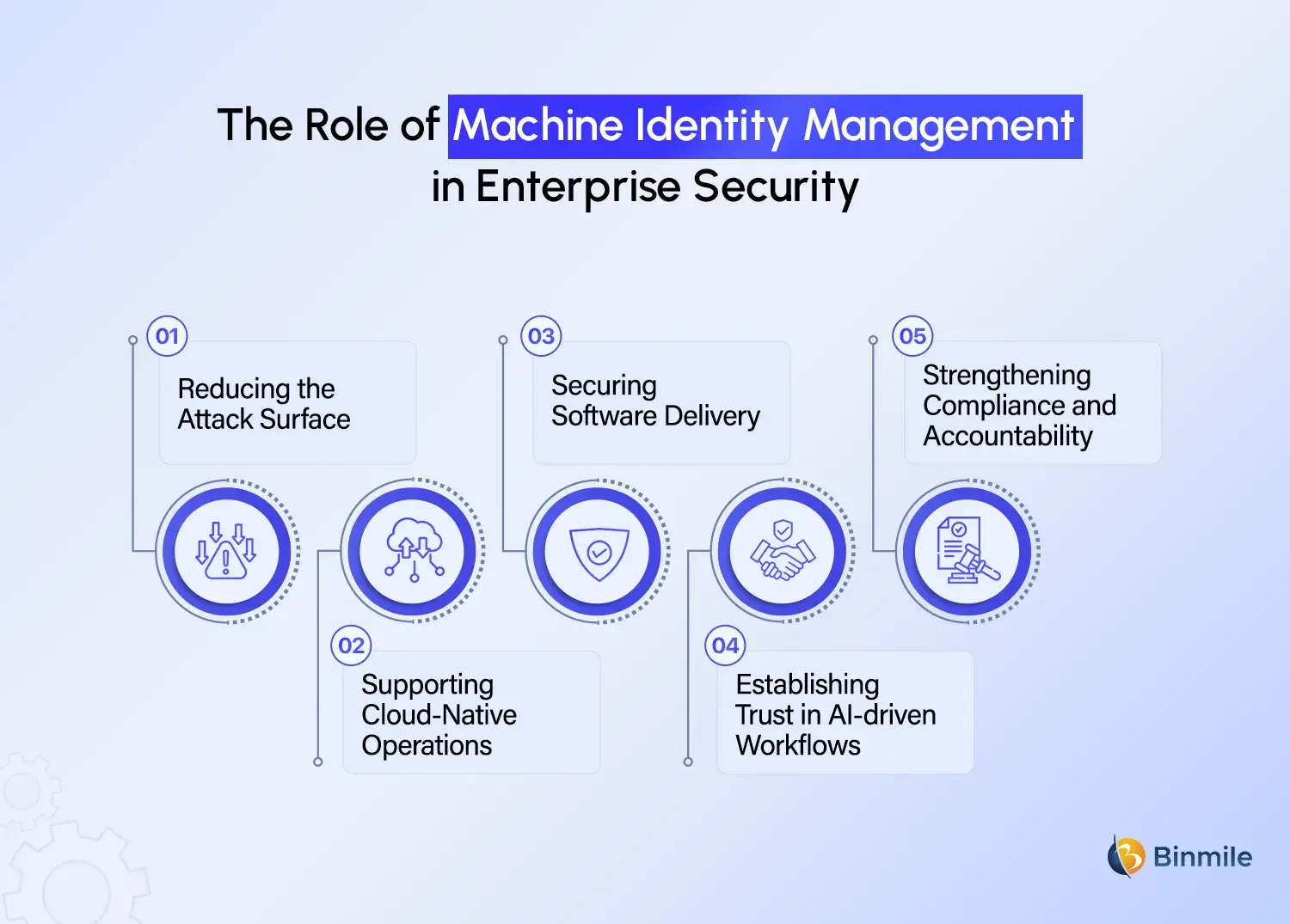
2. Supporting Cloud-Native Operations
Cloud infrastructures are highly dynamic and are continually provisioning and de-provisioning workloads. Enterprises require strong identity lifecycle management to ensure that these resources are issued the appropriate credentials and that permissions are automatically granted, rotated, and revoked when required. Additionally, this becomes especially important with virtualization in cloud computing, where workloads can be provisioned rapidly across distributed environments.
3. Securing Software Delivery
CI/CD pipelines require access to various resources across the software delivery lifecycle. The credentials and access controls provided to these identities could pose significant risks if they are excessive or insecure. Enterprises utilize machine identity security to ensure that pipelines have the least access required to perform their functions and reduce the risks of unauthorized access. A secure DevSecOps approach helps integrate these controls into development and deployment processes.
4. Establishing Trust in AI-driven Workflows
AI agents interact with APIs, enterprise data, and business applications. Enterprises establish dedicated identities for these agents with specific access rights and permissions to ensure that they cannot access or alter data beyond their intended purposes. Effective AI agent identity controls also help establish accountability for automated decisions and actions.
5. Strengthening Compliance and Accountability
Maintaining records of the ownership, access audits, and approval workflows of identities helps enterprises demonstrate how and who provisioned these resources. Additionally, it helps with accountability by ensuring that no unauthorized access to enterprise resources is possible. Consistent machine identity governance can also support audit readiness and internal security reviews.
Overall, machine identity management helps enterprises reduce the attack surface and maintain compliance while also supporting the increased use of cloud-native technologies, DevOps automation, and AI-driven processes.
What Are the Common Types of Machine Identities?
Machine identities appear across infrastructure, application development, connected devices, and automated workloads. Each type plays different roles and requires different controls to ensure that they are issued, authenticated, and rotated securely. Understanding these categories helps enterprises define appropriate non-human identity management policies.
| Type of Identity | How it is Used | Example |
|---|---|---|
| Application Identities | Allow software applications to authenticate with other systems | An application connecting to a payment API |
| Service Accounts | Provide an identity for a background process or service | A scheduled backup job accessing cloud storage |
| Workload Identities | Authenticate applications, containers, and compute workloads | A Kubernetes workload accessing a database |
| Device Identities | Identify connected physical devices | An industrial sensor sending telemetry |
| API Credentials and Tokens | Authenticate requests between systems | A service using an API token to retrieve data |
| Certificate-Based Identities | Establish trust through digital certificates | A service presenting a TLS certificate |
| AI Agent Identities | Govern the access of AI agents to tools and resources | An agent retrieving approved information from an enterprise CRM |
These categories can overlap. For instance, a cloud workload could make use of a managed service identity and short-lived tokens, while an AI agent could operate through a workload identity and a separate application-level authorization policy. Additionally, cloud workload identity mechanisms can help applications and services authenticate without relying on embedded, long-lived credentials.
The intent is not to develop a separate machine identity management framework for every type of identity. Instead, it is to establish the level of governance for each segment based on their technical requirements and authentication factors.
What Are the Common Machine Identity Security Risks Enterprises Must Address
The number of machine identities is just one aspect of the challenge. Enterprises must also ensure that they maintain control over the credentials and permissions assigned to these entities. Understanding these machine identity security risks helps organizations develop a more effective machine identity strategy.
1. Unmanaged and Orphaned Identities
Old applications could leave behind active identities with broad access to enterprise resources. Enterprises must routinely scan for such entities, track their ownership records, and de-provision them.
2. Hardcoded and Exposed Credentials
API keys, passwords, and tokens embedded in source code or other systems could be exposed and provide direct access to sensitive systems. Secrets management and shorter-lived credentials help mitigate this risk.
3. Excessive Permissions
Machine identities with elevated permissions provide extensive access to enterprise resources and increase the risk of breaches. Enterprises must ensure that the principle of least privilege is enforced and reviews are performed regularly.
4. Certificate Expiration and Poor Rotation Practices
Poor certificate rotation practices could see expired certificates in use, which could impact business operations. Enterprises must ensure that automatic certificate lifecycle management is enforced. Effective certificate lifecycle management also helps organizations track certificate validity and renew credentials before they expire.
5. Inconsistent Controls Across Cloud Environments
Diverse cloud environments could have varying control needs. Enterprises must ensure they have a coherent approach to machine identity management to ensure consistency across platforms.
6. Misconfigured AI Agent Access
AI agents with excessive permissions could access sensitive enterprise data and impact business operations if credentials are compromised. Enterprises must ensure that the AI risk management framework includes controls for identity ownership records, access governance, credential security, and threat monitoring.
7. Limited Monitoring and Threat Visibility
Lack of visibility at the identity level could impact an enterprise’s ability to investigate suspicious activities. Integrating threat intelligence and identity access logs with cyber threat intelligence helps enhance visibility and supports faster investigation of suspicious authentication patterns.
How Machine Identity Management Works Across Cloud, DevOps, and AI Agents
A successful program should be able to support multiple technical environments while also providing end-to-end visibility into the identities, permissions, and lifecycle of each entity. Organizations can achieve this through a machine identity management platform or an integrated set of security tools that supports centralized governance.
-
Machine Identity Management in Cloud Environments
Cloud environments connect virtual machines, containers, databases, and APIs that require secure authentication. Cloud workload identity mechanisms, such as managed identities or federation and short-lived tokens, reduce the risks associated with long-lived credentials for these workloads.
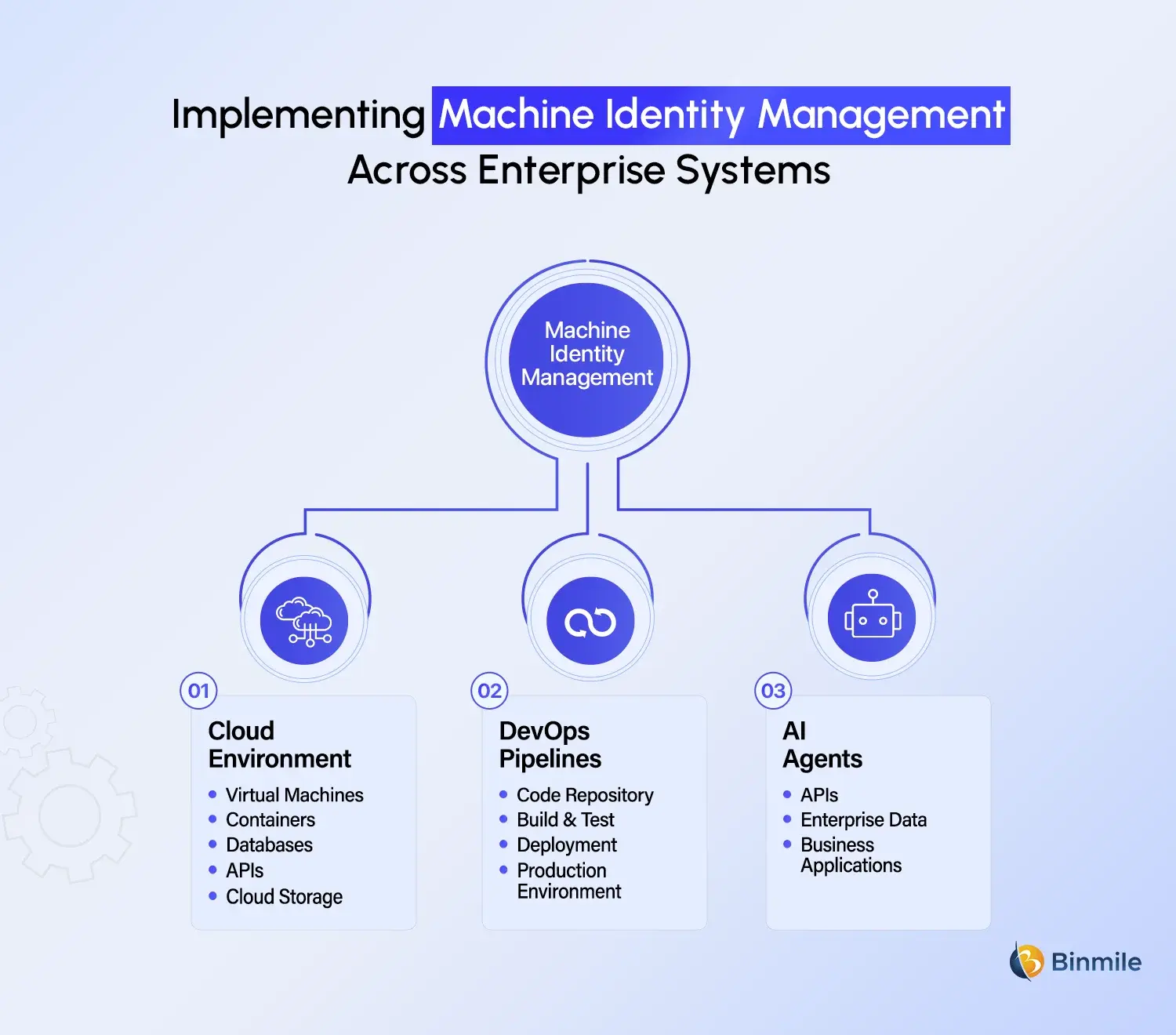
Organizations must ensure that these resources are issued dedicated identities that only have the least access to perform their functions. Additionally, they must be issued automatically and revoked at the end of their lifecycle. Enterprises can integrate cloud workload identity management into their cloud strategy and IoT consulting initiatives to secure workloads and IoT devices as they proliferate their digital infrastructure.
-
Machine Identity Management in DevOps Pipelines
CI/CD pipelines require access to code repositories, cloud resources, and production environments. The credentials and access controls provided to these identities could pose significant risks if they are excessive or insecure. By enforcing short-lived credentials, federated workload identities, and environment-specific access controls, enterprises reduce the risks of unauthorized access to these resources.
DevOps Consulting can help organizations implement these controls into their CI/CD pipelines, while cloud automation tools can help enforce these policies consistently without disrupting software delivery.
-
Machine Identity Management for AI Agents
AI agents interact with APIs, enterprise data, and business applications. Each agent should be issued an accountable owner, a dedicated identity, and specific permissions based on their intended purpose. For instance, an agent that summarizes customer support tickets may only have read access to ticket records, but cannot update billing information. Additionally, by monitoring these agents, restricting their access to tools and data, protecting their credentials, and revoking their identities at the end of their lifecycle, enterprises maintain control over these resources as they leverage AI-driven processes.
For example, an agent summarizing customer support tickets may need read access to ticket records, but not permission to modify billing information. Monitoring agent activity, restricting tool access, protecting credentials, and revoking identities when agents are retired help enterprises maintain control as AI-driven workflows expand.
Strengthen identity governance across cloud, DevOps, and AI environments with Binmile’s tailored cybersecurity and cloud solutions
Understanding the Machine Identity Lifecycle
Machine identity management is not a one-time provisioning activity. It is a continuous process that governs an identity from discovery through retirement.
The machine identity management lifecycle typically includes six stages.
1. Discovery and Inventory
Enterprises discover and document the different machine identities that exist in their environments. This includes their owners, permissions, and credentials to ensure that they are secure and managed appropriately.
2. Provisioning and Issuance
Enterprises provision and issue identities based on their needs. This consists of certificates, managed identities, and service accounts, and adheres to organizational policies.
3. Authentication and Authorization
Machine-to-machine authentication establishes the level of trust between systems. The process of granting access to resources is also performed during this stage.
4. Monitoring and Governance
Organizations monitor the activities, permissions, and credentials of identities to ensure that they are not compromised or misused. This stage is central to effective machine identity governance because it helps identify policy violations and unnecessary access.
5. Credential Rotation and Renewal
Enterprises perform regular secret rotation and certificate renewal to reduce the risks of compromise and unauthorized access.
6. Revocation and Decommissioning
This step entails digitally signing off on an identity and removing its access to resources. Enterprises must also revoke any delegated permissions and tokens that may exist.
How To Choose a Machine Identity Management Platform
As the volume of identities grows, enterprises may need a dedicated identity management platform or a combination of identity, certificate, secrets, and cloud-native security tools to manage them.
The choice between individual tools or a full platform depends on an organization’s architecture, risk management needs, audit requirements, and current technology stack. Organizations should also evaluate how well a machine identity management platform supports cloud workload identity, certificate lifecycle management, and automated governance across their environments.
Before selecting a solution, evaluate the following capabilities.
| Evaluation Area | What To Look For |
|---|---|
| Identity Discovery | Visibility across cloud, on-premises, application, device, and workload environments |
| Lifecycle Automation | Policy-driven provisioning, renewal, rotation, and revocation |
| Credential Security | Secure storage, limited credential lifetimes, and support for appropriate authentication methods |
| Access Governance | Ownership records, least-privilege controls, approvals, and periodic access reviews |
| Cloud and DevOps Integration | Compatibility with cloud providers, CI/CD platforms, containers, and infrastructure automation |
| AI Readiness | Support for governing workload identities and integrations used by AI agents |
| Monitoring and Reporting | Audit logs, alerts, lifecycle visibility, and integration with security operations |
| Scalability and Resilience | Ability to manage identity growth without creating unnecessary operational complexity |
A platform should not be evaluated on the sheer number of features. It must be evaluated on its ability to align with an enterprise’s existing technology stack and address its unique requirements without creating additional management overhead. In some instances, a native cloud identity service and secrets manager may be sufficient.
On the other hand, some organizations may require certificate lifecycle management tools or comprehensive governance solutions to address their needs.
The intention is to establish effective governance without adding disconnected and complex tools.
Connect with Binmile’s experts to identify machine identity risks, strengthen access controls, and secure your enterprise infrastructure.
How Machine Identity Management Fits Into Enterprise Security Architecture
Machine identity management has become an important part of enterprise cybersecurity because modern applications, cloud workloads, automated pipelines, and AI agents all depend on trusted digital identities. The challenge is not simply to issue credentials. Additionally, organizations must understand which identities exist, who owns them, what they can access, how their credentials are protected, and when their permissions should end. A well-designed program combines centralized visibility, least-privilege access, automated lifecycle controls, secure credential management, and continuous monitoring. It also connects machine identity governance with cloud architecture, DevSecOps, the zero-trust security model, and AI risk management.
CIOs, CTOs, and CISOs should establish these controls before unmanaged identities and excessive permissions become difficult to contain. By making identity security part of the design and delivery process, enterprises can protect critical resources while continuing to innovate. As your organization expands its cloud infrastructure, automates software delivery, or introduces AI-powered workflows, machine identity security should evolve alongside your technology strategy.
Binmile can help you assess your technology environment, identify security and integration gaps, and align cloud, DevOps, and AI initiatives with your business objectives.
Frequently Asked Questions
Machine identity management is the process of discovering, issuing, authenticating, governing, monitoring, and retiring the digital identities used by non-human entities such as applications, servers, containers, devices, and automated services. It helps ensure that these entities can access only the resources they are authorized to use.
Modern enterprises depend on automated communication between applications, cloud workloads, development pipelines, connected devices, and AI agents. Machine identity management helps reduce unauthorized access, prevent credential misuse, automate certificate and credential lifecycles, and improve visibility across complex IT environments.
Common types include application identities, service accounts, workload identities, device identities, API credentials, cryptographic certificates, and identities used by automated agents. The appropriate authentication mechanism depends on the entity, its environment, and the resources it needs to access.
It improves cybersecurity by making machine identities discoverable and accountable, enforcing least-privilege access, reducing dependence on long-lived credentials, automating rotation and revocation, and monitoring authentication activity. These controls can reduce opportunities for attackers to misuse credentials or move between connected systems.
Human identity management primarily governs identities associated with employees, customers, and other people, including their authentication and access permissions. Machine identity management focuses on non-human entities and their credentials, such as certificates, keys, tokens, and workload identities. Both require ownership, governance, access control, monitoring, and lifecycle management, but their authentication methods and cloud automation tools differ.
Organizations can begin by discovering machine identities across their environments and assigning ownership. They should then classify identities by risk, establish least-privilege access policies, centralize secrets and certificate management, automate provisioning and revocation, integrate controls into DevOps and cloud workflows, and monitor identity activity. Regular reviews and measurable security objectives help maintain the program as infrastructure and workloads evolve.