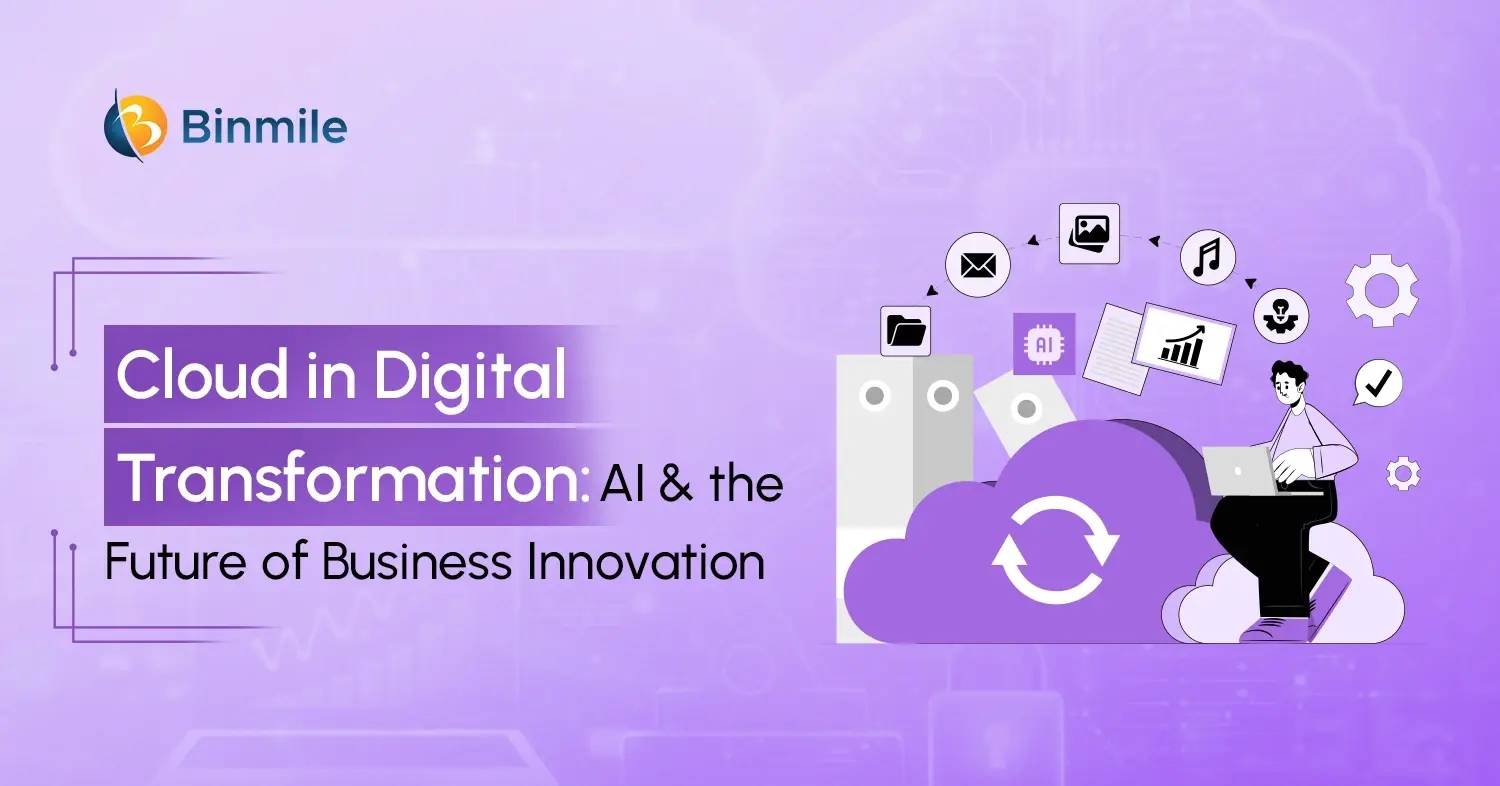
Digital transformation is not just about digitizing applications or running them online. For business leaders, it is about reacting swiftly to customer expectations, making decisions, and innovating. Cloud digital transformation meets the requirements of agility, informed decision-making, and the importance of innovation. Coupled with AI, the cloud empowers enterprises to automate, extract insights, and innovate business solutions.
Gartner reports that public cloud spending in India will hit $17.5 billion in 2026, up 28.1% year-on-year. However, adopting the cloud does not necessarily translate into value creation for an enterprise. An organization must pursue specific goals that use data and have use cases enabled by AI to deliver on business objectives.
What Is Cloud Digital Transformation?
Cloud digital transformation leverages cloud computing to modernize the business, applications, data, analytics, and IT operations. The cloud computing is not an end in itself but a means to an end, an enabler for achieving business objectives. Cloud transformation is different from cloud migration, which is the process of bringing applications and data to the cloud. Businesses must pursue digital transformation, which involves rethinking the way that the company operates, delivers value to customers, and makes decisions. Digital transformation in business requires aligning these technology changes with operational priorities, customer expectations, and long-term business goals.
Suppose a retail enterprise wants to migrate its inventory databases to the cloud to store the data better. In that case, it could be pursuing cloud transformation by analyzing customer behavior, sales, and demand-prediction algorithms to help replenish stocks automatically. An enterprise pursuing cloud transformation does not always just migrate legacy applications to the cloud. A report by McKinsey states that cloud-enabled innovation has the potential to deliver more than 5 times the value of IT cost reduction. For CXOs, it is a matter of prioritizing the value delivered by the cloud to the business over infrastructure costs. This is where cloud-based transformation and cloud-based digital transformation can help enterprises connect technology investments with broader business goals.
How Cloud and AI Work Together to Accelerate Digital Transformation
Cloud provides the infrastructure, storage, and data platforms, while AI uses this foundation to generate insights, automate workflows, and support smarter business decisions. The use of cloud computing for digital transformation helps organizations integrate these capabilities into their operations.
1. Building a Scalable Foundation for AI
Cloud provides scalable and elastic infrastructure to run applications, managed databases, and AI/ML services. Using cloud-native applications means provisioning scalable resources as needed and reducing the strain of infrastructure provisioning for AI/ML applications.
2. Turning Disconnected Data Into Business Intelligence
Cloud-connected systems allow enterprises to consolidate business data into a single repository, where AI can analyze the data to predict demand, identify patterns, and recommend operational improvements and maintenance schedules.
3. Automating Business Workflows
Cloud-integrated AI can help enterprises automate document processing, invoicing, and customer support operations. It can reduce the drudgery of repetitive work and focus on more meaningful tasks that demand human skills.
4. Enabling Faster Product Development
Cloud-native tools, CI/CD pipelines, and AI-assisted coding can help engineering and product teams speed up the coding, testing, and deployment processes. With the help of the cloud and AI, enterprises can shorten the feedback loop, adopt a DevOps culture, and deliver higher-quality products that are more responsive to customer needs.
What Are the Key Business Benefits of Cloud Digital Transformation
The benefits of combining cloud and AI extend across technology operations, customer experience, and business strategy. However, the outcomes depend on the maturity of the organization’s infrastructure, data, processes, and operating model. Cloud computing digital transformation initiatives can help businesses align these capabilities with their strategic priorities.
-
Greater Agility and Faster Innovation
Cloud applications, infrastructure, and platforms can help enterprises scale their operations up and down depending on demand, experiment with new ideas, and accelerate the time-to-market for products and solutions.
-
Improved Operational Efficiency
Enterprises can reap the benefits of cloud and AI together in terms of reduced manual effort, faster processing, better resource utilization, and identification of process improvement areas. They can measure the benefits of cloud digital transformation in terms of reduced time, errors, or cost of operations.
-
Better Customer Experiences
Cloud-connected data and AI analytics can power recommendation engines, faster response times, and personalized communication to engage customers better. Good data governance and ethical AI use are essential to achieving customer-centric outcomes.
-
More Informed Decision-Making
Businesses can consolidate business data in the cloud and use AI-driven analytics to spot patterns, predict future demands, and identify roadblocks. Combined with human judgment, it can lead to improved decision-making.
-
Flexible and More Resilient Operations
Cloud technologies can provide built-in disaster recovery and system resilience, with proper risk management, governance, and security controls. Enterprises could benefit from faster business continuity in the face of disruptions, although it requires designing cloud-native applications with the right security and compliance in mind.
Partner With Binmile to Build a Scalable Cloud and AI Strategy That Delivers Measurable Business Outcomes.
How Businesses Can Implement Cloud and AI Successfully for Digital Transformation
A successful cloud and digital transformation initiative starts with business priorities rather than a technology shopping list. The following approach helps organizations build a foundation for sustainable results through digital transformation with cloud technologies.
Step 1: Define Business Outcomes
Enterprises must identify the business outcomes to pursue, such as reducing customer onboarding time, improving forecasting accuracy, modernizing legacy applications, or reducing infrastructure costs. It is also critical to set benchmarks and success criteria to measure these outcomes and ensure that the enterprise delivers on its objectives.
Step 2: Assess Infrastructure and Application Readiness
Before migrating applications to the cloud, enterprises must understand their maturity, interconnectivity, and technical debt. They can then identify which applications to modernize, migrate, or replace to align with their transformation goals. Design the cloud computing architecture to meet the enterprise’s needs for scalability, security, availability, and maintainability. A well-planned cloud migration digital transformation strategy can help ensure that infrastructure changes support wider business objectives.
Step 3: Establish Data Governance and Security
The data governance framework and data security are equally critical. Before deploying AI at scale, enterprises must evaluate their data quality, sources, storage, access, and retention policies. Encryption, authentication, and authorization measures must be in place to secure the data and applications. Enterprises must design their AI governance framework around security, privacy, data labeling, human-in-the-loop reviews, and model auditing.
Step 4: Prioritize AI Use Cases
Enterprises must adopt a prioritized list of AI use cases based on business value, complexity, feasibility, and risks. Some of the most compelling use cases cut across document processing, demand forecasting, and customer support. It is worth starting with some low-hanging fruit, where enterprises can demonstrate proof of concepts, before embarking on large-scale AI transformation initiatives. Artificial Intelligence as a Service (AIaaS) options provide enterprises with managed services to deploy AI solutions. The integration, data security, and cost considerations must be taken into account when selecting an AIaaS provider.
Step 5: Measure, Optimize, and Scale
Enterprises must measure business and technology performance continuously, including application availability, AI/ML model accuracy, processing speeds, adoption rates, and infrastructure costs. Leaders must optimize the transformation initiatives by analyzing the performance to inform decisions regarding resource allocation. Budget alerts, utilization tracking, and FinOps practices help enterprises optimize infrastructure costs by getting the most out of their cloud spend while maintaining performance and reliability.
What Are the Challenges CXOs Should Address Before Scaling Cloud and AI
Cloud digital transformation introduces organizational and technical challenges that need to be managed from the beginning.
-
Legacy System Complexity
Legacy systems could have complex application programming, integration logic, and technical debt that makes it hard to migrate to the cloud. Modernization must be prioritized based on value and complexity.
-
Data Quality and Fragmentation
Disjointed data architecture and poor data quality could impact the business outcomes of cloud and AI initiatives. The enterprise must define data ownership, integration, quality standards, and governance before scaling AI initiatives.
-
Security and Regulatory Requirements
Cloud transformations change the way that businesses must think about security and governance. Enterprises must establish shared responsibility around security, compliance, and governance based on their industry vertical, location, and regulatory environment.
-
Skills and Organizational Readiness
Cloud and AI initiatives require enterprise-wide collaboration and new skill sets. Enterprises must invest in skills and ensure that there is ownership across departments such as engineering, security, finance, and operations.
-
Unclear Return on Investment
The ROI on cloud and AI initiatives may not always be apparent, especially when it comes to infrastructure-only migrations. Leaders must ensure that every significant initiative has quantifiable benefits and reevaluate the business case after deployment.
The choice of a cloud service provider for cloud digital transformation is, therefore, a strategic decision that entails more than a price comparison. Enterprises must consider the security, regional presence, reliability, integration options, AI capabilities, infrastructure portability, and support the provider can offer. Google Cloud provides enterprises with infrastructure, analytics, and AI/ML capabilities that they can consider as part of their cloud strategy.
The Google Cloud digital transformation must be viewed in the context of the enterprise’s infrastructure, application modernization, data needs, and business imperatives. Google Cloud digital transformation initiatives should focus on the provider’s ability to meet enterprise requirements. It is not always about which cloud provider has the most features but the one that meets the enterprise’s needs. These cloud and digital transformation solutions should align with the organization’s business priorities and long-term technology roadmap.
The Future of Cloud Digital Transformation
The future of cloud digital transformation will likely be characterized by connecting the cloud, governed data, automation, and AI to create end-to-end solutions that power enterprise operations and analytics. Agentic AI is an emerging space where AI agents can consume authorized data and tools to perform multistep tasks, orchestrate activities across applications, and escalate exceptions for human review. Cloud technology can power such systems, providing the infrastructure, integration, and monitoring capabilities. However, autonomous or semi-autonomous AI systems would require stronger governance around policies for performing actions, accessing data, obtaining approvals, and reversing transactions when needed.
Other areas of interest will include cloud-native application modernization, multicloud infrastructure and operations, AI infrastructure, and data governance. These capabilities will empower enterprises to optimize operations and make smarter decisions. As a result, architecture and operating models will become as important as the technology stack. Cloud for accelerating digital transformation will depend on how effectively enterprises combine these capabilities to achieve measurable outcomes. Cloud consulting services can help organizations connect cloud infrastructure, data, and AI with their operational priorities. For business leaders, it is a matter of focusing on the business case for cloud digital transformation while factoring in innovation, security, and operational needs.
Accelerate Your Business Growth With Binmile’s Cloud Digital Transformation and AI Solutions
How Can Binmile Help With Cloud Digital Transformation?
Cloud digital transformation gives businesses a flexible foundation for modernizing applications, connecting data, and improving operational efficiency. When combined with AI, it can support more informed decisions, intelligent automation, faster product development, and better customer experiences. Realizing these benefits requires a clear business case, reliable data, secure architecture, appropriate governance, and continuous measurement.
Binmile helps businesses approach cloud adoption, application modernization, and AI development with their operational and strategic objectives in mind. Through its cloud consulting services and AI capabilities, Binmile can support organizations in evaluating their current environment, identifying suitable use cases, and developing solutions aligned with their business goals.
Frequently Asked Questions
Cloud provides scalable infrastructure, managed platforms, and data services that help businesses modernize applications, connect systems, and introduce new digital capabilities. It supports digital transformation by improving agility and enabling organizations to develop, deploy, and scale solutions without relying entirely on fixed on-premises infrastructure.
Cloud technology provides the computing resources, storage, data platforms, and managed services that AI applications need. AI uses available data to generate predictions, analyze information, automate selected tasks, and support decisions. Together, they can improve workflows, customer experiences, and operational visibility.
Cloud enables businesses to respond more quickly to changing requirements, modernize legacy applications, and experiment with new services. It also creates a foundation for analytics and AI. Its strategic value comes from using these capabilities to improve business outcomes rather than treating migration as an end in itself.
Key benefits include greater operational efficiency, faster product development, improved forecasting, more personalized customer experiences, scalable AI deployment, and better access to business insights. Actual results depend on data quality, implementation, adoption, and the suitability of each use case.
Common challenges include legacy application dependencies, fragmented data, cybersecurity and compliance requirements, cloud cost management, talent gaps, integration complexity, and uncertain ROI. Organizations can address these issues through structured assessments, governance, phased implementation, and ongoing performance measurement.
Businesses should begin by defining measurable objectives, assessing application and data readiness, establishing security and governance controls, and prioritizing high-value AI use cases. They should test solutions through controlled pilots, measure results against defined baselines, and scale only when performance, costs, and operational risks are understood.