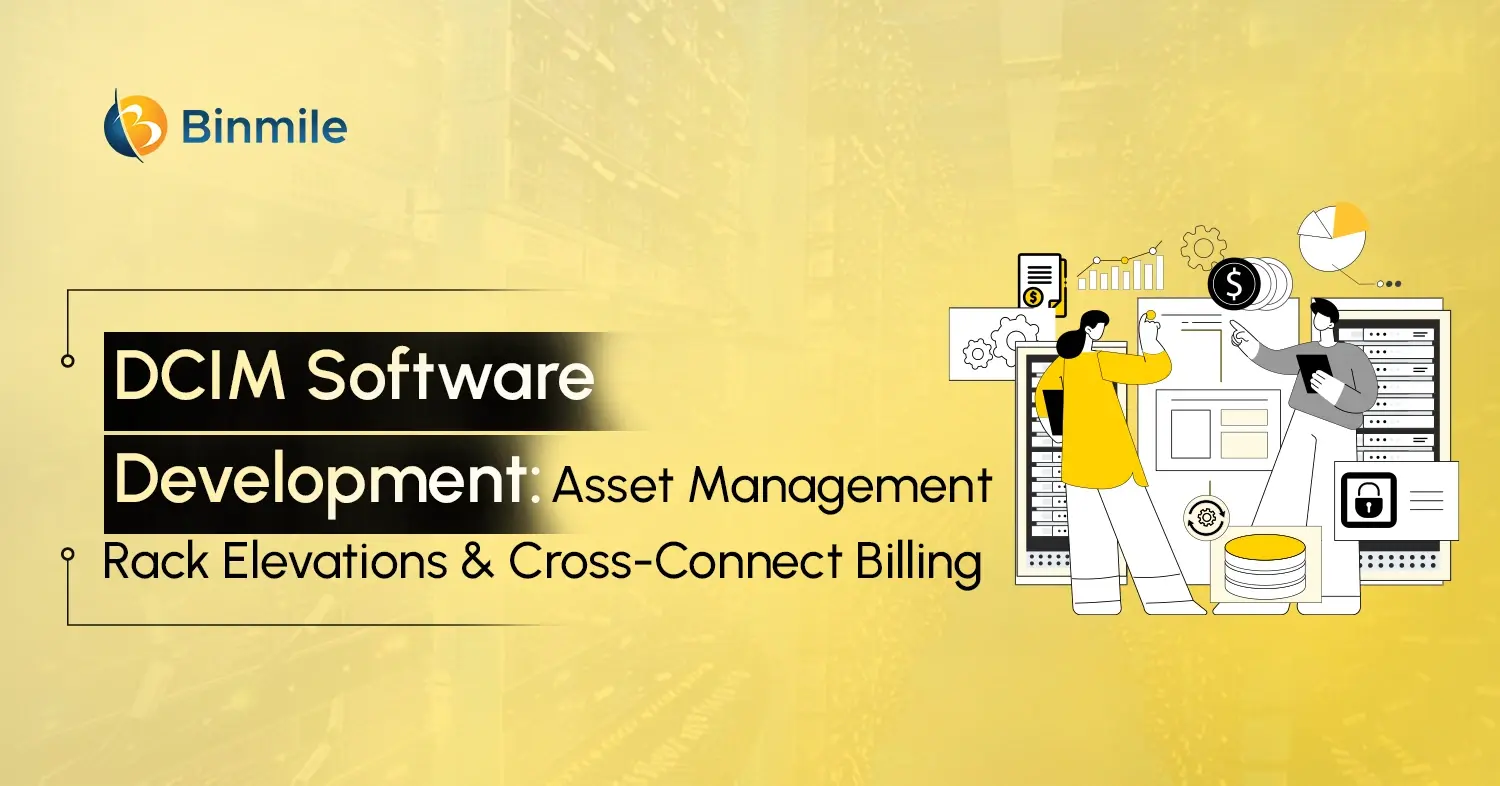
As your data centers grow and the number of servers, racks & network connections increases, managing large numbers of assets can become very complex. If you do not have all the data in one place, this can cause issues with capacity, delays, and lost billing. A well-designed DCIM software solution can address these challenges through centralized data center asset management software and connected operational workflows.
According to the Uptime Institute 2026 Global Data Center Survey, one in ten had suffered from an impactful outage. While there are many reasons why outages happen, it shows how important it is to have solid infrastructure management in place, supported by reliable data center software and data center automation.
By developing DCIM software, organizations can bring asset management, rack elevations, and cross-connect billing into one place so they can have greater infrastructure visibility, capacity planning, and service management. We will look at what you need to know to ensure your software will have the right features, architecture, integrations & considerations, including DCIM architecture, implementation requirements, and DCIM software development benefits.
What Is DCIM Software Development?
DCIM software is developed so you can monitor, manage, and optimize your data center infrastructure. It allows you to have all your physical assets, power usage, cooling, rack capacity & network connections in one place. DCIM platform development can also support data center automation and help organizations manage increasingly complex data center environments.
Unlike traditional IT infrastructure management tools, DCIM software will help bring your IT assets together with the physical infrastructure, providing better visibility across IT infrastructure management processes.
With a DCIM software solution, you can have greater visibility of where your assets are, how they are being managed throughout their lifecycle, rack elevations, cross-connects, power & cooling, and automate your processes. It can be integrated with ITSM, CMDB, and billing through DCIM software integration and enterprise application integration.
Depending on your requirements, colocation providers may want to focus on tenants and cross-connect billing, whereas enterprises may want to focus on capacity planning. By developing a custom DCIM solution through custom DCIM software development, you can ensure you are getting the right features for your operational needs.
Why Data Center Operators Need a More Connected DCIM Strategy
Managing data center infrastructure requires more than monitoring individual devices. Operators need to understand how physical assets, available capacity, power distribution, network connectivity, and customer services influence one another. A connected DCIM strategy brings these operational elements together, helping teams make informed decisions across facilities and infrastructure workflows. A well-defined DCIM strategy also helps organizations evaluate the benefits of DCIM software development against their existing infrastructure requirements.
Three capabilities are particularly important to this approach:
-
Data Center Asset Management
Maintain a centralized, reliable inventory of servers, switches, racks, and other infrastructure components, including their locations, ownership, dependencies, and lifecycle status. This helps teams reduce discrepancies between records and maintain better control over infrastructure changes through data center asset tracking software.
-
Rack Elevations and Capacity Planning
Ensure you can visualize where you have your equipment and how much physical capacity you have. This will allow you to plan if you can deploy new equipment, taking into consideration any power, cooling & network issues. This is particularly important in AI data centers, which can be very high density. DCIM maps and rack visualization capabilities can also support data center asset capacity planning software requirements.
-
Cross-Connect Management and Billing
Connect physical connectivity records with customer orders, service activation, and billing workflows. This helps operators track service changes, coordinate provisioning, and identify potential billing discrepancies across the service lifecycle. These capabilities are particularly relevant to data center operators that need accurate connectivity records and automated billing processes.
How Asset Management, Rack Elevations, and Cross-Connect Billing Work Together
These three capabilities deliver the greatest value when they operate as connected parts of the same DCIM platform. A well-integrated DCIM software platform can coordinate asset records, capacity information, connectivity, and billing workflows through a shared data model.
Consider the lifecycle of a new customer deployment in a colocation facility.
1. Asset Registration
The operator registers the customer’s equipment, assigns asset identifiers, and associates the hardware with the correct account. A centralized DCIM database helps maintain consistent asset records across the data center environment.
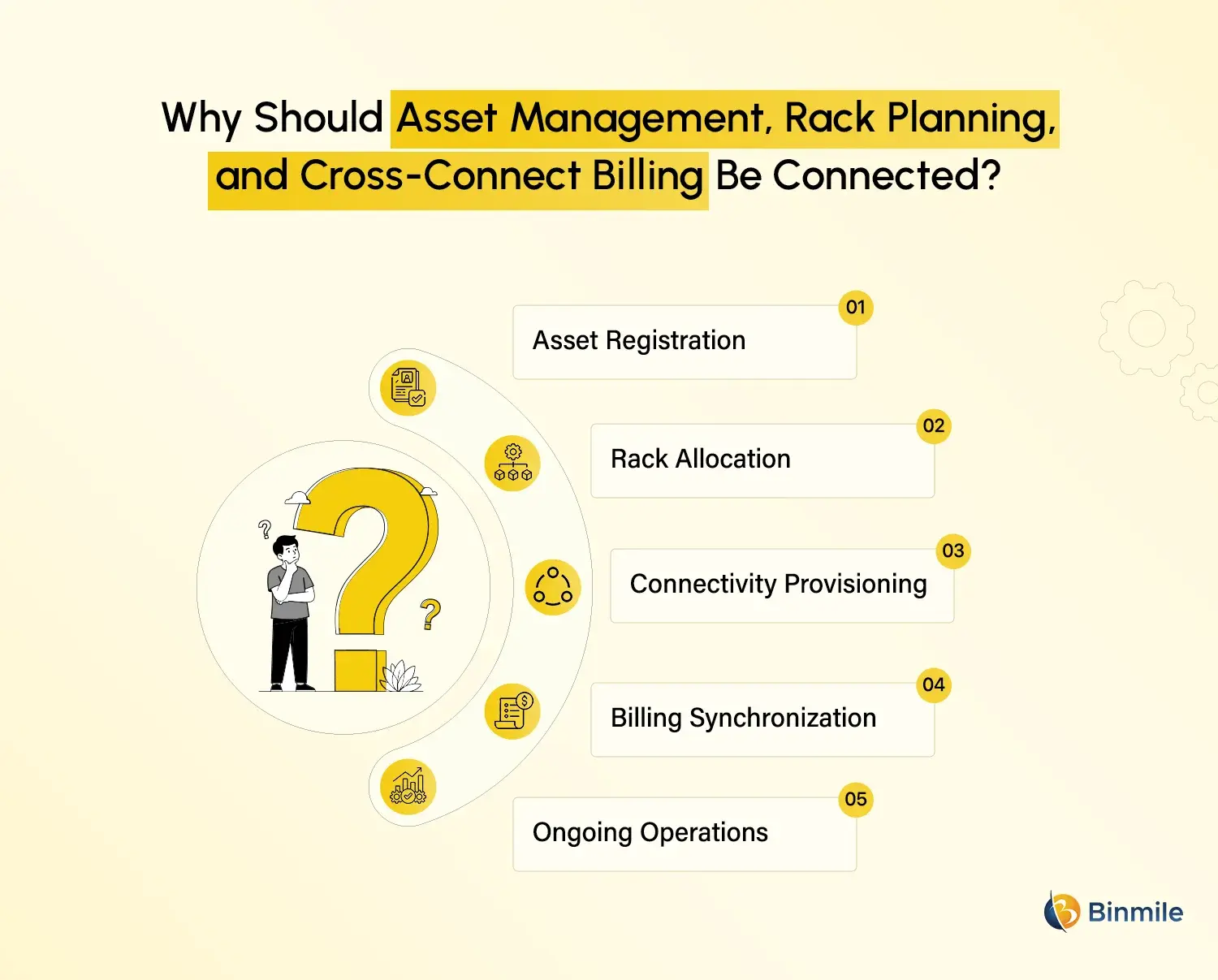
2. Rack Allocation
The DCIM platform reserves the required rack units and checks available space, power capacity, and other deployment constraints. This supports data center asset capacity planning software requirements and helps operators evaluate infrastructure availability.
3. Connectivity Provisioning
The operator records the required cross-connects, maps their endpoints, and tracks installation and activation. DCIM maps and connectivity records help teams maintain visibility into physical connections and their associated services.
4. Billing Synchronization
Approved service events are passed to the billing system, where configured rates and contract terms determine the applicable charges. DCIM software integration helps synchronize these records with existing financial applications.
5. Ongoing Operations
Equipment changes, service modifications, relocations, and disconnections update the relevant records and trigger the appropriate operational workflows. Business process automation can further streamline these activities and reduce manual intervention.
When these steps share consistent identifiers, lifecycle states, and validation rules, operators can trace a customer service from its physical installation to its commercial record.
What Are the Essential Features to Include in a Custom DCIM Software Solution
Although requirements vary by facility type, a robust DCIM platform should cover the following functional areas. These capabilities form the foundation of a custom DCIM software solution and can be expanded based on the organization’s DCIM software development requirements.
| Feature | What It Should Support |
|---|---|
| Asset Management | Asset listing, ownership, location, lifecycle & maintenance |
| Rack Elevations | Visual rack layout, U space & equipment |
| Cross-Connect Management | Port mapping, connection, status & service lifecycle |
| Capacity Planning | Rack, power, cooling & network capacity |
| Monitoring and Alerts | Telemetry, thresholds & alerts |
| Workflow Automation | Provisioning, approvals, changes & decommissioning |
| Billing Integration | Chargeable events, contracts & reconciliation |
| Reporting and Analytics | Asset utilization, capacity planning, service tracking & trends |
| Security and Governance | Roles, audit & changes |
| Enterprise Integration | APIs & connectors to ITSM, CMDB, BMS, ERP & monitoring tools |
Not every organization needs all these capabilities in its first release. The most effective DCIM strategy prioritizes the workflows that create the greatest operational or commercial value, then expands the platform as requirements evolve. Organizations can also evaluate DCIM software development benefits against their existing data center software and infrastructure management investments.
DCIM Software Architecture: What Powers the Platform?
DCIM software architecture connects infrastructure records, real-time telemetry, operational workflows, and enterprise applications. A modular DCIM system architecture helps manage these components efficiently while supporting future expansion. The right DCIM software architecture also depends on the organization’s integration requirements, infrastructure scale, and security needs.
1. Data Collection and Integration Layer
This will collect data from your infrastructure devices & enterprise applications. Depending on the devices you have, this can be done via SNMP, Modbus, BACnet, MQTT & REST APIs. These DCIM software development tools and integration methods help connect different infrastructure systems.
2. Asset and Connectivity Data Layer
This will store all your assets, rack layout, ports, connections, customer details & service relationships in your DCIM database. With a good data model in place, you can ensure your data is accurate. A well-planned DCIM software architecture should also maintain consistent relationships between physical assets and logical services.
3. Processing and Business Logic Layer
This will process your telemetry, validate any changes to your infrastructure, check capacity, manage your provisioning & create service events. Predictive analytics can also support capacity forecasting, while AI in data engineering can help organizations derive insights from infrastructure data where appropriate.
4. Visualization and Application Layer
This will provide dashboards, rack elevation, floor plans, asset search & reporting to help you manage your infrastructure. Managers can view how much of their assets are being utilized. Digital twin software can also extend these capabilities by creating a digital representation of physical infrastructure for visualization and operational analysis.
5. Security and Governance Layer
This will ensure your infrastructure data is protected. You can do this by having authentication, roles, encryption, secure APIs & audit logs. Application security should remain a priority throughout the DCIM software development process, particularly when the platform handles customer information and infrastructure configurations.
A modular architecture makes it easier to integrate DCIM software with existing enterprise systems and introduce new capabilities as operational requirements evolve. Organizations should also consider cloud data migration strategy requirements when moving existing infrastructure records into a new DCIM platform.
Managing complex data center infrastructure? Let's build a solution that grows with your infrastructure.
How Does DCIM Software Integrate With Existing Enterprise Systems?
A DCIM platform rarely operates in isolation. Its effectiveness depends on how reliably it exchanges information with the applications already used by infrastructure, finance, facilities, and service management teams. Enterprise application integration and software integration services can help connect these systems while maintaining consistent data across workflows.
The most relevant integrations include:
-
ITSM Platforms
Connect equipment changes, installation requests, maintenance activities, and incident records with service management workflows. These integrations can also support managed IT services benefits trends by improving operational visibility and coordination.
-
Configuration Management Databases (CMDBs)
Synchronize configuration items and their relationships while defining data ownership to prevent conflicting updates.
-
Building Management Systems (BMS)
Exchange facility data, including cooling conditions, environmental readings, and equipment status. This helps operators connect infrastructure management with facility operations and green cloud computing initiatives focused on more efficient resource usage.
-
Network Management Tools
Connect device and port information with physical rack locations and connectivity records. This can be particularly useful when organizations need to integrate DCIM applications with a legacy network structure.
-
ERP and Billing Systems
Transfer customer service events, approved charges, and lifecycle changes for financial processing. These integrations support cross-connect billing and help maintain consistency between operational and financial records.
-
Identity Providers
Enable centralized authentication and access control across the DCIM platform.
-
Cloud and Analytics Services
Support reporting, historical analysis, and capacity forecasting as operational requirements evolve. Organizations can evaluate top cloud platforms based on their existing technology stack, integration requirements, security controls, and deployment preferences.
Can DCIM Software Integrate With ServiceNow?
Yes. A custom DCIM solution can integrate with ServiceNow through supported APIs and integration mechanisms, subject to the organization’s ServiceNow configuration and licensing.
For example, you can raise an ITSM workflow based on a rack installation request. If you have approved an infrastructure change, you can update the relevant asset/configuration. You can also add context to an incident showing what equipment is impacted, what rack it is in & what it is dependent on.
The integration design should define how data flows between systems, which application is authoritative for each record, and how duplicate events or failed synchronization attempts are handled.
For organizations already using ServiceNow, these connections can make DCIM part of a broader IT infrastructure management and service delivery strategy.
What Is the DCIM Software Development Process
Building a custom DCIM platform requires an understanding of both software engineering and physical data center operations. The data center infrastructure management software development process should therefore start with infrastructure workflows and data quality before moving into interface design and implementation. Working with experienced DCIM software development vendors or a DCIM software development company can help organizations assess these requirements and plan delivery.
Step 1: Assess Existing Infrastructure and Workflows
Identify what assets you have, rack layout, connections, billing, monitoring & any issues. Identify who owns the data & any discrepancies between operations & finance.
Step 2: Define Requirements and Architecture
Define your initial scope, roles, data model, integration requirements, security, telemetry & deployment. Think about how your assets, racks, connections & billable services will interact. This stage also helps establish the DCIM system architecture and identify the right DCIM software development services for the project.
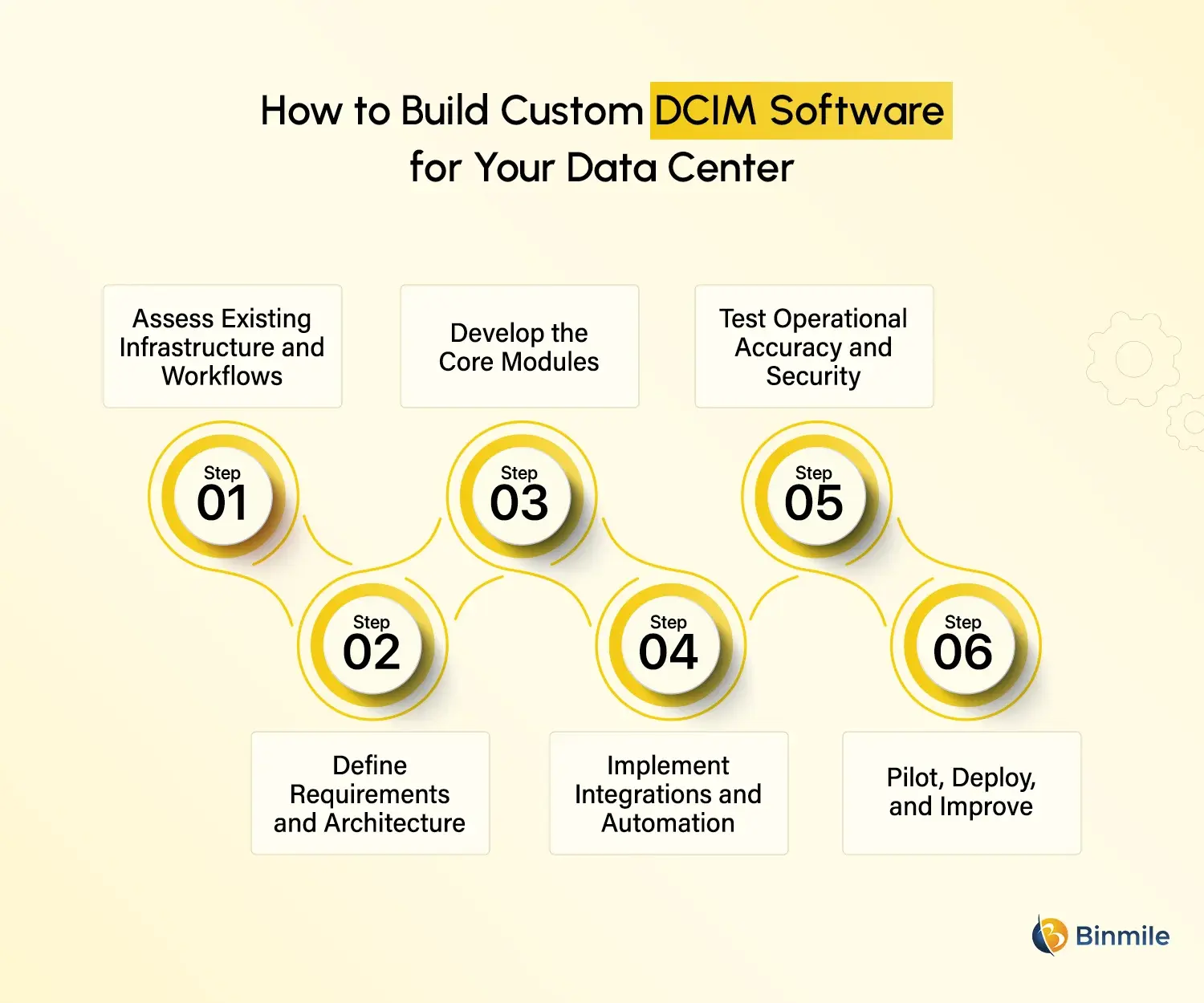
Step 3: Develop the Core Modules
Create your asset listing, rack elevation, connections & core processes. Focus on the features that will solve your biggest issues. Custom software development services can support these requirements by aligning the platform with your operational workflows.
Step 4: Implement Integrations and Automation
Integrate with your relevant infrastructure devices, ITSM/CMDB & billing. Add validation, synchronization & error handling. Enterprise application integration helps maintain data consistency across the DCIM platform and connected systems.
Step 5: Test Operational Accuracy and Security
Validate your asset relationships, rack capacity calculations, connection routes, lifecycle changes, billing events, permissions & failed integrations. Application security testing should also be included to identify vulnerabilities before deployment.
Step 6: Pilot, Deploy, and Improve
Start with a sample facility/workflow. Ensure your data is reconciled, train your users & analyze your results. Once validated, you can roll out to more.
After launch, software maintenance and support services help keep device integrations compatible, address security vulnerabilities, and accommodate changes in equipment, enterprise applications, and operational requirements. These activities are also an important consideration when evaluating the long-term DCIM software development cost.
How Much Does DCIM Software Development Cost?
The cost to develop DCIM software will depend on how complex your platform is. A simple asset management application will be cheaper to develop than a multi-site DCIM platform with real-time telemetry, interactive rack elevation, predictive analytics & automated cross-connect billing. DCIM implementation cost also depends on the DCIM software development tools, integration requirements, and infrastructure complexity.
The main factors that will impact the cost are:
- Number of facilities, racks, assets & connections
- Complexity of data model
- Rack visualization & capacity planning
- Number of hardware protocols & vendors
- Billing rules, ERP & reconciliation
- Security, compliance, availability & disaster recovery
- Cloud/on-premises & maintenance
Unfortunately, there is no reliable price for a custom DCIM solution. The best thing to do is carry out a discovery to identify what modules you will need, what systems you have, how much data you will need migrating & how complex the integrations will be. This also helps clarify the expected DCIM software development cost and identify suitable implementation priorities.
You should also take into account any ongoing costs such as infrastructure, support, software updates & new features.
Looking to streamline data center operations with better asset visibility, rack capacity planning, and automated cross-connect billing?
How Binmile Can Help With Custom DCIM Software Development
Data center operations require software to help you have better visibility of your infrastructure. Binmile can help you design & develop your DCIM features to work with your systems, processes & infrastructure goals. We can develop your asset management modules, rack elevation, connections, enterprise integration & operations dashboards. Using our software integration services, you can also connect your DCIM applications to your existing ITSM, CMDB, billing & facility management systems.
Through custom software development services, organizations can build DCIM applications around their operational requirements while integrating existing data center software and enterprise platforms. Our approach can also account for application security, infrastructure scalability, and the software maintenance and support services needed after deployment.
Depending on your requirements, you can also include predictive analytics, business process automation & digital twin software. This will help you make more informed decisions around your capacity planning. These capabilities can support more efficient infrastructure utilization and align with broader green cloud computing objectives. We aim to develop a DCIM software solution that works for your infrastructure.
Frequently Asked Questions
DCIM software development is the process of building applications that help organizations manage data center assets, rack layouts, power and cooling capacity, network connectivity, and facility operations. Custom solutions can also integrate with enterprise applications to support provisioning, monitoring, reporting, and billing workflows.
A DCIM platform should typically include centralized asset inventory, rack elevations, capacity planning, connectivity mapping, infrastructure monitoring, alerts, reporting, and role-based access controls. Colocation providers may also require customer service management, cross-connect lifecycle tracking, and billing integration.
DCIM software centralizes asset records and connects them with physical locations, configurations, ownership, power dependencies, and maintenance history. This helps teams identify missing or duplicate records, track equipment changes, improve inventory accuracy, and make better-informed capacity decisions.
Rack elevations are visual representations of equipment installed within a rack. They show occupied and available rack units, equipment placement, and relevant infrastructure relationships. When integrated with capacity planning, they help operators evaluate whether proposed installations fit within physical, power, and cooling constraints.
Yes. DCIM software can record cross-connect endpoints, ports, physical connections, service status, and lifecycle changes. When integrated with billing systems, it can also transmit approved activation and disconnection events to support recurring charges, installation fees, and billing reconciliation.
Yes. DCIM software can integrate with ServiceNow through supported APIs and integration mechanisms to synchronize asset and configuration information, initiate service requests, and connect infrastructure changes with ITSM workflows. The implementation should establish clear data ownership and synchronization rules.
Off-the-shelf DCIM platforms provide predefined features and may offer faster deployment. Custom DCIM software development provides greater control over data models, workflows, integrations, user experiences, and specialized requirements. The right choice depends on existing systems, customization needs, implementation timelines, and total cost of ownership.
The cost depends on the number of facilities and devices, the required modules, visualization complexity, hardware integrations, security requirements, and deployment model. A focused asset management application will have different cost requirements than a multi-site enterprise platform with real-time monitoring, digital twins, and automated cross-connect billing. A discovery and scoping exercise is the best way to establish a credible estimate.
Yes. Binmile can support custom software development and enterprise integration requirements for DCIM initiatives, including asset management, rack elevation interfaces, connectivity workflows, operational dashboards, and integration with existing business systems. The final scope, architecture, and delivery plan would be defined around the organization’s specific requirements.