Cloud procurement has long been focused on reducing costs, performance, security, and scalability. Sustainability is now gaining attention as enterprises scale cloud workloads, adopt AI, and seek to understand their impact on the environment. The growing green data center market reflects this shift, with green computing and cloud sustainability becoming increasingly relevant to enterprise procurement.
The International Energy Agency (IEA) estimates that data centers consumed 415 terawatt-hours (TWh) of electricity in 2024. If demand continues to grow at the current rate, data centers will consume 945 TWh in 2030 under the IEA’s base-case scenario.
For CIOs, CTOs, CFOs, and procurement leaders, selecting a sustainable cloud vendor can go beyond simply identifying a buyer that uses renewable energy. They must ask themselves questions about carbon emissions, energy efficiency, water use, reporting, and costs. Green cloud computing procurement helps enterprises evaluate factors such as carbon emissions, performance, costs, and compliance to make informed vendor selection decisions while pursuing business objectives. The benefits of green cloud computing can extend to better resource utilization, greater cost visibility, and more informed infrastructure decisions.
What Is Green Cloud Computing Procurement, and Why Does It Matter For Enterprises?
Green cloud computing procurement refers to selecting cloud services and providers based on their environmental impact while considering cost, security, reliability, and technical suitability. It focuses on carbon emissions, energy efficiency, sustainability reporting, water consumption, and hardware lifecycle management. Green cloud computing procurement helps enterprises balance cloud procurement requirements, from technical specifications and costs to vendor performance, compliance, and reporting. This approach also supports sustainable cloud computing by bringing environmental criteria into everyday procurement decisions.
The need for green cloud computing procurement goes beyond simply wanting to contribute to environmental sustainability. Underutilized resources and workloads can increase cloud costs without providing the necessary business value while limiting enterprises’ ability to control and report on their carbon emissions. Focusing on green tech innovation with a green cloud computing architecture, region, and vendor can also have implications for long-term costs and sustainability performance. A well-planned green cloud architecture can help enterprises align infrastructure choices with energy efficiency and operational requirements.
With this in mind, enterprise leaders can take a holistic view of their procurement needs, identifying the most sustainable cloud options that meet their performance and compliance requirements. These decisions also contribute to broader green cloud transformation goals.
What Should You Evaluate When Choosing Sustainable Cloud Vendors?
A sustainable cloud vendor should demonstrate measurable environmental performance, provide transparent reporting, and support enterprise operational requirements. Evaluating these criteria helps organizations identify suitable green cloud technologies and adopt sustainable cloud computing practices without compromising business priorities. Enterprises should also consider energy-efficient cloud computing approaches when assessing infrastructure and workload requirements.
1. Carbon Emissions and Reporting Transparency
Carbon reporting gives enterprises an idea of the environmental impact of their operations. Evaluate how vendors calculate their emissions, what cloud consulting services and regions are considered, and whether location- and market-based reporting is provided. With this information, businesses can determine how much control they have over their carbon footprint and identify areas of improvement. Reporting should give enough detail for enterprises to assess their cloud operations’ sustainability performance, including carbon emissions, and determine which areas require improvement. Clear reporting is also central to measuring cloud computing sustainability over time.
2. Renewable Energy Sourcing and Regional Electricity Mix
While many companies have committed to using renewable energy, that does not always mean that every data center is powered entirely by renewable electricity. Evaluate vendors’ energy sourcing practices, regional electricity mix, and renewable energy accounting methods while considering factors such as latency, data residency, and availability. A green cloud solution depends not only on the data center, but also on how efficiently applications are utilizing the allocated resources. The same considerations apply when evaluating a green cloud environment across different deployment regions.
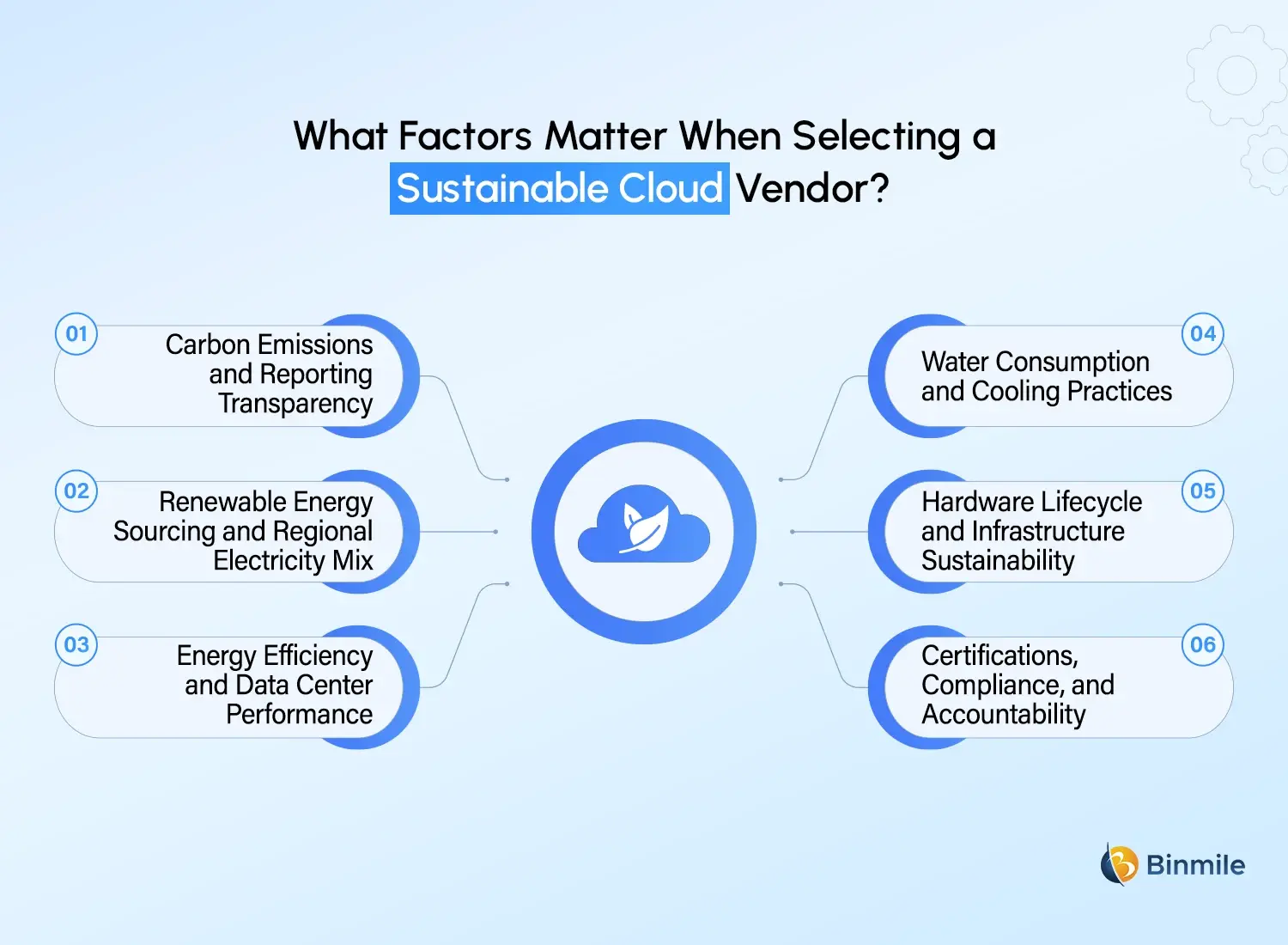
3. Energy Efficiency and Data Center Performance
Energy-efficient cloud computing can reduce the amount of resources consumed and the operating costs incurred. Evaluate Power Usage Effectiveness (PUE), the scope of measurements taken, and the efficiency of the facilities that host workloads. Consider workload optimization tools that help eliminate idle resources and improve utilization rates. Understanding cloud computing energy consumption is key when considering infrastructure options. Enterprises should also assess how a green cloud computing system supports workload efficiency without compromising application performance.
4. Water Consumption and Cooling Practices
Water is used in data centers for cooling purposes, and its consumption can vary depending on the technology and location. Evaluate vendors’ water usage metrics, cooling practices, and considerations for water stress in the regions where data centers are located. Understanding water withdrawal and consumption helps enterprises determine the impact of their cloud operations on water resources in the surrounding areas.
5. Hardware Lifecycle and Infrastructure Sustainability
The production of servers, equipment replacement, and e-waste can contribute significantly to a cloud infrastructure’s environmental footprint. Evaluate vendors’ practices for reusing, refurbishing, and recycling hardware while considering their impact on embodied carbon. Enterprises should also consider workload optimization and selective migrations rather than assuming that every cloud migration will contribute to sustainability. Enterprises should take these factors into account when determining how to modernize legacy applications and infrastructure to be more efficient. Green cloud computing development and green cloud computing integration should account for these lifecycle considerations when infrastructure is redesigned or modernized.
6. Certifications, Compliance, and Accountability
Environmental certifications can be useful for vendor selection, but they are not always an indicator of a company’s overall sustainability performance. Evaluate the scope and validity of certifications while considering whether the vendors provide reporting, audit documentation, and evidence to support their claims.
Ready to make sustainability a measurable part of your cloud strategy for efficiency, cost, and long-term business value.
How to Compare Sustainable Cloud Providers
AWS, Microsoft Azure, and Google Cloud publish sustainability resources that enterprises can use to evaluate environmental performance. Their offerings provide useful starting points for comparing green cloud computing technology, although reporting methodologies and available metrics differ.
| Cloud Provider | What enterprises should evaluate |
|---|---|
| Amazon Web Services (AWS) | Sustainability reporting, workload optimization guidance, carbon and water impact estimates, and methodology limitations |
| Microsoft Azure | Sustainable workload guidance, architecture efficiency, environmental reporting capabilities, and workload optimization |
| Google Cloud | Carbon footprint reporting, location-based and market-based emissions, and reporting by project, product, and region |
Enterprises evaluating Azure cloud services should examine sustainability reporting alongside workload efficiency, regional requirements, and the technical suitability of proposed services. Similar criteria should apply when assessing other providers.
The comparison should extend beyond sustainability dashboards. Enterprises should examine historical data availability, reporting granularity, regional information, and the ability to use the data in internal sustainability processes.
| Evaluation criterion | What to compare |
|---|---|
| Carbon Reporting | Coverage, calculation methodology, granularity, and exclusions |
| Energy Sourcing | Regional electricity mix and renewable energy accounting |
| Infrastructure Efficiency | PUE disclosures, measurement scope, and facility coverage |
| Water Stewardship | Water metrics, cooling practices, and local water stress |
| Workload Optimization | Tools for improving utilization and reducing unnecessary resource consumption |
| Commercial Fit | Total cost, performance, availability, and compliance |
| Accountability | Reporting access, documentation, and contractual commitments |
When comparing green cloud computing companies, procurement teams should assess the evidence behind each provider’s claims rather than rely on a universal sustainability ranking. The right choice depends on workload requirements, deployment regions, reporting needs, and commercial priorities.
How to Build a Green Cloud Computing Procurement Framework
A structured framework helps enterprises turn sustainability objectives into vendor requirements and measurable outcomes. These green cloud computing best practices can form part of a broader cloud adoption strategy, helping organizations align environmental priorities with infrastructure planning.
Step 1: Define Sustainability Requirements Before Issuing an RFP
Identify the organization’s requirements and convert them into RFP requirements so that vendors can be evaluated based on specific criteria.
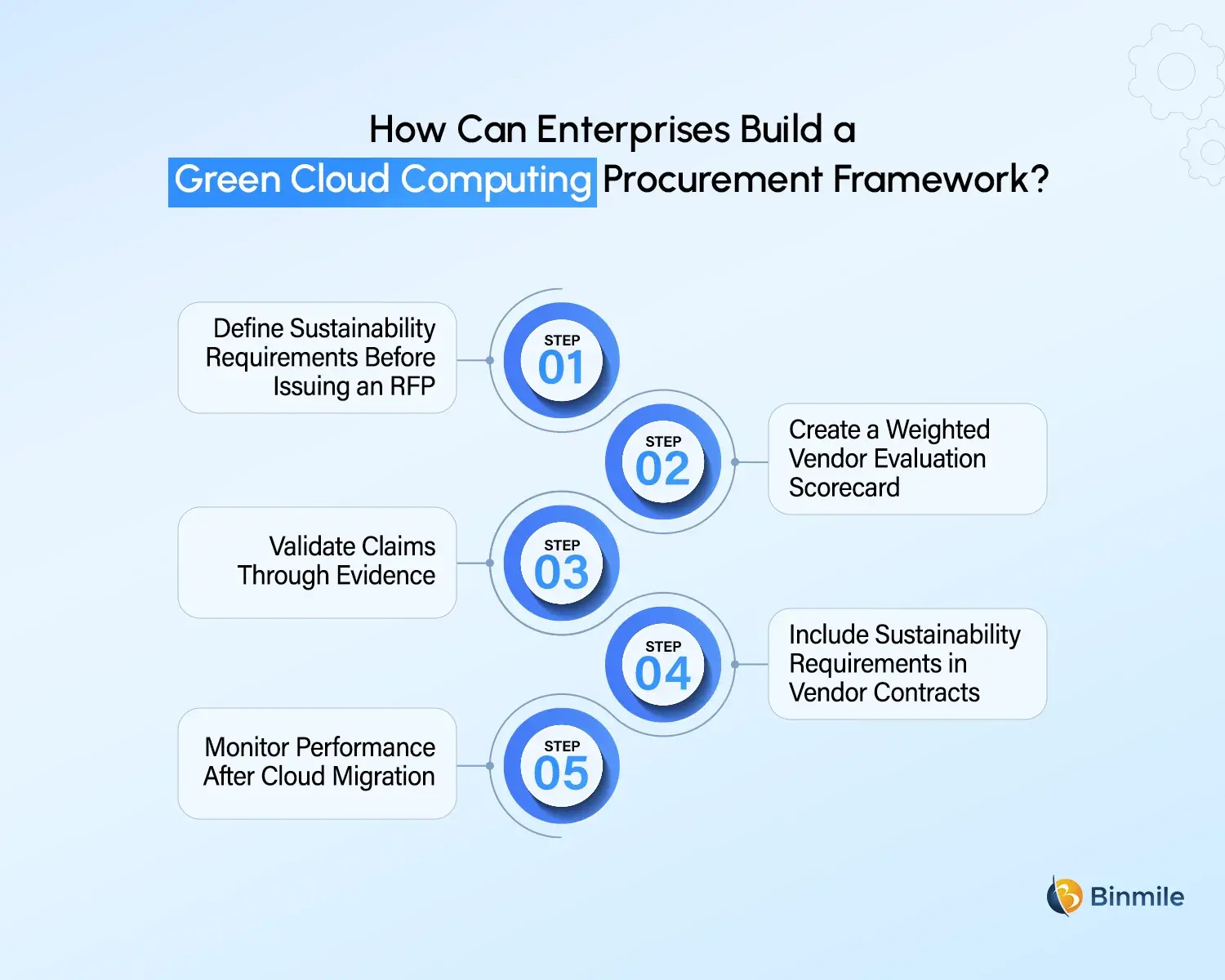
Step 2: Create a Weighted Vendor Evaluation Scorecard
Evaluate vendors based on a combination of environmental performance, cost, and technical suitability. Assign weights to each criterion based on the organization’s requirements, such as carbon reporting, energy efficiency, water stewardship, compliance, total cost of ownership (TCO), and workload performance. Require justification for each score to ensure that vendors are held accountable for their claims.
Step 3: Validate Claims Through Evidence
Review sustainability reports, emission calculation methodologies, certifications, and regional energy data to determine whether the claims made by vendors are valid. Where possible, request demonstrations of the tools that vendors are using and verify that the differences in reported emissions are not due to reporting inconsistencies.
Step 4: Include Sustainability Requirements in Vendor Contracts
Specify what is expected from the vendor concerning reporting, documentation, and best sustainability management software in vendor contracts. This includes ensuring that documentation and reporting are provided in a manner that is accessible and useful for the enterprise. Organizations evaluating the best sustainability software management options should consider how well these tools support their reporting and data integration requirements.
Step 5: Monitor Performance After Cloud Migration
Continuously monitor sustainability performance, resource utilization, cloud costs, and workload performance after migrating workloads to the cloud. This allows enterprises to identify inefficiencies and ensure that their cloud operations continue to align with their sustainability and business objectives. Regular reviews also help track green cloud implementation progress and maintain a practical green cloud computing roadmap.
How to Balance Cloud Sustainability, Cost, and Performance
The cloud option with the lowest reported emissions is not always the best option for an enterprise. CXOs must evaluate cloud computing cost, performance, availability, and data residency to balance sustainability and business requirements.
For example, migrating an application to a lower-carbon region may come at the expense of higher latency or regulatory and compliance challenges. Similarly, a cloud migration on its own does not guarantee that an enterprise will be able to achieve its sustainability goals.
Right-sizing instances, removing any unnecessary resources, and scaling up or down based on demand can help enterprises achieve efficiency gains. Applying green software principles and green cloud computing architecture also helps enterprises make the best use of their resources during cloud modernization. These measures can contribute to green cloud architecture that balances infrastructure efficiency with application requirements.
For AI in green cloud computing, efficient scheduling, allocation of resources, and selection of models can reduce the demand for unnecessary compute. Enterprises should evaluate these initiatives based on their business outcomes while selecting infrastructure that can support their requirements for energy efficiency, performance, and resilience. AI green cloud computing initiatives should be assessed using measurable efficiency and environmental outcomes rather than assumptions about their benefits.
The use cases of green cloud computing can include workload optimization, efficient resource allocation, and infrastructure modernization, depending on an enterprise’s operational needs.
Common Mistakes to Avoid When Selecting Sustainable Cloud Vendors
Even with clear sustainability goals, enterprises can make procurement decisions based on incomplete data or misleading claims. Avoiding these common mistakes helps ensure vendor selection supports both environmental objectives and business requirements.
-
Relying Only on Renewable Energy Commitments
Renewable energy commitments are a useful indicator, but they should not be the sole consideration when selecting a cloud vendor. Evaluate vendors based on carbon emissions, energy efficiency, sustainability reporting, and water consumption.
-
Comparing Emissions Without Checking Methodologies
Cloud providers can use different methodologies and coverage when reporting their emissions. Review vendors’ methodologies and coverage before comparing their emissions or concluding that one option is significantly better than the others.
-
Overlooking Water Consumption and Local Impact
Water consumption and local impact should be considered when evaluating a cloud provider’s sustainability performance. Enterprises should look at vendors’ cooling practices and water metrics and conduct a review of the environmental conditions in the regions where data centers are hosted.
-
Ignoring Workload Efficiency
Cloud infrastructure can be inefficient if workloads are not optimized. Enterprises should evaluate resource utilization, remove any idle resources, and right-size workloads for optimal performance and cost.
-
Failing To Monitor Performance After Migration
Cloud sustainability requires continuous monitoring to ensure that workloads are performing efficiently and that cloud costs are optimized. Enterprises should evaluate resource utilization, cloud costs, and workload performance regularly to identify areas for improvement.
Looking to make cloud procurement more sustainable without compromising performance or cost?

Building a Sustainable Cloud Strategy for Long-Term Business Value
Green cloud computing procurement works best when sustainability is part of the broader cloud strategy. Beyond vendor selection, architecture, workload utilization, cost management, and ongoing measurement determine how efficiently enterprises use cloud resources.
CXOs should align environmental goals with business performance by setting clear requirements and collaborating across technology, finance, procurement, and sustainability teams. Digital transformation in procurement can further standardize vendor assessments and improve decision-making.
Binmile helps enterprises modernize workloads, optimize resource utilization, and manage cloud costs through cloud consulting services and cloud computing solutions. Businesses can also use DevOps consulting and sustainability management software to improve deployment efficiency, environmental reporting, and performance tracking. Cloud computing solutions, cloud consulting services, DevOps consulting, and cloud modernization initiatives tailored to enterprise needs can support these efforts.
A clear assessment of infrastructure, workload demands, and sustainability priorities provides a practical starting point for green cloud computing investment and long-term efficiency. For enterprises planning their next infrastructure changes, this assessment can help identify opportunities for green cloud transformation while keeping operational and commercial goals in view.
Frequently Asked Questions
Green cloud computing procurement involves selecting cloud providers and services based on environmental performance alongside cost, security, reliability, and technical requirements. It considers emissions, energy efficiency, renewable energy sourcing, water use, and sustainability reporting.
Evaluate providers using consistent criteria, including carbon reporting, energy sourcing, infrastructure efficiency, water stewardship, and workload optimization. Validate their claims through published methodologies, relevant documentation, and measurable evidence.
There is no universally best provider for every enterprise. AWS, Microsoft Azure, and Google Cloud offer different sustainability resources and reporting capabilities. The appropriate choice depends on workloads, deployment regions, compliance requirements, reporting needs, and commercial priorities.
Useful metrics include carbon emissions and calculation boundaries, energy sourcing, Power Usage Effectiveness (PUE), relevant water metrics, and infrastructure efficiency. Enterprises should also assess reporting granularity, historical data availability, and calculation methodologies.
It can. Right-sizing resources, removing idle infrastructure, improving utilization, and optimizing workloads can reduce unnecessary cloud consumption and spending. The actual financial and environmental benefits depend on workload requirements, architecture, pricing, and implementation.