Cloud investment is no longer limited to replacing physical servers. Businesses now use the cloud to launch digital products, support distributed teams, improve business continuity, modernize applications, and prepare data for AI. Gartner projected worldwide end-user spending on public cloud services to reach $723.4 billion, and that 90% of organizations will adopt a hybrid cloud approach through 2027. The expanding cloud computing market shows clear demand, but adoption alone does not guarantee value.
The outcome depends on what a business moves, how the cloud computing environment is designed, and whether cost, security, governance, and operating responsibilities are managed from the start. What cloud computing solutions include, when they are worth implementing, and what leaders should evaluate before investing. It also covers the benefits of cloud computing, deployment models, architecture, cost, security, readiness, migration planning, provider selection, and the future of cloud computing.
What Are Cloud Computing Solutions?
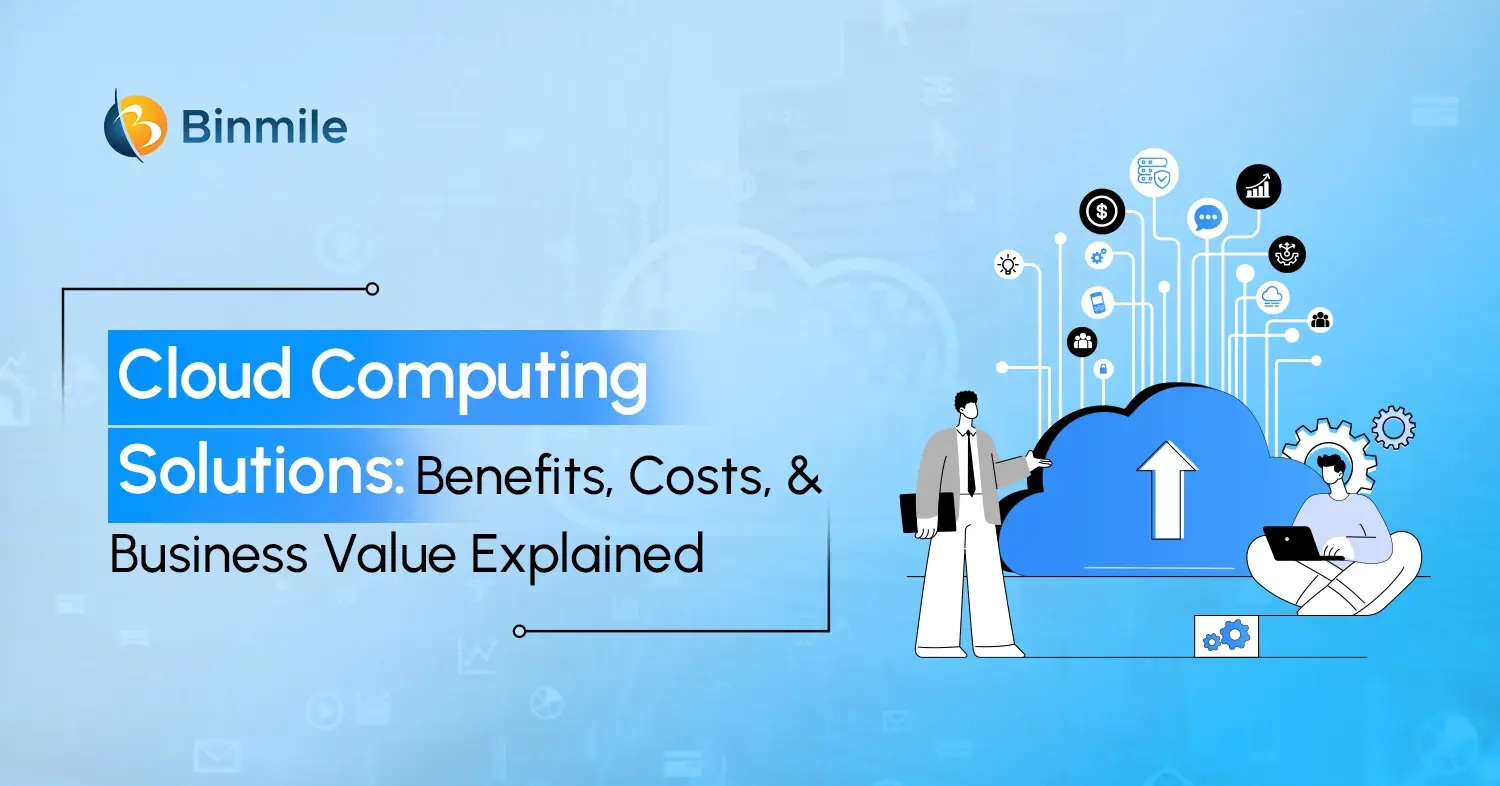
Cloud computing solutions provide on-demand access to servers, storage, databases, networks, software, development platforms, analytics, security tools, and other technology resources through the internet. Instead of purchasing and maintaining every component internally, businesses use resources operated by a cloud service provider and pay according to the selected service or consumption model.
A complete cloud solution combines cloud computing infrastructure, which includes computing, storage, virtualization, and networking resources, with a well-designed cloud computing architecture that connects applications, users, identities, data, integrations, monitoring, and security. It also incorporates various cloud computing services, such as Infrastructure as a Service (IaaS), Platform as a Service (PaaS), Software as a Service (SaaS), managed databases, analytics platforms, backup, and disaster recovery.
The value comes from how these elements support a business objective. Simply moving existing systems to a hosted infrastructure may change their location without improving cost, performance, or maintainability.
Are Cloud Computing Solutions Worth the Investment?
For many organizations, cloud computing solutions are worth implementing when they solve a defined problem. They can reduce infrastructure provisioning time, support changing demand, improve access to modern technologies, and lower the effort required to manage physical systems.
Cloud is not automatically cheaper, safer, or simpler. Poorly planned Cloud Adoption can create duplicate systems, uncontrolled spending, weak access controls, and greater complexity. Leadership should ask which workloads will create enough value to justify migration or modernization.
| Business Need | Potential Cloud Value | What To Validate |
|---|---|---|
| Demand Changes Frequently | Resources can scale without permanent capacity purchases | Scaling policies, performance targets, and budget limits |
| Hardware needs replacement | The business may avoid another major infrastructure cycle | Long-term Cloud Computing Cost and Total Ownership Cost |
| Product delivery is slow | Managed platforms and automation can accelerate releases | Application dependencies and engineering readiness |
| Recovery processes are weak | Backup, replication, and failover can improve resilience | Recovery objectives and regular testing |
| Legacy systems restrict growth | Cloud modernization can improve scalability and integration | The right migration approach for each workload |
The strongest business cases connect cloud investment to measurable outcomes, such as faster releases, improved availability, shorter recovery time, lower maintenance effort, or the ability to enter new markets.
What Are the Major Benefits of Cloud Computing for Businesses
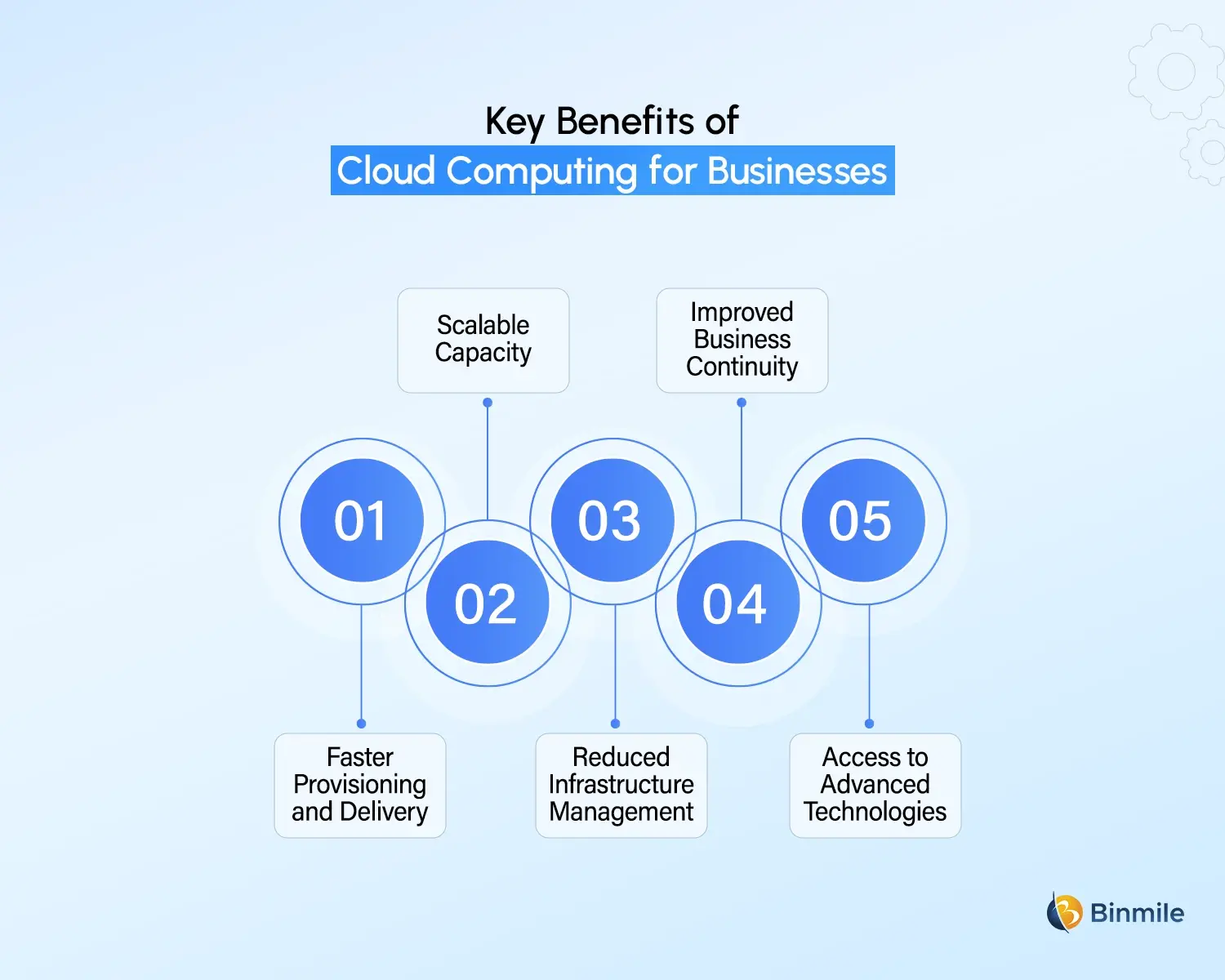
The biggest benefits of cloud computing extend beyond cost savings. When implemented strategically, cloud technologies help businesses become more agile, resilient, and innovation-driven.
-
Faster Provisioning and Delivery
Traditional infrastructure deployment often involves lengthy procurement and configuration processes. A well-managed cloud environment enables teams to provision resources quickly, reducing the time required for development, testing, and production deployments.
-
Scalable Capacity
One of the most valuable benefits of cloud computing is the ability to scale resources based on demand. Whether handling seasonal traffic spikes or supporting business expansion, organizations can increase or decrease capacity without major infrastructure investments.
-
Reduced Infrastructure Management
Managed cloud computing services minimize the effort required to maintain servers, databases, operating systems, and storage, allowing internal IT teams to focus on strategic initiatives instead of routine maintenance.
-
Improved Business Continuity
Cloud platforms support automated backups, disaster recovery, and high availability, helping businesses recover more quickly from unexpected disruptions while minimizing downtime.
-
Access to Advanced Technologies
Modern cloud IT solutions provide access to artificial intelligence, machine learning, analytics, automation, and IoT capabilities without requiring businesses to build complex infrastructure from scratch.
Types of Cloud Computing and Their Best Use Cases
The right deployment model depends on workload sensitivity, performance, compliance, existing systems, internal skills, and budget.
| Deployment model | Suitable for | Key consideration |
|---|---|---|
| Public Cloud | Fast provisioning, broad service access, and variable workloads | Cost governance and secure configuration |
| Private Cloud | Dedicated control or specialized internal requirements | Higher investment and management effort |
| Hybrid Cloud | Connecting on-premises systems with public or private cloud resources | Integration, identity, and monitoring complexity |
| Multi-Cloud | Using specialized services or reducing dependence on one provider | Greater governance and skill requirements |
These types of cloud computing can operate together. An enterprise may retain regulated data privately, run customer-facing cloud computing applications publicly, and connect older systems through a hybrid architecture.
The right model should be selected for each workload. Choosing multiple platforms without a clear reason can increase management effort, duplicate tools, and require employees to maintain skills across several environments.
Which Cloud Computing Applications Should Businesses Prioritize?
Common candidates include customer portals, ecommerce systems, mobile backends, CRM and ERP platforms, analytics, AI workloads, backup and disaster recovery, development environments, application integration, and remote asset monitoring.
Applications with unpredictable demand may benefit from scalable resources. Systems requiring frequent updates may gain from automated deployment pipelines and managed platforms. Data-intensive applications may benefit from cloud storage, processing, and analytics services.
Not every application requires the same approach. A stable system nearing retirement may stay in place, while a high-growth product may need redesign. Workload-level decisions usually produce better enterprise cloud computing solutions than a blanket “move everything” policy.
How to Determine Whether Your Business Is Cloud Ready
Cloud readiness goes beyond technical compatibility. Before adopting a cloud computing environment, businesses should evaluate whether they have clear objectives, defined success metrics, and a realistic budget for implementation.
It is equally important to assess the existing application portfolio, including dependencies, technical debt, licensing, and performance requirements. Organizations should also review their current infrastructure costs, security and compliance requirements, governance policies, and the internal expertise needed to manage cloud operations. If these capabilities are lacking, partnering with experienced Cloud Consulting Services can help reduce implementation risks.
A cloud readiness assessment helps identify technology, process, and skill gaps before migration begins, ensuring business, IT, finance, and security teams are aligned for a smoother and more successful cloud adoption.
Need a secure, scalable cloud strategy that controls cost while supporting growth?
Understanding Cloud Computing Cost and ROI
Evaluating cloud investments requires looking beyond monthly subscription fees. While cloud adoption replaces large capital expenditures with operational spending, the overall business case should consider both direct and indirect costs.
A comprehensive Cloud Computing Cost assessment should include migration expenses, licensing, maintenance, staffing, training, security, monitoring, data transfer, and ongoing operational costs. Comparing only infrastructure pricing often provides an incomplete picture.
Return on investment should also be measured through business outcomes such as improved application availability, faster software delivery, increased employee productivity, better disaster recovery, and greater scalability.
At the same time, organizations should actively manage cloud spending. Unused resources, oversized workloads, unnecessary data transfers, and poor governance can significantly increase costs over time. Regular architecture reviews, automated budgeting, resource tagging, and FinOps practices help ensure cloud investments continue delivering measurable value.
For most enterprises, cloud ROI should be evaluated over several years rather than focusing solely on migration costs or the first month’s bill.
A Practical Cloud Implementation Roadmap
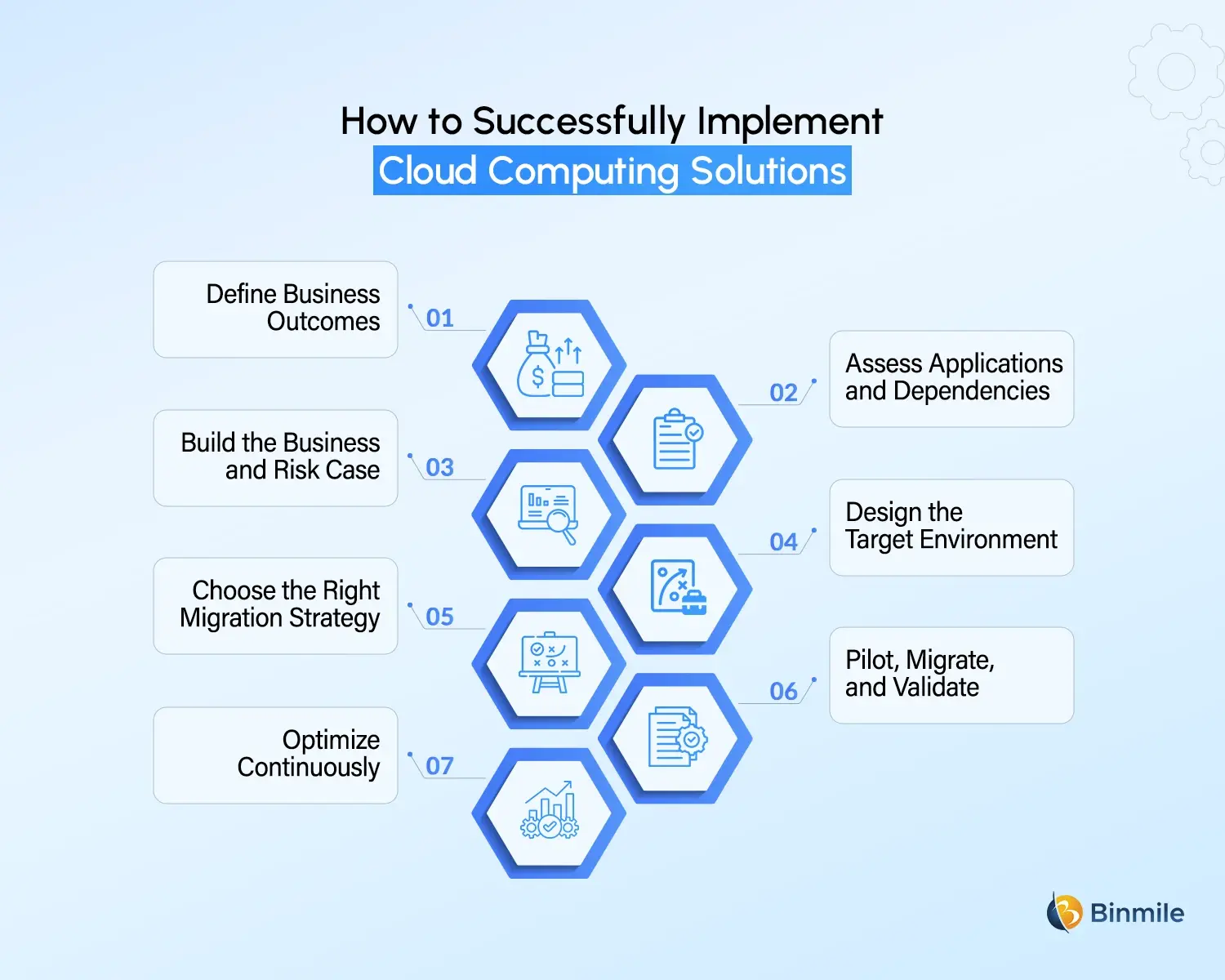
A successful cloud journey requires a structured approach rather than simply moving workloads from one environment to another.
-
Define Business Outcomes
Start by identifying what the business aims to achieve, whether it is reducing infrastructure costs, improving scalability, accelerating software delivery, or enhancing business continuity. Clear objectives make it easier to measure success.
-
Assess Applications and Dependencies
Evaluate applications, integrations, compliance requirements, and technical complexity to determine which workloads should move first and which may require modernization.
-
Build the Business and Risk Case
Compare current operating costs with projected cloud investments while identifying expected benefits, potential risks, and measurable success criteria.
-
Design the Target Environment
Establish networking, security, identity management, monitoring, backup, and governance before migrating critical workloads to ensure a stable and secure foundation.
-
Choose the Right Migration Strategy
Each application should have its own migration approach. Depending on business needs, workloads may be rehosted, replatformed, refactored, replaced, or retained.
-
Pilot, Migrate, and Validate
Begin with low-risk workloads to validate performance, security, and cost assumptions before expanding migration across the organization.
-
Optimize Continuously
Cloud adoption does not end after migration. Regularly monitor cost, utilization, performance, and security to ensure the environment continues supporting evolving business needs.
When Cloud May Not Be the Right Immediate Choice
Although cloud adoption offers significant advantages, it is not always the right solution for every workload. Applications that rely on specialized hardware, have strict latency requirements, or are subject to complex regulatory restrictions may continue to perform better in on-premises environments.
Migration should also be postponed if application dependencies are unclear, governance processes are immature, or security responsibilities have not been defined. Similarly, organizations that have recently invested in modern on-premises infrastructure may not see immediate financial benefits from migrating.
Rather than following a cloud-first strategy, businesses should focus on placing each workload in the environment that delivers the best balance of cost, performance, security, and operational efficiency.
What Is the Future of Cloud Computing?
The future of cloud computing will be shaped by AI infrastructure, edge computing, industry platforms, automation, sovereign cloud requirements, platform engineering, and stronger financial governance. Businesses will select architectures according to workload economics, data control, performance, and compliance.
Cloud platforms will also connect more closely with application modernization through containers, serverless services, event-driven systems, managed databases, and AI platforms. Leadership attention will shift from moving servers to building an adaptable operating model.
Enterprises will also expect greater portability and visibility across hybrid and multi-cloud environments. Cost, security, resilience, data governance, and AI readiness will become central architecture considerations rather than secondary operational concerns.
Ready to determine whether cloud computing solutions can deliver measurable value for your business?

How Binmile Can Help Build a Business-Ready Cloud Environment
Implementing cloud computing solutions requires a clear business case, a realistic assessment of the existing technology estate, secure architecture, controlled migration, and an operating model that supports long-term growth.
Binmile helps enterprises evaluate readiness, create adoption roadmaps, design secure environments, migrate and modernize applications, establish governance, and improve cost and performance after deployment. The approach can align Azure Cloud Services, hybrid systems, application requirements, security expectations, and internal capabilities with measurable business outcomes.
This helps organizations avoid fragmented adoption and build a cloud foundation that supports resilience, innovation, analytics, AI, and future expansion without losing control of security or spending.
Frequently Asked Questions
Cloud Computing Solutions provide on-demand access to infrastructure, software, storage, databases, security, and development platforms. They help businesses scale resources, improve collaboration, reduce infrastructure maintenance, strengthen continuity, and access advanced technology without building every capability internally.
Your business may be ready when it has clear objectives, an application inventory, documented security requirements, a financial baseline, accountable owners, and migration priorities. A readiness assessment can reveal skill, governance, architecture, and process gaps before investment begins.
Businesses should assess workload requirements, security, compliance, scalability, integration, regional availability, provider support, internal skills, migration complexity, and total cost of ownership. The selected solution should support measurable outcomes rather than simply offer the lowest advertised price.
They improve efficiency by accelerating infrastructure provisioning, automating routine administration, enabling secure access, simplifying deployment, supporting collaboration, and scaling resources according to demand. Strong governance is still required to prevent waste, inconsistent configurations, and duplicated services.
An experienced partner can assess readiness, identify dependencies, design secure architecture, select suitable migration approaches, manage implementation risk, and establish cost controls. This helps businesses avoid rushed decisions and create a cloud environment that remains manageable after deployment.