Artificial intelligence is no longer a future investment. It is becoming a competitive advantage for businesses looking to improve operations, reduce costs, and make faster decisions. However, adopting AI successfully is far more challenging than purchasing an AI tool or integrating a chatbot. According to IBM’s Global AI Adoption Index, 42% of large enterprises have actively deployed AI, yet many organizations still struggle to achieve meaningful business outcomes because they lack a clear implementation strategy.
This is where choosing the right AI Implementation Consultant becomes critical. The right consultant helps businesses identify practical AI opportunities, build a roadmap, integrate AI into existing systems, and ensure measurable returns on investment. This guide explains what an AI implementation consultant does, why businesses need one, the factors to consider before hiring, common mistakes to avoid, and the questions every executive should ask before selecting an AI partner.
What Does an AI Implementation Consultant Do?
Many businesses assume AI implementation is simply about building machine learning models or deploying generative AI in digital product development. In reality, an AI Implementation Consultant acts as a strategic advisor who ensures AI initiatives align with business goals rather than becoming isolated technology projects.
An AI Implementation Consultant begins by understanding your business objectives and identifying areas where AI can create measurable value. They assess your existing data, technology infrastructure, and operational processes to determine whether your organization is ready for AI adoption. Based on this assessment, they develop a practical implementation roadmap, recommend the most suitable AI technologies, and ensure seamless integration with your existing enterprise systems.
Beyond deployment, they also help manage organizational change, monitor AI performance, and continuously optimize solutions to maximize business outcomes. The goal is not simply to implement AI, but to improve productivity, enhance customer experiences, streamline operations, and support better decision-making across the organization.
Why Does Your Business Need an AI Implementation Consultant?
Many organizations invest in AI, expecting immediate results, only to discover that technology alone cannot solve business problems. Successful AI adoption requires a clear strategy, quality data, system integration, governance, and ongoing optimization.
An experienced AI Transformation consultant helps businesses avoid these challenges while reducing implementation risks.
Consider hiring an AI consultant if your organization is facing any of the following situations:
| Business Challenge | How an AI Consultant Helps |
|---|---|
| Manual and repetitive processes | Identifies automation opportunities |
| Increasing operational costs | Optimizes workflows using AI |
| Large volumes of unused business data | Builds data-driven decision systems |
| Poor customer experience | Implements intelligent automation and AI-powered support |
| Digital transformation initiatives | Aligns AI adoption with long-term business strategy |
| Scaling business operations | Develops enterprise-ready AI solutions |
Whether your goal is automating workflows, improving customer engagement, or modernizing legacy systems, AI strategy and consulting ensures every AI investment supports measurable business outcomes.
Factors to Consider When Choosing the Right AI Implementation Consultant
Selecting the right consultant is not about choosing the company with the most impressive AI portfolio. It is about finding a partner who understands your business, has proven implementation experience, and can deliver measurable outcomes.
1. Prioritize Business Understanding Over Technical Buzzwords
A reliable consultant focuses on understanding your business goals before discussing AI tools. They should ask about your challenges, priorities, expected outcomes, and success metrics to ensure the solution aligns with your business objectives rather than just the latest technology trends.
2. Evaluate Their AI Implementation Experience
Choose consultants with proven experience delivering enterprise AI projects. Look for relevant industry expertise, successful implementations, measurable business outcomes, and case studies that demonstrate how they solved real business problems instead of simply showcasing technical capabilities.
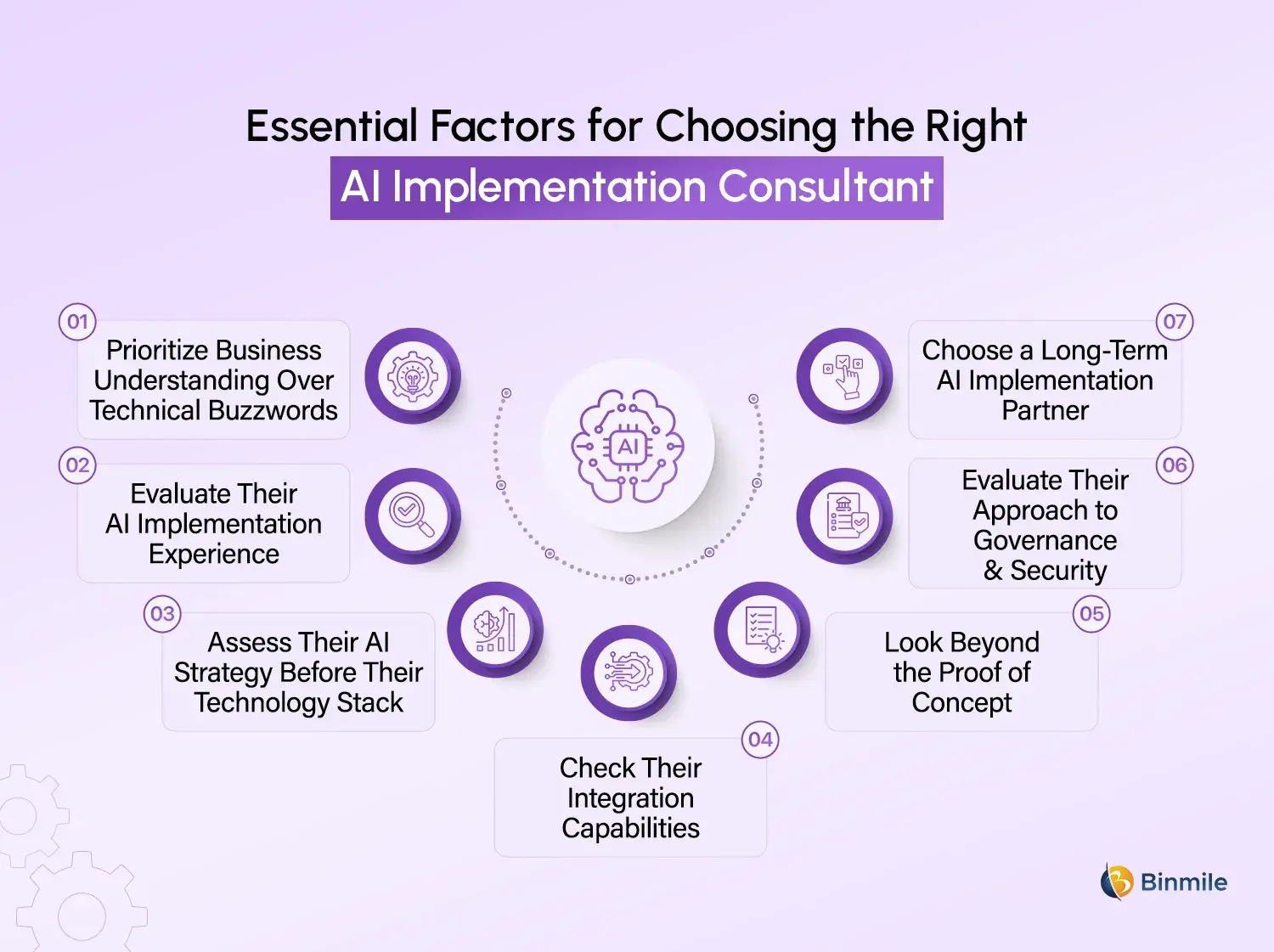
3. Assess Their AI Strategy Before Their Technology Stack
An effective consultant follows a structured approach that includes understanding business goals, assessing AI readiness, evaluating data quality, identifying high-impact use cases, estimating ROI, and creating a roadmap for implementation. This ensures AI investments are practical and outcome-driven.
4. Check Their Integration Capabilities
AI should work seamlessly with your existing technology ecosystem. The consultant should have experience integrating AI with ERP, CRM, cloud platforms, data warehouses, business intelligence tools, and legacy systems to ensure smooth adoption across the organization.
5. Look Beyond the Proof of Concept
Many AI projects fail to move beyond the pilot stage. Choose a consultant who has experience scaling AI solutions, monitoring their performance, improving models over time, and providing long-term support after deployment.
6. Evaluate Their Approach to Governance and Security
A good consultant should address data privacy, security, compliance, AI governance, and risk management from the beginning. This is especially important for industries handling sensitive customer or business data.
7. Choose a Long-Term AI Implementation Partner
The best AI implementation partners work with organizations beyond deployment by helping them scale AI initiatives, measure performance, identify new opportunities, and maximize long-term return on investment.
Looking for an AI implementation partner that delivers more than proof of concepts?
What Are the Common AI Implementation Mistakes Businesses Should Avoid
Even organizations with significant budgets and experienced teams can struggle with AI adoption. In most cases, the issue is not the technology itself. It is the implementation approach. Understanding these common AI implementation failures can help you evaluate consultants more effectively and avoid costly mistakes.
-
Starting with Technology Instead of Business Goals
One of the biggest mistakes businesses make is investing in AI because it is trending rather than because it solves a specific problem. A successful implementation starts with a clear business objective, whether it is reducing operational costs, improving customer experience, or automating repetitive tasks.
-
Ignoring Data Readiness
AI is only as good as the data it learns from. Poor-quality, incomplete, or siloed data can significantly reduce the effectiveness of AI solutions. Before implementation begins, businesses should evaluate whether their data is accurate, accessible, and suitable for AI models.
-
Expecting Immediate ROI
AI implementation is a journey, not a one-time deployment. While some use cases deliver quick wins, enterprise-wide transformation takes time. A reliable consultant sets realistic expectations, defines measurable milestones, and continuously optimizes the solution after deployment.
-
Overlooking Employee Adoption
Technology alone cannot drive transformation. Employees need to understand how Artificial Intelligence as a service supports their work, not replaces it. Proper training, communication, and change management are essential for successful adoption.
-
Choosing a Vendor Instead of a Strategic Partner
Many businesses select consultants based on pricing or technical capabilities alone. The better approach is to evaluate whether the consultant understands your business, has relevant industry experience, and can support your AI journey long after deployment.
Questions to Ask Before Hiring an AI Implementation Consultant
Before signing an agreement, ask these questions to understand whether the consultant is the right fit for your business.
| Question | Why It Matters |
|---|---|
| Have you implemented AI solutions in my industry? | Demonstrates domain expertise and familiarity with industry challenges. |
| Can you share measurable business outcomes from previous projects? | Shows whether they focus on results rather than just technology. |
| How do you identify the right AI use cases? | Helps you understand their strategic approach. |
| How will AI integrate with our existing systems? | Reduces implementation risks and avoids future compatibility issues. |
| How do you measure project success? | Ensures the engagement is tied to business KPIs and ROI. |
| What happens after deployment? | Confirms whether they provide long-term optimization and support. |
The answers to these questions often reveal more about a consultant’s capabilities than a technical presentation or sales pitch.
Choosing the Right Consultant for Your Industry
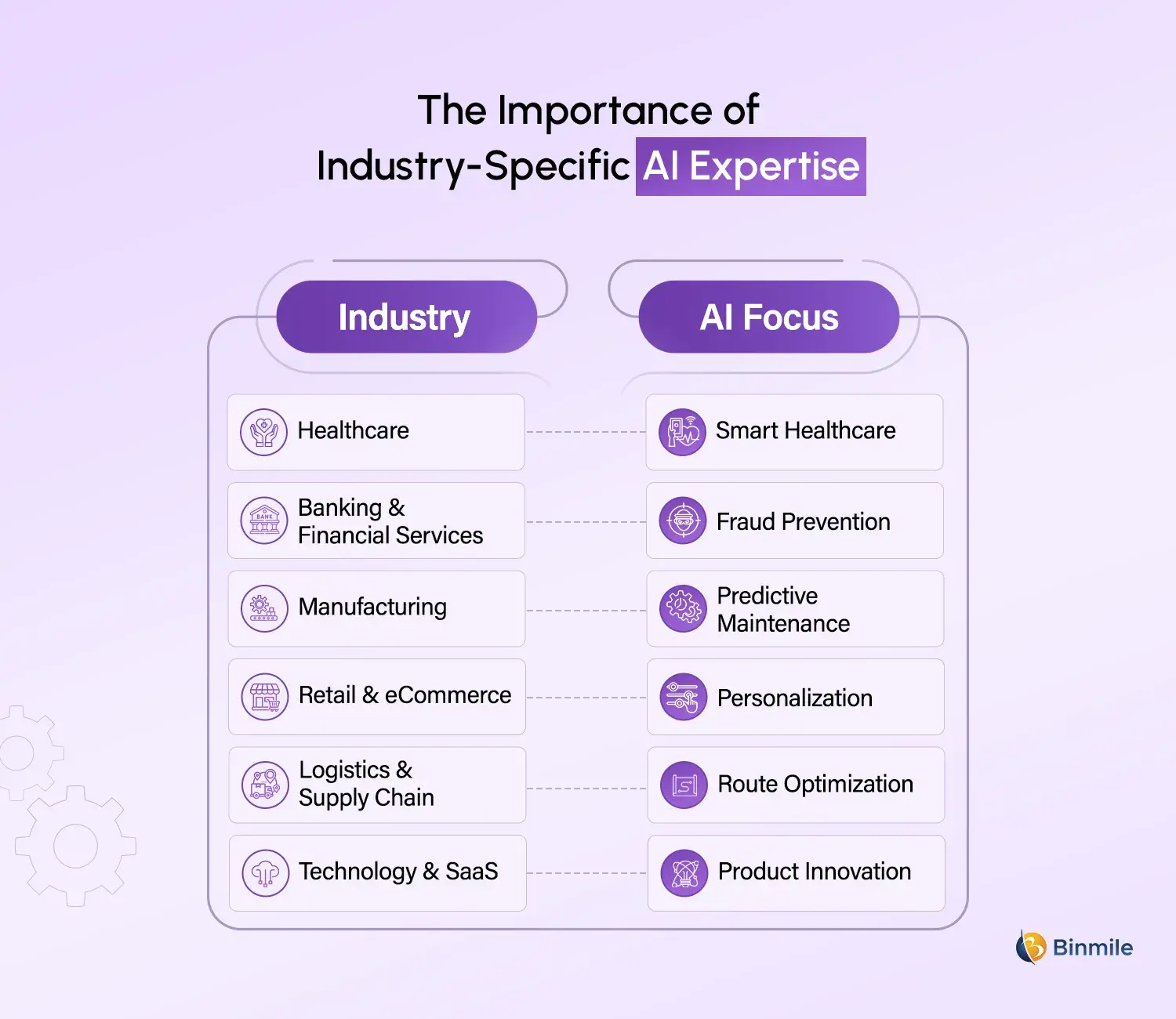
Every industry has different business priorities, regulations, and operational challenges. While evaluating an AI consulting company, ensure they understand your domain and have relevant implementation experience.
-
Healthcare
Look for consultants experienced in patient data management, clinical workflows, diagnostics, and regulatory compliance to ensure secure and effective AI adoption.
-
Banking & Financial Services
Choose partners with expertise in fraud detection, risk analysis, regulatory reporting, and customer experience to address the industry’s strict compliance requirements.
-
Manufacturing
Consultants should understand predictive maintenance, quality inspection, production optimization, and supply chain operations to improve efficiency and reduce downtime.
-
Retail & eCommerce
Look for experience in demand forecasting, inventory optimization, personalized recommendations, and customer analytics to enhance shopping experiences and business performance.
-
Logistics & Supply Chain
An experienced consultant should be able to implement AI for route optimization, warehouse automation, inventory planning, and end-to-end supply chain visibility.
-
Technology & SaaS
Choose consultants who can help integrate AI into products, automate workflows, improve customer support, and accelerate software development with scalable AI solutions.
Ready to turn your AI vision into measurable business results? Scale AI solutions that align with your business goals.

How the Right AI Partner Creates Long-Term Business Value
Choosing the right AI Implementation Consultant is about more than implementing new technology. It is about finding a partner who understands your business objectives, develops a practical implementation strategy, and helps your organization scale AI with confidence.
A successful implementation combines business strategy, data readiness, technology expertise, governance, and continuous optimization. Organizations that evaluate consultants based on these factors are more likely to achieve measurable improvements in efficiency, customer experience, and decision-making while avoiding common implementation challenges.
Businesses looking to accelerate AI adoption often need more than technical expertise. They need a partner that can bridge business strategy with execution. With capabilities spanning AI implementation consulting, enterprise software engineering, cloud modernization, and AI Transformation, Binmile, an AI development company, helps organizations identify high-impact AI opportunities, integrate solutions with existing systems, and build scalable AI initiatives that deliver measurable business outcomes.
Frequently Asked Questions
An AI Implementation Consultant identifies suitable AI use cases, develops an implementation roadmap, integrates AI with existing business systems, and ensures AI solutions deliver measurable business value through continuous optimization and support.
An AI consultant helps reduce implementation risks, align AI initiatives with business goals, improve system integration, establish governance, and maximize the return on your AI investment.
Look for proven implementation experience, industry expertise, a structured delivery approach, strong integration capabilities, governance practices, and a clear focus on business outcomes rather than just technical skills.
Healthcare, banking, manufacturing, retail, logistics, and technology companies benefit significantly by using AI to improve efficiency, automate processes, enhance customer experiences, and make faster, data-driven decisions.
The timeline depends on project complexity, business objectives, data readiness, and integration requirements. Pilot projects may take a few months, while enterprise-wide AI implementations are typically delivered in multiple phases over several months.