Artificial intelligence has become a key driver of productivity, operational efficiency, and business growth. According to McKinsey, 78% of organizations now use AI in at least one business function, yet many still struggle to turn AI investments into measurable business outcomes. The challenge is no longer adopting AI but integrating it into everyday business processes.
The ServiceNow AI Platform addresses this by embedding AI directly into enterprise workflows. Rather than functioning as a standalone tool, it helps organizations automate routine tasks, improve service delivery, strengthen security, and enhance the employee and customer experience.
In this guide, you will learn about the platform’s core capabilities, enterprise use cases, implementation best practices, and how it supports workflow automation across IT, HR, customer service, asset management, and security operations.
What Is the ServiceNow AI Platform?
The ServiceNow AI Platform is an enterprise AI platform that combines generative AI, predictive intelligence, workflow automation, and intelligent search to streamline business operations. Built into the ServiceNow ecosystem, it enables organizations to automate repetitive tasks, surface relevant information, and support faster decision-making across departments.
Unlike standalone AI tools, it embeds intelligence directly into existing workflows, allowing employees to search enterprise knowledge, automate approvals, summarize cases, and interact with AI assistants from a single platform. By combining AI with workflow automation, organizations can improve productivity, enhance customer experiences, strengthen security, accelerate service delivery, and support digital transformation while maintaining governance and scalability.
How the ServiceNow AI Platform Supports Enterprise Functions
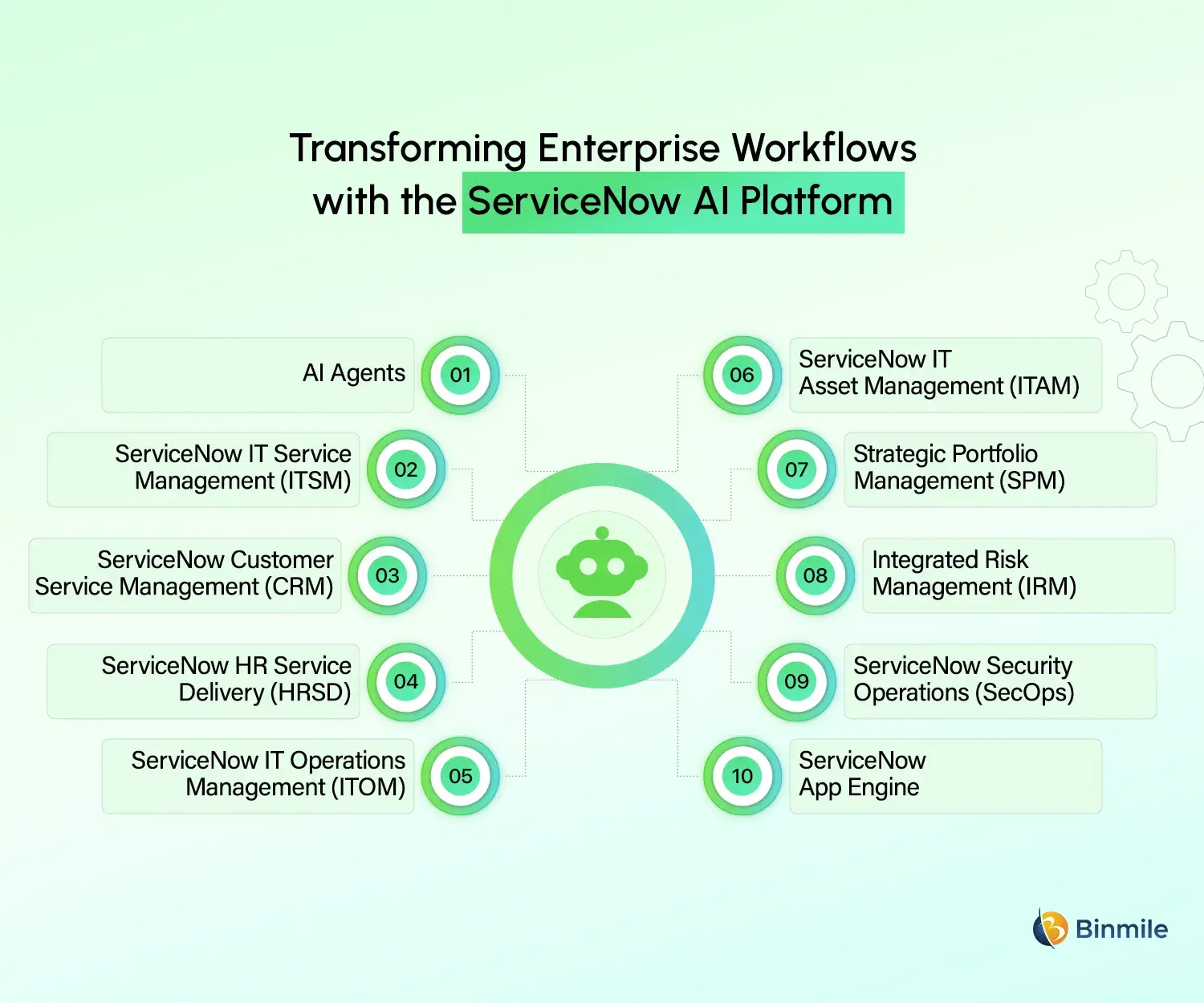
One of the biggest advantages of the ServiceNow AI Platform is its ability to improve multiple business functions through a single, connected platform.
-
AI Agents
ServiceNow AI Agents act as intelligent digital assistants that automate tasks, retrieve enterprise data, and complete multi-step workflows with minimal human intervention. By learning from real-time interactions, they help improve productivity and accelerate issue resolution.
-
ServiceNow IT Service Management (ITSM)
ServiceNow ITSM uses AI to automate incident management, service requests, and change processes. It categorizes tickets, recommends knowledge articles, routes requests intelligently, and helps IT teams resolve issues faster while maintaining SLA compliance.
-
ServiceNow Customer Service Management (CRM)
The ServiceNow Customer Service Management streamlines customer support by automating case routing, tracking SLAs, and recommending next-best actions. AI-powered insights enable agents to resolve issues faster while delivering consistent customer experiences.
-
ServiceNow HR Service Delivery (HRSD)
ServiceNow HR Service Delivery automates routine HR processes such as onboarding, leave management, and benefits inquiries. AI-powered self-service enables employees to receive instant support while reducing administrative workloads for HR teams.
-
ServiceNow IT Operations Management (ITOM)
ServiceNow IT Operations Management monitors enterprise infrastructure, identifies potential disruptions, and analyzes service dependencies. This helps organizations reduce downtime, improve system reliability, and proactively manage IT operations.
-
ServiceNow IT Asset Management (ITAM)
ServiceNow IT Asset Management tracks hardware and software throughout their lifecycle. AI helps optimize asset utilization, improve compliance, identify unused licenses, and reduce unnecessary technology costs.
-
Strategic Portfolio Management (SPM)
Strategic Portfolio Management helps organizations align projects, budgets, and resources with business objectives. It provides visibility into performance and risks, enabling leaders to make informed investment decisions.
-
Integrated Risk Management (IRM)
Integrated Risk Management (IRM) centralizes risk assessments, compliance activities, and regulatory monitoring. Automated workflows provide better visibility into enterprise risks, helping organizations strengthen governance and improve audit readiness.
-
ServiceNow Security Operations (SecOps)
ServiceNow Security Operations uses AI to prioritize threats, correlate alerts, and automate security response workflows. When combined with ServiceNow Vault, it helps organizations improve their security posture while maintaining compliance.
-
ServiceNow App Engine
The ServiceNow App Engine enables teams to build low-code applications using AI-assisted development tools. Organizations can quickly automate workflows, develop custom solutions, and integrate enterprise systems without extensive coding.
What Are the Core Capabilities of the ServiceNow AI Platform
The strength of the ServiceNow AI Platform lies in the way its AI capabilities work together to simplify enterprise operations.
| Capability | Business Value |
|---|---|
| ServiceNow AI Agents | Execute tasks, automate workflows, and assist employees with complex requests. |
| ServiceNow AI Search | Delivers contextual search results across enterprise systems for faster information retrieval. |
| ServiceNow App Engine | Enables rapid low-code application development with AI-assisted workflows. |
| Predictive Intelligence | Uses historical data to categorize incidents, prioritize requests, and recommend actions. |
| Generative AI | Creates summaries, drafts responses, generates knowledge articles, and reduces manual documentation. |
| ServiceNow Vault | Protects sensitive enterprise data through advanced security and governance capabilities. |
Together, these capabilities transform AI from a productivity tool into an intelligent operational layer that supports every stage of a business workflow.
Implementing the ServiceNow AI Platform: Best Practices for Success
A successful AI implementation goes beyond enabling new features. It requires a clear strategy, quality data, and well-defined business objectives. Organizations that take a phased approach are more likely to see measurable improvements in productivity, service quality, and operational efficiency.
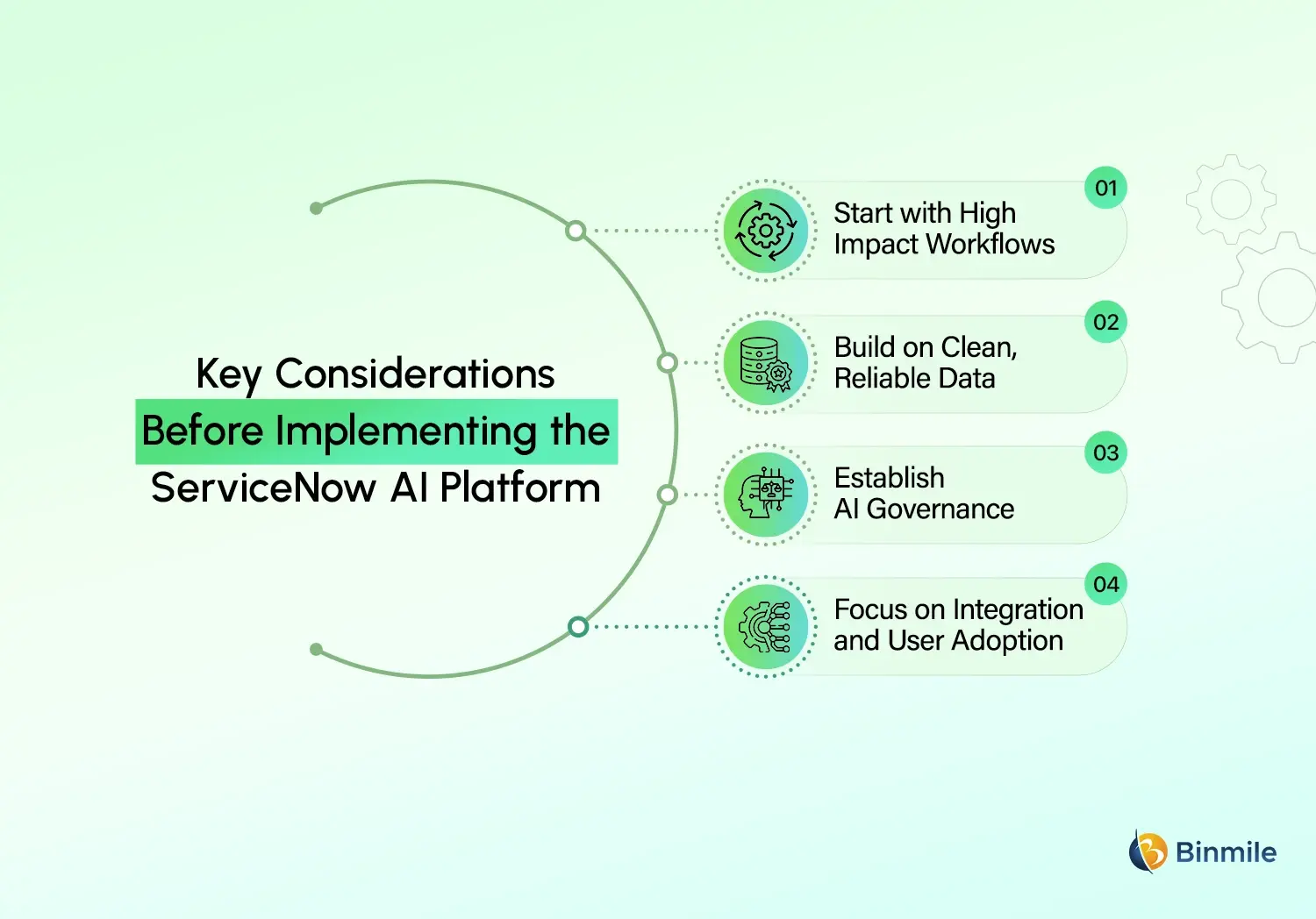
Here are four best practices to consider before implementing the ServiceNow AI Platform:
-
Start with High-Impact Workflows
Rather than automating every process at once, begin with workflows that are repetitive, time-consuming, and high in volume. Common starting points include IT incident management, employee onboarding, customer case routing, and approval workflows. Early successes help build confidence and demonstrate ROI across the organization.
-
Build on Clean, Reliable Data
AI performs best when it has access to accurate and consistent enterprise data. Before deployment, review your CMDB, knowledge base, service catalog, and asset records to remove outdated or duplicate information. Better data leads to better AI recommendations and automation outcomes.
-
Establish AI Governance
As AI becomes part of business operations, governance is essential. Organizations should define data access policies, approval workflows, compliance requirements, and security controls from the beginning. Features like ServiceNow Vault help protect sensitive information while supporting secure AI adoption.
-
Focus on Integration and User Adoption
The platform delivers the greatest value when connected to existing enterprise applications such as Microsoft Teams, SAP, Salesforce, and other business systems. Equally important is helping employees understand how AI improves their daily work through training and change management initiatives.
From AI-powered automation to enterprise workflow optimization, the right implementation strategy makes all the difference.
What Are the Common Challenges During Implementation
While the benefits are significant, organizations should prepare for common implementation challenges.
-
Poor Data Quality
AI depends on accurate and well-structured data. Cleaning and standardizing enterprise data before implementation helps improve AI recommendations and automation accuracy.
-
Disconnected Business Systems
Organizations often rely on multiple business applications. Planning integrations early ensures seamless data flow and enables AI to work across existing enterprise systems.
-
Employee Resistance
New technologies can face adoption challenges. Training employees and implementing effective change management strategies encourage faster adoption and better user experiences.
-
Security and Compliance Concerns
As AI processes enterprise data, strong governance becomes essential. Establishing security policies and using capabilities like ServiceNow Vault helps protect sensitive information while meeting compliance requirements.
-
Undefined Success Metrics
Without measurable goals, it becomes difficult to evaluate AI performance. Defining KPIs before implementation allows organizations to track business outcomes and demonstrate return on investment.
Measuring the Business Impact of the ServiceNow AI Platform
The success of an AI initiative should be measured through business outcomes rather than technology adoption alone. Enterprise leaders should track metrics that directly reflect operational improvements.
-
Mean Time to Resolution (MTTR)
Measures how quickly incidents are resolved. Lower MTTR indicates improved service efficiency and faster issue resolution.
-
First Contact Resolution
Tracks the percentage of issues resolved during the first interaction, helping improve customer satisfaction and reduce repeat requests.
-
Ticket Deflection Rate
Measures how many support requests are resolved through self-service or AI-powered virtual agents, reducing the workload on support teams.
-
Employee Productivity
Evaluates the reduction in manual tasks and the amount of time employees save by using AI-powered automation.
-
SLA Compliance
Monitors whether service requests are resolved within agreed timelines, helping organizations maintain service quality and customer trust.
-
Automation Rate
Tracks the percentage of business processes completed automatically, providing a clear indication of workflow efficiency and operational maturity.
Monitoring these KPIs provides a clear picture of how AI contributes to cost savings, productivity, and service quality.
Industries Benefiting from the ServiceNow AI Platform
The ServiceNow AI Platform supports organizations across a wide range of industries by automating workflows and improving operational efficiency. In banking and financial services, it streamlines fraud investigations, employee services, and compliance workflows. Healthcare organizations use it to enhance patient support, HR operations, and regulatory compliance.
Manufacturers benefit from AI-driven asset maintenance, production support, and field service management, while retailers improve customer service, inventory management, and employee self-service experiences. In the telecommunications sector, the platform helps automate incident management, customer support, and network operations.
Regardless of the industry, the platform enables organizations to simplify complex workflows, improve visibility across business operations, and deliver faster, more consistent services.
Discover how the ServiceNow AI Platform can streamline operations and accelerate business growth.
How the Right Implementation Partner Drives Better Outcomes
Implementing the ServiceNow AI Platform is not simply about enabling AI capabilities. The real value comes from identifying the right business processes to automate, integrating AI into existing enterprise systems, and ensuring long-term scalability. Without a clear strategy, organizations often struggle to realize the full potential of their AI investments.
Working with an experienced implementation partner helps accelerate adoption while minimizing complexity. From evaluating AI readiness and modernizing workflows to integrating enterprise applications and optimizing ServiceNow automation strategies, the focus should always remain on delivering measurable business outcomes.
Drawing on extensive experience in enterprise digital transformation, Binmile helps organizations unlock greater value from their ServiceNow ecosystem by implementing intelligent workflows across IT, HR, customer service, asset management, and security operations. By combining AI, automation, and industry best practices, businesses can improve operational efficiency, strengthen governance, and build scalable digital experiences that continue to evolve with changing business needs.
Frequently Asked Questions
The ServiceNow AI Platform combines generative AI, predictive intelligence, AI Search, AI Agents, and workflow automation to help organizations streamline business processes. It embeds AI into enterprise workflows, enabling faster decision-making, improved productivity, and better service experiences.
The platform supports IT Service Management, Customer Service Management, HR Service Delivery, IT Asset Management, Security Operations, finance, procurement, and other enterprise functions by automating repetitive processes and improving operational efficiency.
It automates routine tasks, intelligently routes requests, provides contextual search results, generates case summaries, and enables AI-powered self-service. This reduces manual work, accelerates issue resolution, and allows employees to focus on higher-value activities.
Organizations should evaluate workflow maturity, data quality, integration requirements, governance policies, security controls, and employee readiness. Starting with high-impact use cases and defining measurable KPIs helps ensure successful implementation.
By combining AI with workflow automation, the platform modernizes business operations, connects enterprise systems, improves collaboration, and enables organizations to deliver faster, more efficient services while adapting to changing business needs.
ServiceNow is the enterprise workflow platform that manages digital processes across business functions. The ServiceNow AI Platform extends these capabilities with AI-powered features such as AI Agents, AI Search, predictive intelligence, and generative AI to automate and optimize workflows.