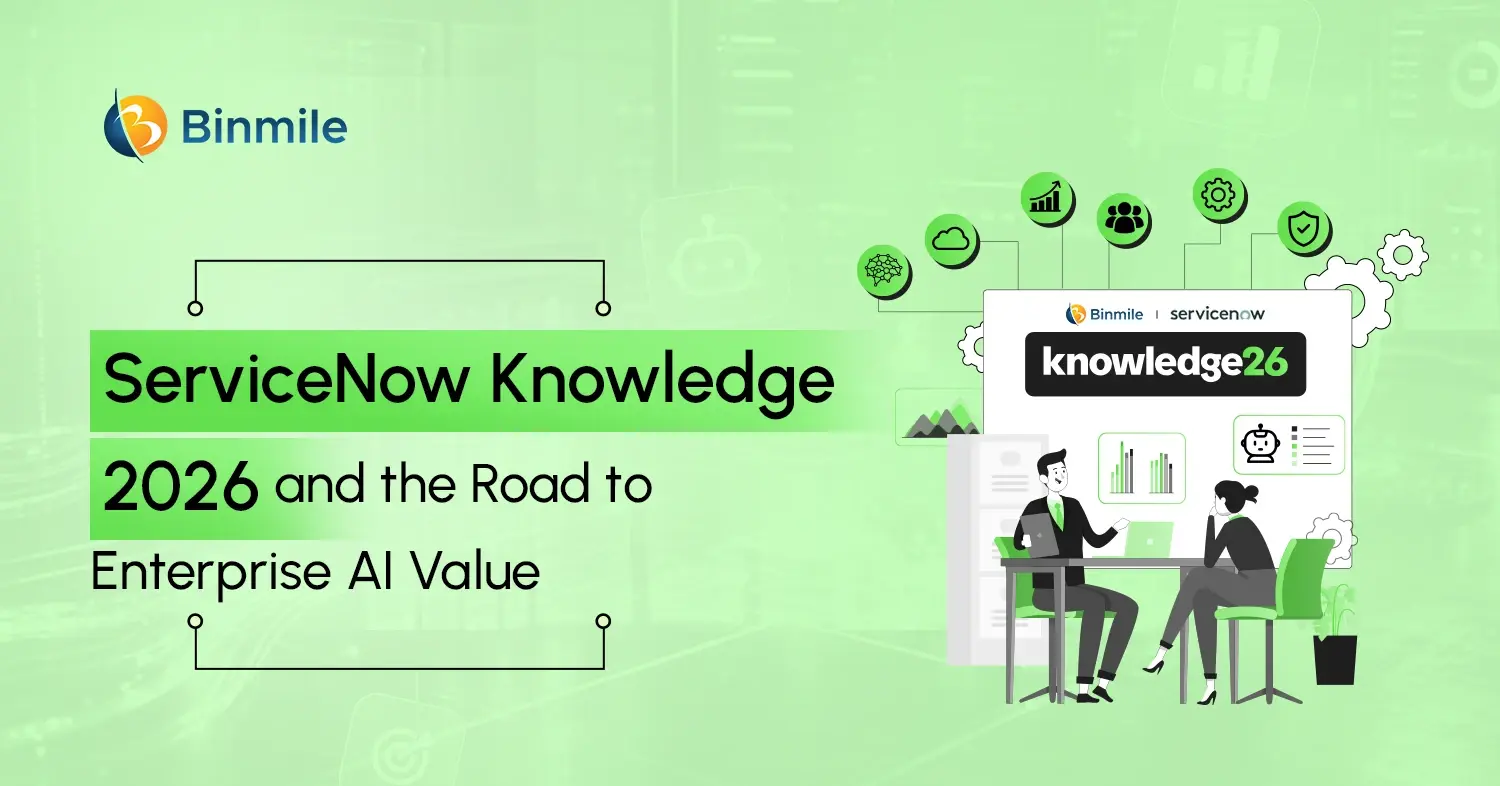
ServiceNow Knowledge 2026 arrived as enterprise AI moved from experimentation toward operational scale. According to an IDC projection cited by ServiceNow, active AI agents worldwide could increase from about 28.6 million in 2025 to more than 2.2 billion by 2030. That growth creates major opportunities, but it also raises practical questions about governance, security, integration, cost, accountability, and return on investment.
This blog explains the most important enterprise themes from ServiceNow Knowledge 2026 and what they mean beyond the keynote stage. It covers ServiceNow AI Agents, AI governance, autonomous workflows, knowledge management, application development, IT operations, portfolio planning, industry use cases, implementation priorities, and the metrics leaders should track while converting the ServiceNow roadmap into business outcomes.
ServiceNow Knowledge 2026 Signals a Shift from AI Assistance to Autonomous Work
The central message was clear: enterprises are moving beyond AI that only summarizes information, drafts responses, or recommends the next action. The next phase is about AI that understands business context, coordinates with systems, completes multi-step work, and operates within defined permissions.
This does not mean giving agents unlimited authority. It means assigning routine, repeatable, and rules-based work to digital specialists while people handle decisions, exceptions, relationships, and innovation. The ServiceNow platform is increasingly becoming the operational layer that connects AI workers with enterprise data, workflows, approvals, systems, and governance controls.
For CEOs and COOs, this creates an opportunity to redesign operating models. Moreover, for CIOs and CTOs, it raises architecture and integration questions. For CISOs and risk leaders, identity, access, auditability, and agent behaviour become central priorities. The value of Knowledge 2026 lies in selecting the right capabilities for the right business problems.
What the Major ServiceNow Knowledge 2026 Themes Mean for Enterprises
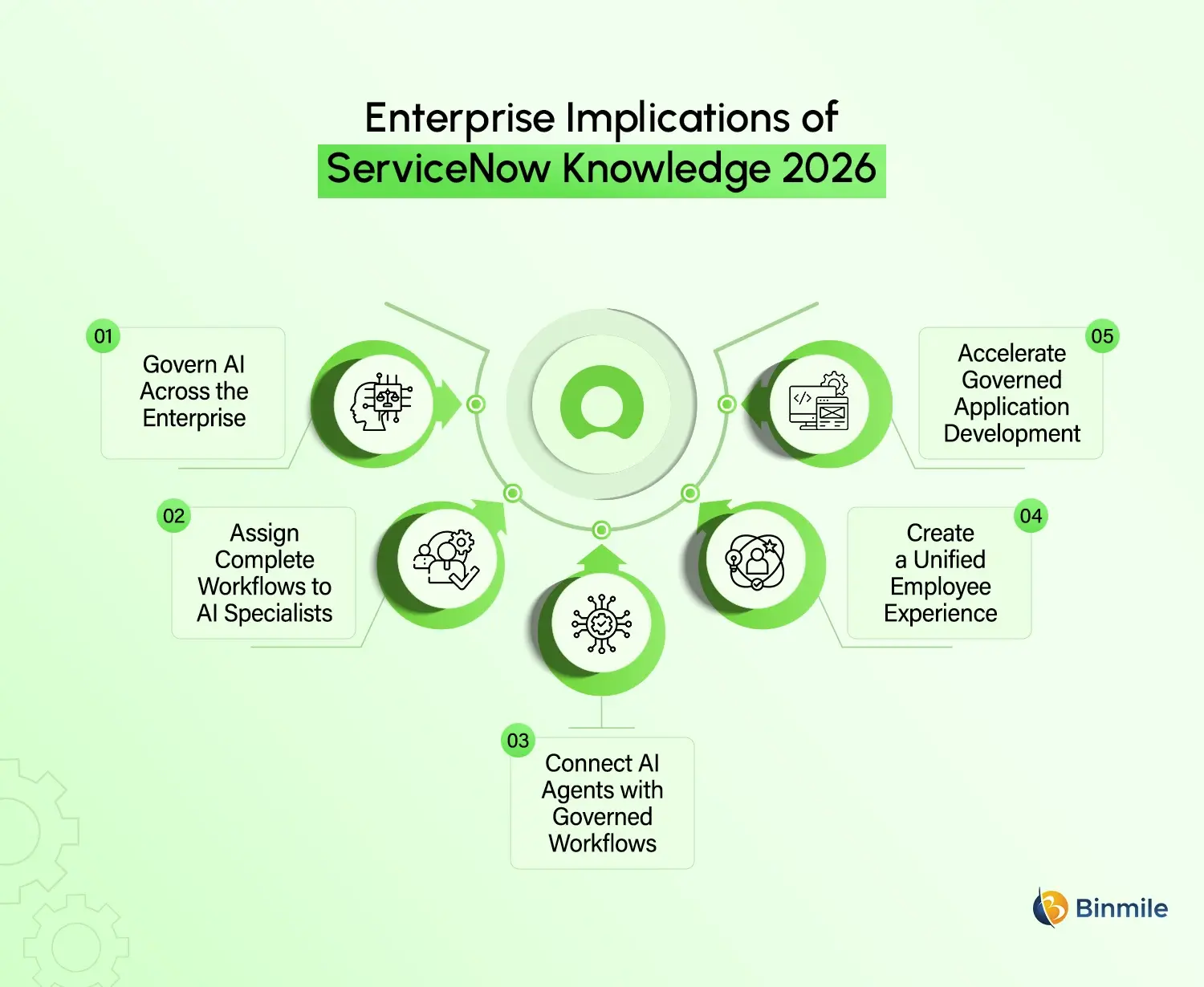
ServiceNow Knowledge 2026 highlighted how enterprises can connect AI, data, people, and workflows through one governed platform. The following themes show where organizations can create the most practical value.
-
Govern AI Across the Enterprise
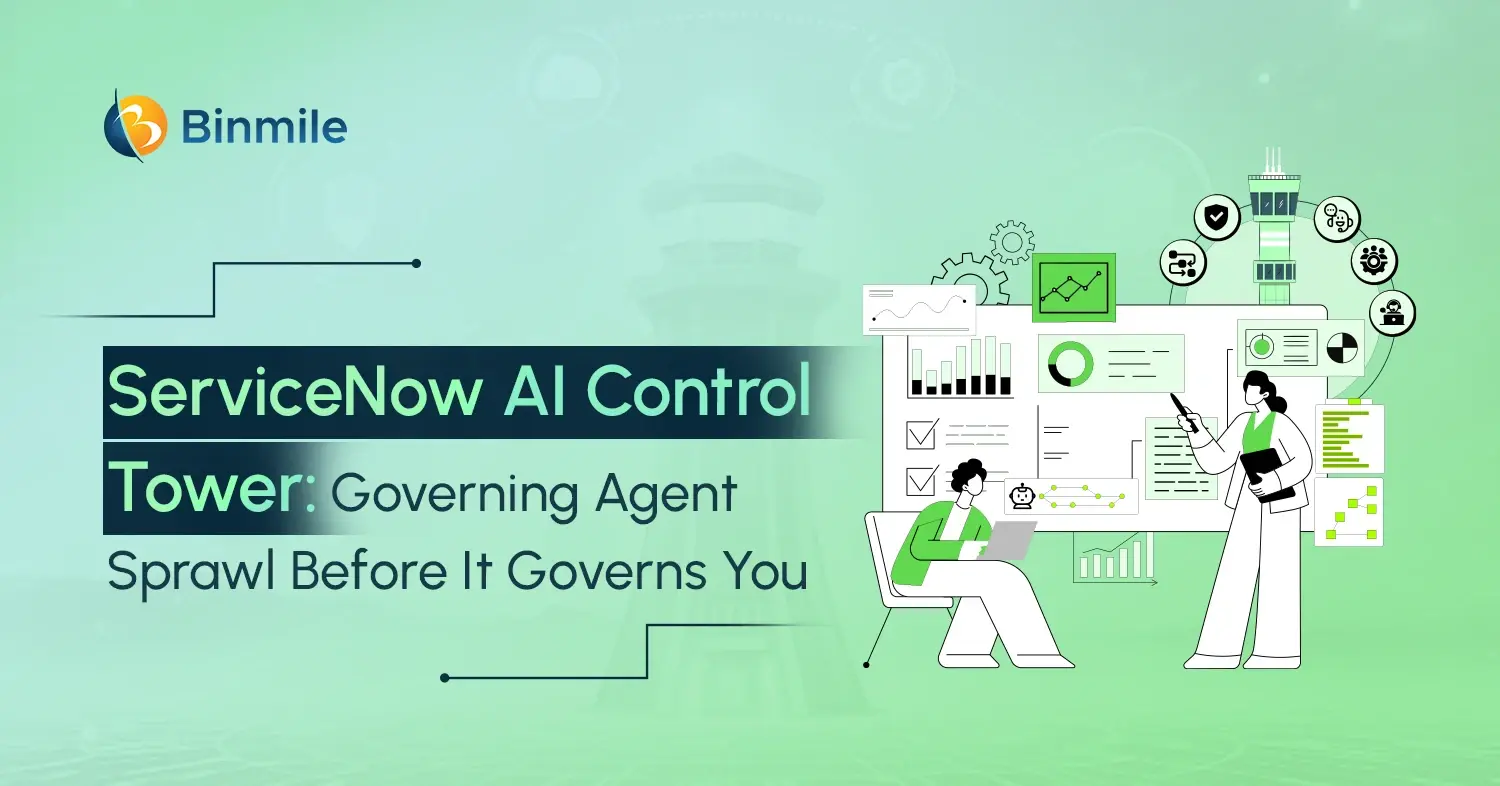
ServiceNow AI Control gives businesses visibility across AI agents, models, permissions, risks, workflows, and costs. This allows organizations to scale AI while maintaining security, compliance, and accountability.
-
Assign Complete Workflows to AI Specialists
The Autonomous Workforce model focuses on AI specialists who complete defined jobs, perform approved actions, update records, and escalate exceptions. This can reduce manual effort across IT, customer service, employee support, and security operations.
-
Connect AI Agents with Governed Workflows
ServiceNow can connect approved external agents with enterprise workflows, systems, policies, and records. This supports interoperability across the ServiceNow ecosystem while keeping execution and controls within a governed environment.
-
Create a Unified Employee Experience
AI-native experiences can provide employees with one conversational interface for requests, approvals, workplace tasks, and information searches. This reduces tool switching and improves self-service across departments.
-
Accelerate Governed Application Development
AI-assisted capabilities in ServiceNow App Engine can help teams build workflow applications faster. Organizations can modernize manual processes while retaining controls for security, approvals, integrations, and reporting.
These capabilities should be tied to specific business problems, process owners, performance targets, and governance requirements. Otherwise, the ServiceNow product roadmap may become another collection of disconnected initiatives.
Establish Enterprise-Wide Control Before Scaling AI Agents
As AI adoption grows, organizations may lose visibility into which agents and models are being used, what data they can access, and which actions they are authorized to perform. This creates security, compliance, cost, and accountability risks.
ServiceNow AI Control provides a common governance layer for discovering AI assets, monitoring usage, managing risks, and evaluating business value. It gives technology, security, risk, and business teams a shared view of enterprise AI activity.
A governed ServiceNow environment should define agent registration, access permissions, approval requirements, testing standards, monitoring, incident response, and accountability. These reusable controls can help enterprises launch approved AI use cases faster without creating separate governance processes for every tool or vendor.
Choose AI Agent Use Cases Around Complete Jobs
ServiceNow AI Agents deliver more value when they manage an end-to-end workflow rather than one isolated task. For example, an IT service agent can collect incident details, review known solutions, perform an approved action, update the ticket, notify the user, and escalate exceptions.
Enterprises should evaluate potential use cases using the following factors:
-
High Process Volume
Frequent and repetitive workflows offer stronger opportunities to reduce manual work, backlogs, and response times.
-
Clearly Defined Decision Rules
Processes with documented policies, approval conditions, and escalation paths are easier and safer to automate.
-
Reliable Enterprise Data
Agents need accurate knowledge, customer records, configuration data, and workflow context to make dependable decisions.
-
Frequent Delays and Handoffs
Workflows involving long queues, repeated transfers, duplicate work, or multiple approvals are strong candidates for AI-led improvement.
-
Controlled Operational Risk
Organizations should begin with use cases where incorrect actions can be reviewed, reversed, or escalated before creating a serious impact.
The right use case is not necessarily the most advanced one. It is the workflow where AI can solve a visible business problem within a controlled ServiceNow environment.
Prepare Enterprise Knowledge for Human and AI Use
AI agents depend on reliable enterprise knowledge to understand policies, procedures, previous resolutions, and approved actions. Outdated, duplicated, or incomplete content can lead to inaccurate answers and incorrect automated actions.
The ServiceNow Knowledge App can centralize information, manage approvals, assign ownership, and improve access for employees and AI agents. However, enterprises still need clear processes for creating, validating, updating, and retiring content.
Important knowledge articles should have a responsible owner, a defined review schedule, role-based access, and clear action or escalation instructions. The ServiceNow community can also help platform teams learn from implementation guidance, product discussions, and the experience of other users.
A dependable knowledge foundation improves self-service, strengthens AI accuracy, and reduces the risk of automating incorrect information.
Need a practical ServiceNow roadmap for AI agents, operations, and platform growth?
Modernize Business Workflows with ServiceNow App Engine
ServiceNow App Engine helps enterprises replace spreadsheets, shared inboxes, disconnected forms, email approvals, and outdated internal systems with governed workflow applications.
Teams can use the existing capabilities of the ServiceNow platform for identity, approvals, integrations, automation, security, reporting, and mobile access. This reduces the need to develop these functions separately for every application.
Modernization should begin by simplifying the process. Teams should remove duplicate approvals, repeated data entry, broken handoffs, and unnecessary customizations before building the new workflow.
A successful ServiceNow Platform Implementation should combine application development with process redesign, data preparation, security, integrations, testing, adoption, and performance measurement. This connected approach can reduce development backlogs and help organizations use ServiceNow for future-ready business.
Make IT Operations More Predictive
ServiceNow IT Operations Management gives enterprises visibility across applications, infrastructure, cloud environments, configuration items, events, and business services. Combined with ServiceNow AI Agents, it can help IT teams identify service impact, automate responses, and prevent recurring incidents.
Enterprises should focus on the following areas:
-
Improve CMDB Accuracy
Remove duplicate records, validate configuration items, assign ownership, and maintain accurate service relationships.
-
Map Critical Business Services
Identify the applications, infrastructure, cloud resources, integrations, and teams supporting important business services.
-
Reduce Event and Alert Noise
Group related events, remove unnecessary alerts, and prioritize issues based on their business impact.
-
Define Service Health Indicators
Monitor technical and business signals that can reveal service degradation before users are significantly affected.
-
Automate Low-Risk Remediation
Start with controlled actions such as collecting diagnostics, routing incidents, restarting approved services, or clearing temporary resources.
Progress can be measured through detection and restoration time, recurring incidents, service availability, alert reduction, automation rates, and infrastructure costs. Once the approach works for critical services, it can be extended across more applications and environments.
A Practical Roadmap After Knowledge 2026
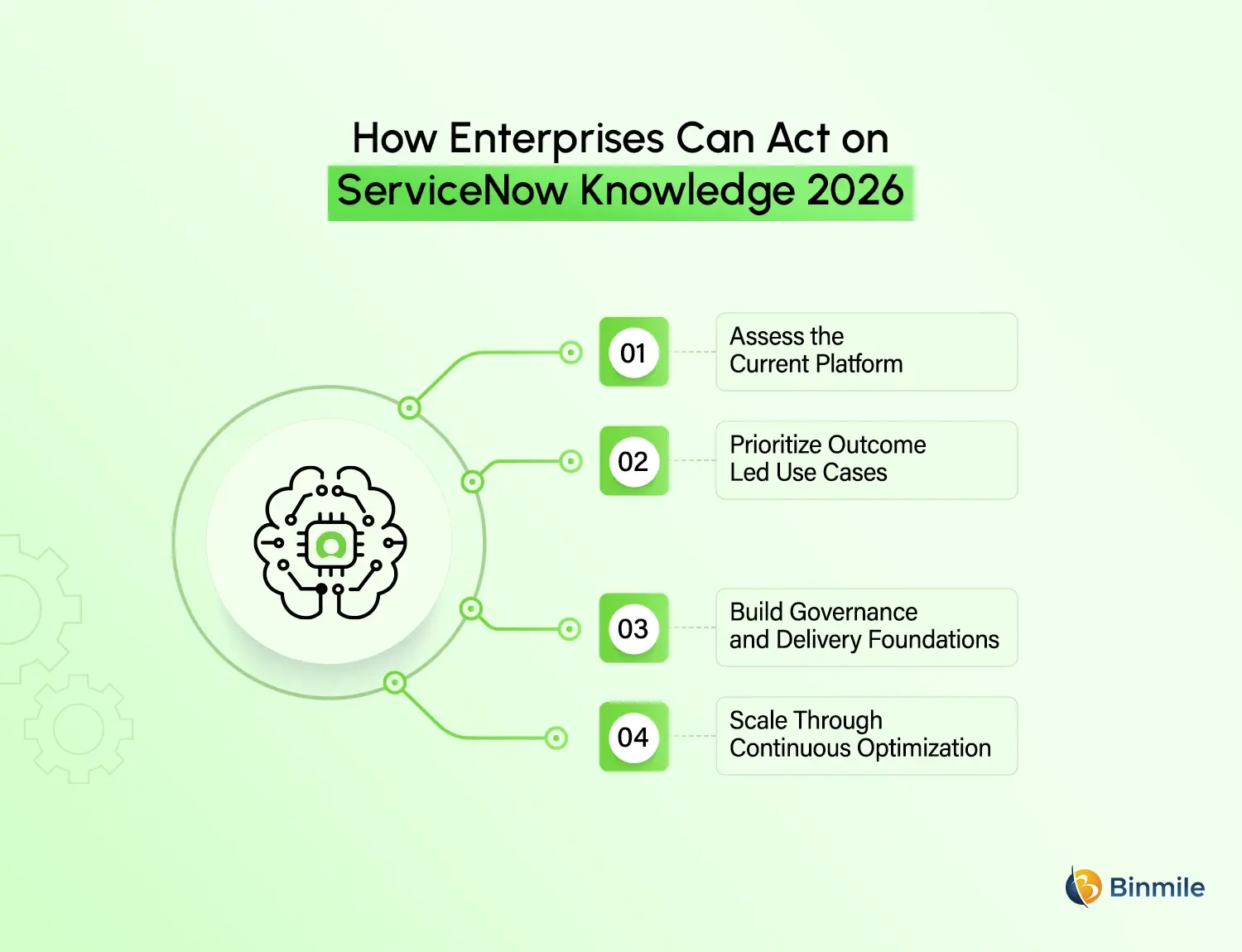
Enterprises should translate Knowledge 2026 announcements into a phased roadmap based on their platform maturity, business priorities, data readiness, and governance requirements.
-
Assess the Current Platform
Review modules, customizations, integrations, licensing, CMDB quality, knowledge health, technical debt, workflow performance, and adoption. Identify areas still dependent on manual work or disconnected tools.
-
Prioritize Outcome-Led Use Cases
Select a focused group of initiatives based on process volume, business pain, data readiness, risk, expected value, and implementation effort. Record baseline metrics before making changes.
-
Build Governance and Delivery Foundations
Define architecture standards, data ownership, AI policies, access controls, testing, human escalation, monitoring, release management, and change support.
-
Scale Through Continuous Optimization
Track adoption and outcomes, improve workflows using operational data, update knowledge, control AI costs, and expand successful use cases across other functions.
ServiceNow Managed Services can support this process by maintaining platform health, monitoring integrations, addressing technical debt, strengthening governance, and keeping the platform aligned with changing business priorities.
How to Measure Enterprise Outcomes
| Outcome area | Metrics to track |
|---|---|
| Productivity | Hours saved, cases handled per employee, reduction in manual touches |
| Service Performance | Resolution time, fulfilment time, SLA achievement, backlog reduction |
| Experience | Self-service completion, customer satisfaction, and employee satisfaction |
| Reliability | Availability, recurring incidents, event noise, mean time to restore |
| AI Governance | Registered agents, policy exceptions, approval overrides, risk findings |
| Financial Value | Cost per transaction, avoided cost, AI consumption spend, ROI |
| Adoption | Active users, agent usage, workflow completion, knowledge reuse |
| Development | Application delivery time, backlog reduction, reusable components |
Executives should review these measures by workflow and business function. A single enterprise-wide automation number can hide whether users are benefiting, bypassing the process, or creating additional work elsewhere.
Which Industries Can Benefit Most?
Financial services can apply governed agents to service operations, access requests, customer cases, regulatory workflows, and risk investigations. Healthcare organizations can improve employee services, equipment support, case coordination, and non-clinical operations while maintaining strict access controls.
Manufacturers can connect IT and operational workflows, improve maintenance coordination, manage incidents across plants, and support warranty processes. Telecom businesses can use AI agents for customer cases, network operations, order management, and field service coordination.
Retailers can improve store operations, employee support, customer service, and technology incident response. Public sector organizations can modernize citizen services, case management, employee workflows, and asset operations while preserving auditability.
The strongest candidates are usually organizations with high service volumes, complex handoffs, multiple systems, distributed workforces, and demanding governance requirements.
Ready to turn ServiceNow Knowledge 2026 insights into governed AI workflows and measurable enterprise value?
How Binmile Can Turn ServiceNow Knowledge 2026 into Enterprise Outcomes
Moving from announcements to operational value requires more than enabling new features. It requires a business case, process redesign, reliable data, secure architecture, disciplined implementation, and continuous improvement. Binmile helps enterprises assess their platform, identify high-value workflow and AI opportunities, and build a practical transformation roadmap around business priorities.
The engagement can cover platform strategy, ServiceNow Platform Implementation, AI agent use cases, App Engine development, IT operations, integrations, knowledge management, governance, testing, adoption, and optimization. Each technical decision is connected to an outcome such as faster resolution, lower manual effort, improved reliability, stronger compliance, or better employee and customer experiences.
For existing users, the next step may involve simplifying customizations, improving CMDB and knowledge quality, modernizing workflows, or preparing for governed AI. For new adopters, it may involve establishing the right architecture and delivery model from the start.
In both cases, the goal is to create a scalable foundation that can evolve with the ServiceNow roadmap without losing control of cost, risk, or user experience.
Frequently Asked Questions
ServiceNow Knowledge 2026 was the company’s annual customer and partner event focused on governed AI, autonomous workflows, connected agents, employee experiences, security, and application development. It matters because these capabilities can reshape how enterprises operate and measure productivity.
Leaders should watch governed AI adoption, role-based AI specialists, cross-platform agent execution, AI-native employee experiences, stronger identity controls, knowledge readiness, and faster application development. Each trend affects operating models, technology investment, workforce design, security, and accountability.
Organizations should select high-volume processes, define baseline metrics, assess data readiness, establish governance, launch controlled implementations, and track productivity, service, experience, risk, and financial results. Successful patterns can then be expanded across departments through reusable architecture and operating standards.
Financial services, healthcare, manufacturing, telecom, retail, technology, and public sector organizations can gain significant value. The strongest candidates usually manage complex services, regulated data, distributed teams, large case volumes, multiple systems, and workflows with frequent handoffs.
An implementation partner can connect platform capabilities with business processes, architecture, integrations, data, governance, testing, adoption, and measurable outcomes. This reduces the risk of isolated deployments, unnecessary customization, weak user adoption, technical debt, and investments that fail to scale.
Binmile can assess platform maturity, prioritize use cases, design secure workflows, implement modules, integrate enterprise systems, improve knowledge and CMDB quality, support AI governance, and provide continuous optimization so ServiceNow investments produce practical, measurable, and scalable business outcomes.