A cloud setup can look efficient from the outside and still carry hidden risks inside. Misconfigured storage, excessive permissions, weak identity controls, unmonitored workloads, insecure APIs, and unclear ownership can quietly increase exposure until something breaks. That is why a Cloud Security Assessment has become more than a technical review. It is a business risk control. IBM’s 2025 Cost of a Data Breach Report found that the global average cost of a data breach was USD 4.44 million, showing why enterprises cannot afford to treat cloud security as an afterthought.
This blog will define what an Enterprise Cloud Security Assessment is, how it helps to reduce risk for your organization, what areas are assessed, what tools and techniques will be employed to do the assessments, and how businesses can utilize them to create their own cloud security assessment checklists. The blog will explain the Cloud Security Assessment Process, discuss the advantages of performing cloud security assessments, review typical risks related to cloud computing, outline best practices to use to mitigate those risks, and provide suggestions for the appropriate method of cloud security assessment to use regardless of which cloud platform (AWS, Azure, GCP), application or infrastructure is being assessed for cloud security and/or data protection.
What Is a Cloud Security Assessment and Why Does It Matter?
A Cloud Security Assessment is a structured review of an organization’s cloud environment to identify security gaps, compliance risks, configuration issues, access weaknesses, and operational vulnerabilities. It helps businesses understand whether their cloud computing environment is secure, compliant, scalable, and aligned with enterprise security goals.
Unlike a basic audit, a cloud security risk assessment looks at both technical and business risks. It reviews workloads, users, applications, APIs, storage, networks, and third-party integrations to understand how cloud risks may affect revenue, operations, customer trust, compliance, and business continuity.
Cloud adoption often moves faster than security governance. Teams deploy workloads, enable APIs, migrate data, and connect SaaS tools across AWS, Azure Cloud, or GCP. Over time, the environment becomes complex and difficult to monitor. A Cloud Security Assessment reduces this uncertainty by helping CEOs, CTOs, CISOs, and cloud teams identify what is exposed, what needs attention, and what should be fixed first.
Key Business Risks Reduced by Cloud Security Assessments
A well-planned cloud security assessment process helps organizations reduce several types of business risk. Some of the most common include:
1. Data Exposure Risk
Assessing cloud security includes various things, such as permissions to storage, encryption, data backups, access control, and data classifications, in order to prevent any sensitive business/customer data from being at risk of exposure by others.
2. Compliance and Regulatory Risk
All businesses need to conduct assessments of their policies, be prepared for an audit, conduct access reviews, log access, retain data, and respond to incidents to correctly identify areas of potential non-compliance and mitigate compliance risk.
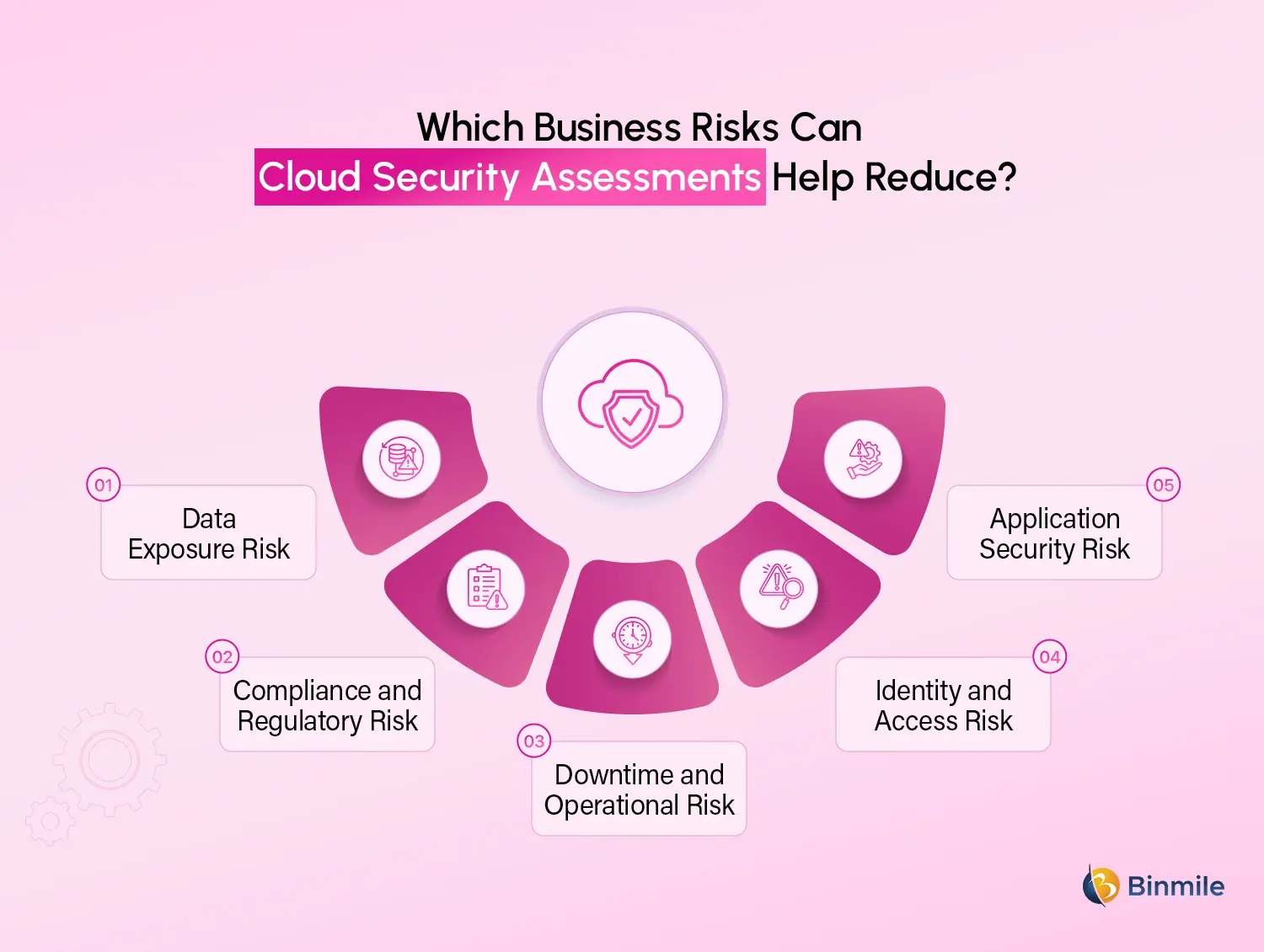
3. Downtime and Operational Risk
Assessing the security of a cloud-based infrastructure includes verifying the readiness of backups, monitoring capabilities, recovery controls, and gaps within the design of the architecture that would impact uptime and possibly affect business continuity.
4. Identity and Access Risk
Assessing all privileged access, using MFA, identifying inactive users, checking for role-based access arrangements, and examining records of service accounts can help eliminate the potential for unauthorized access or the misuse of credentials.
5. Application Security Risk
Assessing cloud application security would include conducting checks on APIs, the way users authenticate themselves, and secrets being shared amongst applications, dependencies, and application runtime controls, which will assist in reducing application vulnerabilities. For containerized cloud environments, organizations can also evaluate Chainguard alternatives to compare options for securing container images and reducing vulnerabilities across their workloads.
What Are the Components of a Cloud Security Assessment
A complete assessment should not only check cloud settings. It should evaluate the full cloud environment from business, technical, and operational angles.
| Component | What It Evaluates | Why It Matters |
|---|---|---|
| Identity and Access Management | User roles, privileged access, MFA, service accounts | Reduces unauthorized access |
| Cloud Configuration | Storage, databases, network rules, public exposure | Prevents misconfigurations |
| Data Protection | Encryption, backup, classification, retention | Protects sensitive information |
| Application Security | APIs, code risks, containers, dependencies | Reduces app-level attacks |
| Network Security | Firewalls, segmentation, VPNs, traffic rules | Limits lateral movement |
| Logging and Monitoring | SIEM, alerts, audit logs, anomaly detection | Improves threat visibility |
| Compliance Controls | Policies, evidence, audit readiness | Reduces regulatory risk |
| Incident Response | Cloud-specific response plans and recovery | Improves breach readiness |
| Third-Party Risk | Vendor integrations, SaaS access, API dependencies | Controls external exposure |
These components of Cloud Security Assessment services help businesses move from scattered security checks to a complete view of risk.
What Are the Types of Cloud Security Assessment
Different businesses need different assessment approaches depending on their cloud maturity, architecture, industry, and risk level.
-
Cloud Infrastructure Security Assessment
This assessment will examine the following assets: virtual machines, storage, databases, networks, firewalls, containers, Kubernetes clusters, load balancers, and Cloud-native services in AWS, Azure Cloud, and GCP.
-
Cloud Application Security Assessment
It will evaluate web applications, mobile applications, APIs (application programming interfaces), microservices, serverless functions, authentication flows, vulnerabilities at the code level, and reliance on third parties.
-
Cloud Security Risk Assessment
This assessment links the technical findings from the cloud security and application security assessments to a business impact and ranks each risk based on: severity; likelihood of occurrence; assets being affected; exposure to compliance; and operational consequences.
-
Cloud Computing Security Risk Assessment
This is a broader assessment of the cloud strategy, shared responsibility, governance, architecture, compliance, vendor dependency, identity management, and disaster recovery.
-
Cloud Migration Security Assessment
Before, during, or after your cloud migration process, this assessment will determine whether your workloads, data, access controls, integrations, and architecture are sufficiently secured.
Looking to strengthen cloud security, compliance, and data protection across your enterprise environment?

What Is the Cloud Security Assessment Process
The Enterprise Cloud Security Assessment Process should be structured, repeatable, and easy for both business and technical teams to understand.
Step 1: Define Scope and Business Objectives
Define the scope of your project, including what types of workloads and applications need an assessment, as well as which cloud platforms, users, data types, and business units fall under review.
Step 2: Map Cloud Assets
Identify workloads, databases, storage, APIs, users, applications, and third parties that provide additional visibility into your cloud infrastructure.
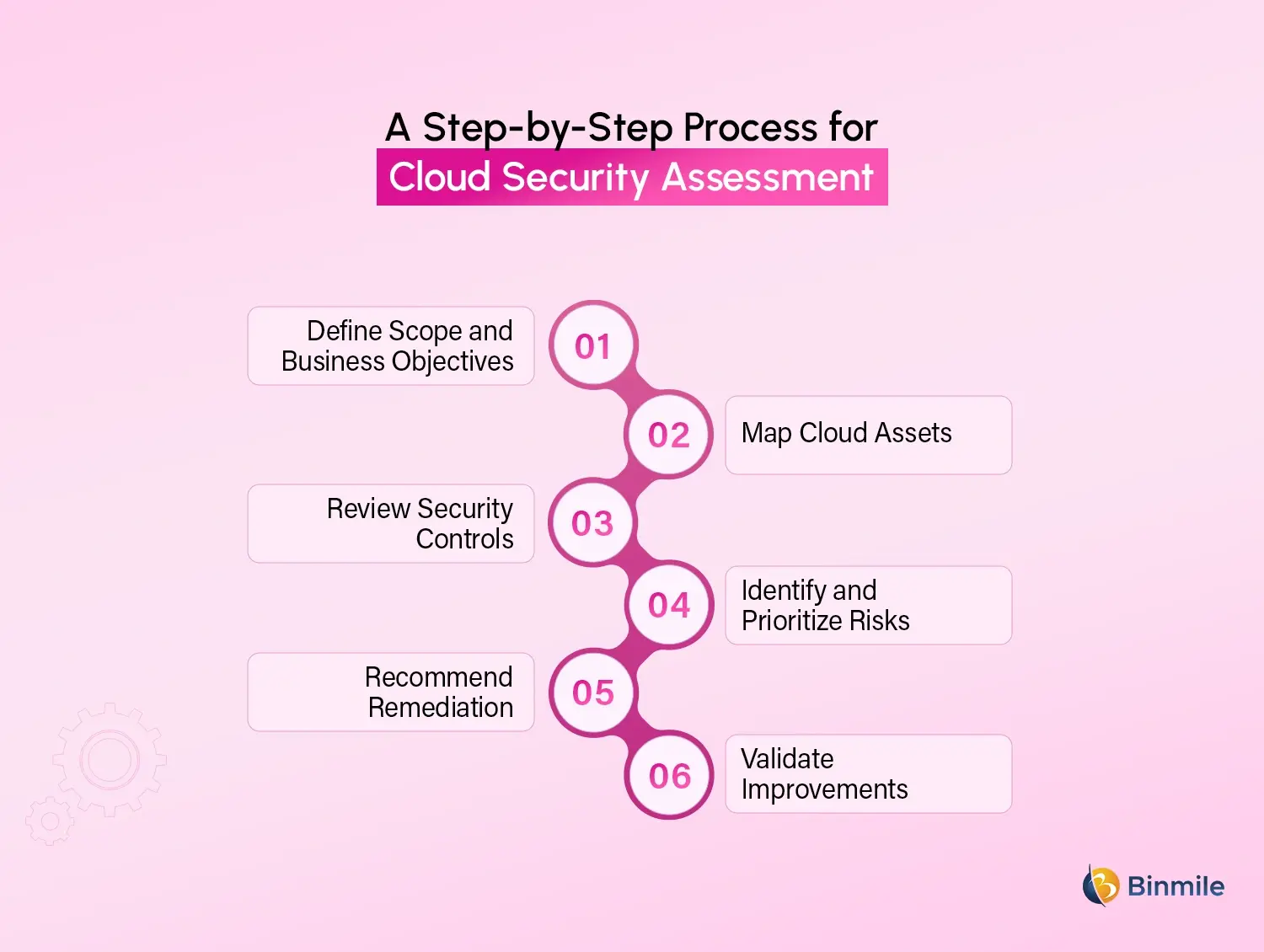
Step 3: Review Security Controls
Identify workloads, databases, storage, APIs, users, applications, and third parties that provide additional visibility into your cloud infrastructure.
Step 4: Identify and Prioritize Risks
Assess all findings based on their business impact, severity, likelihood of occurring, who they affect, and urgency so your teams can focus on the most critical risks first.
Step 5: Recommend Remediation
Offer concrete recommendations such as updating permissions, implementing multi-factor authentication, enhancing encryption protocols, addressing configuration gaps, strengthening monitoring capabilities, or redesigning cloud infrastructure.
Step 6: Validate Improvements
After implementing remedial actions, confirm that the risk is mitigated and that the environment is now considered more secure than before.
Cloud Security Assessment Tools and Testing Methods
Tools that perform cloud security assessments automate many tasks, such as finding physical assets, scanning for malware, reviewing configurations, identifying vulnerabilities, performing compliance audits, and monitoring activity. These tools are beneficial, but they should not replace the experience of an expert, because the expert will be able to see how the technical deficiencies identified by the tools will impact the business.
The most common tools a company will use to test for cloud security problems would be vulnerability scanners, cloud security posture management (CSPM) tools, compliance automation tools, identity governance tools, SIEM tools, container security tools, API security testing tools,s and threat detection systems.
When choosing tools for enterprise deployments, workload type, cloud platform, risk maturity, and compliance requirements will help determine the best tools for your environment. Although AWS, Azure, and GCP all provide native security services within their respective clouds, utilising third-party security solutions across multiple clouds will provide you with a unified view across your multi-cloud environments.
In addition to the other methods of managing your cloud security risk, you can use cyber threat intelligence to assist your team in understanding the latest attack methods, identifying threats unique to your industry, and identifying new risks.
What Are the Benefits of Cloud Security Assessments
Cloud Security Assessments offer benefits beyond just technical protection – they also provide businesses with better decision-making capabilities, reduced uncertainty, and increased resiliency over time.
A solid cloud security assessment allows leadership to identify the company’s weaknesses and the areas that need immediate action. It provides CTOs and CISOs with a practical roadmap for identifying and remediating security vulnerabilities. Additionally, while offering cloud teams guidance on addressing misconfigurations, improving cloud architecture, and enhancing overall cloud monitoring.
Enterprise Cloud Security Assessments also support compliance teams by providing documentation, audit evidence, and a clearer way to control ownership of all assets within the cloud. They provide ways to discover and eliminate unnecessary costs caused by unused resources. Also, overprovisioned access points, duplicate tools, and poorly managed cloud expansion.
Ultimately, cloud security assessments generate confidence in an organization. Knowing that the cloud environment is actively monitored, reviewed, and improved. This will help organizations scale with fewer unexpected security events.
Cloud Security Assessment vs Penetration Testing
Many businesses confuse Cloud Security Assessment with penetration testing, but they serve different purposes.
| Cloud Security Assessment | Penetration Testing |
|---|---|
| Reviews the overall cloud security posture | Tests whether attackers can exploit specific weaknesses |
| Covers identity, configuration, data, compliance, architecture, and monitoring | Focuses mainly on exploitable vulnerabilities |
| Helps prioritize business and technical risks | Validates real-world attack paths |
| Useful for governance and risk management | Useful for offensive security validation |
| Should be performed regularly | Usually performed at defined intervals or before major releases |
The best approach is not choosing one over the other. A Cloud Security Assessment gives the full risk picture, while penetration testing validates how serious certain weaknesses may be in real attack scenarios.
How Often Should Businesses Perform Enterprise Cloud Security Assessments?
Businesses should perform a Cloud Security Assessment at least once or twice a year, but high-growth or regulated organizations may need more frequent reviews. Assessments should also happen before major cloud migration projects and after significant architecture changes. Additionally, before launching critical applications, after mergers or acquisitions, and following major security incidents.
For enterprises using multi-cloud environments, continuous assessment is even more important. Cloud systems change quickly, and even small changes in permissions, network rules, or APIs can create new risks.
Need to identify hidden cloud risks before they impact your business operations?

Strengthening Cloud Security Risk Management with the Right Partner
Cloud security becomes harder to manage as businesses scale across cloud computing platforms, applications, data pipelines, third-party tools, and distributed teams. A strong assessment helps, but real value comes from turning findings into long-term improvements.
This is where Binmile can support enterprises with assessment-led cloud security solutions that align with business risk, compliance needs, and technical priorities. From cloud infrastructure security assessment and cloud application security assessment to cloud migration security, cloud architecture review, cyber threat intelligence, and cloud data protection, the focus remains on helping organizations identify what matters, fix what creates risk, and build stronger security foundations across AWS, Azure Cloud, GCP, and enterprise environments.
Instead of treating assessment as a static report, the approach should help businesses move toward practical remediation and stronger governance. Also, better visibility and scalable cloud security risk management.
Frequently Asked Questions
A Cloud Security Assessment is a detailed review of cloud systems, configurations, applications, identities, data controls, and compliance readiness. It helps businesses identify security gaps, prioritize risks, and improve cloud protection before issues affect operations or customers.
A Cloud Security Assessment usually evaluates identity and access, cloud configuration, cloud data protection, network security, application security, logging, monitoring, compliance controls, backup readiness, incident response, third-party integrations, and cloud architecture across platforms like AWS, Azure Cloud, or GCP.
Businesses should perform a Cloud Security Assessment at least once or twice a year. They should also assess cloud environments after major migrations, application launches, architecture changes, compliance updates, security incidents, or rapid cloud expansion.
Common risks include misconfigured storage, excessive user permissions, weak authentication, exposed APIs, poor encryption, missing logs, vulnerable applications, insecure network rules, compliance gaps, untested backups, and unclear ownership across cloud infrastructure and applications.
A Cloud Security Assessment cannot guarantee complete breach prevention, but it significantly reduces risk by finding and fixing weaknesses early. It improves visibility, strengthens controls, supports faster response, and helps prevent avoidable exposure of sensitive business data.
A Cloud Security Assessment reviews the overall cloud security posture, including configuration, access, compliance, data, and architecture. Penetration testing focuses on actively exploiting vulnerabilities to validate how attackers might break into specific systems or applications.