AI is getting more efficient, but the enterprise AI bill is increasing. While the compute needed for individual AI tasks is decreasing, organizations are using AI in more areas, for more users, and across more complex agentic applications. The International Energy Agency estimates that data centers consumed 415 TWh of electricity in 2024, with a forecast of 945 TWh in 2030.
For CEOs, CTOs, CIOs, and CFOs, the challenge is to embrace AI’s business potential while controlling its costs and environmental impact. That is why Green AI applications are so important; they focus on efficient models, infrastructure, engineering, and resource utilization. Green AI technology helps organizations make AI more sustainable and valuable to the business. Green AI solutions and Green Artificial Intelligence play a key role in helping businesses realize the benefits of more sustainable AI adoption.
What Is Green AI And Green AI Applications?
Green AI refers to developing and using artificial intelligence in ways that balance computational and environmental efficiency with accuracy and performance. Green AI development services and Green AI system development help organizations achieve these goals.
For enterprises, this means analyzing whether a particular application requires the largest model, how many resources are used for each inference, whether the cloud is fully utilized, whether agentic AI is making unnecessary calls to other models, and whether data processing and transfers can be reduced.
These factors play a key role in maintaining an AI program’s sustainability while maximizing its business value. Green AI technology therefore spans AI architecture, FinOps, cloud strategy, software engineering, and enterprise governance, with Green AI engineering and Green AI software development playing key roles in the process.
Green AI vs. Green in AI vs. Green by AI
Although these terms may seem similar, they have distinct meanings that CXOs need to understand.
The terms surrounding sustainable AI can be confusing, but the distinction is useful for CXOs.
| Concept | Meaning | Example |
|---|---|---|
| Green AI | Making AI itself more resource-efficient | Using a smaller model for a high-volume task |
| Green in AI | Building sustainability into AI design and operations | Measuring resource consumption during development |
| Green by AI | Using AI to improve the sustainability of other systems. | AI optimizing electricity demand |
| AI for Green | Applying AI to environmental objectives | Forecasting renewable energy generation |
An enterprise can therefore work on Green AI while also leveraging Green by AI to optimize other systems.
For instance, a utility company can use AI to manage green energy more effectively while ensuring that its own AI platform is developed and operated sustainably. Ideally, enterprises should consider Green AI, Green in AI, and Green by AI together.
Why Employing Green AI Applications Becomes a CXO Issue
The enterprise AI bill goes beyond model subscriptions, as AI workloads also incur costs for inference, GPUs, CPUs, storage, data transfers, cloud platforms, monitoring, security, and application infrastructure. At scale, inefficiently designed AI applications can become a significant financial burden for businesses.
Agentic AI exacerbates the risk, as a single business action can involve hundreds of model calls and operations. Green AI is closely linked to FinOps, as a well-planned approach can boost infrastructure utilization, control spending, limit cloud costs, reduce environmental impact, and improve end-to-end visibility. These Green AI strategies help enterprises manage Green AI costs while achieving better outcomes.
The aim is not to limit AI adoption, but to ensure that every additional unit of usage delivers measurable business value.
What Are the Green AI Application Strategies CXOs Should Prioritize
For CXOs, Green AI focuses on maximizing value rather than restricting AI adoption. Five key strategies can help achieve this goal, while Green AI practices provide direction for enterprise applications.
1. Right-Size AI Models
The largest model is rarely the most efficient one, and enterprises should consider using reduced-parameter ones for simpler tasks, such as classification, extraction, summarization, or forecasting. Quantization, pruning, and knowledge distillation can help make models smaller and faster while preserving performance. Choosing the right model is fundamental to achieving Green AI.
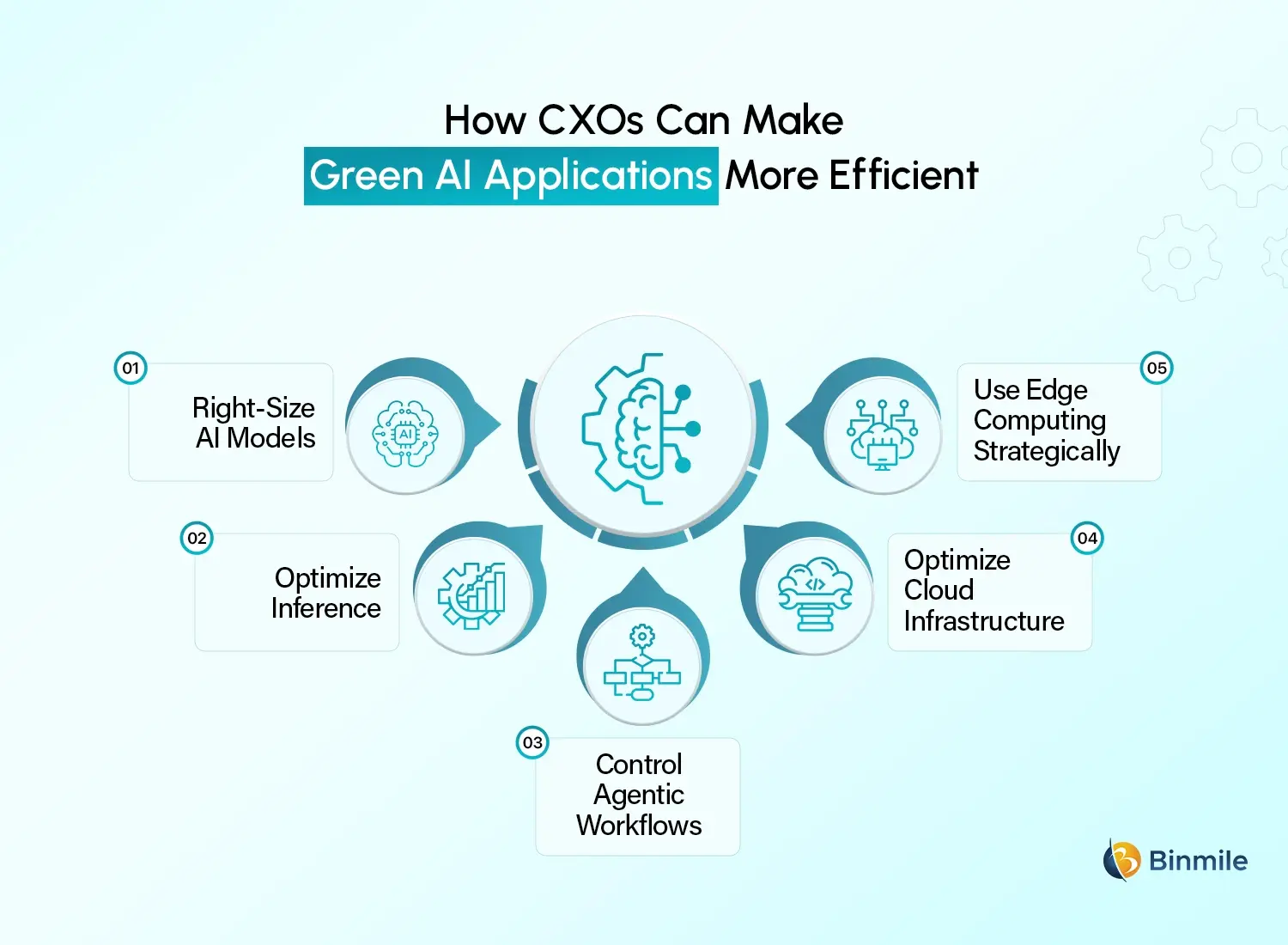
2. Optimize Inference
Inference can consume more resources than training, particularly for large language models. Enterprises should use token and context optimization, caching, retrieval augmentation, batching, and routing to lower compute requirements and costs per request.
3. Control Agentic Workflows
Agentic applications routinely call multiple models and tools, and excessive model calls, recursion, and function use should be limited by context, tool availability, and other guardrails. This reduces unpredictable costs and improves security and governance.
4. Optimize Cloud Infrastructure
Cloud costs should be controlled using autoscaling and model right-sizing, with a focus on utilizing GPUs and other accelerators as much as possible. Storage optimization, workload orchestration, and taking advantage of renewable energy when possible also contribute to a Green AI system. Green AI cloud services and Green AI cloud infrastructure also play an important role in improving overall efficiency.
5. Use Edge Computing Strategically
Edge processing can help lower data center workloads, particularly in manufacturing, healthcare, retail, and other industries with distributed digital infrastructure. The value of edge computing for Green AI should be evaluated on a case-by-case basis, however, as it requires significant investments in hardware and networking.
Where Does the Enterprise AI Bill Come From For Green AI Applications?
Before optimizing, enterprises need to understand the key sources of AI expenditure. The following breakdown highlights opportunities for Green AI optimization. Green AI optimization should be considered across all these cost drivers.
| Cost Driver | Common Issue | Green AI Response |
|---|---|---|
| Model Inference | Large models used for simple tasks | Model right-sizing |
| Agentic Workflows | Excessive model and tool calls | Workflow guardrails |
| Compute | Overprovisioned resources | Autoscaling and rightsizing |
| Data Processing | Repeated processing | Efficient data pipelines |
| Data Transfer | Unnecessary movement | Better architecture and edge processing |
| Storage | Excessive retention | Data lifecycle management |
| Training | Repeated experiments | Selective retraining |
This is also where sustainability and cost optimization intersect, with infrastructure utilization, reduced inference, and model right-sizing lowering both the business and environmental costs of an AI program.
What Does a Green AI Architecture Look Like?
Enterprise applications typically route all requests to a single large general-purpose model. While simple to build, such an approach tends to be wasteful at scale.
A more efficient approach involves introducing intelligence, letting requests qualify for different levels of processing and utilizing model-specific tools where appropriate. A Green AI framework can help establish consistent principles for this architecture.
Essentially, a large model is used for the most complex tasks, while simpler requests are delegated to smaller specialized models or processed with retrieval. That way, the enterprise only uses the most computationally intensive tools when necessary. This is the basis of a Green AI system:
Using the right amount of intelligence for the business task at hand, as opposed to defaulting to the largest available model. Green AI Models should be selected according to workload requirements.
What Is the Green AI Applications Maturity Model for Enterprises
Enterprises should also assess their maturity on a spectrum from minimalism to end-to-end optimization. A Green AI framework can help organizations prioritize Green AI projects and assess their progress.
| Stage | Enterprise Position | Priority |
|---|---|---|
| Experimental AI | Independent AI pilots | Establish visibility |
| Scaling AI | Growing usage and cloud costs | Measure workloads |
| Optimized AI | Models and infrastructure actively tuned | Reduce waste |
| Governed Green AI | Sustainability integrated into AI governance | Establish KPIs |
| Green by AI | AI actively improves business sustainability | Scale high-value use cases |
The objective is to move from experiment to governance, getting the most value out of every model inference.
What Should CXOs Measure?
As mentioned, Green AI is about maximizing value, and the best way to do this is to measure the business outcomes per model inference, compute, memory, and token. An enterprise can track AI costs per transaction, per inference, and per model, as well as utilization, performance, cloud costs per workflow, model performance versus cost, and energy industry trends where measurable.
When reliable data is available, organizations can analyze their carbon footprint and the carbon intensity of their compute consumption. From a CXO perspective, however, the most important metric is business value per unit of consumption, as it directly addresses the cost-efficiency of the AI program. These measurements help organizations quantify Green AI benefits and evaluate Green AI outcomes.
Looking to build more sustainable and cost-efficient AI solutions tailored to your business needs.

What Are the Green AI Application Use Cases Across Industries
Green AI is most effective when applied to specific real-world use cases, and the choice of the use case depends on the industry. Green AI use cases can help enterprises identify opportunities to improve efficiency across their operations.
-
Green AI in Retail
Retailers can apply Green AI to demand planning, inventory management, personalization, pricing, warehousing, and logistics. For each application, specialized models can be used to maximize performance while reducing the compute footprint. Green AI in retail can support more efficient operations across these workflows.
-
GenAI in Financial Services
Banks and other financial institutions can leverage a combination of rule-based systems, smaller models, retrieval augmented with larger foundation models, and traditional software to maximize performance while minimizing costs. This approach can be used for fraud detection, document processing, customer service, and risk management. GenAI in financial services can benefit from these Green AI strategies.
-
AI in Healthcare
Healthcare organizations can utilize AI for medical imaging, documentation, predictive analytics, engagement, and operations. Edge AI can be leveraged for time-sensitive, sensitive, or high-volume applications, with the balance between accuracy, performance, security, infrastructure, and sustainability determining the choice of architecture. AI in healthcare can also benefit from efficient model selection and Green AI engineering.
-
Green AI in Energy and Utilities
The energy vertical is uniquely positioned to benefit from Green by AI, with applications spanning wind and solar forecasting, grid management, predictive maintenance, and demand planning. As the energy transition continues, efficient AI will play a critical role in power utilities worldwide, impacting software development and operations. Energy industry trends also create opportunities for energy and utilities software development.
How Renewable Energy Fits Into Green AI
Renewable energy is an important component of a larger strategy for reducing the carbon footprint of AI infrastructure, but it is not a substitute for optimization.
Solar, wind, hydro, and other renewable sources can complement AI infrastructure strategies from a sustainability perspective, with procurement options including grid electricity, PPAs, and direct ownership.
From a CXO perspective, the priority should be to reduce the overall demand for compute, and then to make the remaining demand as clean as possible.
What Are the Biggest Green AI Application Challenges?
Enterprises should be aware of some of the biggest challenges associated with Green AI initiatives before launching them in production. Understanding Green AI challenges is essential for effective implementation.
-
Measurement and Visibility
Cloud costs are easy to understand, but the energy footprint of AI workloads and the value delivered by individual models are difficult to measure consistently.
-
Performance Trade-offs
Reduced model size, quantization, and similar techniques can hurt performance, and enterprises should carefully analyze the performance versus efficiency of different approaches.
-
Infrastructure Complexity
Modern enterprise AI involves multiple cloud providers, models, data centers, and edge nodes, and optimization requires holistic oversight of all areas.
-
Rapidly Changing Workloads
An AI workload that performs well during the proof of concept can see its performance and costs skyrocket with increased data and users.
-
Unpredictable Agentic Workflows
These applications can add numerous model calls and other operations, and appropriate guardrails need to be identified to ensure efficient operations.
These challenges are why enterprises need to pursue a continuous improvement approach to Green AI, with ongoing measurement and optimization of every aspect.
What Are Green AI Applications Compliance and Governance
AI governance is becoming a priority for enterprises that use the technology extensively.
Many regulations are already in place or pending, with the EU AI Act imposing energy-related transparency and documentation requirements on general-purpose AI providers. Some models will be subject to additional requirements depending on the risk category. Green AI compliance is an important consideration when assessing these requirements.
For enterprises, the broader implication is that AI systems need to be made more transparent and straightforward to govern.
Organizations need to understand which models they use and where their workloads run while also considering the resources they consume and the regulatory requirements applicable to them. This will allow enterprises to comply with regulations while also optimizing costs.
This ties into ESG reporting, as enterprises can leverage ESG reporting software to incorporate their technology-related sustainability data and governance practices for a comprehensive view of their ESG performance.
How Can Businesses Implement Green AI Applications?
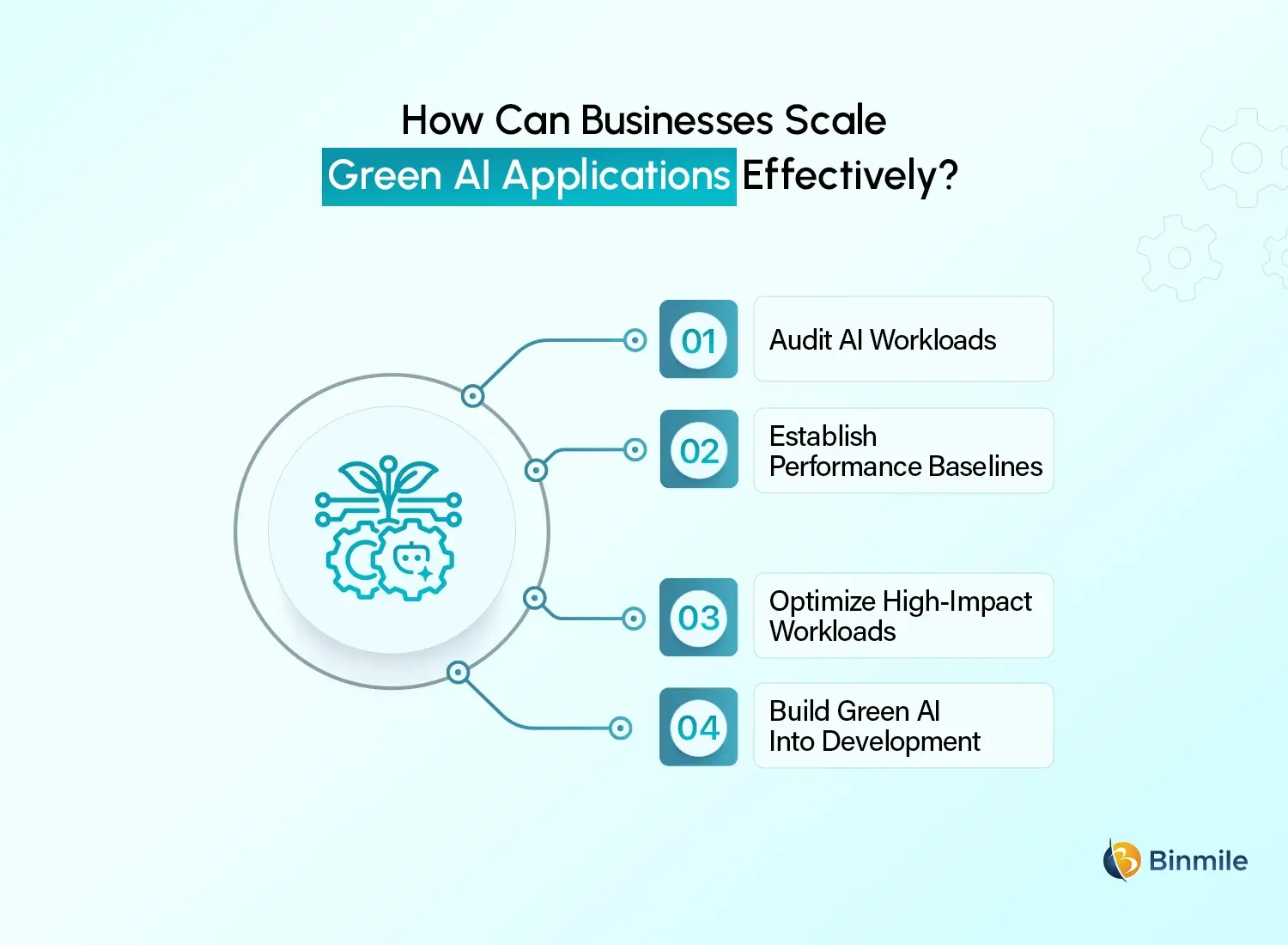
Enterprises do not need to rethink every AI application at once; a phased approach that prioritizes the most valuable opportunities makes the most sense. Effective Green AI implementation can help enterprises prioritize these improvements.
-
Audit AI Workloads
Enterprises should begin by identifying workloads with the highest compute use, cloud costs, or volume of inferences, as well as the applications with the fastest user or data growth.
-
Establish Performance Baselines
Measurable targets should be established, with optimizations informing adjustments to model selection, infrastructure, and other aspects.
-
Optimize High-Impact Workloads
The focus should be on workloads that offer the highest value, with the specific actions dependent on the use case. Model compression, better data caching, infrastructure rightsizing, improved agent orchestration, and other opportunities can all be explored.
-
Build Green AI Into Development
The principles of Green AI should be embedded in software development practices, informing future projects and encouraging continuous improvement. Green AI integration can support the integration of these principles into existing enterprise systems.
The Future of Green AI Applications Is Efficient Intelligence
The future of enterprise AI belongs to those who can extract the most value from the most efficient models. Large language models will continue to drive innovation, but they will also be joined by a wide variety of application-specific and smaller foundational models, including Generative AI models.
For the CXO, the future is about asking the right questions, not just about what a model can do but also about how much is needed, where it should be deployed, whether it adds value, and how it can be made more efficient.
A Green AI strategy is therefore a strategic priority for enterprises that want to balance AI’s business and sustainability benefits while also controlling costs. It connects the dots between architecture, cloud economics, software engineering, governance, and digital transformation.
Green AI is not a constraint on innovation; it is an enabler of more intelligent, more valuable, and more sustainable business technology.
Ready to optimize your AI infrastructure and reduce unnecessary compute costs to build scalable, efficient, and business-focused AI applications.

How Binmile Can Help Enterprises Build More Efficient AI
Building sustainable AI demands strategic decisions concerning application architecture, data pipelines, cloud infrastructure, integrations, model development, and optimization, among others. Binmile can assist enterprises in evaluating these aspects to cut down on computational overhead and design the AI environment according to the business needs.
Whether enterprises want to refresh their AI environment, develop new Green AI solutions, optimize GenAI workloads, or design a better Green AI platform, the focus should remain on reaping practical benefits. That is, there is a need to balance model performance and scalability while also considering security, infrastructure costs, and resource optimization. Enterprises, therefore, considering GenAI development services or AI development services in general, can opt for this option to actualize an AI system that can scale up its operations while also remaining cognizant of its environmental impact. Green AI engagements can further support enterprises in identifying opportunities for Green AI system development and Green AI optimization.
Frequently Asked Questions
Green AI applications are AI systems designed to deliver business outcomes while minimizing unnecessary computation, energy consumption, infrastructure use, and environmental impact across development, deployment, inference, and ongoing operations.
Green AI focuses on making artificial intelligence itself more efficient. Green by AI uses AI to improve sustainability elsewhere, such as optimizing energy systems, reducing waste, forecasting renewable generation, or improving resource utilization.
Green AI helps enterprises manage rising AI infrastructure costs and resource consumption. Efficient models, infrastructure, and workflows can improve scalability and cost control while supporting sustainability and governance objectives.
Businesses can reduce Green AI costs by right-sizing models, optimizing inference, improving data pipelines, using caching, controlling agentic workflows, implementing autoscaling, and matching infrastructure to actual workload requirements.
Yes. Renewable energy can reduce the carbon intensity of electricity used by AI infrastructure. However, renewable power does not eliminate inefficient computation. The strongest approach combines efficient AI architectures with lower-carbon electricity.
Common Green AI use cases include demand forecasting, energy optimization, predictive maintenance, sustainable supply chains, inventory planning, healthcare analytics, fraud detection, data-center optimization, customer service, and AI workload management.
CXOs can track AI cost per transaction, compute per task, model and GPU utilization, inference volume, cloud cost per workflow, energy consumption where measurable, carbon intensity, and model performance relative to computational resources.