For many businesses, ESG reporting is no longer a once-a-year exercise of collecting spreadsheets, chasing teams for missing figures, and manually preparing disclosures. The market reflects that shift. The global ESG reporting software market was valued at approximately $1.32 billion in 2025 and is projected to reach $7.36 billion by 2034, growing at a CAGR of 21.02%. As reporting expectations become more structured and sustainability data becomes increasingly connected to business decisions, companies need a more reliable way to collect, validate, manage, and report ESG information.
But choosing or building a platform is not simply about automating report generation. The real challenge is creating a dependable data foundation behind the report. That means connecting information from finance, HR, procurement, operations, facilities, suppliers, and other business systems, while maintaining data quality and traceability. This guide looks at what ESG reporting software does, the features businesses should consider, its key benefits, how to choose the right platform, and what an effective implementation approach looks like.
What Is ESG Reporting Software and How Does It Work?
ESG reporting software is used to collect, validate, manage, analyze, and report environmental, social, and governance data. It brings information from different sources into a central system rather than leaving teams to work across spreadsheets, emails, and separate databases.
Data can come directly from business systems, or it can be entered through forms, surveys, and other collection methods. Once it is in the system, the software can apply validation rules, store supporting information, map the data to relevant ESG metrics or reporting frameworks, and use it for dashboards and disclosures.
This also makes ESG reporting less dependent on one reporting cycle. Information collected for one disclosure can be used again where the same metric is required elsewhere.
ESG reporting software is broader than carbon accounting software. Carbon accounting tools mainly deal with greenhouse gas emissions, including Scope 1, Scope 2, and Scope 3. ESG reporting covers those areas as well as social and governance information.
Why Are Businesses Moving Away From Spreadsheet-Based ESG Reporting?
There is nothing wrong with using spreadsheets when the ESG program is small. They are familiar, easy to set up, and useful for getting started.
The trouble starts when the number of people, locations, metrics, and reporting requirements increases.
A multinational company, for example, may have to collect sustainability information from multiple business units and facilities. Some figures may come from finance, some from HR or procurement, and some directly from suppliers. Different teams may also follow different calculation methods or reporting periods.
That is when the spreadsheet starts becoming harder to manage. A file gets updated, another version is sent around, someone changes a calculation, and later nobody is quite sure which version contains the final figure.
There are other issues too: duplicate data, missing information, manual calculations, repeated data entry, unclear ownership, and limited audit trails.
ESG reporting automation can take many of these repetitive steps out of the process. Data can be collected through defined workflows, checked against set rules, approved by the relevant person, and then used for reporting.
It is less about getting rid of spreadsheets completely and more about having a reporting process that does not depend on them for everything.
What Are the Key Features of ESG Reporting Software?
The exact features differ from one ESG reporting tool to another. For businesses with more complex reporting needs, however, a few capabilities tend to matter more than others.
1. Centralized ESG Data Management
ESG data can come from a surprisingly wide range of sources. Emissions, energy use, workforce information, waste, water consumption, supplier data, and governance metrics may all sit in different systems.
ESG data management software brings these datasets into one place. More importantly, it can retain information about where the data came from, who owns it, which period it relates to, and what happened to it over time.
That context is useful when a figure needs to be checked months after it was first entered.
2. Automated Data Collection
Collecting ESG information manually takes time, particularly when the same data has to be requested every quarter or every year.
ESG data collection software can connect with ERP, HR, finance, procurement, IoT, and other enterprise systems and pull recurring information into the reporting system.
Not everything will be available through integration. Supplier questionnaires, forms, and surveys can cover the gaps where people still need to provide information themselves.
3. Data Validation and Quality Controls
A report is only as useful as the information behind it. If the source data is inconsistent, automation alone will not fix the problem.
The software can apply validation rules, run calculations, check for duplicates, flag unusual values, and route information for approval before it is included in a report.
These checks are particularly useful when data is coming from several departments that may not follow the same process.
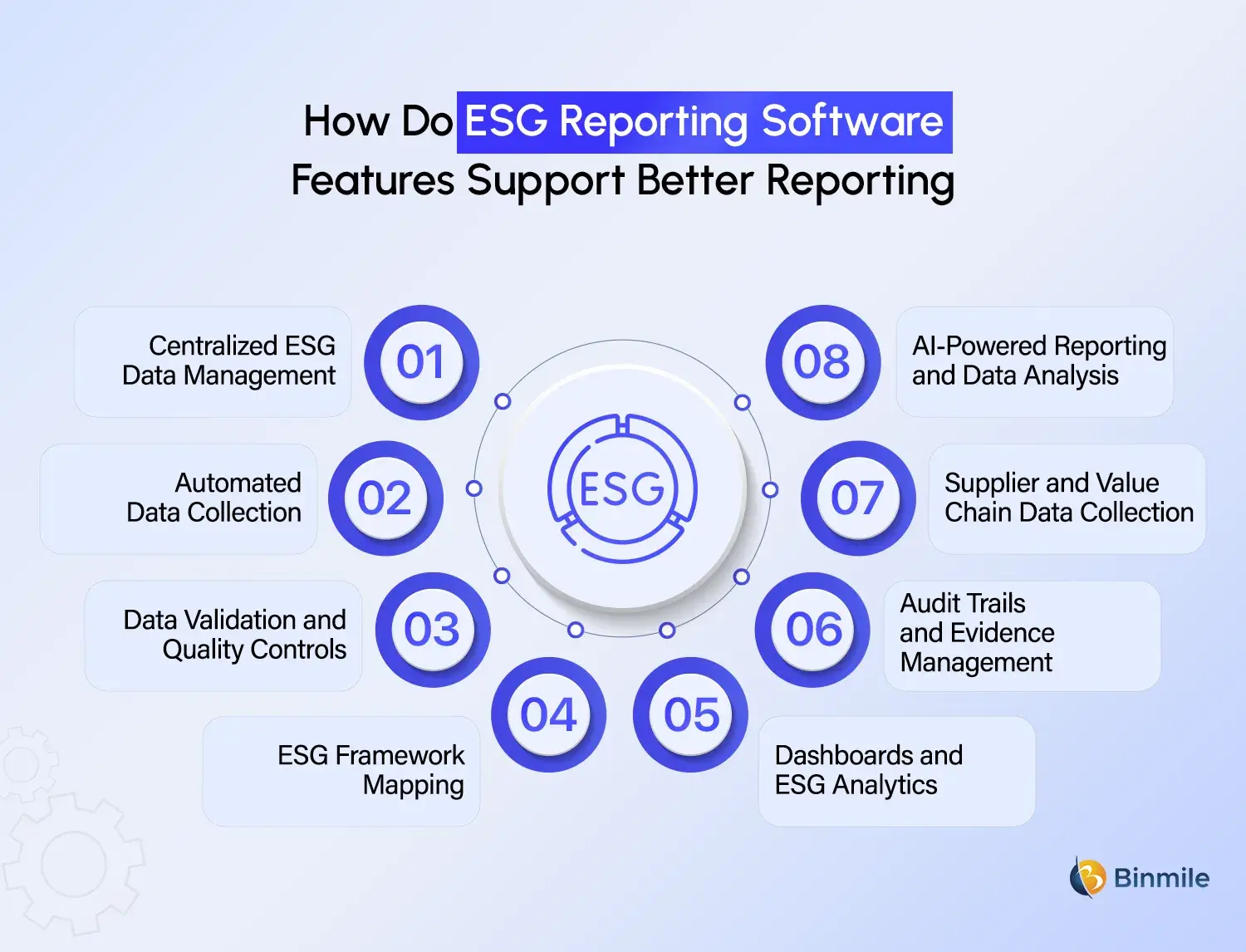
4. ESG Framework Mapping
Businesses may need to report against several frameworks or disclosure requirements. Keeping a separate dataset for each one can create a lot of unnecessary work.
An ESG reporting platform can map a central set of data to requirements such as GRI, ISSB, SASB, ESRS, TCFD, or CDP.
The same underlying information can then be reused where the requirements overlap, rather than asking teams to collect it again.
5. Dashboards and ESG Analytics
Dashboards provide a way to see ESG performance before the reporting deadline arrives.
Teams can track KPIs, compare business units or locations, check progress against targets, and see where information is missing. Leadership can also use the data during the year rather than only looking at it when a disclosure needs to be prepared.
6. Audit Trails and Evidence Management
An ESG compliance software solution should make it possible to trace a reported figure back to its source.
That may include the original data, supporting documents, calculation methods, approvals, changes, and user activity. If someone questions a number later, the team has a record to work from.
This is especially useful for internal reviews, assurance processes, and compliance checks.
7. Supplier and Value Chain Data Collection
A company’s ESG information does not always stop at its own offices, facilities, or operations.
Suppliers can be a major source of information, particularly for Scope 3 emissions, sourcing practices, labor conditions, and other value chain metrics. Supplier portals, questionnaires, document collection, and validation workflows can make this information easier to gather and organize.
For businesses working with hundreds or thousands of suppliers, a structured process becomes increasingly important.
8. AI-Powered Reporting and Data Analysis
AI-powered ESG reporting software can be used for tasks such as extracting information from documents, classifying data, identifying unusual entries, mapping information to frameworks, and preparing parts of a report.
It can also point out missing or unusual information that needs a closer look. That does not mean the output should go straight into a disclosure. People still need to review the information and approve the final numbers.
What Are the Benefits of ESG Reporting Software?
The benefits of ESG software are not limited to getting a report out the door. A well-designed system can change how the organization handles ESG information throughout the year.
-
Faster Reporting
A lot of reporting time goes into work that has to be repeated every cycle: asking for figures, checking spreadsheets, reconciling numbers, and preparing the same information for different reports.
Automating these steps can reduce that workload for sustainability and finance teams.
-
Better Data Accuracy
Centralized data and validation rules make it easier to catch duplicate entries, inconsistent calculations, and other errors.
Teams can also see where a metric came from and whether it has been reviewed or approved.
-
Improved Compliance Readiness
Reporting requirements do not stay the same forever. An ESG reporting solution can keep evidence, map metrics to relevant requirements, and maintain records that can be referred to when requirements change.
It does not replace the need to monitor regulatory updates, but it makes the underlying reporting process easier to manage.
-
One Source of Truth
When sustainability, finance, management, and auditors each maintain their own version of the data, reconciliation becomes another task.
A centralized system gives these groups a common set of information to work from.
-
Better Decision-Making
ESG data has more value when teams can see it throughout the year.
Dashboards can show where performance is falling behind, how different locations compare, whether targets are being met, and where potential risks may be emerging.
-
Lower Reporting Effort
Once recurring workflows are set up, teams do not have to repeat the same collection and reconciliation work manually every reporting cycle.
That leaves more time for reviewing the numbers and working on the issues behind them.
-
Greater Stakeholder Transparency
Investors, customers, employees, regulators, and other stakeholders increasingly want ESG information that businesses can stand behind.
Having traceable data and supporting evidence makes it easier to communicate that information consistently.
Looking to replace fragmented spreadsheets with a scalable ESG reporting platform?

ESG Reporting Software vs. ESG Reporting Tools: What Is the Difference?
The two terms are often used interchangeably, although they can refer to different levels of functionality.
An ESG reporting tool may focus on a particular requirement, such as emissions calculations, materiality assessments, or a specific disclosure. An ESG reporting platform usually brings several parts of the process together, including data collection, management, analytics, workflows, compliance, and reporting.
| Capability | Basic ESG Reporting Tool | Enterprise ESG Reporting Platform |
|---|---|---|
| Data Collection | Limited or manual | Automated and centralized |
| Data Validation | Basic | Configurable controls and workflows |
| Framework Support | Often specific | Multiple frameworks |
| Integrations | Limited | APIs and enterprise systems |
| Audit Trail | Basic | Detailed and traceable |
| Dashboards | Limited | Advanced analytics and KPI tracking |
| Supplier Data | May be limited | Supplier portals and workflows |
| AI Capabilities | Limited | AI-assisted analysis and automation |
| Scalability | Suitable for smaller needs | Designed for complex organizations |
There is no single answer for every organization. Reporting maturity, data complexity, regulatory requirements, and the number of entities or locations involved all play a role in deciding what type of software makes sense.
How Can Businesses Choose the Right ESG Reporting Software?
Before comparing products, it helps to understand what is actually going wrong with the current reporting process.
-
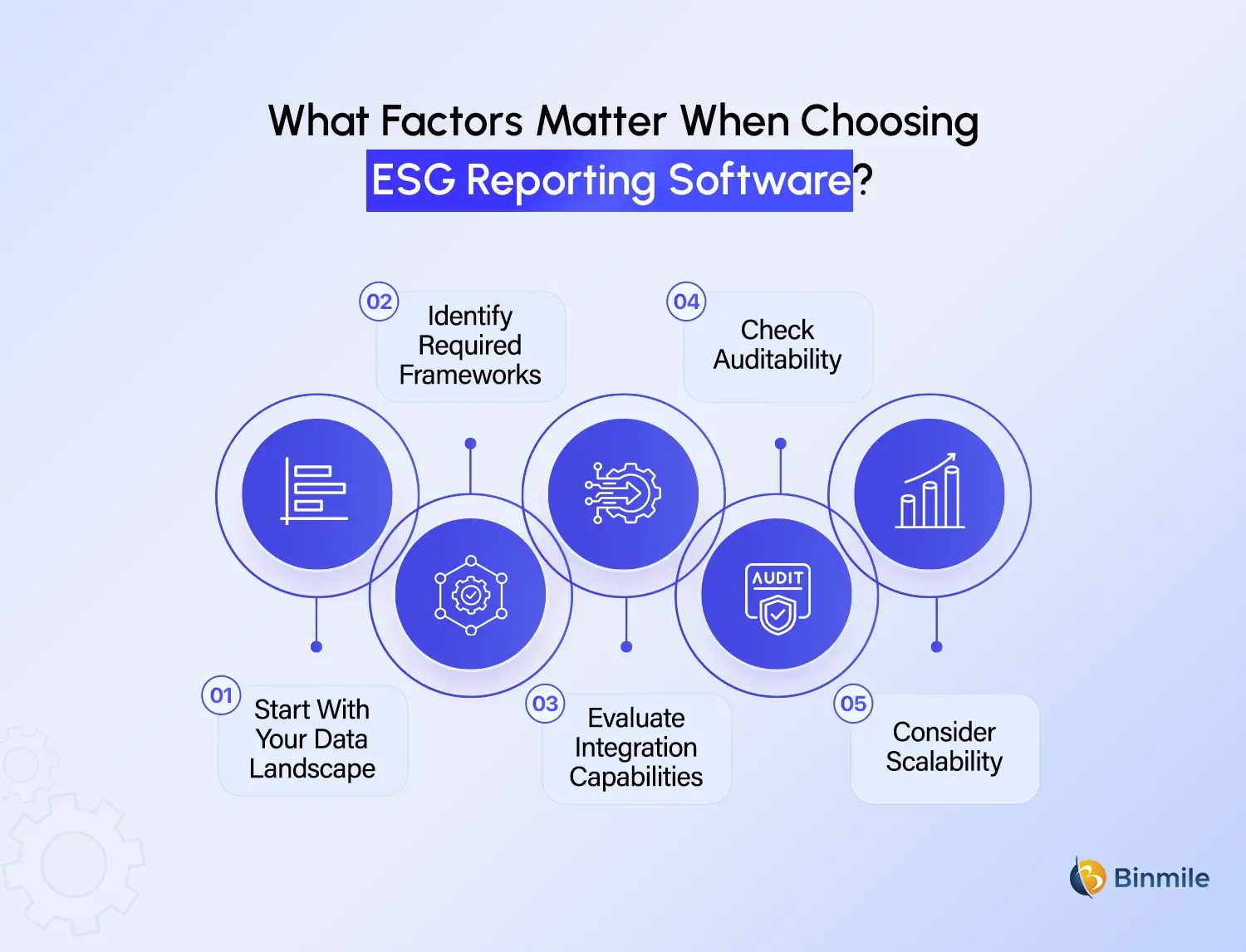
Start With Your Data Landscape
Make a list of the systems and people currently supplying ESG information. That could include finance, HR, procurement, facility systems, spreadsheets, and supplier records.
This will show where the gaps are. If most of the data is spread across different systems, integration and data management should be high on the list when comparing platforms. This is also where data governance strategies can help establish clear ownership and control over ESG data.
-
Identify Required Frameworks
Look at the frameworks, regulations, and disclosure requirements that apply to the business and its operating regions.
Then check whether the platform supports those requirements. It is worth looking at how the software handles updates too, particularly if the organization expects its reporting requirements to change.
-
Evaluate Integration Capabilities
Check how the platform connects with the systems already being used. APIs and other integration options can reduce manual uploads and duplicate data entry.
Also think about systems that may be added later. A platform that works with the current setup but becomes difficult to extend can create another problem down the line.
-
Check Auditability
Look for features that record data changes, approvals, calculations, supporting evidence, and historical records.
A good audit trail should make it possible to answer straightforward questions about a number: where did it come from, what happened to it, and who signed off on it?
-
Consider Scalability
The system should be able to handle additional users, entities, metrics, frameworks, and data sources as reporting requirements grow.
This is particularly relevant for businesses expanding into new regions or bringing more suppliers and business units into the reporting process.
How to Implement ESG Reporting Software Successfully?
Buying the software is only the beginning.
Start by defining what the organization actually needs to report and which ESG metrics are involved. Then trace those metrics back to their sources. Who provides the data? How is it calculated? How often does it change? Who checks it?
The answers will shape the data architecture and integration plan.
Where possible, enterprise systems can be connected to automate recurring data flows. For information that cannot be pulled directly from a system, controlled forms and workflows can be used.
The platform can then be configured with validation rules, approval processes, framework mappings, dashboards, and reporting templates.
A pilot is worth considering before rolling everything out at once. A smaller business unit or a defined reporting scope can expose problems with data quality, permissions, calculations, or workflows while they are still relatively easy to fix.
People need to be part of the process as well. Sustainability teams may know the reporting requirements, finance may handle controls and data governance, and operations teams may own the actual source data.
If these responsibilities are not agreed upfront, one team can end up spending most of its time chasing everyone else for information. For organizations looking to build these capabilities as part of a broader product, custom software development services can also support the development of workflows and integrations around existing systems.
When Should Businesses Consider Custom ESG Reporting Software?
Off-the-shelf platforms can be a good fit when their capabilities line up with the way a business already works. Custom ESG reporting software becomes more relevant when the reporting process involves specialized workflows, complex data structures, industry-specific metrics, or integrations that standard products cannot handle easily.
Custom development also gives organizations more control over things such as the data model, user roles, dashboards, APIs, automation logic, and future functionality.
Consider two examples. An energy company may need ESG workflows tied closely to operational and asset data. A large manufacturer may have a different problem, with extensive supplier data and several enterprise systems feeding into the reporting process. For energy businesses with these kinds of requirements, an Energy & Utilities Software Development Company can build around the operational systems already in use.
The development cost will depend on what the platform actually needs. Integrations, user roles, analytics, AI functionality, security, deployment requirements, and overall complexity can all affect the final figure. That is why a detailed scope is more useful than relying on a generic estimate of custom software development cost.
Need a reporting system that connects your data, workflows, and compliance requirements?
How Can Binmile Help With ESG Reporting Software Development?
Building an ESG reporting platform involves more than putting reporting data behind a few dashboards. The system needs to handle the way data enters the platform, how it is checked, who can access it, and how it moves through the reporting process.
Binmile can work with businesses to design and develop ESG reporting software around their existing technology environment. This can include integrations with enterprise applications and data sources, centralized ESG data management, automated collection workflows, validation rules, dashboards, framework mapping, compliance workflows, and AI-assisted capabilities where they make sense for the use case. These capabilities can also complement broader sustainability management software requirements where ESG reporting forms part of a wider sustainability program.
Custom development can also be useful when the standard approach does not fit the business. Industry-specific workflows, complex operational data, large supplier networks, and reporting requirements across different regions can all call for a more tailored setup. For organizations with more complex compliance needs, this can also extend into compliance management software development.
The aim is straightforward: make ESG reporting a process that teams can manage throughout the year, rather than a scramble that starts when the next reporting deadline gets close. A flexible architecture also leaves room for new metrics, frameworks, integrations, and reporting requirements as the business grows.
Frequently Asked Questions
ESG Reporting Software helps businesses collect, validate, manage, analyze, and report environmental, social, and governance data. It connects data sources, applies validation and workflows, maps information to frameworks, and supports reporting.
Key features include automated data collection, centralized ESG data management, validation, framework mapping, dashboards, KPI tracking, audit trails, workflow management, supplier data collection, integrations, and AI-assisted reporting capabilities.
ESG software reduces manual reporting work, improves data consistency, strengthens auditability, supports compliance, centralizes ESG information, and provides better visibility into sustainability performance and progress toward organizational targets.
Yes. Many modern platforms support multiple frameworks by mapping a centralized ESG dataset to different reporting requirements. This allows organizations to reuse validated information across disclosures instead of maintaining separate datasets.
Businesses should evaluate their reporting requirements, data sources, frameworks, integrations, auditability, security, scalability, analytics, and workflow needs. The right platform should solve current reporting challenges while supporting future regulatory and business requirements.