Regulatory obligations now affect almost every part of an enterprise, from data access and financial reporting to vendor oversight, cybersecurity, employee conduct, and product delivery. This complexity is reflected in the expanding compliance management software market, which reached an estimated USD 60.02 billion in 2025 and is projected to reach USD 106.76 billion by 2030. The growth signals a clear move away from spreadsheets, emails, and periodic checks toward connected systems that support continuous compliance.
This software development guide explains what compliance management software does, the types, features, benefits, and enterprise use cases to consider, and how to choose between a custom and off-the-shelf product. It also covers compliance management software for enterprises, including development, architecture, integrations, AI, implementation, testing, and cost factors.
What Is Compliance Management Software and Why Do Enterprises Need It?
Compliance management software is a centralized platform for managing regulations, policies, controls, risks, evidence, assessments, corrective actions, and audits. It gives compliance, legal, security, IT, and risk teams a shared view of obligations, ownership, control, performance, and unresolved issues.
A modern compliance management solution turns regulatory requirements into workflows, assigns tasks, collects evidence, records approvals, monitors controls, and generates reports. It can support HIPAA, GDPR, SOX, PCI DSS, ISO 27001, and other industry-specific requirements.
As enterprises expand across systems, vendors, locations, and regulatory environments, spreadsheets and manual follow-ups become difficult to manage. A connected compliance management strategy improves ownership, reduces missed deadlines, and gives executives, technology leaders, compliance teams, and auditors clearer visibility into regulatory exposure and remediation.
What Are the Essential Compliance Management Software Features
The right features help enterprises automate compliance tasks, monitor risks, manage evidence, and maintain audit readiness.
-
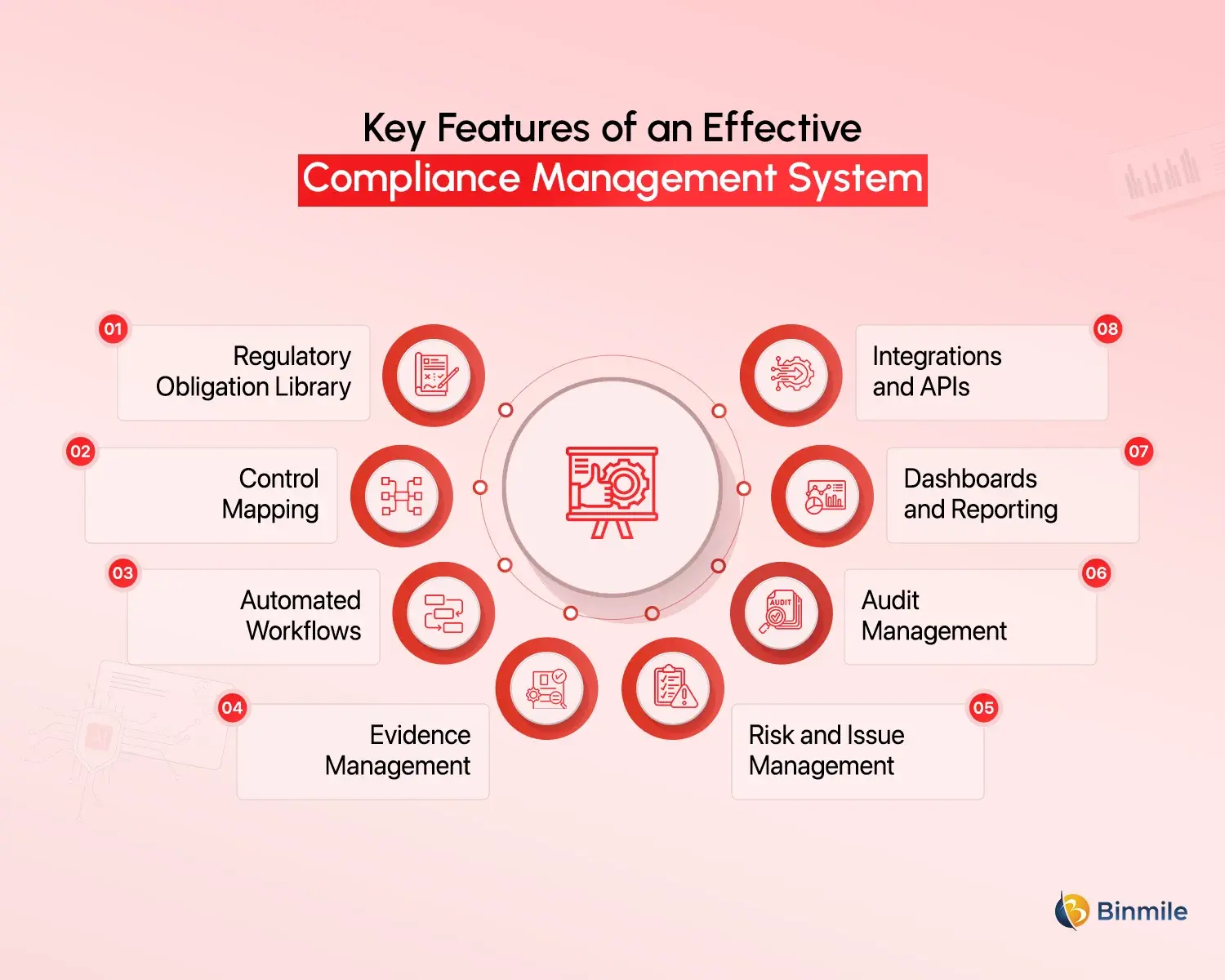
Regulatory Obligation Library
Stores searchable, version-controlled requirements and maps them to relevant locations, processes, systems, products, and owners.
-
Control Mapping
Links one control to multiple frameworks, reduces duplicate testing, and shows where coverage gaps remain.
-
Automated Workflows
Assign tasks, request approvals, send reminders, escalate delays, and route exceptions based on risk.
-
Evidence Management
Collects and retains logs, reports, policies, screenshots, access reviews, training records, and vendor documents with ownership and time stamps.
-
Risk and Issue Management
Records control failures, scores risks, creates remediation plans, and tracks deadlines and residual exposure.
-
Audit Management
Supports planning, testing, sampling, findings, management responses, and closure through a complete activity history.
-
Dashboards and Reporting
Gives executives concise risk and compliance views while providing operational teams with detailed action reports.
-
Integrations and APIs
Connects identity, HR, ERP, CRM, cloud, security, ticketing, document, and data systems to reduce manual collection.
What Are the Types of Compliance Management Software
Different compliance management software solutions serve different operational needs. Enterprise platforms often combine several categories.
| Type | Primary Purpose | Common Users |
|---|---|---|
| Regulatory Compliance Management Software | Tracks obligations, regulatory changes, and required actions | Compliance, legal, risk |
| Compliance Audit Management Software | Plans audits, collects evidence, manages findings, and tracks remediation | Audit teams, control owners |
| IT Compliance Management Software | Monitors access, configurations, assets, and technology controls | CIO, CTO, CISO, IT governance |
| Policy Management Software | Creates, approves, distributes, and reviews policies | Legal, HR, compliance |
| Third-party Compliance Software | Assesses vendors, partners, and outsourced providers | Procurement, security, vendor risk |
| Industry-specific Compliance Software | Supports requirements such as HIPAA or financial controls | Healthcare, BFSI, manufacturing |
| Compliance Risk Management Software | Connects obligations with risks, incidents, and treatment plans | Risk, compliance, leadership |
Ready to replace fragmented compliance tasks with a secure, connected, and audit-ready enterprise platform?

What Are the Compliance Management Software Use Cases
Compliance management software supports industry-specific regulations, risk monitoring, audit preparation, and control management across business functions.
-
Healthcare Compliance Management
Healthcare organizations can monitor HIPAA controls, patient data access, incidents, training, policies, and third-party vendors while maintaining reliable audit documentation.
-
Banking and Financial Services Compliance
Financial institutions can track regulatory changes, manage financial controls, assess risks, collect evidence, and monitor remediation across departments and locations.
-
SaaS and Technology Compliance
Technology companies can support SOC 2, ISO 27001, privacy, cloud security, access governance, and software audit requirements through connected controls and evidence.
-
Manufacturing Compliance
Manufacturers can manage quality standards, workplace safety, environmental obligations, supplier compliance, inspections, and corrective actions across facilities.
-
Retail and eCommerce Compliance
Retailers can address payment security, consumer privacy, vendor compliance, access controls, data governance, and incident management through automated workflows.
-
Compliance Across Global Enterprises
Global enterprises can manage jurisdiction-specific requirements, localized policies, regional ownership, data residency, and consolidated compliance reporting.
What Are the Benefits of Compliance Management Software
Compliance management software improves efficiency, accountability, risk visibility, audit readiness, and regulatory response.
-
Greater Consistency Across the Enterprise
Standard workflows, control definitions, ownership rules, and evidence requirements create consistent compliance practices across departments, locations, and business units.
-
Reduced Manual Compliance Work
Compliance automation software handles recurring tasks, reminders, evidence requests, escalations, and reporting, reducing dependence on emails and spreadsheets.
-
Improved Audit Readiness
The compliance audit management software organizes controls, evidence, findings, and remediation records, making audit preparation faster and less disruptive.
-
Better Risk Visibility
Compliance risk management software connects obligations with incidents, control failures, risks, and treatment plans, helping teams prioritize critical issues.
-
Stronger Accountability
Assigned owners, time stamps, activity logs, and escalation rules make responsibilities clearer and help prevent delayed or overlooked compliance tasks.
-
Faster Response to Regulatory Changes
Teams can record new requirements, assess their impact, update controls, and assign actions through a structured and coordinated process.
-
Better Executive Decision-Making
Dashboards give leaders visibility into regulatory exposure, overdue actions, control performance, and high-risk areas for better business decisions.
Custom Compliance Management Software or an Off-the-Shelf Platform?
The decision depends on business complexity, regulatory exposure, technology, budget, and long-term ownership expectations.
| Decision Factor | Off-The-Shelf Software | Custom Compliance Management Software |
|---|---|---|
| Deployment | Faster for standard workflows | Requires discovery, development, and testing |
| Flexibility | Limited to configuration and extensions | Designed around specific processes and controls |
| Integrations | Usually provides standard connectors | Supports proprietary and legacy systems |
| Regulatory Coverage | Suitable for common frameworks | Better for specialized or combined obligations |
| Data Control | Depends on the vendor architecture | Greater control over access, location, and retention |
| Cost Model | Subscription fees increase with users and modules | Higher initial investment with more ownership |
| Differentiation | Standard capabilities | Compliance can be embedded into operations and products |
Custom compliance management software is valuable when an enterprise operates across several jurisdictions, has unique approvals, needs strict data residency, uses legacy systems, or wants compliance built directly into operational workflows.
How to Develop Compliance Management Software for Enterprises
Developing compliance management software requires careful planning around regulations, workflows, security, integrations, scalability, and user needs.
1. Define Scope and Business Outcomes
Identify the regulations, systems, locations, vendors, and processes the platform must support. Set measurable goals such as faster audits, better evidence coverage, or shorter remediation cycles.
2. Build a Requirement-to-Control Model
Connect regulations with policies, controls, tests, evidence, risks, issues, and owners. Allow controls to support multiple frameworks and preserve historical versions.
3. Design a Secure and Scalable Architecture
Use role-based access, encryption, authentication, audit logs, backups, and retention controls. The platform should scale across users, entities, frameworks, and records.
Data governance should also define ownership, classification, residency, retention, quality, and approved data usage.
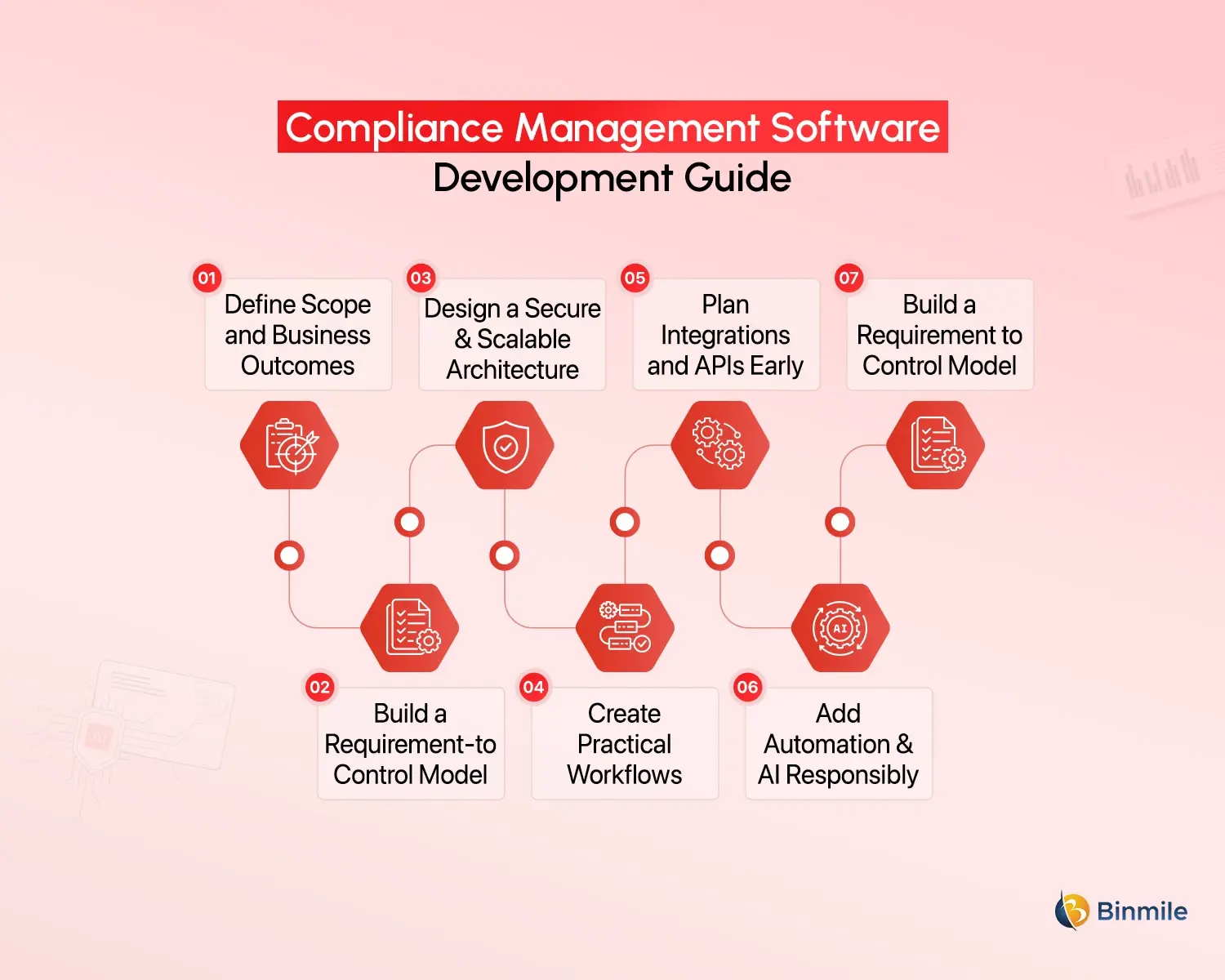
4. Create Practical Workflows
Design workflows for approvals, assessments, evidence requests, exceptions, escalations, and corrective actions. Keep each user experience simple and role-specific.
5. Plan Integrations and APIs Early
Connect identity, HR, finance, cloud, security, ticketing, document, and enterprise systems by following API Design Best Practices for secure, reliable, and scalable data exchange.
6. Add Automation and AI Responsibly
Use automation for tasks, reminders, evidence collection, assessments, and remediation. Enterprise AI implementation can support obligation extraction, policy comparison, summarization, classification, and risk prioritization.
Maintain human review, explainability, access controls, monitoring, and audit trails for high-impact decisions.
7. Test and Roll Out in Phases
Test functionality, permissions, integrations, workflows, security, migration, and recovery. Begin with one framework, region, or process before expanding.
A phased rollout helps validate workflows, improve adoption, resolve issues, and measure outcomes before wider implementation.
What Affects Compliance Management Software Development Cost?
The compliance management enterprise software development cost depends on the scope. A platform supporting one framework and a limited user group requires less effort than a global system covering multiple regulations, entities, languages, integrations, and risk models.
Major cost drivers include workflow complexity, user roles, regulatory libraries, dashboards, APIs, migration, security, AI, mobile access, infrastructure, testing, and support. A reliable estimate should follow discovery and solution design. Enterprises should compare the total cost of ownership, including maintenance, regulatory updates, infrastructure, training, and future integrations, rather than only initial development or subscription fees.
Planning a custom compliance platform that can support evolving regulations, complex workflows, and enterprise-scale integrations?

How Binmile Can Help Build a Scalable Compliance Management Solution
Building a compliance platform requires more than converting regulations into software screens. It requires a clear control model, secure architecture, usable workflows, dependable integrations, and flexibility to support regulatory and organizational change.
Binmile helps enterprises design and develop compliance management software solutions aligned with their operating environment. The engagement can include product discovery, architecture, workflow design, platform engineering, AI development services, cloud implementation, data governance, AI-enabled automation, testing, security validation, migration, and modernization.
The result is a compliance management solution that fits existing systems and responsibilities while improving visibility, accountability, evidence quality, and audit readiness. Development can begin with a focused use case and expand into a broader enterprise platform as requirements mature.
Frequently Asked Questions
Compliance management software centralizes regulatory requirements, policies, controls, evidence, risks, tasks, and audit records in one system. It helps organizations assign accountability, automate recurring activities, monitor and control performance, identify gaps, and maintain reliable documentation for internal and external reviews.
Custom software is useful when an enterprise has complex workflows, multiple jurisdictions, proprietary risk models, strict data residency needs, or integrations that standard platforms cannot support. Organizations with simpler requirements may gain faster value from configurable commercial products.
Implementation time depends on scope, integrations, data quality, frameworks, user groups, and customization. A focused first release may take a few months, while a global platform covering multiple business units and regulations usually requires a phased rollout.
Development cost is influenced by platform complexity, supported regulations, workflow depth, integrations, reporting, security, AI capabilities, cloud infrastructure, testing, and ongoing maintenance. A detailed discovery phase is necessary before creating a reliable budget and delivery roadmap.
Compliance audit management software improves audit readiness by organizing evidence, linking controls to requirements, recording ownership, tracking findings, and maintaining time-stamped activity histories. Auditors receive clearer documentation, while internal teams spend less time locating files and validating records.
AI can classify obligations, summarize regulatory updates, prioritize risks, detect unusual patterns, and assist with evidence review. However, high-impact decisions should retain human approval, explainable logic, access controls, validation procedures, and complete audit trails for accountability.