ServiceNow has built a large global delivery ecosystem, giving enterprises more choice but also making partner selection more challenging. In January 2026, ServiceNow reported that its ecosystem had grown to more than 2,700 partners globally. With providers offering advisory, implementation, development, managed services, and AI capabilities, choosing a ServiceNow Partner based only on company size, pricing, or a sales presentation can create costly problems later.
This guide explains what a ServiceNow Certified Partner should bring to your business, how to compare shortlisted providers, what affects ServiceNow implementation cost, and which questions can help you identify a reliable partner. It also covers ServiceNow Certifications, industry experience, ServiceNow adoption, outsourcing, workflow automation, AI readiness, and post-implementation support.
Understanding the Role of a ServiceNow Partner and Defining Your Objectives
A ServiceNow Partner helps businesses plan, implement, integrate, improve, and support the ServiceNow platform. Depending on its capabilities, the partner may provide licensing support, ServiceNow consulting, implementation, development, managed services, process redesign, and change management.
The right partner should connect technology with measurable outcomes such as faster incident resolution, better asset visibility, automated employee requests, improved security operations, or more consistent customer service. Buyers should also verify the ServiceNow Certifications and project experience of the architects, consultants, developers, and project managers assigned to their work.
Before comparing providers, define clear ServiceNow objectives. These may include improving CMDB accuracy, automating onboarding, replacing email approvals, strengthening vulnerability response, or introducing AI agents. Connect each objective with a measurable indicator such as resolution time, automation rate, service availability, user adoption, or cost per ticket.
Clear objectives also help determine whether you need a strategic advisor, a ServiceNow Implementation Partner, an AI Agents Partner, a development team, or a long-term managed services provider.
Key Factors to Consider When Choosing a ServiceNow Certified Partner
A structured assessment helps businesses compare partners based on actual delivery capabilities rather than sales claims.
1. Relevant Platform Expertise
Confirm that your partner has experience working with the particular functional modules, workflows, and integrations in your scope of work. For example, ITSM, SecOps, HRSD, CSM, ITOM, and SPM projects require various skills.
Who will provide the services for which workstream? Confirm these specialists have appropriate ServiceNow Certifications and experience on similar projects.
2. Experience With Similar Business Problems
Your partner does not have to know the particular industry you are in; however, they should understand operational problems that your business is trying to solve.
For example, in the manufacturing sector, the project may include operational technology, production assets, maintenance workflows, etc., and for the healthcare sector, the partner may need experience operating with sensitive data, providing patient services, and fulfilling medical compliance and regulatory requirements. Ask for specific examples of similar business challenges and measurable results.
3. Consulting Capability Before Configuration
Consulting with ServiceNow should begin with a review of the business process prior to making any configuration on the ServiceNow platform.
When reviewing the business process, confirm the partner can identify unnecessary approvals for decisions; unclear ownership of the business process; repeated transfers of ownership of responsibility for the same task or event; and data being managed incorrectly or being managed in multiple ways. Reducing the amount of customization will make the ServiceNow platform easier to use throughout its lifecycle and will result in lower maintenance costs.
4. A Clear Implementation Method
Your partner should be able to provide you with a clearly defined ServiceNow Implementation method that includes: Discovery, Solution Design and Architecture, Configuration, Integrations, Testing, Deployment, Training, and Stabilization.
You should utilize this method as a guide for understanding how governance, escalations, approvals, scope change, risk, and responsibilities will be handled throughout the project.
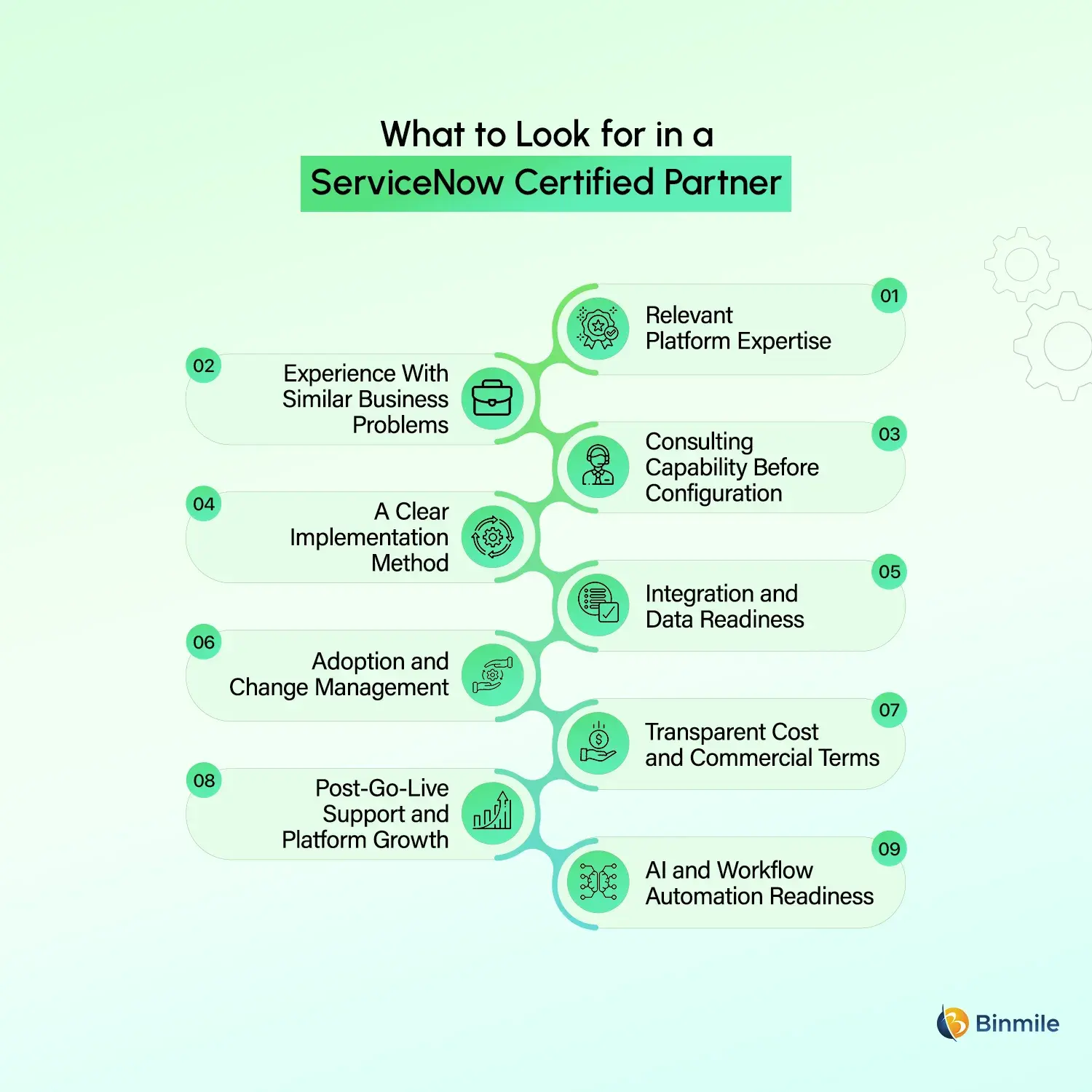
5. Integration and Data Readiness
ServiceNow needs to be integrated with ERP systems, cloud services, identity solutions, HR systems, security services, and legacy systems.
Ask how your partner plans to maintain quality data throughout the migration, including managing integration security, identifying ownership and errors, and supporting ongoing maintenance. The partner should clarify in which areas standard features will work adequately and where custom development will be required.
6. Adoption and Change Management
A successful rollout will not provide much benefit if end-users continue using outdated tools like spreadsheets, emails, phone calls, etc.
The partner shall consider a role-based training program, provide feedback opportunities, establish a communications protocol, conduct user testing prior to implementation, create a knowledge base or resources, and create a plan for measuring ServiceNow’s adoption as part of their overall implementation strategy.
7. Transparent Cost and Commercial Terms
The cost associated with implementing ServiceNow will depend on several factors, including which modules are being implemented, whether there is any integration, what types of data are being migrated, how many customizations are needed, how many different user groups will be using the platform, where the users are located, and how much training and testing will be required, along with post-implementation support.
Make sure you request a detailed breakdown of costs along with confirmation of what deliverables, exclusions, assumptions, and conditions for additional charges will be included in the contract.
8. Post-Go-Live Support and Platform Growth
All ServiceNow solutions require ongoing administration, upgrades, performance monitoring, product development, and continuous optimization.
Determine if the partner can offer knowledge transfer, platform management, roadmap planning, integration support, or ServiceNow outsourcing based on your existing internal capabilities.
9. AI and Workflow Automation Readiness
The partner should identify where AI agents, intelligent routing, summarization, self-service, and workflow automation can create measurable business value.
An experienced AI Agents Partner should also evaluate data readiness, access controls, human approvals, auditability, performance, and workflow ownership.
Need a scalable ServiceNow implementation that improves workflows, adoption, and long-term platform value?
ServiceNow Partner Evaluation Scorecard
Use a weighted evaluation scorecard to ensure that all shortlisted partners are assessed using the same business and technical criteria.
| Evaluation Area | What to Verify |
|---|---|
| Platform and Module Expertise | Relevant certifications, named specialists, and architecture capability |
| Industry and Use-Case Experience | Similar workflows, scale, regulations, and business challenges |
| Delivery Method | Governance, testing, risk management, and phased rollout |
| Consulting and Process Design | Ability to simplify processes and support business outcomes |
| Integration and Data Capability | Integration approach, migration planning, security, and ownership |
| Adoption and Change Support | Training, communication, user testing, and adoption measurement |
| Commercial Transparency | Clear assumptions, deliverables, exclusions, and change controls |
| Support and Roadmap Capability | Knowledge transfer, managed services, upgrades, and optimization |
The scorecard should guide the decision rather than determine it automatically. Leadership should also consider communication, accountability, cultural fit, and the partner’s willingness to challenge unrealistic requirements.
Questions to Ask Before Signing the Contract
Before signing an agreement, ask each shortlisted provider to explain how it will approach your environment, team, processes, and ServiceNow objectives.
Confirm which architects, consultants, developers, and project managers will work on the project and whether they have delivered similar ServiceNow solutions. The partner should also explain which requirements can be addressed through standard platform capabilities and where custom development may be required.
Clarify what resources the partner needs from your organization, including process owners, data teams, technical specialists, and executive decision-makers. You should also understand how risks, dependencies, delays, approvals, scope changes, and project reporting will be managed.
Review the ServiceNow implementation cost beyond the final quoted amount. Confirm whether migration, testing, training, documentation, knowledge transfer, stabilization, and post-go-live support are included.
Finally, ask how success will be measured and what the partner would remove, simplify, or postpone from the initial scope. This reveals whether the provider can prioritize value and control risk instead of accepting every requirement.
Common Mistakes to Avoid When Selecting a ServiceNow Partner
Avoiding common evaluation errors can reduce implementation risk, control costs, and improve long-term value from the ServiceNow investment.
-
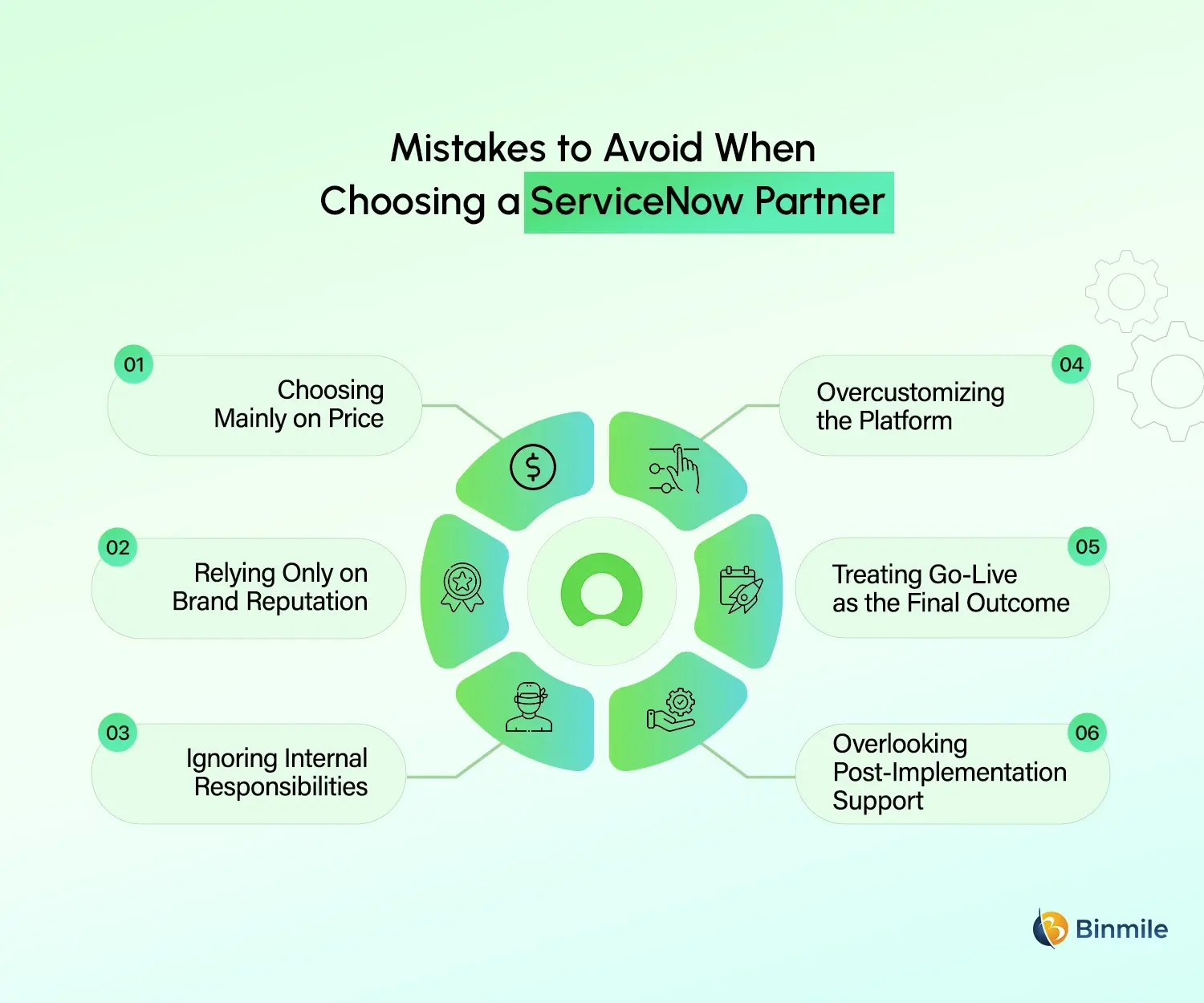
Choosing Mainly on Price
The lowest proposal may exclude key activities, rely on junior resources, or lead to frequent change requests.
Compare the complete scope, assigned team, support model, and long-term maintenance cost instead of evaluating only the initial price.
-
Relying Only on Brand Reputation
A large provider may have strong credentials, but that does not guarantee that its most experienced professionals will work on your project.
Review the actual ServiceNow team, including its module expertise, availability, responsibilities, and industry experience.
-
Ignoring Internal Responsibilities
A ServiceNow Partner cannot resolve poor data, unclear ownership, unavailable stakeholders, or delayed decisions alone.
Assign internal process owners, platform leaders, data owners, and executive sponsors who can support discovery, testing, approvals, training, and adoption.
-
Overcustomizing the Platform
Customizing the platform to match every existing process can create technical debt, increase costs, and complicate upgrades.
Use standard ServiceNow capabilities wherever possible and reserve custom development for requirements that create clear business value.
-
Treating Go-Live as the Final Outcome
A technical launch does not automatically mean the implementation has succeeded.
Measure results through ServiceNow adoption, automation rates, resolution times, service quality, user experience, cost reduction, and continuous improvement.
-
Overlooking Post-Implementation Support
Businesses often plan for implementation without deciding who will manage the platform after launch.
Define whether ongoing ownership will remain internal, move to managed services, or use a combined model supported through ServiceNow outsourcing.
Looking for a ServiceNow Certified Partner who can turn platform investment into measurable business outcomes?
How Binmile Can Support Your ServiceNow Journey
Choosing the right partner becomes easier when technical delivery is connected with practical business needs. Binmile helps organizations assess workflows, define measurable objectives, prioritize implementation requirements, and configure ServiceNow solutions around operational goals.
Our capabilities cover ServiceNow consulting, implementation, integration, custom development, workflow automation, testing, modernization, adoption, and platform optimization. For AI-led use cases, the approach includes data readiness, appropriate controls, and governed workflow integration.
Whether the requirement involves a new deployment, industry-specific workflows, ongoing ServiceNow development, or long-term ServiceNow outsourcing, Binmile can provide structured delivery support while enabling knowledge transfer and internal platform ownership.
Frequently Asked Questions
A ServiceNow Partner provides consulting, implementation, integration, development, and support expertise. The right partner helps align the platform with business processes, reduce delivery risks, manage technical complexity, improve user adoption, and create measurable value from your ServiceNow investment.
A ServiceNow Certified Partner brings trained professionals, delivery practices, platform knowledge, and relevant project experience. It can improve solution design, reduce avoidable customization, strengthen testing and governance, support adoption, and help the business maintain and expand the platform after launch.
Define your business objectives first, then compare partners on module expertise, industry experience, delivery approach, team quality, integrations, adoption support, commercial transparency, and post-launch services. Use a weighted scorecard and interview the actual professionals proposed for your project.
Industries with complex service operations, strict controls, distributed teams, or large asset environments benefit strongly. These include manufacturing, healthcare, financial services, telecommunications, retail, technology, public services, and other enterprises seeking connected workflows, better visibility, and scalable automation.
Timelines vary by module scope, integrations, data quality, customization, locations, and stakeholder availability. A focused first phase may take weeks, while complex multi-module programs can take several months. A reliable partner provides phased milestones rather than a single broad completion date.