A technology that can create realistic images, synthetic data, videos, and other digital content from learned patterns is no longer just a research experiment. Generative adversarial networks have become an important part of the broader generative AI landscape, particularly for use cases where visual realism, data generation, and transformation matter. According to Grand View Research, the global GAN market was valued at approximately USD 5.52 billion in 2024 and is projected to reach USD 36.01 billion by 2030, growing at a CAGR of 37.7% from 2025 to 2030. The numbers reflect growing interest in GAN-based technologies across industries, from healthcare and financial services to media, retail, automotive, and product design.
But what makes a GAN useful for a business? How does a GAN machine learning model actually generate new data, and where does it fit alongside other generative AI solutions? This guide explains the fundamentals of GANs, how GAN architecture works, the major types of GANs, practical generative adversarial networks applications, business benefits, implementation considerations, and the challenges organizations should understand before investing in GAN development.
What Are Generative Adversarial Networks and How Do They Work?
Generative Adversarial Networks (GANs) are deep learning models that learn patterns from existing data and use them to create new, realistic outputs. Introduced by Ian Goodfellow and his colleagues in 2014, GANs work through two neural networks that compete with each other: a generator creates synthetic data, while a discriminator evaluates whether that data is real or AI-generated.
The generator improves whenever the discriminator detects its output as fake, while the discriminator becomes better at spotting generated content. This repeated competition gradually helps the generator produce increasingly realistic results.
For example, if a business wants to create realistic shoe images, the generator produces synthetic designs, and the discriminator compares them with real shoe photographs. With repeated training, the generator learns the visual patterns needed to create convincing new designs. This forms the foundation of GAN architecture and makes GANs useful for image generation, data augmentation, enhancement, style transfer, and other AI applications.
What Is the Architecture of a GAN?
A typical GAN architecture can be understood through four basic stages:
1. Random Input
The generator receives random numerical input called latent noise, which acts as the starting point for creating new synthetic data.
2. Data Generation
The generator processes this random input and transforms it into synthetic content, such as an image, video, audio file, or dataset.
3. Real vs. Fake Evaluation
The discriminator compares generated content with real training data and predicts whether each example is authentic or artificially generated.
4. Feedback and Optimization
The discriminator’s feedback helps both networks improve, allowing the generator to create increasingly realistic outputs through repeated training cycles.
This process continues until the generator produces outputs that are sufficiently realistic for the intended application.
Different requirements call for different GAN architectures. A simple GAN may work for basic experimentation, while architectures such as DCGAN, Conditional GAN, CycleGAN, StyleGAN, and Wasserstein GAN address more specialized requirements involving image quality, controllability, style transformation, or training stability.
What Are the Major Types of GANs?
There is no single GAN model that fits every business problem. Different types of GANs have been developed to solve different generation and transformation challenges.
| GAN type | What it does | Example use case |
|---|---|---|
| Vanilla GAN | Basic generator-discriminator framework | General data generation |
| DCGAN | Uses convolutional networks for image generation | Realistic image creation |
| Conditional GAN | Generates outputs based on specific conditions | Creating a particular category of image |
| CycleGAN | Converts one visual domain into another | Converting summer scenes into winter scenes |
| StyleGAN | Provides greater control over visual characteristics | Face and character generation |
| Pix2Pix | Performs image-to-image translation | Sketch-to-image conversion |
| Wasserstein GAN | Improves training stability | More reliable GAN training |
For enterprises, choosing between these generative adversarial network models should begin with the business objective rather than the popularity of a particular architecture.
What Are the Business Applications of Generative Adversarial Networks?
The real value of GANs becomes clearer when they are connected to business problems rather than treated simply as an AI experiment.
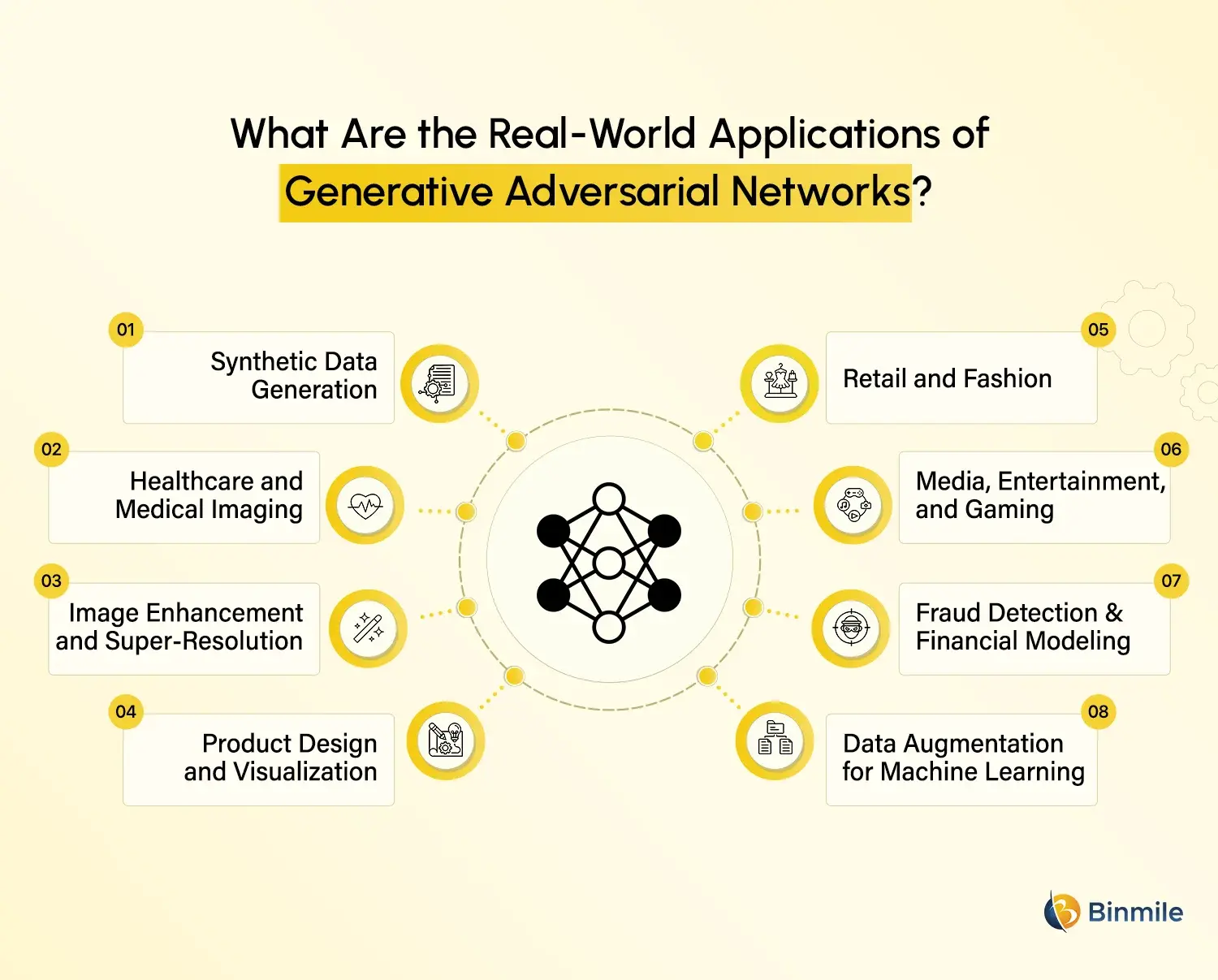
Here are some of the most relevant real-world applications of GANs.
1. Synthetic Data Generation
Organizations often lack enough high-quality training data due to cost, privacy restrictions, limited availability, or rare events. GANs can create synthetic datasets that resemble real-world data, helping businesses supplement existing datasets for training, testing, and experimentation.
2. Healthcare and Medical Imaging
GANs can support healthcare applications such as medical image generation, enhancement, reconstruction, and data augmentation. They can help expand limited datasets, although generated medical data requires careful validation, privacy controls, and clinical oversight.
3. Image Enhancement and Super-Resolution
GANs can enhance low-resolution images by learning patterns from high-resolution examples and generating realistic details. This makes them useful for medical imaging, satellite imagery, photography, video enhancement, and other visual applications.
4. Product Design and Visualization
GANs can help businesses generate different product concepts and visual variations quickly. Fashion, automotive, and consumer product companies can use these capabilities to explore ideas and refine promising designs before investing in physical development.
5. Retail and Fashion
Retailers can use GANs to create product variations, enhance product images, and experiment with different visual styles. This can reduce the effort involved in producing visual assets while giving creative teams more options to explore.
6. Media, Entertainment, and Gaming
GANs can support content creation across media and gaming, including character generation, visual effects, texture creation, image transformation, and video enhancement. They can help creative teams experiment with and produce visual assets faster.
7. Fraud Detection and Financial Modeling
GANs can generate synthetic examples of rare or unusual financial events, helping organizations test models against scenarios where real examples are limited. However, synthetic data should complement real transaction data rather than replace it.
8. Data Augmentation for Machine Learning
When training datasets are small or imbalanced, GANs can generate additional examples for underrepresented categories. This can help improve dataset diversity and support more effective machine learning model training.
What Benefits Can GANs Provide to Enterprises?
The business case for GANs extends beyond content creation.
-
Better Use of Limited Data
When organizations have limited examples of a particular category, synthetic generation can help expand the training dataset.
-
Faster Experimentation
Teams can generate multiple variations of an image, design, or scenario without creating every version manually.
-
Improved Model Training
Synthetic data can supplement real datasets and help machine learning teams test models against a broader range of scenarios.
-
Greater Personalization
Conditional GANs can generate outputs based on specified characteristics, making them useful for controlled content and design generation.
-
Lower Content Production Effort
For visual workflows, GANs can automate parts of image generation, enhancement, and transformation.
-
Support for Innovation
Generative Adversarial Networks allow organizations to experiment with product concepts and data scenarios that may otherwise be difficult or expensive to reproduce.
Need to turn synthetic data and AI-generated content into a practical business advantage?

GANs vs Other Generative AI Models
GANs are important, but they are not automatically the best option for every Generative Artificial Intelligence requirement.
| Technology | Strength | Common applications |
|---|---|---|
| GANs | Realistic synthetic generation and visual transformation | Images, augmentation, style transfer |
| VAEs | Structured latent representations | Data generation, anomaly detection |
| Diffusion models | High-quality and controllable generation | Images, video, creative content |
| Transformers | Sequential and contextual generation | Text, code, multimodal AI |
The choice should depend on the required output, training data, latency, controllability, infrastructure, and business objective.
For instance, GANs can be highly effective when visual realism and fast generation are priorities. Diffusion models may be preferable for certain modern image-generation workflows, while transformers are generally more suitable for language-heavy applications.
The rise of newer Generative AI Models does not make GANs irrelevant. It simply means organizations have a broader technology landscape to evaluate.
What Are the Challenges of Implementing GANs?
GANs can be powerful, but they are not particularly simple models to build and operate.
-
Training Instability
GAN training can be difficult to balance. If the discriminator becomes too strong, the generator may struggle to learn. If the generator improves too quickly, the discriminator may fail to provide useful feedback.
-
Mode Collapse
A generator may discover a small set of outputs that successfully fool the discriminator and repeatedly produce similar results.
This reduces diversity and limits the usefulness of the generated dataset.
-
High Computational Requirements
Training complex GAN models can require significant GPU resources, particularly when working with large datasets and high-resolution outputs.
-
Data Quality Matters
GANs learn from their training data. Poor-quality, biased, incomplete, or unrepresentative datasets can influence the generated output.
-
Evaluation Can Be Difficult
Determining whether generated content is realistic, diverse, useful, and safe requires appropriate evaluation methods. Visual quality alone is not enough.
-
Privacy and Security Risks
Synthetic data can still create privacy concerns if models memorize or reproduce sensitive patterns from their training data.
-
Ethical and Governance Concerns
Generated images, synthetic identities, manipulated media, and other outputs can be misused. Enterprises therefore need clear governance around ownership, consent, authenticity, and responsible use.
How Can Businesses Implement Generative Adversarial Networks Effectively?
Successful GAN implementation requires more than selecting an open-source model and training it on available data.
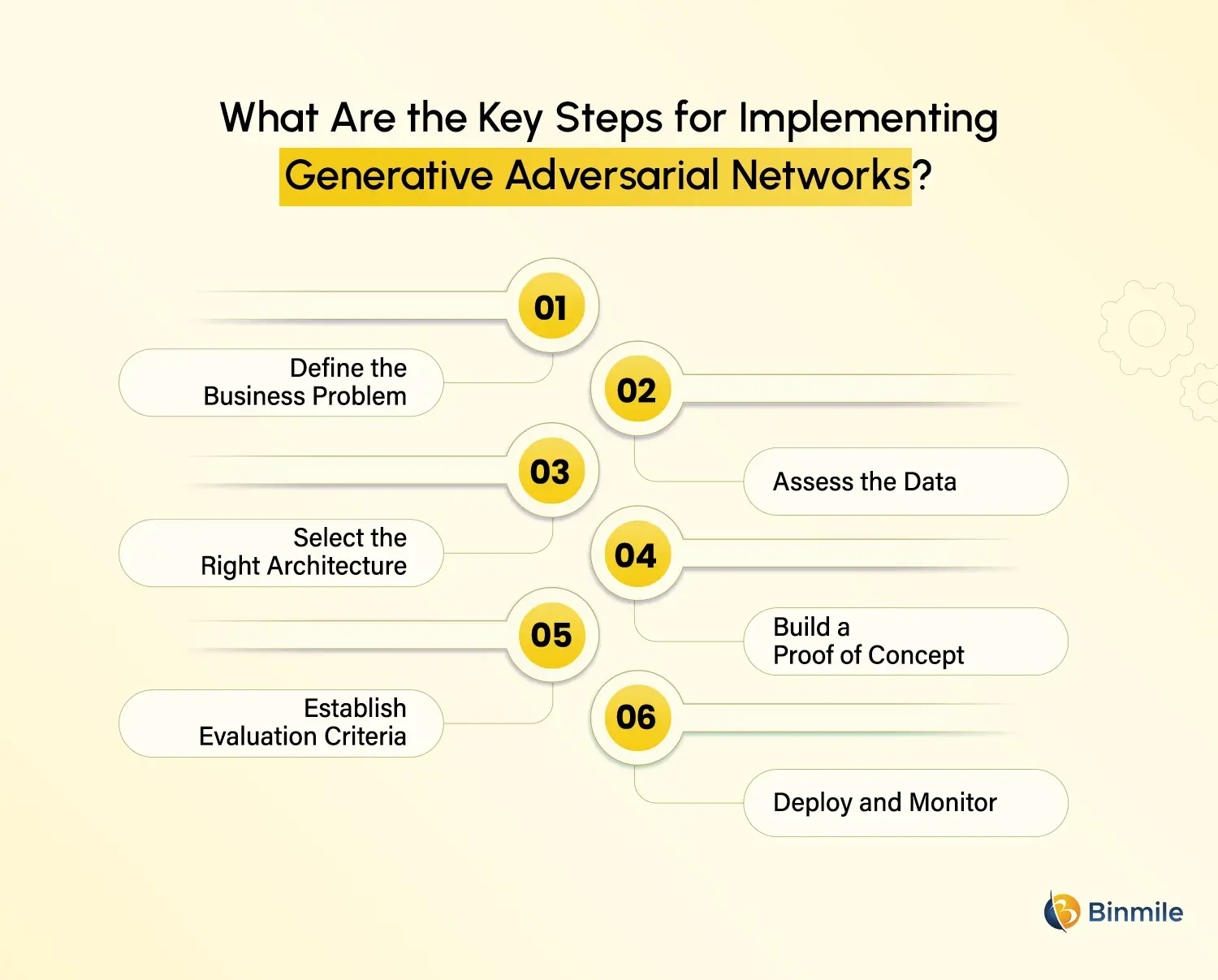
A practical implementation usually follows a structured path:
-
Define the Business Problem
Start by identifying the specific business objective, whether it involves data augmentation, image generation, enhancement, simulation, personalization, or another use case.
-
Assess the Data
Evaluate the available data for quality, volume, diversity, labeling, privacy requirements, and potential bias before using it to train the model.
-
Select the Right Architecture
Choose a suitable GAN architecture based on the type of output required, desired quality, level of control, available computing resources, and overall business requirements.
-
Build a Proof of Concept
Develop a small-scale proof of concept to test whether the GAN can deliver the expected results before investing in a larger production implementation.
-
Establish Evaluation Criteria
Define measurable metrics such as output quality, diversity, accuracy, usefulness, latency, and resource consumption to determine whether the model is performing effectively.
-
Deploy and Monitor
Once deployed, continuously monitor model performance, output quality, infrastructure usage, and potential risks to maintain reliable results over time.
For organizations using cloud-based machine learning infrastructure, GANs in Azure Machine Learning can also be explored as part of an MLOps strategy, helping teams manage experiments, training resources, model versions, deployment, and monitoring more efficiently.
What Should Businesses Consider Before GAN Development?
A GAN project should begin with a clear question: Why does the business need generated data or content? If the problem can be solved more efficiently using traditional machine learning, computer vision, diffusion models, or another approach, a GAN may not be the right choice.
Businesses should assess the expected business value, availability and ownership of data, infrastructure requirements, training costs, required output quality, privacy and compliance considerations, and the methodology for evaluating model performance. They should also consider how the GAN will integrate with existing systems and what resources will be required for long-term maintenance.
This assessment helps organizations move beyond treating GANs as a technology experiment and instead determine whether the technology can deliver a measurable and sustainable business outcome.
Ready to explore what GANs can do for your products, data, or digital workflows?

How Binmile Can Help With GAN-Based AI Solutions
Building a reliable GAN solution requires expertise across data engineering, machine learning, model development, cloud infrastructure, integration, and deployment. Binmile, an AI development company, can help organizations assess whether GANs are suitable for a specific business problem, identify the right model architecture, prepare and validate training data, develop proofs-of-concept, and integrate trained models into existing applications and workflows. Its broader expertise across Machine Learning Development Services, Generative AI Solutions, and AI engineering can also support organizations that need to move from experimentation to production-ready AI systems.
For enterprises exploring GAN development, the focus should ultimately remain on measurable outcomes. A well-designed GAN solution can support faster experimentation, richer training datasets, improved visual workflows, and new AI-powered product capabilities, but its value depends on choosing the right use case, architecture, data, and deployment strategy.
Frequently Asked Questions
Generative Adversarial Networks are deep learning models containing a generator and a discriminator. The generator creates synthetic data, while the discriminator evaluates whether the data is real or generated. Both networks improve through competitive training.
Important applications include synthetic data generation, image enhancement, product design, healthcare imaging, retail personalization, media production, gaming, data augmentation, and financial modeling, where realistic synthetic examples are valuable.
GANs can help enterprises expand limited datasets, accelerate visual content creation, improve machine learning training, support product experimentation, automate image transformation, and explore scenarios that are difficult or expensive to reproduce using real-world data.
Businesses should consider training instability, mode collapse, computational costs, data quality, model evaluation, privacy, bias, security, and governance. Strong validation and monitoring are essential before deploying GAN-generated outputs in business-critical workflows.
Healthcare, financial services, retail, fashion, automotive, media, entertainment, gaming, manufacturing, and technology businesses can benefit from GANs when they have use cases involving synthetic data, visual generation, image transformation, simulation, or data augmentation.
Businesses should first identify a measurable use case, assess data quality and privacy requirements, select the appropriate GAN architecture, develop a proof of concept, define evaluation metrics, and establish deployment, monitoring, governance, and maintenance processes.